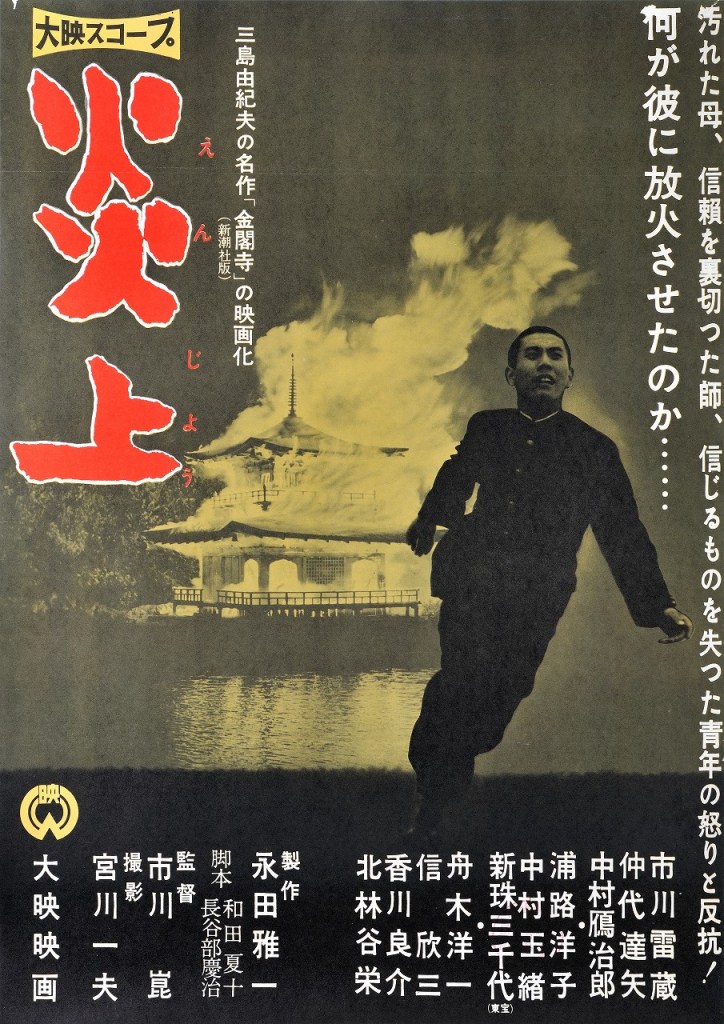
Enjo (炎上, Kon Ichikawa, 1958)

a0212807_23483150Kon Ichikawa turns his unflinching eyes to the hypocrisy of the post-war world and its tormented youth in adapting one of Yukio Mishima’s most acclaimed works, The Temple of the Golden Pavilion. Inspired by the real life burning of the Kinkaku-ji temple in 1950 by a “disturbed” monk, Enjo (炎上, AKA Conflagration / Flame of Torment) examines the spiritual and moral disintegration of a young man obsessed with beauty but shunned by society because of a disability.

The film begins near its ending as a young boy with a monk’s haircut sits in a police interrogation room. He was found passed out in the woods behind a burning temple with two knife wounds on his chest plus the knife and a packet of matches lying next to him. The police would quite like to know why he, obviously, set fire to one of Japan’s most popular historical monuments, but the boy refuses to speak.

At this point we enter a series of extended flashbacks as the boy, Goichi (Raizo Ichikawa), enters the Soen Temple after his father’s death as an apprentice to the head monk there, Tayama, who was a friend of his father’s. The assistant chief monk is unhappy about this as he’s long wanted his own son to be accepted as a novice with an eye to one day inheriting the temple as the current head monk is not married and has no son of his own. When the other monks find out that the reason Goichi rarely speaks is his stammer, they begin to doubt his suitability to become a representative of their organisation.

Having grown up in a temple, Goichi idolised his father and wants nothing other than to become a monk himself. His father also loved the golden temple, “Shukaku-ji” more than anything else in the world and so it has come to symbolise a shining pillar of purity for the young Goichi who will stop at nothing to protect it. Simply being allowed to be near it is enough for him. That the temple survived the wartime air raids and subsequent chaos is nothing short of a miracle, if not proof of the gods’ love for it.

Yet, Goichi burns it down. He destroys this thing that he loved above all else, so why did he do it? The temple is too good for the world, too pure to be permitted to exist. Simply put, we don’t deserve it. One of Goichi’s earliest attempts to protect the sacred environs of the monument sees him physically push a woman away from its doors. The woman, dressed in a very modern style, had been having an argument with a GI and though it originally looks as if Goichi may come to her rescue it’s the temple he runs for. After the woman lands flat on her back, the GI thanks him for saving them “a lot of trouble with the baby”.

After having committed an unintended sin in defending his beloved temple from being defiled by an impure woman, Goichi has the urge to confess but never quite brings himself to do it. This begins to create a rift between himself and his mentor the head priest. Though the priest had been his champion, Goichi always doubted that he really saw him as a possible successor because of his stammer and only now realises that the priest has lost faith in him because of his cowardliness in not informing him of the incident with woman outside Shukaku-ji. After this slight the priest goes on supporting Goichi but not with the same warmth as before and Goichi eventually comes to resent him.

The priest has feet of clay – though it’s not unusual for priests to marry and have families, Tayama has nominally dedicated himself to the temple only, leaving himself with a problem as to its succession. However, Goichi discovers that the priest has a mistress in one of the most popular geisha houses in Kyoto. The monks are some of the wealthiest people around thanks to pimping out Shukaku-ji as a major tourist attraction and Tayama has already forgotten himself, becoming lost in the “worldliness” necessary to manage a religious establishment which is actually a lucrative business enterprise. The temple is itself defiled, prostituted, by the very people who are supposed to be protecting it and the proceeds fed back into funding an “immoral” lifestyle for its “CEO”.

This hypocrisy adds to the injustice dealt Goichi by the uncharitable nature of the monks who also, like just about everyone else, shun him because of his stammer. Though he never stammers reading the sutras and can even speak English plainly, his lifelong stutter has left him reluctant to speak and he finds only one friend at the temple. Later he meets another bad tempered man with a lame leg and the two develop an odd bond based on their shared “deformities”. Kashiwagi (Tatsuya Nakadai) is at odds with the world and encourages Goichi further onto the course of mistaken anger born of insecurity. He urges Goichi to test Tayama’s true virtue by constantly provoking him which only leads to a further fall in Goichi’s fortunes. However, Kashiwagi is also shown up for a hypocrite who exploits other people’s reactions to his disability for his own advantage.

All of Goichi’s idols fall. His parents – his mother an adulteress and his father a sickly heartbroken monk, his mentor a lecherous hypocrite and his friend a self hating coward. The world he saw in Shukaku-ji can never exist, humans are fallible and always will be including Goichi himself who is tormented by dark thoughts. An idealistic absolutist, the existence of Shukaku-ji in this imperfect world becomes to much for him to bear.

Ichikawa tells his story in a fractured, dreamlike way full of gentle dissolves as one period segues into another without warning. Goichi’s memories become more disparate and keenly focussed at the same time as his spiritual health deteriorates. Ichikawa tries to capture some of Goichi’s inner claustrophobia through the oppressive architecture of the temple environment but can’t get close to the pervading sense of dread in Mishima’s novel. Enjo is the dissection of one man’s self immolation in the fire of his own spiritual disintegration but is also a condemnation of the corrupting modern world which enables such pollution to take place and its tale of the doomed innocence of the idealist is one which is retold throughout history.


I can’t seem to find any video clips of this film, but as a side note 炎上 is current Japanese netslang for a flamewar so I did find a bunch of other “interesting” stuff.

Here’s a short video featuring clips from several of Ichikawa’s films including Enjo which you’ll be able to spot what with the temple on fire and everything…

The Elegant Life of Mr. Everyman (江分利満氏の優雅な生活, Kihachi Okamoto, 1963)

81zKsQWUtKL._SL1442_Kihachi Okamoto might be most often remembered for his samurai pictures including the landmark Sword of Doom but he had a long and extremely varied career which saw him tackle just about every conceivable genre and each from his own characteristically off-centre vantage point. The Elegant Life of Mr. Everyman (江分利満氏の優雅な生活, Eburi Man-shi no Yugana Seikatsu) sees him step into the world of the salaryman comedy as his hapless office worker reaches a dull middle age filled with drinking and regret imbued with good humour.
The film opens with an exciting, strangely edited setup of young people having fun singing, dancing and playing sports on a rooftop while a middle aged man sits apart from them looking gloomy with his head in his hands. Eburi is a depressed ad exec who laments that nothing really interests him anymore. It’s all so crushingly dull that he’s taken to drink, only he’s not very good at it so no one wants to join him. When Eburi drinks, he tends to go off on long and often non sensical rants which is probably quite funny for the first half hour but perhaps less so at 3am. One day he runs into some people from a magazine and gets so roaring drunk that he accidentally promises to write them the best magazine serial they’ve ever seen. Only problem being Eburi’s a copywriter, not a novelist, so he’s no idea what he’s doing. Going with “write what you know” he turns his everyday life into a humorous exposé of modern society and ends up becoming one of the most popular writers around.

The Elegant Life of Mr. Everyman is based on the prize winning magazine serial by Hitomi Yamaguchi which was also inspired by the author’s own life. Yamaguchi and Eburi are both of the generation who came of age around the end of the war, spared the front lines but not the post-war chaos. Somehow, they were the ones who were supposed to rebuild their nation whilst trying to make a life for themselves in the difficult post-war economic environment. Eburi spins a humorous yarn about how he ended up marrying his wife for reasons of financial necessity and the pair didn’t even get a proper honeymoon because they hadn’t bothered to book ahead so all of the inns in the resort town they ended up at were full. Eburi also lost his job twice when the companies he worked for went under and seems a little mystified that he has this pretty good position in the ad agency (even if he doesn’t like it much and no one seems to think he’s very good at it).

There’s an awful lot of social comedy here as the Eburis try to lead their “elegant” lifestyle on his relatively modest salary. The family – Eburi, his wife, son, and father, all live in “company accommodation” which is a complex of small homes where all the employees live close to each other. Eburi’s neighbour works in his office and is a much younger man who’s been married for six months and, in contrast to Eburi, comes straight home at 6pm to have dinner with his wife whom he adores. Eburi is wearing army surplus suits, cheap underwear from the thrift store and a vest which is full of holes in contrast to his neighbour who is wearing swanky sports underwear and fashionable outfits including unshined shoes – unthinkable to Eburi (though his own footwear is in such a state that the shoeshine boys send him packing). Eburi’s wife is also quite excited when she realises their garden might just be a little bigger than next door’s, something which also gives Eburi a lot of pleasure.

In keeping with the source material, Okamoto opts for a first person narrative style with Eburi narrating his life in the manner of his book only employing a fair few other devices in addition to the wild and radical editing. When Eburi goes further back into the past to tell the story of how his no good father became a rich man by exploiting the populace during the years of militarism, the film suddenly becomes a chaplin-esque silent comedy complete with over emphasised acting and pantomime-like painted sets before turning into a full on cartoon. He mixes montage with onscreen graphics which appear way ahead of their time considering this is a film from 1963 and a fairly mainstream comedy at that.

The Elegant Life of Mr. Everyman is also extremely funny. Obviously owing a lot to its source material, the script is one of the wittiest ever written and even if it’s talking about early 1960s social mores, the humour has barely dated at all. Much of the success of this is owed to the committed performance of the leading man, Keiju Kobayashi, who is able to give Eburi a sort of soulful weariness as his cynical rants take on an odd quality of warmth, appearing both strangely energetic and endlessly tired.

Whatever else he says and does, Eburi loves and has a duty to his family that proves extremely stressful for him as he feels the pressure to provide though he only wants the best for them (even at one point lamenting that he’s had to give up thinking about suicide because of the responsibilities he now has). These simple things must have struck a cord with the men of Eburi’s age who found themselves in a similar position of feeling eclipsed by the younger generation coupled with resentment towards their parents who had lead Japan into the folly of war and left the mess for their kids to clean up. Keenly observed, hilariously recounted and brilliantly brought to the screen, The Elegant Life of Mr. Everyman might just be one of the funniest films ever made and an unjustly neglected masterpiece of early 1960s Japanese cinema.


Reviewed at the Japan Foundation Touring Film Programme 2016 at London’s ICA 10th February 2016.

http://www.youtube.com/watch?v=20SCQYPoJ6Y


Kwaidan (怪談, Masaki Kobayashi, 1964)

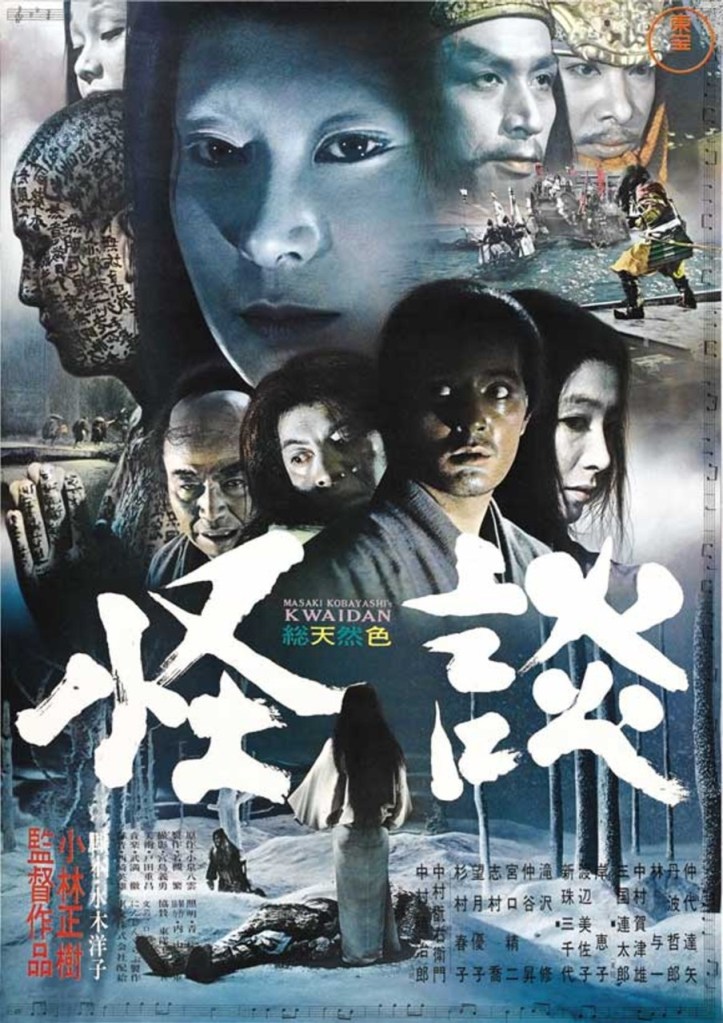
tumblr_ly5zbgdNH61rn3yrmo1_1280Kwaidan (怪談) is something of an anomaly in the career of the humanist director Masaki Kobayashi, best known for his wartime trilogy The Human Condition. Moving away from the naturalistic concerns that had formed the basis of his earlier career, Kwaidan takes a series of ghost stories collected by the foreigner Lafcadio Hearn and gives them a surreal, painterly approach that’s somewhere between theatre and folktale.

The first tale, Black Hair, is the story of an ambitious young samurai (Rentaro Mikuni) who abandons his one true love to marry a wealthy woman and advance his career. However, his second marriage is far from happy and he begins to appreciate just what it is he’s cast aside. Eventually returning home he meets his former wife again and harbours the desire to start afresh. However, when the sun comes up all is not as it seems.

Tale two, The Woman of the Snow, begins when two woodsmen are caught in a blizzard and a mysterious woman appears to suck one of them dry of blood. She spares the other, Minokichi (Tatsuya Nakadai), because she’s moved by his youth but she instructs him never to reveal the events of that evening or she will return to finish what she started. Minokichi returns home and meets another mysterious woman who later becomes his wife and bears him three children but will he remember to keep his secret even from the love of his life?

The third tale is perhaps the most famous, Hoichi the Earless, and features the sad tale of a blind biwa player (Katsuo Nakamura) whose storytelling ability is so great that the dead themselves petition him nightly to recount their story. Eventually the head monk finds out and disapproves of Hoichi’s dealings with the supernatural so the monks paint sutras all over his body to protect him from the malevolent spirits. However, like achilles and his vulnerable heel, they forget to paint Hoichi’s ears…

The fourth tale, A Cup of Tea, is a little more whimsical and opens with a framing sequence lamenting the fact that some ancient tales were never finished for one reason or another. The tale within the tale features a samurai who keeps seeing a face appear in his tea. Obviously this is quite disturbing, but eventually he just decides to drink it anyway only for the owner of the face to suddenly appear and complain about soul having been stolen.

Like all good fables the stories each have a moral to offer but also, crucially, paint the protagonists as victims of circumstance more than rash or unwise people. The samurai feared poverty so he abandoned his love in search of riches only to discover he’d been chasing the wrong kind of dreams. Minokichi momentarily forgot himself, perhaps entrapped by the Snow Woman’s final trick, Hoichi just wanted to play his biwa but his desires were frustrated by the powers at be who further mess things up for him by botching the sutra application. The protagonist of A Cup of Tea does choose to drink the tea himself but the resultant madness is not something that could ever have been reasonably expected. These are worlds of spirits where the doorway to the supernatural is always ajar, waiting for some ordinary person to tumble through accidentally.

Though employing slightly different styles for each of the four segments, Kobayashi sets his stage with a deliberately theatrical, almost hyperreal set design. Obviously shot on a soundstage, the tales take on the feeling of stories which have been told and retold, replayed countless times across the great theatre of life. Black Hair steers closest to a traditional kabuki play, an effect aided by Toru Takemitsu’s more traditional score but The Woman of the Snow gives way to intense color play full of cold blue ice vistas mixed with impressionistic, passionate red skies. Hoichi’s tale begins with an overlay of a scroll painting recounting the famous The of the Heike of which Hoichi sings his song. Full of epic battle scenes, ghostly apparitions and a whole load of biwa music, this segment is the lengthiest but also the meatiest when it comes to subtext. The final tale by contrast is much more straightforward and brings a little chanbara exuberance to the otherwise heavy atmosphere though it does leave us with one of the most haunting images in the entire film.

Kwaidan may look like an exercise in style for Kobayashi – it was also his first colour picture and he makes full use of that aspect of the film. However, that isn’t to say he’s abandoned his recurrent concerns. The people in the stories are all ordinary, they’re flawed but they aren’t evil. The samurai comes closest to bringing his fate on himself when he makes the selfish decision to abandon his loving wife for money and status though he pays a heavy price when he finally realises his foolishness. Minokichi’s crime is a loss of faith of perhaps of having doubted the truth of his tale in itself. In the end, he simply forgot his promise rather than making a conscious decision break it like the samurai. Hoichi is something of a passive player here as his blindness renders him unable to understand his plight – he is unable to keep his promise to the fallen samurai firstly because of the physical toll it’s taking on him and secondly as he’s prevented by his superiors. The protagonist of the final tale simply gives in to temptation and then to madness perfectly symbolising human weakness. Kobayashi maybe more artful here than acerbic but his bleak view of human nature still wins out. However, what Kobayashi crafted in Kwaidan is a beautiful, dreamlike canvas of supernatural visions which continue to dazzle in their artistry long after the screen has gone dark.


Kwaidan is available on blu-ray in the US from Citerion and on DVD in the UK from Eureka Masters of Cinema.