Shinobi no mono 8: The Three Enemies (新書・忍びの者, Kazuo Ikehiro, 1966)

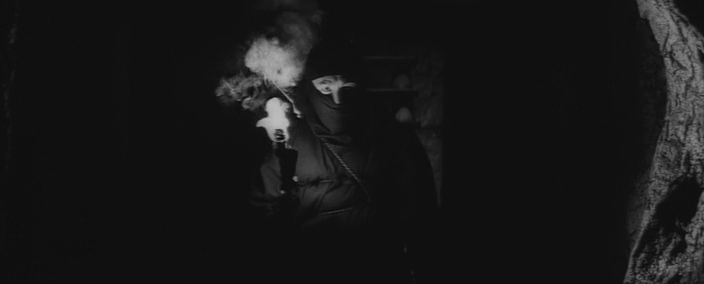
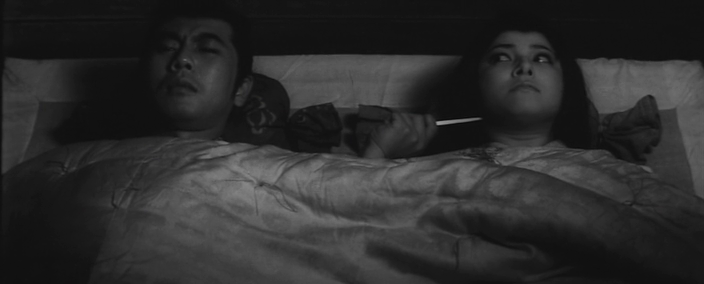
The abiding constant of the Shinobi Mono series had been its continual forward motion, at least up until instalment seven which had backtracked to the death of Ieyasu. This eighth and final film (save for a further sequel released in 1970 starring Hiroki Matsukata replacing Raizo Ichikawa who had sadly passed away a couple of years earlier at the young age of 37) however reaches even further back into the mists of time setting itself a few years before the original trilogy had begun.

This time around, we follow young Kojiro (Raizo Ichikawa) on what is a more stereotypical tale of personal revenge albeit that one that eventually becomes embroiled in politics as he joins a ninja band that’s working for Takeda Shingen (Kenjiro Ishiyama). In slightly surprising turn of events, Ieyasu (Taketoshi Naito) turns out to be what passes for a good guy at least in contrast to Shingen’s duplicity though Ieyasu himself is still young and at the very beginning of his military career which is why unlike his older self he’s a little more proactive and willing to start a fight as well as finish one. In any case, Shingen thinks he’s an easy target largely because he simply hasn’t been in post long enough to have begun making connections with local lords, bribing them with gifts to secure their loyalty. 

In any case, Kojiro’s journey begins as something more like a martial arts film as he surpasses his current teacher and is told to find a man called Sadayu (Yunosuke Ito) in the mountains if wants to be up to gaining his revenge against the three men who killed his father while trying to steal his gunpowder. Perhaps there’s something a little ironic in the fact that Kojiro’s father was killed in a fight over what amounts to the substance of the future engineering a wholesale change in samurai warfare and edging towards the oppressive peace of the Tokugawa shogunate. But to get she revenge, Kojiro commits himself to learning true ninjutsu as the film demonstrates in a lengthy training montage. Unlike previous instalments, however, there is left emphasis place on the prohibition of emotion with the reason Kojiro cannot romance Sandayu’s adopted daughter down to her father’s whim forbidding her from marrying a ninja.

Apparently not the Sandayu of the earlier films despite the similarity of the name, this one has decided to side with Shingen because he’s mistakenly concluded that he is a “fair person who understands us ninja” when in reality he just using them and is no better than Nobunaga or Ieyasu. Shingen hires them to tunnel into a castle through the well, but is entirely indifferent to their complaints about safety leaving a Sandayu voiwing vengeance. The ninja, he says, generally serve themselves and are bound to no master but he seems to have thought Shingen was different only to be proved wrong once again.

Of course, Kojiro continues looking for the men who killed his father though they obviously guide him back towards conflict anyway. When he tracks some of them down, one remarks that all he did was finish him off which was an act of kindness to end his suffering not that he necessary approved of what his fallow gang members had done. Kojiro finds a surrogate father in Sadayu much as Goemon had though this time a slightly better one even if Sandayu is also a man with a lot on his conscience. Even more so than the other films, this one takes place in a largely lawless land too consumed with perpetual warfare to notice the starving and the desperate let alone the inherent corruption of the feudal era. The bad of ninjas has a rather scrappy quality, not quite as sleek as the Iga of previous films while also a little naive. Shooting more like a standard jidaigeki, Ikehiro uses relatively few ninja tricks generally sticking to smoke and blow tarts with a few shrunken battles. Nevertheless, the violence itself is surprisingly visceral beginning with unexpected severing of an arm and leading to a man getting stabbed in both eyes. Then again, the film ends in the characteristically upbeat way which has become somewhat familiar only this time Kojiro runs back towards romantic destiny now freed of his mission of vengeance and the oppressive ninja code. 


I’m Flash! (Toshiaki Toyoda, 2012)

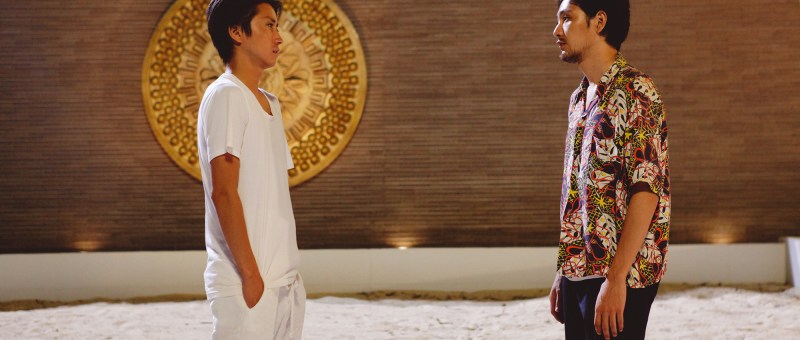
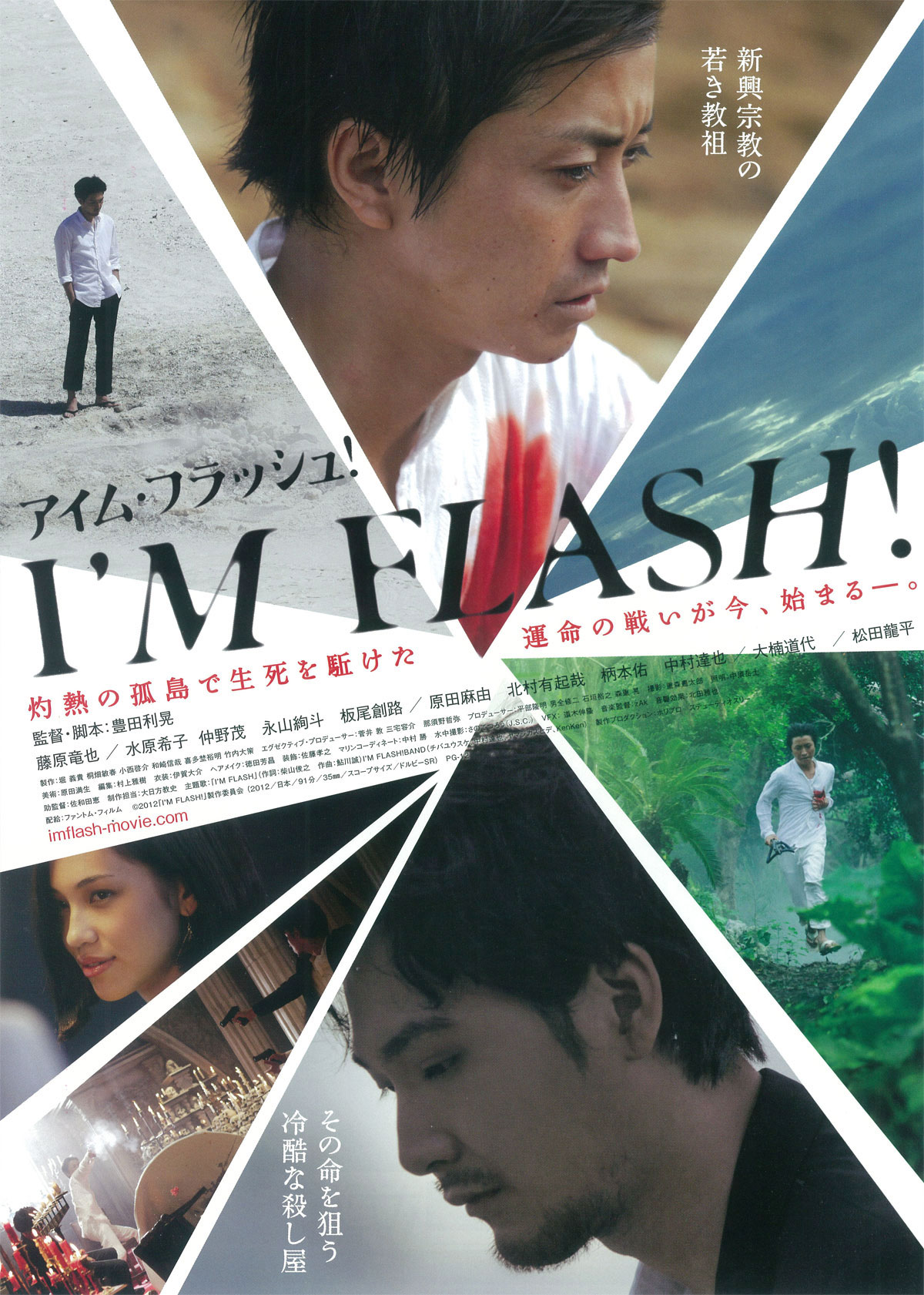
A conflicted cult leader’s existential crisis plays havoc with the “family business” he’s unwillingly inherited in Toshiaki Toyoda’s ironic contemplation of life, death, and everything in-between, I’m Flash!. Taken from a Sheena & The Rokkets song, the slightly awkward title refers not to the hero’s taste for visible wealth, but to the briefness of life. Shot in the wake of the 2011 earthquake, Toyoda apparently intended the film to “shake off death” but ultimately casts off only its shadow while suggesting once again that “death is the ultimate salvation” and the only true path to freedom. 

As the film opens, “guru” Rui (Tatsuya Fujiwara) literally collides with destiny as the bright red sports car he’s driving meets a motorcyclist coming in the other direction. The unnamed cyclist (Tasuku Emoto) is killed instantly and thereafter callously forgotten while the girl in the passenger seat next to him (Kiko Mizuhara) who’d he’d only met that evening in a bar is now in a coma with no indication of when or if she may wake up. Rui is shaken, however, most in being confronted with the real world cost of his phoney religion something which he has perhaps been ignoring in order to continue living his life. “If you want to make serious money there’s nothing better than religion” he’d cynically joked, playing the playboy enjoying the attention his gurudom grants him, particularly with the opposite sex, while living a life of undeserved luxury built on exploiting the vulnerability of others. 

Yet as we come to realise his troubles are not only moral or spiritual but personal in realising that he is but a puppet of his own organisation which is in reality run by his pragmatic mother (Michiyo Okusu) and hard-nosed sister (Mayu Harada) to whose marketing genius he attributes the cult’s recent success. One of three bodyguards hired to protect him quips that Rui is “kind of like a mob boss”, and he’s not far off except that Rui is only the face of the organisation with no real power to affect change. The cult, which runs under the slogan “Life is Beautiful”, was apparently founded by his grandfather and can only be inherited through the male line but Rui later discovers that both his grandfather and father whose skulls sit in his ossuary may have died unnatural deaths suggesting perhaps that they too came to experience this same sense of existential impotence or fell victim to the machinations of others. Feeling emasculated, Rui was forced to become the guru when his middle sister decided to transition, joining older sister Sakura and his mother as part of the matriarchal governing body while refusing the burden Rui must now carry. 

“Everyone needs something to cling to” Rui’s mother rationalises, justifying herself that the members of the cult would merely have joined another organisation if not theirs. Veteran hitman Kamimura (Shigeru Nakano) says something similar when the bodyguards are asked to switch sides and take Rui out of the picture, insisting that if they don’t do it someone else will. Rui’s decision to dissolve the church sparked by his meeting with the girl in the bar creates a serious business problem for his mother and sisters, yet reflecting he realises that he had plenty of opportunities to change his life and let each of them pass him by. “Is life supposed to be enjoyable?” zen hitman/bodyguard Fujiwara (Ryuhei Matsuda) answers when Rui asks him if he’s happy living on the sidelines, but it’s he alone who seems to see the value of living in the present ironically embodying the cult’s central messages that it’s only the fear of death that prevents one living a happy life while also correcting Rui’s minder that the contemplation of mortality shouldn’t be as “effortless” as the solutions they offer profess.  

Rui’s only escape lies in the ocean, in a sense diving into life while swimming towards the sun in search of rebirth while Fujiwara asks himself if he’s completely free if the world is but a fleeting dream and after death everything disappears as if it never existed. The guru may have fallen victim to his own philosophy, looking for salvation in death while perhaps selfishly prioritising his own liberation rather than destroying the corrupt system of which he was a part and in which he will simply be replaced. “Not at any time will the illusion of hope be destroyed” according to an ethereal voiceover casting doubt over its own message of positivity even while its hero swims toward the light. 


I’m Flash! is released on blu-ray in the UK on 18th October as part of the Toshiaki Toyoda: 2005 to 2021 box set courtesy of Third Window Films accompanied by a typically insightful commentary from Tom Mes.

Original trailer (English subtitles)

Bu Su (BU・SU, Jun Ichikawa, 1987)

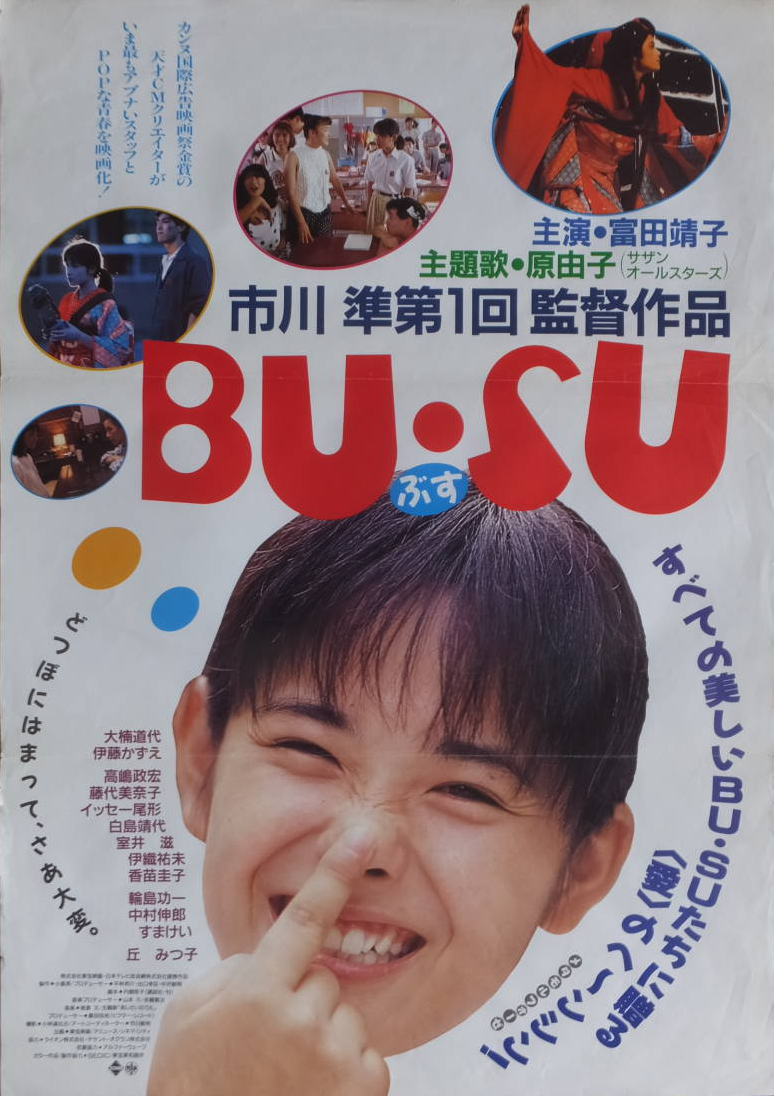
Busu poster 2Already a well respected and much in demand director of television commercials Jun Ichikawa released his debut feature, Bu Su (BU・SU), in 1987. “Bu Su” is, loosely translated, pejorative slang for a woman who is not considered to be attractive. The closest equivalent, in British English at least, would be something like “a dog”. It’s especially ironic then that the movie was conceived as a vehicle for a popular idol whose success was perhaps dependent on a perception of attractiveness, or at least of “kawaii” innocence. Yasuko Tomita was at that time at the height of her fame having shot to stardom through open audition leading to an award winning role in Aiko 16 Sai. Two years later she starred for Nobuhiko Obayashi, who was originally slated to direct Bu Su, in Miss Lonely, but even in comparison to Obayashi’s melancholy heroines, Bu Su’s Mugiko (Yasuko Tomita) is a particularly moody teen, the “ugliness” here apparently relating to her emotional isolation.

For reasons we never quite understand, Mugiko leaves her island home after a traumatic incident and moves in with her aunt in Tokyo with the intention of becoming a geisha. It seem’s Mugiko’s mother was once a famous geisha herself until she met Mugiko’s late father and left for a more conventional life in the peaceful countryside. Mugiko’s flight then has a peculiarly perverse quality in being both to and from her mother with whom she seems to be on bad terms despite her mother’s obvious affection for her. Unfortunately Mugiko is not a fantastic fit for the world of the geisha, being somewhat innocent and childishly clumsy, not to mention her ongoing grumpiness. Nevertheless, everyone at the geisha house is keen to help her if only out of loyalty to her mother.

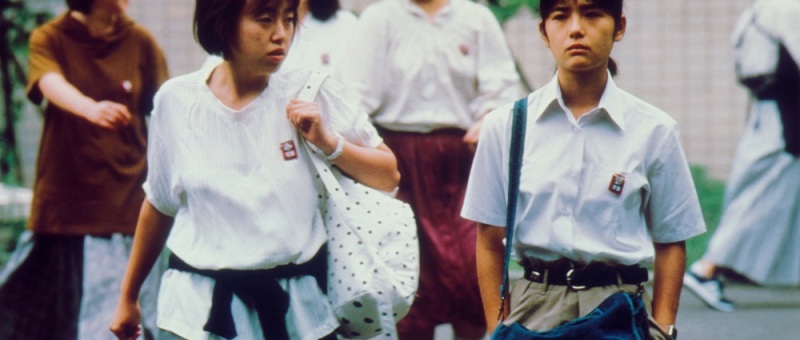
At school, meanwhile, Mugiko is nervous and withdrawn, barely audible during her introduction to her new classmates and with her eyes permanently on the floor. Her teacher, taking her aside, adds to the mystery in remarking that she’s certainly been through a lot back in Izu and that she should leave all that behind and try to make a new start. Nevertheless, she remains sullen and isolated, barely speaking to anyone yet perhaps examining the dynamics of the people around her. Maybe that’s why she alone finds the strength to stand up to a popular kid bullying another girl (Yuriko Hirooka) considered to be “plain” with a mean trick teasing a nasty surprise lurking in a box which turns out to be nothing more than a hand mirror.

Mugiko might not be quite sure what it is that’s worrying her, or at least we can’t be sure because we don’t know exactly what happened in Izu, but the rest of her classmates have their own insecurities to deal with from Sakurako’s preoccupation with her perceived lack of looks to boxing enthusiast Tsuda (Masahiro Takashima) who knows he’s not much for studying but is less than convinced of the possibility of living off his fists. What they’re going through is the normal teenage process of figuring themselves out, which they begin to do through the time-honoured fashion of the school cultural festival which is an extra special event this year because it’s the school’s centenary. Goaded into it by the mean popular girl who meant to embarrass her by outing her as a geisha, Mugiko agrees to dance the dance of Yaoya Oshichi who was prepared to burn the world in the hope of meeting her love.

Yaoya Oshichi was burned at the stake for arson, and though Mugiko’s path eventually ends in flames they’re of a much less threatening variety. When she first arrives in Tokyo we see her taking in some of the iconic sights of the city, crossing at Shibuya Scramble and taking a stroll through upscale Ginza before taking a bite out of a fast food hamburger as if she were about to taste some famous local delicacy. When not training with the other geisha we see her wander through the city alone, sullen but also taking pleasure in exploring her new environment. It’s here that we hear the film’s title uttered, crudely, by a sleazy middle-aged man who picks Mugiko up and takes her to a coffeeshop where he embarks on weird chat up lines about the beauty of the local railway before trying to drag her into a love hotel. Luckily, Mugiko manages to get away from him only for the man to shout “busu” after her, implying that he didn’t want her anyway but also that her refusal is in someway arrogant.

By Ichikawa’s logic, Mugiko’s “busu”ness is not because she’s “ugly” but that she’s so sour faced, permanently sulky and angrily keeping a deliberate distance from everyone around her. We see her spikily refuse her mother’s tearful attempt to see her off to the train, and then speak rudely to her on the phone, while remaining aloof from most of the other geishas save her aunt’s daughter, primed to take over the business but unbeknownst to most longing for a more conventional life with a boring salaryman husband. Yet through all of these encounters, some friendlier than others, her heart finally begins to open and she’s no longer so closed off or aloof, eventually able to laugh along with her mother and pithily dismiss her questions with the generic answers that Tokyo is “fun” and yes she’s going to school. Mugiko’s path is certainly a meandering one, taking the scenic route through the charms of bubble era Tokyo, but it has its charms and even if she takes her time she gets there in the end, smiling at last having rediscovered the joys of being alive.


Short clip (Japanese subtitles only)