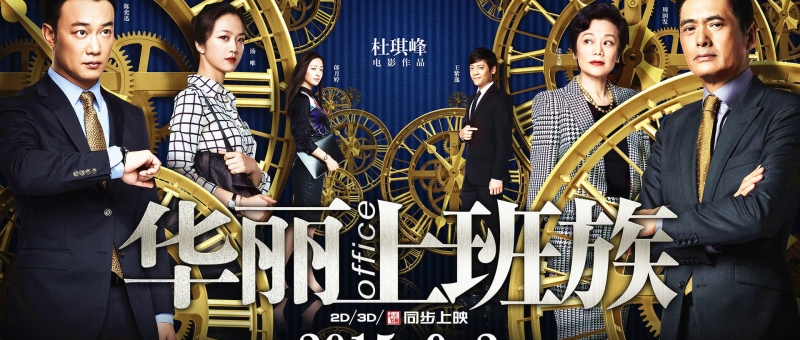
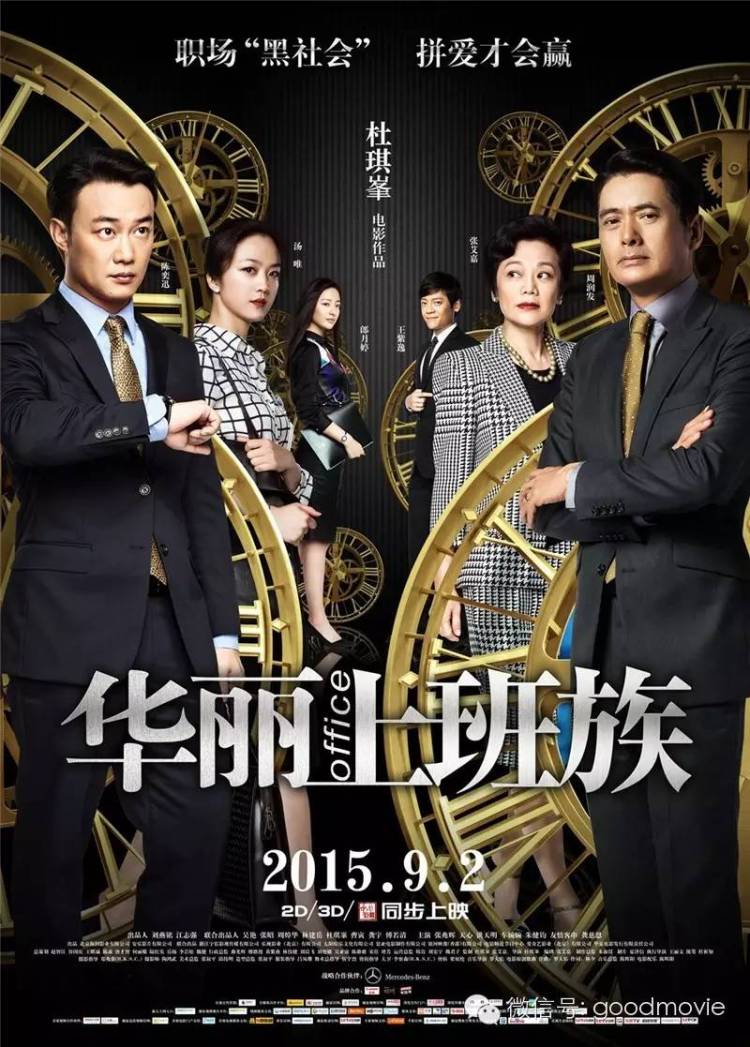
 Can love and capitalism walk hand in hand? Perhaps not, at least in Johnnie To’s beautifully choreographed musical exploration of high stakes finance and moral bankruptcy, Office (華麗上班族). Adapted from Sylvia Chang’s stage play, Office situates itself on the edge of an abyss as the 2008 financial crisis edges its way towards Hong Kong while enterprising businessmen try to figure out how to ride the waves even if that means standing on someone else’s shoulders as they sink deeper into the moral morass that is the modern economy.
Top Hong Kong trading company Jones & Sunn is about to go public. CEO Winnie Chang (Sylvia Chang) has long been running the show for her boss and lover, Chairman Ho (Chow Yun-fat), who has promised her a sizeable dividend once the floatation is complete. Meanwhile, two new interns have just joined the company, eager to make their marks in the corporate world and ensure they survive their three month probation. Bright-eyed and bushy-tailed Li Xiang (Wang Ziyi), “Lee like Ang Lee, Xiang like dream”, just wants to work hard and get rich so he can live a nice life, while his colleague Kat Ho (Lang Yueting) has just returned from studying economics at Harvard and appears to be slumming it in a lowly internship while (unconvincingly) pretending to be from a humble background. The funny thing is no one seems to pick up on the fact Kat has the same surname as the company’s owner, or they might have figured out she’s the boss’ daughter either forced to learn the trade from the ground up or working as a spy among the regular employees. In any case, Li Xiang is smitten.
Love, it seems, is the destabilising force at the centre of this great machine. CEO Chang, an all powerful woman in a male dominated industry, rules the office with a will of iron but allows herself to be manipulated by Ho with whom she has been having a longstanding affair. Ho has a wife in a coma, but neither of the pair object to the office gossip which brands Chang as “Mrs. Ho”, seeing it only as cutely romantic rather than a slight on Chang’s very real authority. Meanwhile, lonely in Ho’s lack of serious commitment, Chang has also been sleeping with her favourite underling, the feted David (Eason Chan), who in turn is getting fed up with feeling like a spare part who’s hit the peak of his career. Unbeknownst to Chang who may have taken her all-seeing eye off the ball, David has started playing with fire in gambling with company money and losing badly. As a counter measure, he’s begun romancing lovelorn accountant Sophie (Tang Wei), who unlike Chang, is still facing the work/home dilemma in that her fiancé back on the Mainland is pressuring her to give up work and settle down.
Li Xiang is very keen on following his “dreams” which in the beginning are charmingly naive – he wants a nice life for himself and the ability to pay off his friends’ debts (seemingly for entirely altruistic reasons, not as an excuse to show off). Slowly, however, his new world begins to corrupt him. He’s irritated that he’s not allowed to ride the executive elevator and badly wants in, but is still green enough to chivalrously cover up for Kat’s mistakes, while Kat is so clueless that she forgets turning up to work in designer outfits and in a chauffeur driven car is going to blow her cover. Li Xiang sees through her, but only to the nice part – it never really occurs to him she’s a mole or planning to betray Mrs. Chang who is kind of her step-mother. Chang isn’t blind to office politics. She sees Li Xiang take the blame for Kat and even likes him for it. She also likes his “originality” and plans to take him under her wing for her new expansionist plans but finds herself once again blindsided by all the difficult romantic drama bubbling under the surface of coldhearted capitalism.
David and Sophie decide they want to start a “love revolution”, but David has already gone to a dark place and his romantic confession is immediately followed by a manipulative request to get Sophie to help him with his nefarious plans. Meanwhile, Li Xiang’s gradual descent into corporatism begins to sour Kat who’d taken a liking to him because he wasn’t like everyone else. They didn’t mean to do it, but they’ve betrayed themselves and others in their relentless pursuit of conventional success. Drunken salarymen at a local bar ask themselves what all of this is for when their kids don’t recognise them and they barely recognise themselves, yet no one quite has the guts to get off the corporate train and go do something else.
In To’s elaborate set design, no one is ever truly able to leave the office. An elegant construction of neon and steel, the abstract theatricality of To’s artificial universe only underlines its essential meaninglessness – something the Office’s denizens eventually come to understand whether they choose to stay or not. As Chang quips, smart guys control money and stupid ones are controlled by it, but she herself is wise enough to know when the game is up and it’s time to move on. Did love destroy the system or did the system destroy love? Beautiful melodies telling us terrible things, To’s anti-capitalist musical crushes its earnest heroes under the wheel of progress while they dance blithely all the way over the edge.
Office screens in Chicago on Oct. 5 as part of Asian Pop-Up Cinema.
Original trailer (English subtitles)
 Johnnie To is best known as a purveyor of intricately plotted gangster thrillers in which tough guys outsmart and then later outshoot each other. However, To is a veritable Jack of all trades when it comes to genre and has tackled just about everything from action packed crime stories to frothy romantic comedies and even a musical. This time he’s back in world of the medical drama as an improbable farce develops driven by the three central cogs who precede to drive this particular crazy train all the way to its final destination.
 Windows on Worlds