
Ciao UFO (再見UFO, Patrick Leung Pak-Kin, 2019/2026)

“Where will I go in this future?” a young man tearfully asks, unexpectedly cast adrift and handed a future he never expected to have with no one to help him navigate this new reality. Speaking from the perspective of the Handover, his confusion hints at a sense of despair falling over Hong Kong, but also echoes through the contemporary society in a place where, as he later says, nothing stays the same, though that might not necessarily be such a bad thing.

Long delayed for a wider release, Patrick Leung Pak-Kin’s Obayashi-esque drama has a potent sense of nostalgia for a lost Hong Kong of the 80s and 90s, but also a hope that, even if the past cannot be reclaimed and we cannot become who we once were, it is never too late to start again or to choose a new path that leads back to who we were really supposed to be. As children, Heem, Kin, Hoyi, and her unnamed little brother were firm friends living on the Wah Fu estate. The fact that they are no longer in touch reflects a sense of displacement amid the rapid economic growth of that later 20th century in which these kinds of apartment complexes fell out of use leaving communities scattered as the housing market escalated to the extremes of today thanks to rampant property speculation. 

The children see the UFO at moment of extreme emotional despair and it gives them only a temporary respite from the terrors of a more adult world. In the mid-1990s, they have all lost their way. Kin (Chui Tien-you) once said he wanted to be an explorer like his father, but is now working several low-paying jobs such as manning a paper stand, selling vacuum cleaners, and acting as an agent of encroaching modernity by setting up home computers for first-time users. He no longer believes in aliens or the UFO, and though he reconnects with an equally melancholy former schoolmate, keeps her at arms’ length and lacks the courage to fight for what he really wants. Heem (Wong You-nam), whose childhood leukaemia has gone into remission, is working as an extra without much of a plan for the rest of his life, because he never expected to have one. He still believes in the UFO and tries to reconnect with his childhood friends amid the X-Files inspired alien obsessions of the ‘90s.

Hoyi (Charlene Choi), meanwhile, who wanted to be a joker making people laugh has been pushed onto a more conventional path as a professional accountant that appears to be making her unhappy, though she’s unable to escape it. While Kin falls victim to stock market mania and Heem Tamagotchi profiteering before joining his brother’s burgeoning real estate business, Hoyi’s straight and steady path would seem to be the winner, though perhaps there’s not so much need for accountants when everyone’s going bankrupt in the Asian financial crisis just as no has the money to buy apartments, which is something Heem’s brother didn’t seem to consider in thinking himself superior to those who got hooked on the stock market.

Several times the three’s path cross, though they do not meet each other and remain locked on their own melancholy paths. Hoyi’s free spirited “hippie” uncle teaches her a classical song written by an ancient poet that he says is about learning to find beauty in loneliness, perhaps sensing her sense of isolation as she wilfully suppresses herself to be the person that she thinks she’s supposed to be including a potential marriage to a man who’s the polar opposite of her authentic self. Austin (Joey Leung) pulls her back to earth when she’s lost in space, which is another way of saying that he crushes her dreams and desire for happiness by telling her to forget about UFOs and concentrate on being a wife and mother after their wedding.

The UFO then comes to represent a kind of nostalgia and the longing for a lost a past, but within that also finds a sense of hope that what once was can be again. It might not be the same, but it’s still there and it’s not too late to turn around and rediscover that sense of wonder in life. The childhood friends eventually reunite and find new solidarity in their shared experience that makes this new reality a little more bearable, even amid its painfulness and irony. The film ends with Hoyi’s brother (Ng Siu-hin) wearing a mask and telling us that it is April 1, 2003, which is the day that Leslie Cheung died, along with perhaps a certain vision of another Hong Kong, but also hints at the SARS crisis that would strike that year along with the more recent pandemic. Perhaps everything is a cycle, but as they say, the end of one thing is the start of another. They haven’t seen any UFOs for a long time and perhaps won’t ever see one again, but the hope remains, and with it the courage to live in this new future whatever it may hold.


Ciao UFO is in UK cinemas from 15th May courtesy of Central City Media.

Trailer (English subtitles)

Trivisa (樹大招風, Frank Hui & Jevons Au & Vicky Wong, 2016)

Trivisa posterIt’s worth just taking a moment to appreciate the fact that a film named for the three Buddhist poisons – delusion, desire, and fury, is intended as a criticism of Hong Kong as an SAR that revels in the glory and subsequent downfall of three famous criminals who discover that crime does not pay right on the eve of the handover. Mentored by Johnnie To, Trivisa (樹大招風) is directed by three young hopefuls discovered through his Fresh Wave program each of whom directs one of the film’s three story strands which revolve around a trio of famous Hong Kong criminals.

Back in the ‘80s, as Mrs. Thatcher delivers her pledges on the Hong Kong handover, King of Thieves Kwai Ching-hung (Gordon Lam) gets stopped by a random police patrol, kills the officers, and then has to fake his identity to escape. 15 years later he’s a petty mobile phone trafficker dreaming of pulling off a big score. Meanwhile, Yip Kwok Foon (Richie Jen), once known for his AK47 brandishing robberies is a “legitimate businessman” smuggling black market electronics into Hong Kong and bribing Mainland officials to do it, while Cheuk Tze Keung (Jordan Chan) is a flamboyant gangster revelling in underworld glory and dreaming of eternal fame.

Rather than weave the three stories into one coherent whole or run them as entirely separate episodes, the three strands run across and through each other only to briefly reunite in the ironic conclusion. The most famous of the three real life criminals, Kwai Ching-hung’s arc is perhaps the most familiar though rather than fighting an existential battle against his bad self, Kwai’s quest is to regain his title as Hong Kong’s most audacious thief. To do this, he’s reunited with an old friend and comrade in arms who’s retired from the life and married a Thai woman with whom he has an adorable little daughter. Unbeknownst to him, Kwai has not come for old times’ sake but is taking advantage of the fact that the family live directly opposite his latest score. Employing two Mainland mercenaries, Kwai has his eyes on the prize but his friend is wilier than he remembered, is quickly suspicious of Kwai’s friendship with his daughter, and has his suspicions confirmed when he finds his kid’s backpack full of guns.

Yip’s story, by contrast, is one of diminished expectations and ongoing financial woes. An early scene at a restaurant finds Yip in the company of Mainland officials to whom he must scrape and bow, placating them with various bribes and engaging in the strange trade of precious vases which seems to pass as currency among corrupt civil servants. Corporate shenanigans and business disputes, however, are no substitute for good old fashioned firefights and Yip’s frustration with his new career is sure to lead to some kind of explosion at some point in time.

Cheuk becomes the lynchpin of the three as he takes an advantage of a rumour that the three “Kings of Thieves” are getting together to plan a giant heist to track down the other two and see if he can make it work for real. The most successful and happiest in his life, Cheuk has made his fortune out of ostentatious crime – kidnapping the sons of the extremely wealthy for hearty ransoms. He is, however, bored and dreams of making a giant splash which will ensure his name remains in the history books for evermore – i.e., blowing up the Queen.

Facing the approaching handover, each is aware the world will change, unsure as to how they’re in the process of trying to secure their futures either way. Kwai wants one last heist, Yip has already begun courting Chinese business, and Cheuk just wants to be the face in all the papers across the entire Chinese world. Kwai’s sin is “desire” – he wants one last hit as a criminal mastermind and he’s willing to take advantage of his friend (and even his friend’s young daughter) to get it, Yip’s sin is “fury” as dealing with constant humiliation leaves him longing for his AK 47, and Cheuk’s failing is “delusion” in his all encompassing need to be the big dog around town, all flashy suits and toothy grins. On the eve of the handover they all meet a reckoning – betrayal, a stupid and pointless death, or merely ridiculous downfall.

The heyday of crime has, it seems, ended but that’s definitely a bad thing, laying bare a change in dynamics between nations and a decline in the kind of independence which allows the flourishing of a criminal enterprise. Bearing To’s hallmark in its tripartite structure, ironic comments on fate and connection, and eventual decent into random gun battle, Trivisa is a ramshackle exploration of a watershed moment in which even hardened criminals must learn to live in a brave new world or risk being consumed by it.


Screened at Creative Visions: Hong Kong Cinema 1997 – 2017

Original trailer (English subtitles)

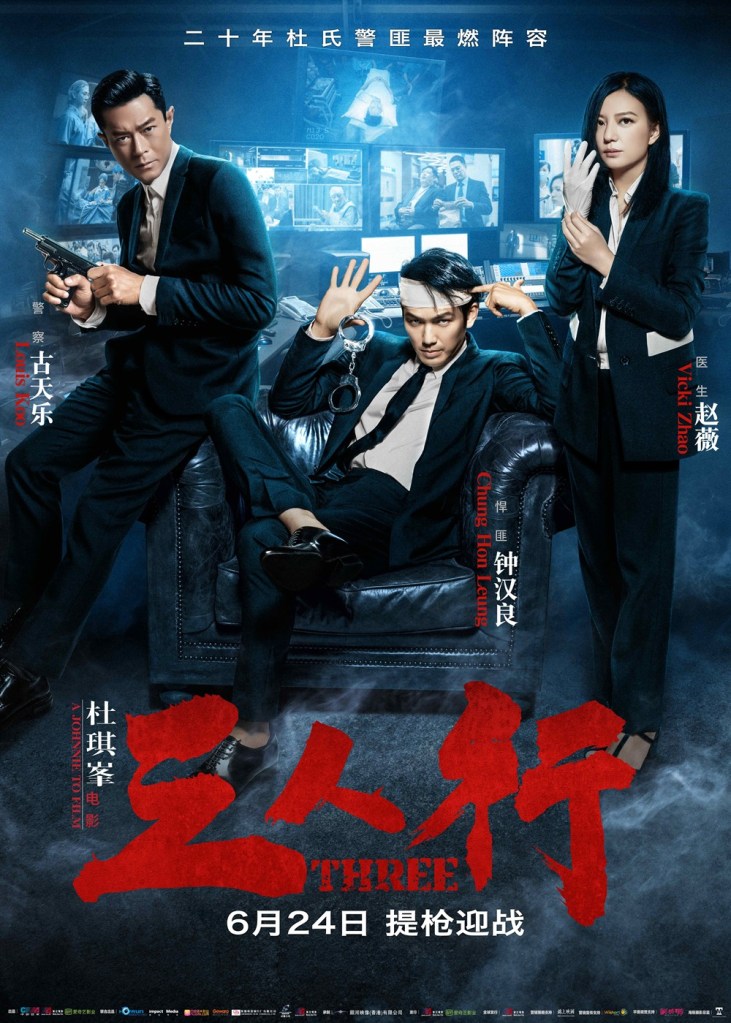
Three (三人行, Johnnie To, 2016)

Johnnie To is best known as a purveyor of intricately plotted gangster thrillers in which tough guys outsmart and then later outshoot each other. However, To is a veritable Jack of all trades when it comes to genre and has tackled just about everything from action packed crime stories to frothy romantic comedies and even a musical. This time he’s back in world of the medical drama as an improbable farce develops driven by the three central cogs who precede to drive this particular crazy train all the way to its final destination.

Dr. Tong (Zhao Wei), is a tough as nails neurosurgeon. Having arrived in Hong Kong from the mainland at 17, she learned Cantonese, got into medical school and has built a fine career for herself but this same drive means she’s unwilling to delegate and constant overwork is beginning to eat into her statistics. She thinks her day can’t get much worse after an angry patient rants and calls her a quack because there has been a complication with his surgery and he’s currently unable to walk but her next patient, a man with a gunshot wound to the head brought in by the police, is about to add to her already long list of workplace stressors.

Shun (Wallace Chung) is actually almost OK except for having a bullet lodged in his brain. Against all the advice, Shun refuses the offer to have it removed surgically because he’s playing a long game with the police and it’s his one bargaining chip. The police’s story is that Shun grabbed a gun and tried to escape whereupon an officer shot him. However, this turns out to be not quite true and Inspector Chen (Louis Koo) has twin worries – finding Shun’s accomplices and covering up the extreme misconduct committed by his team members.

The original Chinese title of the film, 三人行 which means three people walking, is inspired by the traditional saying that among three people you will always find someone you can learn something from. However, the tragedy of these three is that they’re incapable of learning anything from anyone else and are actually quite disinterested in other people. Tong is always thinking of her targets and can’t bear the thought of losing again if Shun dies of his injuries, but rather than learning to step back and recharge, she continues to push herself to near breaking point. Chen is series of walking contradictions – a lawbreaking policeman, so certain of his own ability to counteract crime that he’s lost all accountability. Shun’s big personality flaw is taking far too much pleasure in his playful scams. He wants to make a phone call so he refuses surgery until he can (quoting Bertrand Russell and throwing the Hippocratic oath back at Tong, already nearing the boil), never quite realising that the delay could very well signal the end of everything.

Tong, Chen, and Shun are three pillars of society – the respectability of the medical profession, the authority of law enforcement, and the inevitability of crime. Tong, the most sympathetic, propels herself into overwork but her selfish need to prove herself to herself puts patients’ lives at risk. The police force which is supposed to represent protection under the law, is shown to be corrupt and little more than criminal in itself. Chen says he can break the law to enforce the law, but what he’s really trying to do is save his own skin after going too far. Shun is simply a sociopathic genius intent on showing off his cerebral prowess to anyone who will give him the slightest bit of attention but like all criminals he’s a goal orientated, short term thinker. Each of the three is, in a sense, moving in their own universe and driven only by their own certainty of primacy.

As much as Three is a crime thriller, psychological character piece, and medical drama, what lies at the heart of it is farce. In keeping with much of his work, To’s world is an absurd one filled with eccentric fringe characters who may be more important than they otherwise appear and, as usual, the final god is luck – a paralysed man attempts suicide by throwing himself down the stairs only to suddenly find he can stand up by himself at the bottom, and Chen’s gun jams several times preventing him from taking decisive action. At one very strange juncture, Shun even tries to escape the hospital by making use of the classic boys own adventure tactic of tying a number of sheets together and using them to climb out of the window. To’s true centrepiece takes the form of a tense, exciting shootout which looks like slow motion but was apparently filmed in real time with the actors moving slowly in perfectly choreographed formation. The improbable scene of carnage, prefaced by bombs going off right, left and centre, is conducted to a the strains of a genial pop song extolling Confucianist wisdom. Beautifully balletic, the bullets hit in real time but the actors react as if stunned, allowing us to fully experience all of their fear and confusion at the centre of such a shocking event.

The man who may have the most to teach us the genial old man with a key stealing habit who erupts into a bawdy song as he’s being discharged. He may have the right idea when he suggests that everyone follow his example and learn to laugh loudly to live a happy life. To reinforces his absurd intentions with intense realism, embracing the ritualistic, “theatrical” nature of the operating room with all of its various performances set atop the heated bloody scenes of bodily gore and coldly metallic nature of the surrounding equipment. To’s gleefully graceful aesthetic is back in force for this tale of lonely wandering planets pushed out of orbit by the imposing centrifugal forces of their rivals. Strange and tinged with absurd humour, Three is To is in a playful mood but nevertheless deadly serious.


Reviewed at Raindance 2016.

Original trailer (English/Traditional Chinese subtitles)