Bayside Shakedown the Final: The New Hope (踊る大捜査線: THE FINAL 新たなる希望, Katsuyuki Motohiro, 2012)

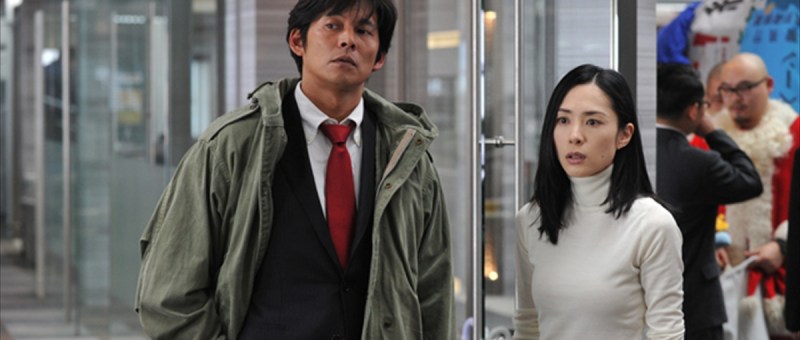
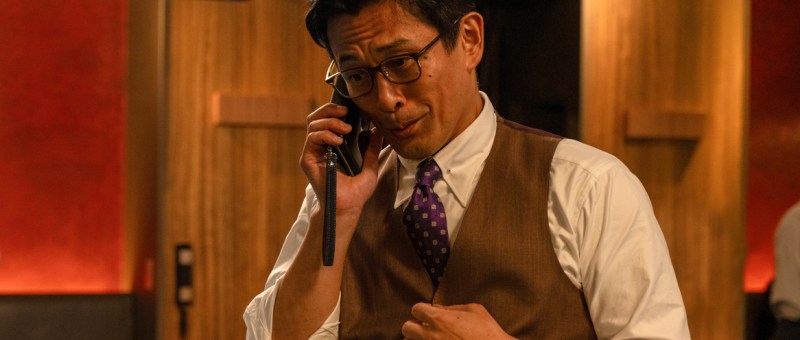
Is it really the end? Billed as the “final” instalment in the Bayside Shakedown series which began with a TV drama in 1997, Bayside Shakedown the Final: The New Hope (踊る大捜査線: THE FINAL 新たなる希望, Odoru Daisousasen the Final: Aratanaru Kibou) once again finds the gang contending with annoying red tape but also with a police force which is intrinsically corrupt and self-serving while questioning if they should remain in an occupation in which they are treated with such disdain. Continuing the familiar pattern from throughout the series, the gang find themselves coming up against a serial killer who may be a crazed vigilante only to discover that the whole thing may have been an extreme inside job designed with the intention of drawing attention to inadequacies in the justice system. 

The problem is that the body they’ve found appears to have been shot with a gun which was removed from the police evidence locker and is linked to a kidnapping case six years previously which just happens to have been handled by Mashita (Yusuke Santamaria) when he was a hostage negotiator. Mashita had ordered an end to the negotiations because of pressure from above to play by the rules with the consequence that the child later died while the prime suspect in the case was recently acquitted of the crime at trial (a staggeringly rare occurrence in Japan). When Mashita’s young son is kidnapped, all eyes are on a rogue policeman, Kuze (Shingo Katori), but it is obvious he is not acting alone. 

Toragai (Shun Oguri), the authoritarian detective from the previous film, has continued along a dark path which only intensifies when his paper on police reforms is rejected out of hand. He too thinks the police force needs structural reform but leans hard into the idea that too many people are getting away with crime rather than concentrating on removing the barriers which prevent police from doing their jobs as Muroi (Toshiro Yanagiba) and Aoshima (Yuji Oda) would probably suggest. Muroi’s lasting dream is of building a police force which trusts policemen to do the right thing and he frequently tells his subordinates that they should feel free to exercise their own judgment. 

Meanwhile, the local cops continue to suffer under the command of the elitist officers from HQ who not only look down on them but assign menial tasks, as does Mashita in finding himself short staffed while most are busy providing security for a local energy summit. While Aoshima had experienced a health crisis that turned out to be a false alarm in the previous film, so this time Sumire (Eri Fukatsu) finds herself struggling with ongoing effects from her shooting in Bayside Shakedown 2 eventually deciding that it might be better to leave the police force entirely while lamenting her unfinished business with Aoshima which remains unresolved even in this “final” instalment while he somewhat unsympathetically can only ask her not to leave rather than express his true feelings. 

Ironically enough, by the time of the final showdown neither of them are actually in possession of a police badge, Aoshima scapegoated by Toragai who still holds a grudge against him while inconvenienced by interference in his scheme to frame a local petty thief for the killings, presenting him with an invitation to resign following serious misconduct accusing him of beating up suspects and planting evidence. One again, the police chiefs sit around a large circular table issuing orders from afar but are mainly concerned how to bury the “scandal” of having a police officer steal a gun from evidence and then use it to commit a murder. In a bizarre twist of fate, it later turns out that the whole thing may be an elaborate, not to mention entirely amoral, plan to expose police shortcomings with a side dose of revenge against Mashita for contributing to the child’s death by insisting on following protocol while receiving heat from above. 

As such the apparently “final” instalment skews a little darker than the series norm while as the subtitle implies offering a new ray of hope in the reversal of Muroi’s fortunes allowing him to embark on the police reforms which have been his and Aoshima’s goal throughout the series. Meanwhile, the film pays tribute to its previous instalments with frequent words of wisdom from the late Waku read from his notebook by his nephew and the ironic return of the previous chiefs reinstated as volunteer mentors as part of a reinforcement programme while familiar faces such as the Captain Kirk cosplayer also make their customary appearances. What’s clear is that there will never really be a “final” outing for Aoshima who reaffirms himself as the last line of defence protecting the local population as he once again runs toward sunset and the next case waiting just behind. 


Trailer (no subtitles)

90 Years Old – So What? (九十歳。何がめでたい, Tetsu Maeda, 2024)

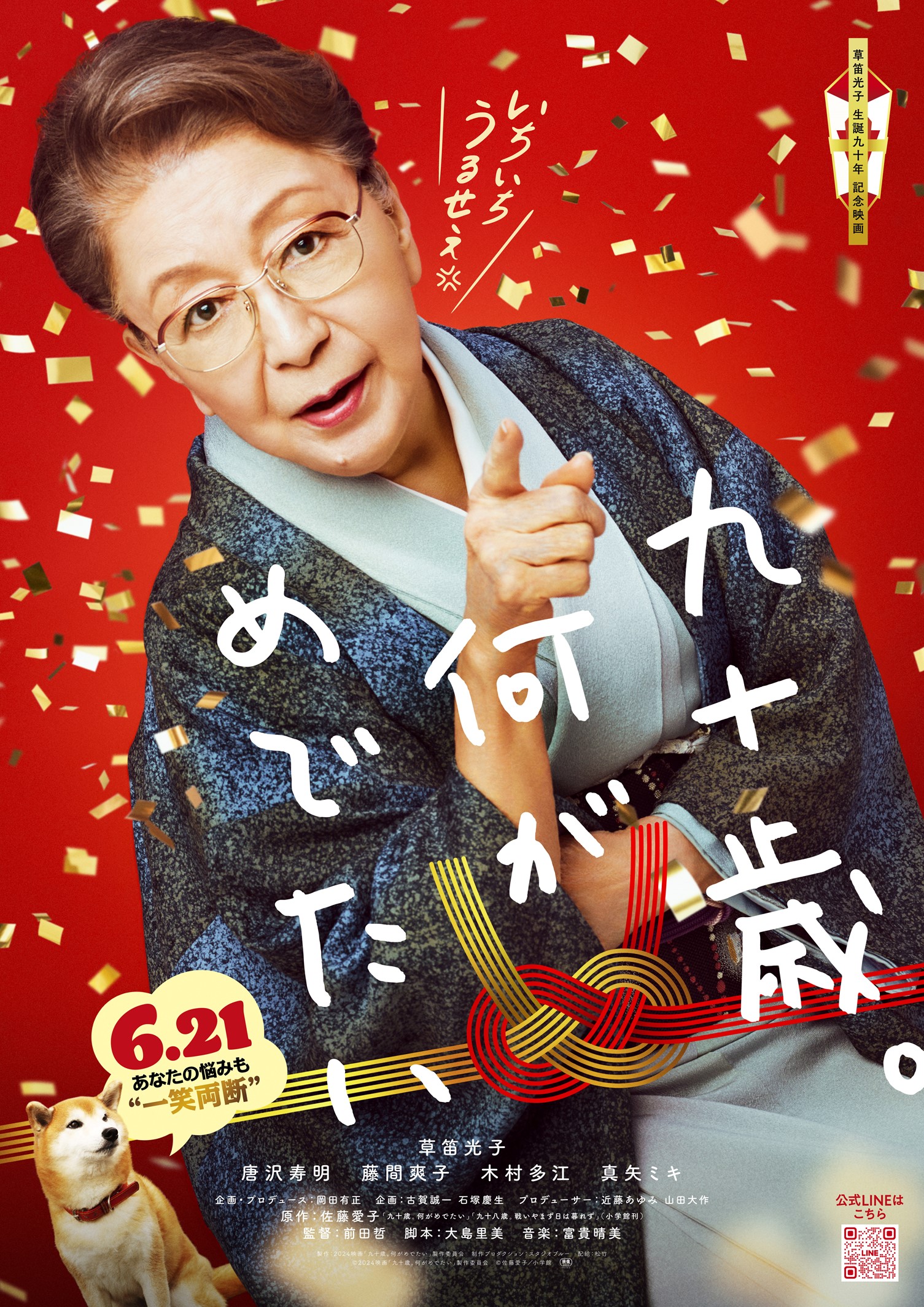
Everyone keeps congratulating Aiko Sato (Mitsuko Kusabue) on reaching 90, but she can’t see what’s so special about it. Having retired from writing after publishing her last novel at 88, she’s really feeling her age and has little desire to anything but sit around waiting to die. That is, until she’s badgered into picking up her pen by a down on his luck, “dinosaur” editor certain that her words of wisdom will strike a chord with the young people of today.

Marking the 90th birthday of its leading lady Mitsuko Kusabue and directed by comedy master Tetsu Maeda, the film takes its name from a collection of essays published under the title “90 Years Old, So What?” which largely deal with what it’s like to be old in the contemporary society along with the way things have changed or not in Japan over the last 90 years. It does not, however, shy away from the physical toll of ageing despite Kusabue’s sprightliness or the undimmed acuity of Aiko whose only barrier to writing is that she fears she’s run out of things to say and the energy to write them. During her retirement, she remarks on the fact that her legs and back hurt while she also has a heart condition and everything just feels like too much bother. Her daughter Kyoko (Miki Maya), who lives with her along with her twenty-something daughter Momoko (Sawako Fujima), asks her why she doesn’t go out to meet a friend, but as Aiko says, most of her friends have already passed on or like her don’t really have the energy to leave the house. 

In many ways, her age isolates her as she finds herself slightly at odds with the contemporary society. She turns the television up louder because she finds it difficult to understand what younger people are saying and doesn’t get why they stare at their phones all the time. Though she manages most things for herself, she has to call repair people, which costs money, if something breaks down while her daughter’s not around to fix it, even if it’s something as simple as a paper jam in a fax machine or pushing the off button on the TV too hard so it won’t turn back on again. Nevertheless, so intent is she on “enjoying” her retirement that she repeatedly turns down the entreaties of a young man from her publisher’s who wants her to write a column and always turns up with fancy sweets which are, as she says, well-considered gifts, but also a little soulless and superficial being driven by fashionable trends of which Aiko knows nothing and by which she is not really impressed.

There is something quite interesting about the contrast between herself and fifty-something Yoshikawa (Toshiaki Karasawa) who is also a man behind the times and a relic of the patriarchal culture she railed against in her writing and rejected in her personal life, divorcing two husbands and going on to raise her daughter alone. In the opening scenes, she reads an entry from an advice column about a woman who’s sick of her husband of 20 years because he’s a chauvinist who dumps all of the domestic responsibilities onto her while looking down on her because of it. Aiko tuts and contradicts the advice of the columnist, remarking that the answer is simple. She should just tell him to his face that she hates him and then leave. Nevertheless, the fact remains that not all that much has changed since she was young. The husband’s behaviour is considered “normal”, while the woman’s desire to be treated with respect or leave her marriage is not. Yoshikawa is effectively demoted because he has no idea that his treatment of a female employee amounts to workplace bullying and sexual harassment even if he didn’t intend that way because he’s trapped within this old-fashioned patriarchal ideal and is unable to see that his behaviour is not acceptable nor that he’s been taking his family for granted while considering only his own needs and positioning himself as the provider. 

Yet it’s 90-year-old Aiko rather than his humiliating demotion or the failure of his marriage who begins to show him the error of his ways by accepting him into her own family like a lonely stray. Aiko’s essays don’t really say that everything was better in the past, even if she’s confused by modern people who are annoyed by the cheerful sounds of children playing and a city alive with life because she remembers how everything went quiet during the war and how depressing that could be. But she does sometimes think that progress has gone far enough and things were better when people had more time for patience with each other. That said, patience is one of the things Aiko has no time for, advising Yoshikawa to charge forward like a wild boar because one of the benefits of age is that you just don’t care anymore what anyone thinks so get ready to annoy people or exasperate them but carry on living life to the full. Ironically, that might be a gift that he gave her by convincing her to write again which returned purpose to her life and gave her a reason to engage again with the world around her lifting her depression and making her feel as if she still mattered. The real Aiko turned 100 in 2023 and carried on writing, while 90-year-old Kusakabe is herself undergoing something of a career resurgence in recent years proving that even if you’re 90 years old, so what? There’s still a lot of life left to be lived and you might as well carry on living it doing what you love for as long as you can.


90 Years Old – So What? screens 21st June as part of this year’s Toronto Japanese Film Festival.

Trailer (English subtitles)

Cottontail (コットンテール, Patrick Dickinson, 2023)

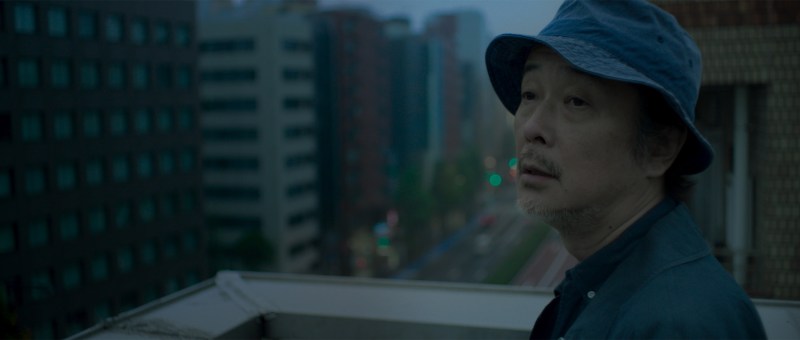
A recently bereaved widower travelling to Lake Windermere to scatter his wife’s ashes begins to reclaim an image of family in Patrick Dickinson’s melancholy character study, Cottontail (コットンテール). Having travelled to the Lake District in her childhood to visit her father who was working in the UK at the time, Akiko (Tae Kimura) recalled fondly a sense of familial connection symbolised by a photo she believes to have been taken on the lake’s shores and continued to wear a Peter Rabbit necklace right to her dying day.

In a poignant note to her husband Kenzaburo Lily Franky) written before her dementia worsened and left with a Buddhist priest until the time of her death, Akiko expresses regret that they were never able to go there again as a family while she was alive but would like him to scatter her ashes on Lake Windermere in the company of their Son, Toshi (Ryo Nishikido), who now has a wife and daughter of his own.

As we can see from the opening scenes, Kenzaburo is a man living at odds with the world around him. Emotionally distant, he finds it difficult to relate to his son and often quite literally shuts him out leaving Toshi hurt and resentful. To begin with, Kenzaburo insists he will go to Lake Windermere on his own and only later agrees to allow Toshi and his family to accompany him, making all the travel arrangements. Once there, however, he becomes impatient and after a minor argument over the itinerary takes off alone only to get on the wrong train and end up on the opposite side of the country as he’s kindly informed by a raucous hen party on their way to York. Forced to rely on the kindness of strangers, he’s taken in by a farmer (Ciarán Hinds) and his daughter (Aoife Hinds) who have suffered a bereavement themselves and attempt to help him process his loss while encouraging him to reconcile with his son. Presenting a kind of mirror he may bounce off while mediating these complex emotions in a second language allows Kenzaburo the opportunity to confront himself and his grief along with his feelings of inadequacy as a husband and father.

We can sense his own regret in a flashback to a meeting in a cafe shortly after Akiko was diagnosed with dementia in which she looks to Kenzaburo for reassurance but he remains in denial. She tells him that she’s afraid and can’t bear the idea of losing her family or becoming a burden to them but he simply tells her that it won’t come to that as if he were closing himself off to the reality but also from her in leaving Akiko alone to deal with her fear and loneliness in refusal to confront anything that is emotionally difficult or unpleasant. Yet Kenzaburo refuses to relinquish her memory, stubbornly carrying her ashes in a tea tin and at times holding it up as if he were showing her around and attempting to share this trip with her in a more literal way.

What threatens to devolve into a more conventional road trip drama in which Kenzaburo is helped on his way by a series of improbably kind and sagacious strangers develops into something deeper as he trudges his way through the English countryside which as it turns out is not all that aesthetically different from that of Japan and largely free of the often claustrophobic hedgerows that literally separate us from the surrounding scenery. The landscape further recalls scenes from Kenzaburo’s life as he begins to reflect on his time with Akiko and confront the reality of her loss along with his new life without her.

In effect, he’s journeying towards a recreation of Akiko’s photograph and its capture of a brief moment of familial unity in a gradual process of reconciling with Toshi and his own position as a father. Quiet and unassuming, Dickinson’s film is less a slow voyage through grief and learning to let go as it is one of gaining courage to open a door that had long been closed, Kenzaburo no longer the melancholy octopus hiding deep in the ocean but a bobbing rabbit eager to experience more of the world around him before it’s too late.


Cottontail opens in UK cinemas 14th February courtesy of Day for Night.

UK trailer (English subtitles)

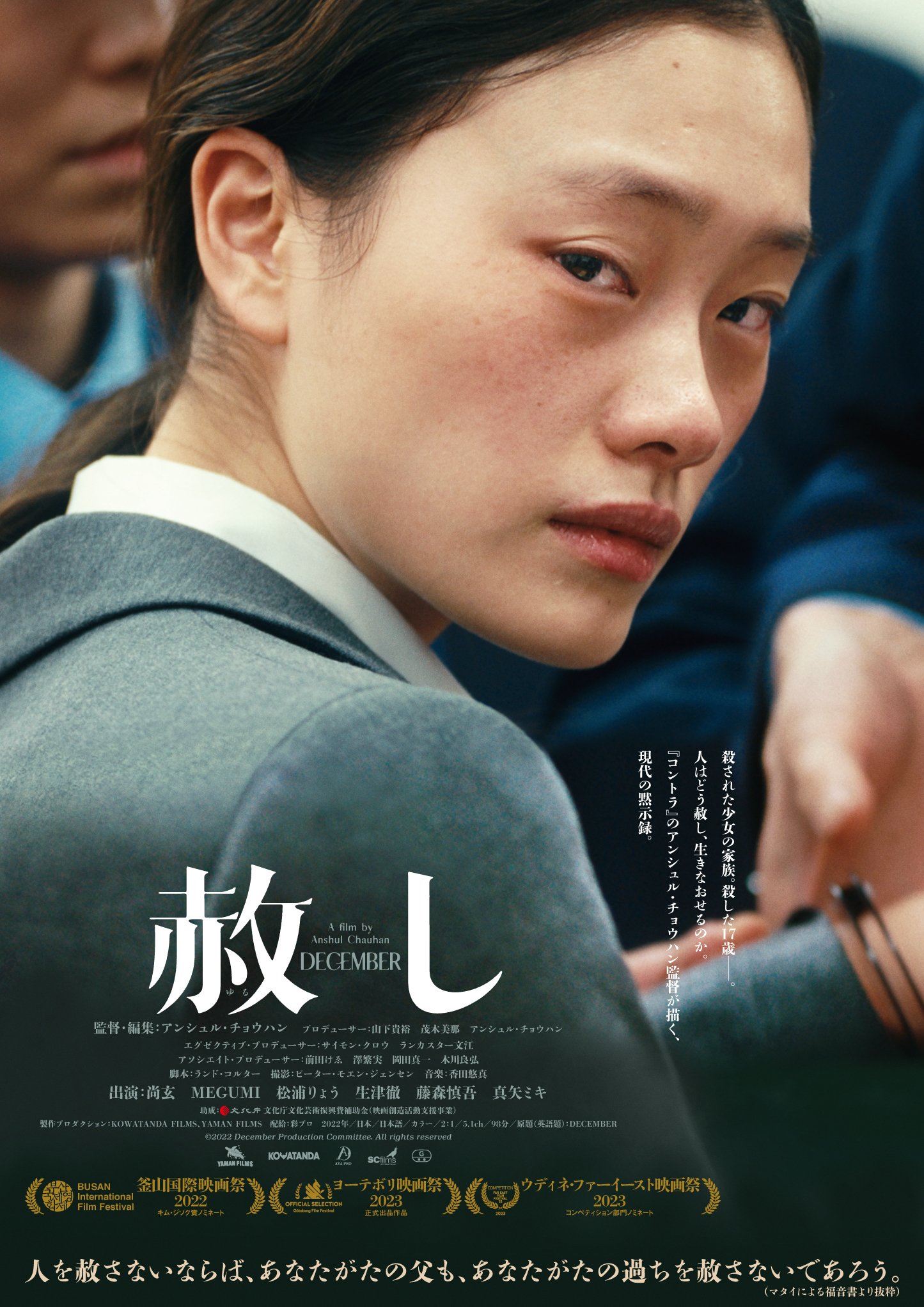
December (赦し, Anshul Chauhan, 2022)

Where is the line between justice and vengeance? The grieving father at the centre of Anshul Chauhan’s December (赦し, Yurushi) is determined that the teenage girl who stabbed his daughter to death should never leave prison, but what he wants is a kind of equivalent exchange in that the person who stole his future along with his child’s should have no right to one herself. A more mainstream effort than either of his previous films Bad Poetry Tokyo and Kontora each of which dealt with similarly thorny themes, Chauhan’s unusually tense courtroom drama is the latest to put the legal system on trial while asking difficult questions about grief, guilt, and what exactly it is we mean when we talk about “justice”.

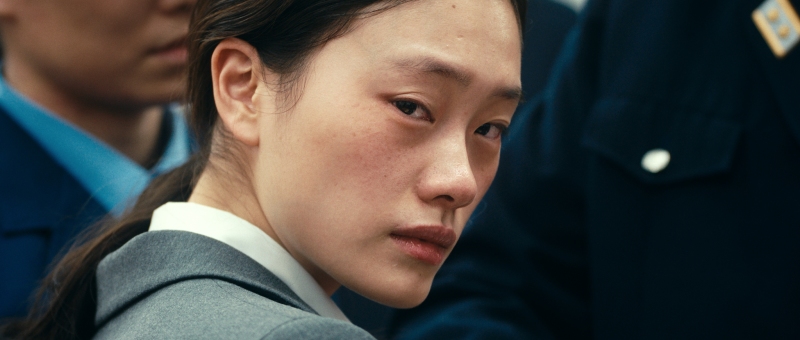
Seven years previously, 17-year-old Kana (Ryo Matsuura) stabbed her classmate Emi (Kanon Narumi) multiple times in a frenzied attack that resulted in her death. She was sentenced to 20 years in prison and has never attempted to deny her crime. It isn’t she who has asked for her sentence to be reviewed but an independent lawyer, Sato (Toru Kizu), who claims he’s doing it for “justice” though as Kana points out might have half an eye on compensation money she’d be able to claim for wrongful imprisonment if the case were successful. Sato seems to think it will be on the grounds that Kana was unfairly tried as an adult, mitigating circumstances were never brought to the defence’s attention, and the judge’s sentencing was swayed by personal feeling placing it outside of conventional guidelines that should be applied in cases like these.

For Emi’s parents, Katsu (Shogen) and Sumiko (Megumi), the appeal is a slap in the face. The couple have separated and while Sumiko has attempted to move on with her life, marrying a man she met in a support group for bereaved parents, Katsu has become a bitter alcoholic living a purgatorial existence of almost total inertia. Outraged, he is determined to make sure that Kana never leaves prison and is only sorry that she could not receive the death sentence because of her age, while Sumiko would rather not be involved at all, uncertain that she would be able to endure the emotionally draining process of another court case. They settle on presenting a united front, but discover that to do so is also to put themselves on trial while being confronted by a past neither has ever really faced.

The strain on Sumiko is evident as she walks along along a bridge at night and peers over the edge as if about to jump. She later learns that Kana had a mother too who did in fact take her own life after selling everything she owned to pay the compensation money that is used against them in court to imply that they’ve already been served “justice” in the form of monetary recompense from the defendant’s family which ought to declare the matter closed. Unlike Katsu, Sumiko had said her goal wasn’t vengeance but only to make sure that no other mother suffers as she has done, yet another mother already has for she lost a daughter too. Kana meanwhile has no one left to turn to even if she were released, she will have to make a new life for herself alone. Kana is herself victimised by an unforgiving society, the subtext suggesting that she was bullied for being the daughter of a single mother who was unable to fully care for her or provide the kind of material comfort children like Emi receive. The “happy family home” Katsu accuses her of destroying is also a symbol of everything Kana was denied but she did not kill out of jealousy or resentment only, ironically, to escape a kind of imprisonment and free herself of an oppressive bully.

Katsu says he’d kill her himself if he had the chance, but as Sumiko points out then he’d just end up in prison for the rest of his life with only his “righteousness” to comfort him. How could he claim to be any better? As Sato says, emotion has no place in a court of law. That’s why the law the exists and we mediate “justice” through a dispassionate third party to ensure the sentence is fair and not merely “vengeance”. Katsu certainly sees himself as a righteous man. In a repeated motif, Chauhan shows him taking the long way round by walking on the pathways of the grid-like forecourt leading to the courthouse while others hurriedly take the direct route crossing the squares at a diagonal angle. For him the answer is only ever black and white and he is very certain of his truths, but also blinded by his pain and unable to see that his desire for vengeance is more for himself than it is for Emi.

Only by accepting a painful truth can he begin to move past his grief, despite himself moved by Kana’s quiet dignity in which she admits her responsibility and suggests that she will never really be “free” even if she is released. What she offers, in her way, is peace allowing the bereaved parents to bring an end to their ordeal or least enter a new phase in their grief which allows them to move forward in memory rather than remaining trapped within the unresolved past. Perhaps in the end that’s what we mean by “justice”, a just peace with no more recrimination only sorrow and regret with renewed possibility for the future.


December screened as part of this year’s Osaka Asian Film Festival.

Original trailer (no subtitles)