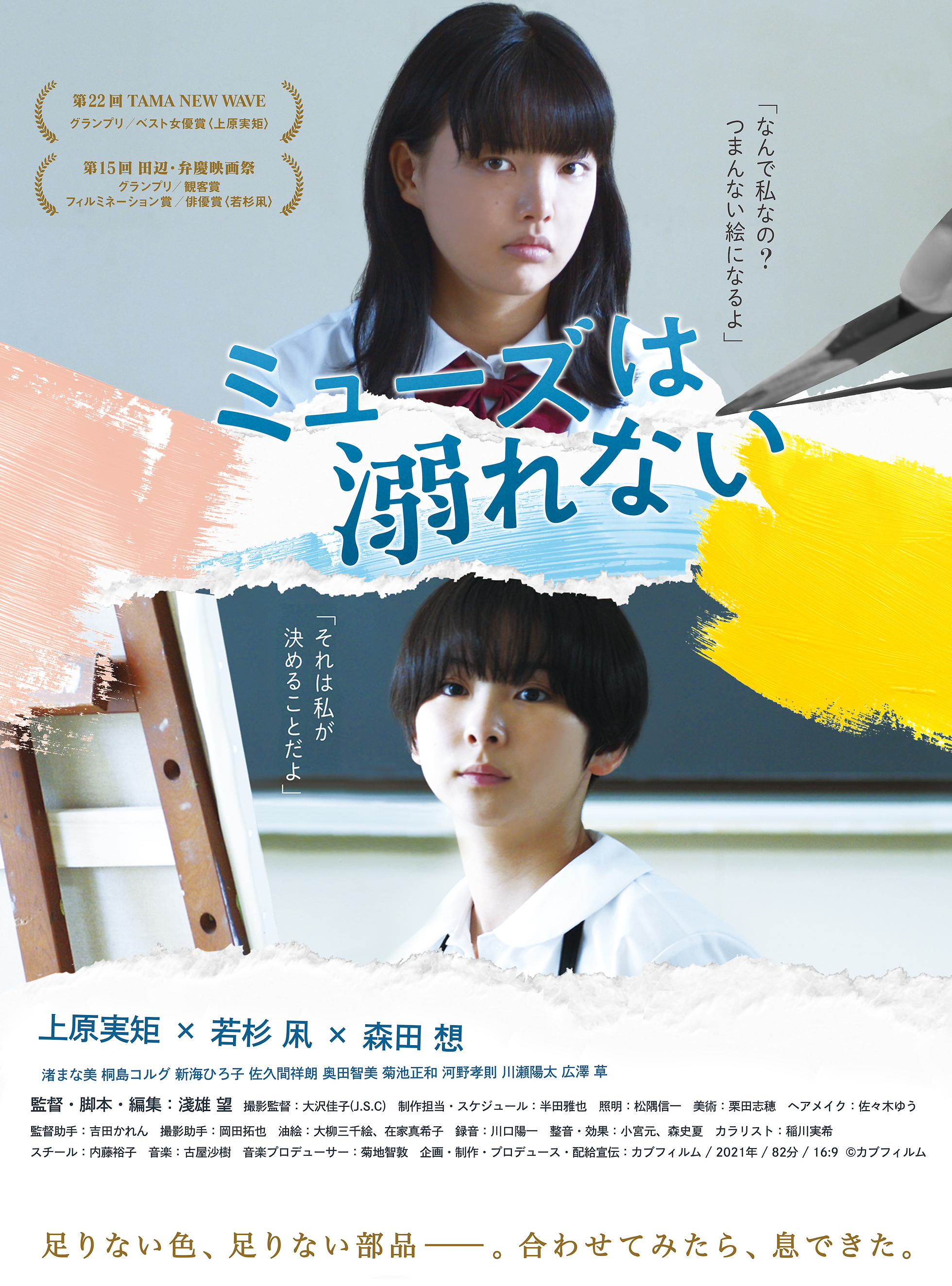
A Muse Never Drowns (ミューズは溺れない, Nozomi Asao, 2022)

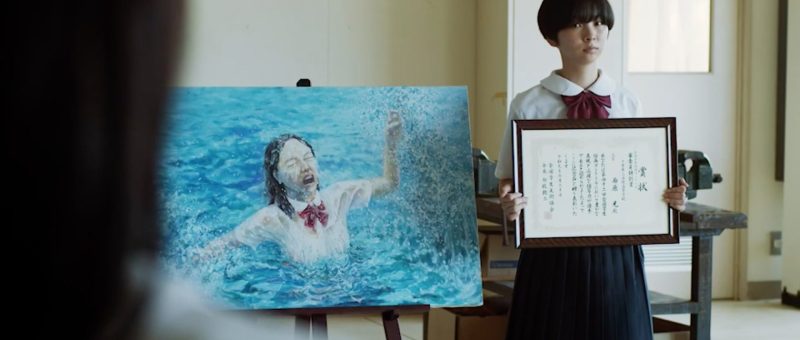
A teenage girl flounders amid a series of changes in her life while questioning her future and identity in Nozomi Asao’s empathetic coming-of-age film, A Muse Never Drowns (ミューズは溺れない, Muse wa Oborenai). Saku (Miku Uehara) is however drowning, a fact brought home to her by the relentlessly aloof Saibara (Mimori Wakasugi) who captures a sense of her panic and despair in a painting of her falling into the local harbour. Yet through their rather tumultuous friendship the pair eventually discover that they aren’t so different after all.

Saibara’s perfectly executed painting destabilises Saku on more than only level, firstly in her discomfort in having been seen and secondly in the insecurity it causes her in her own talent as an artist. Saku had wanted to go to art college, but a teacher harshly corrects her drawing style as if trying to push her towards a more authentic form of expression that’s less worried about getting it right than capturing a sense of what she sees and feels. Lacking confidence that she’ll get in, Saku is thinking about quitting the club in embarrassment but is persuaded to try making something else for the cultural festival while simultaneously receiving an unexpected entreaty from Saibara who wants her to pose for her next painting.

Most of the other students seem to resent Saibara for what they see as her superiority complex, believing she is aloof because she thinks she’s better than them. Because of her blunt manner, Saku too had thought her to be ultra confident and is surprised to realise that Saibara too is filled with doubts and anxieties even if she makes a point of pushing through them. Echoing her teacher’s words, Saibara admits that the lines don’t always come out the way she wants them either but all she can do is try to connect the dots. The reason for her aloofness is a vicious circle of deep-seated loneliness that convinces her she will ultimately be rejected, mirroring Saku’s conviction that she is a “boring” person, and therefore it is easier to remain alone from the start. 

Part of Saibara’s self-rejection is borne of internalised homophobia uncertain if others will accept her sexuality while harbouring a crush on Saku she doesn’t know how to articulate other than through her art while Saku too struggles with her feelings and is confused by the attention she receives from Saibara. Saku’s feelings of insecurity are informed by a sense of embarrassment that she has never experienced a romantic crush like her friend Emi (Kokoro Morita) who likes baseball player Endo despite knowing that likes he Saku, though Emi has also picked up on the way she looks at Saibara and is drawing conclusions about her lack interest in boys. Emi tells her that she accepts her whatever her sexuality is, but is hurt and confused when Saku remains silent and declines the opportunity to open up to her though perhaps partly because she does not really know the answer herself. 

Other than Saibara, Saku is the only one who hasn’t yet returned her careers survey still uncertain of the future direction of her life. Her father has recently remarried and he and her step mother Satomi (So Hirosawa) are expecting a baby all of which has Saku feeling somewhat adrift, displaced within her family and soon to lose her home which has been bought out for a new development project meaning they’ll soon be moving to a new house shorn of the memories of her birth mother and primed for her father’s new start. 

Yet through all her experiences, slowly bonding with Saibara and repairing her friendship with Emi, Saku begins to discover a path towards a more authentic art born of the desire to take things apart and put them back together again while quite literally feeling her way forward with her hands. Coming to terms with her new family circumstances, she builds herself a boat and is no longer drowning but drawing strength from her new found friendships with a renowned sense of possibility for the future while her friends do much the same in the knowledge that they are all scared and uncertain but doing their best to join the dots towards a happier future. 


Trailer (English subtitles)
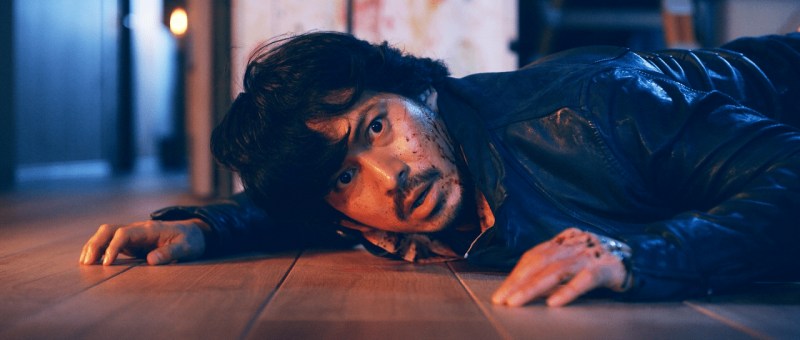
It Comes (来る, Tetsuya Nakashima, 2018)

According to a duplicitous folklorist in Tetsuya Nakashima’s anarchic horror film It Comes (来る, Kuru), monsters aren’t real. People made them up so they wouldn’t have to face an unpleasant reality. Farmers who had more children than they could feed invented a monster who came to claim their infants rather than have to live with the reality that they left them in the in the forest to die. As it turns out this monster may actually be “real”, but undoubtedly fuelled by the loneliness of a neglected child whose parents are burdened by their own particular legacy of parental toxicity. 

The mother of soon-to-be-married Hideki (Satoshi Tsumabuki) more or less says as much when he brings his fiancée to meet the family at a memorial service for his late grandfather. “Maybe it’s her upbringing” she snidely suggests, remarking that Kana (Haru Kuroki) is “a little gloomy” (which seems like an odd criticism to make of a guest at what is effectively a reenactment of a funeral). A strangely beaming Hideki keeps reassuring his fiancée that she’s “perfect” while she continues to worry about whether she’s a good fit seeing as she never knew a “real” family having been raised by a mother she regards as neglectful. But even at the couple’s wedding it’s clear that Hideki mostly ignores her, so obsessed is he with being the centre of attention. “Is it ever not about you?” one of the fed up guests eventually heckles, but it evidently never is. After setting up his “perfect” life in a “perfect” luxury flat and having a “perfect” baby, Hideki sets up a blog about being the perfect dad and barely helps with their small daughter Chisa driving Kana slowly out of her mind with his narcissistic self-obsession and thinly veiled emotional abuse. 

When the ghosts start coming, we might wonder if they reveal the truth or effect a distorted reality that leans in to otherwise unspoken dark thoughts, but Hideki really is as someone puts it all lies. When he’s persuaded to visit an “exorcist” she simply tells him to treat his wife and daughter properly to make the monster go away sending Hideki into a small moment of rage implying that he really does know what he is rather than having “forgotten” a cruel alter ego. In his charmed life, we might even wonder if he made some kind of deal with the devil which would explain his rather vacant smile though as it turns out it’s more like he’s cursed by a forgotten childhood encounter with an ancient forest spirit which hints at a deeper, older evil going all the way back to those farmers and the children they abandoned. 

Then again, it seems as if Hideki was rather spoiled as a child leaving him craving both attention and approval, while Kana is still struggling with resentment towards the mother she mainly had to parent herself and is afraid of becoming. Hideki snaps at her that she shouldn’t lose her temper with the baby because children remember, though as it turns out neither of them can really give their full attention to Chisa because of the realities of parenthood which among other things include constant anxiety and feelings of inadequacy. The parents are effectively haunted while cursed by their own toxic parental legacies that they will inevitably pass on to their daughter whether they mean to or not. 

It’s much the same for occult writer Nozaki (Junichi Okada) brought in to help solve the case with the help of his girlfriend, Makoto (Nana Komatsu), a bar hostess with psychic abilities. He once persuaded an old girlfriend to have an abortion because he was afraid of becoming attached to something he might eventually lose, and may be in a relationship with Makoto partly because she is unable to bear children for reasons connected to her frustrated love for her icy exorcist sister Kotoko (Takako Matsu) who like Nozaki wilfully distances herself from others to protect herself from the pain of loss. But as another shaman tells him, in a land of darkness where you no longer know right from wrong pain is the only truth. 

Nakashima shoots with a thinly veiled irony, vacillating between the ridiculousness of demonic spirits wreaking havoc in a well-appointed Tokyo apartment and the concession that there are indeed monsters in the world and as another infected suggests, they are we. Once again set at Christmas much like World of Kanako, Nakashima’s familial horror juxtaposes the season of goodwill with supernatural violence even as Kotoko marshals every power at her disposal from her roots in Okinawa shamanism to Buddhism and Christianity to hold back the latent evil born of a little girl’s loneliness. Meanwhile, he draws inspiration from classic J-horror and particularly the work of Nobuo Nakagawa in his green mists and swamp-based set piece in which Nozaki finds himself mired in a lake of life and death. Kotoko’s wounded eye and fear of mirrors hark back to Yotsuya Kaidan and the betrayed ghost of Oiwa, herself a victim of a man whose self-involved quest for approval cost her her life. At heart an interrogation of the parental bond the film eventually comes down on the side of family as Nozaki reclaims his frustrated paternity while a little girl dreams of nothing more sinister than a land of omurice. 


It Comes screened as part of this year’s Japan Foundation Touring Film Programme.

International Trailer (English subtitles)

The Hungry Lion (飢えたライオン, Takaomi Ogata, 2017)

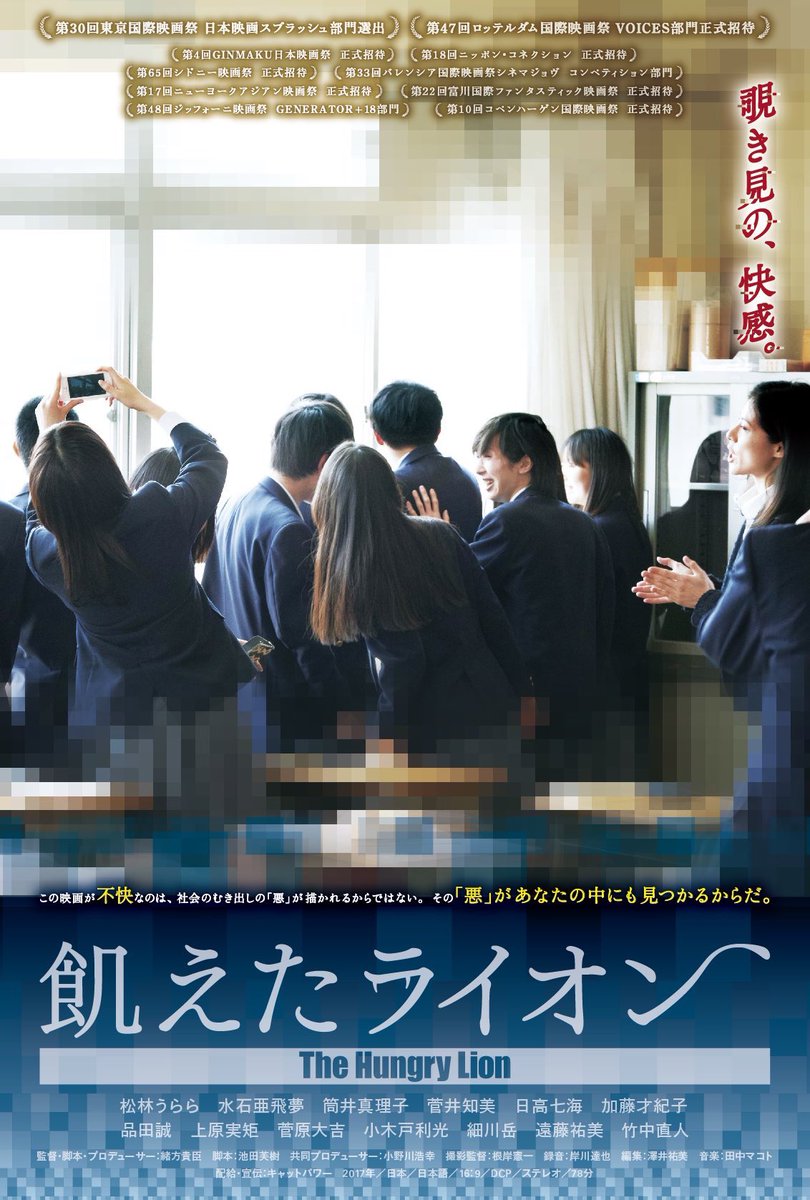
Hungry lion posterRumour has a strange power. A baseless lie, no matter how innocuous, can quickly derail a life but the power of lie with a tiny grain of, if not truth exactly but circumstantial evidence, can prove ruinous when there are vested interests at play which make belief an attractive prospect. The heroine of Takaomi Ogata’s The Hungry Lion (飢えたライオン, Ueta Lion) finds herself at the centre of such a storm through no fault of her own, becoming a victim not only of her country’s restrictive social codes, tendency towards victim blaming, and reluctance to deal openly with “unpleasant” topics, but also more directly of the latent jealousy lurking in her closest friends which finds a convenient home in someone else’s scandal. Nobody will come to her rescue, her “disgrace” has exiled her from the group and she finds herself abandoned as a lonely a sacrifice to the hungry lion that feeds on social shame.

High school teacher Mr. Hosono is not exactly popular with his students. He is strict with the boys but less so with the girls, as he proves greeting one tardy student who blames a train accident for his late arrival by berating him about his regulation busting necklace while allowing a female student, Hitomi (Urara Matsubayashi), who arrives a couple of minutes later to take her seat unharrassed. Midway through the register, Mr. Hosono is called away and eventually arrested in connection with the viral video all the kids were looking at before he arrived which appears to show him in a compromising position with a student. For one reason or another, a rumour spreads that Hitomi is the girl in the video. She isn’t, but few believe her strenuous denials and her life becomes one of constant strife not only because of the bullying itself, or the injustice of being falsely accused and then disbelieved by those closest to her, but by the way she is made to feel embarrassed and shamed for causing trouble to others even though she herself has done nothing wrong.

A “relationship” between a teacher and a student is never appropriate, and Mr. Hosono has at least been removed from his position at the school, but no one seems very interested in identifying the girl in the video in order to help her, only to spread ruin and rumour. Hitomi is not the girl in the video, but even if she had been there is no support on offer to her as a person who has been abused by someone in a position of power she should have been able to trust, nor are there any measures in place to ensure her academic life will not be unduly damaged by becoming involved in such a traumatic incident. Aware of the rumours, the school accepts Hitomi’s assertion that she is not the girl but still suspends her to avoid “awkwardness” and protect their own reputation. Likewise, her own mother and sister are far from supportive, berating her for bringing shame on the family and creating problems for them in making the family a target rather than standing by her in her ordeal whether she had been the girl or not.

The rumour itself seems to spring from persistent shaming and stigmatisation of atypical families. Hitomi is 18 and she has a boyfriend who is a little older. He has some shady friends and likes to push buttons as he does by causing mild embarrassment to Hitomi by taking her into the curtained off “adult” section of the local video store in an attempt to shock her. Nevertheless the pair eventually make their way to a love hotel (where they are not age checked) and he films her in a compromising position. Girls talk and Hitomi’s friends all know about her relationship which is also plastered all over her social media on which she is something of a star. Some of her friends are jealous but also harbour a degree of disapproval and the mere fact that she is already sexually active ties her to the girl in the video and casts her in an “impure” light in the cute and innocent world of high school girls. Similarly, her boyfriend’s estimation of her drops after she consents to sleep with him while his leering friends make lewd comments and regard her as an “easy” girl who has lost the right to refuse their advances.

Ostracised for essentially becoming a “fallen woman”, Hitomi is left entirely alone with no one to turn to for support. Later, authorities are keen to stress that it’s important to speak out if you’re suffering because adults will always help children but like everything else they are just empty words. The school give out a pamphlet on the importance of prudence when using social media, but refuse to accept their responsibility in failing to protect their students. The news meanwhile becomes obsessed with tearing apart Hitomi’s family, laying the blame at their feet, insisting that Hitomi’s downfall is in someway a result of her parents’ divorce even blaming her mother for having the audacity to find a “boyfriend” before her children were fully grown. The image we had of Hitomi is suddenly reversed. No longer is she a “slutty schoolgirl” involved in an illicit relationship with her teacher, but a neglected child damaged beyond repair by “liberal modern society”.

Reputation is what matters, but reputation is easily manipulated and rewritten, muddy even when objective truth is revealed. Ogata shoots in brief vignettes, each severed from the next by a stark black screen which forces us to examine the objectivity of each scene as distinct from the others, assembling our own versions of “objective” truth which are in fact guided by Ogata’s carefully crafted editing. Fake news has an agenda, truth does not, but it’s often much easier to believe the lie especially if the lie benefits us much more than the truth or enables us to feel superior to someone we secretly think needs taking down a peg or two. Society is a hungry lion which feeds on shame, externalised and internalised, as those who find themselves on the wrong sides of a series of social taboos become unwilling sacrifices to its unkind, unforgiving, and unrelenting hunger for suffering.


Screening at New York Asian Film Festival 2018 on 30th June, 2.45pm.

Original trailer (English subtitles)

Assassination Classroom (映画 暗殺教室, Eiichiro Hasumi, 2015)

photo_4First Published on UK Anime Network in November 2015.


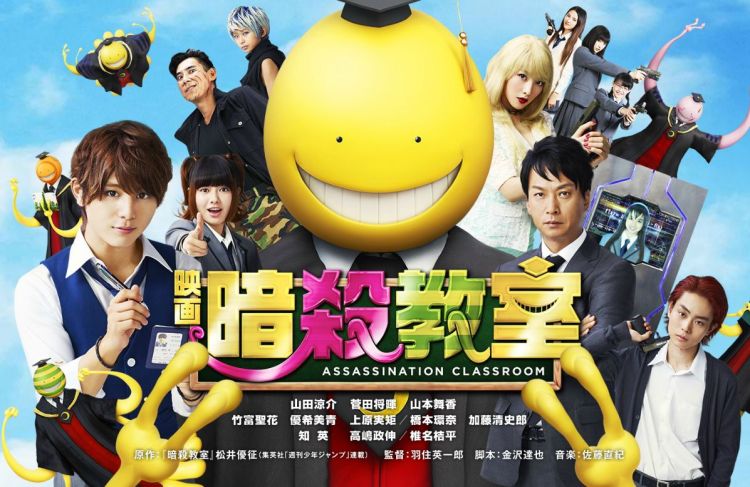
You might make the mistake of thinking that the E in class 3E just means it’s the 5th 3rd year class, or that it stands for “elite” and contains some of the top students in the school. You’d be wrong, “E” stands for “end” because these are the no hoper kids that everyone’s already written off as having no future. However, it’s precisely these kids that a mysterious extraterrestrial being insists on becoming the teacher of in return for not destroying the Earth (just yet). Nicknamed UT (unkillable teacher), the giant yellow octopus-like creature has already destroyed 30% of the moon just for kicks and has now set the challenge that if the boys and girls of class 3E fail to assassinate him before graduation he’ll destroy the Earth too.

The ironic thing is, UT is the best teacher they’ve ever had, but to pass the course (and save the world) they have to kill him. The high schoolers are also under the tutelage of a self defence forces officer for their military training and a sexy assassin who randomly ends up becoming their English teacher (and giving them one of the least appropriate English lessons ever recorded on film). Every morning they bow and then pull out their various kinds of firearms as UT takes the register whilst flitting about dodging bullets. Despite wanting to destroy the Earth, UT is 100% committed to training his students both in the arts of assassination and in the more regular subjects. Because of his super speed and ability to be in several places at once he has time for everybody and is quick to work out each of his charge’s specific weaknesses and help them work on those to become better people as well as ace students.

Still, the students are supposed to kill their teacher and there’s a little bit of sadness creeping in as they inevitably grow closer to UT and his quirky antics. Up ’til now everyone has given up on them and now they’re supposed to kill the one person who’s actually trying to help. Of course, even while this surreal situation is going on these are just regular high school kids undergoing regular high school stuff like wanting to sneak into the girls’ changing rooms or having a crush on someone who hasn’t even noticed you. Despite the impending end of the world, the kids of Class 3E are just enjoying their time trying to work out ever more complex ways of trying assassinate their seemingly invincible teacher.

UT himself is strangely adorable with his giant yellow smiley face style head and bizarre little laugh. He also changes color according to his mood and has a tendency to go off on tangents with one notable example which turns into a long form ‘80s style melodrama about abandoned single mothers before being politely shut down by the bored students. Assassination Classroom is undoubtedly bizarre, surreal and full of absurd humour but all the better for it. It’s just very silly but has an undeniably clever and very witty script that proves near impossible to resist.

To put it mildly, Assassination Classroom is just heaps of zany, crazy fun. It also manages to be genuinely heartfelt as we come to care for this rag-tag bunch of no hopers but also for UT himself as we start to hope the kids will somehow fail and succeed at the same time so we can save both the world and UT. The film drops us a few hints about UT’s backstory but stops short of offering a full explanation for the crazy goings on. Thankfully a sequel, Assassination Classroom: Graduation Day is already in production and even if it doesn’t offer any answers, Assassination Classroom is already one of the most enjoyably absurd offerings to come out of Japan this year.


Assassination Classroom receives its UK premiere at the Leeds International Film Festival on 15th November 2015.

Look out for a review of Tag which is also playing at the festival as it Happy Hour, and Our Little Sister.