
DitO (Takashi Yuki, 2024)

A defeated boxer and absent father rediscovers the will to fight after an unexpected reunion with the daughter he abandoned to chase his dreams in Takashi Yuki’s Philippines-set sporting drama DitO. The title translates simply as “here” which is what Eiji (Takashi Yuki) and those around him eventually accept themselves as being, striving to create a place for themselves to belong rather than fruitlessly searching for one and finding themselves denied.

A contrast is eventually drawn between Eiji, an ageing boxer who remained in the Philippines when his wife (Machiko Ono) and child returned to Japan, and Joshua, a 17-year-old aspiring boxer and surrogate son figure whose boxing dreams are suddenly dashed by unexpected defeat and the death of his father from a long illness. Faced with these two blows, Joshua declares that he’s going to choose his family in giving up boxing to look after his younger siblings in direct contrast to the choice Eiji made to let his family leave him so that he could continue chasing a boxing glory he never achieved. 

When his now 17-year-old daughter Momoko (Momoko Tanabe) shows up out of the blue and tells him her mother has passed away, he’s a defeated figure still nagging his kindly boss Tamagon to set him up with a fight though having apparently fallen out with his coach some years previously. Her father’s living conditions evidently come as a shock to Momoko as she winds her way through the narrow alleyways of a local slum towards a small courtyard where Eiji lives in a home stewn with cardboard boxes that has no functional gas supply or other cooking facilities. In her youth, she’d seen him as a hero who keeps fighting no matter what, but here he’s clearly given up and is far from the saviour she hoped he’d be after travelling all the way from Japan where she believes she has nothing and no one to go back to. 

Meanwhile, as he reminds her the Philippines is not Japan and she finds it difficult to adjust to an environment that much less safe at least for women as her father cautions her not to go walking around alone and especially at night. Tamagon and coach Sese also paradoxically remind them that they shouldn’t trust Japanese people after the pair are scammed by an offer of an apartment which in truth seemed far too good to be true by a pair of Japanese expats apparently expressly targeting their fellow countrymen. Yet as she said, everything she has left in the world is “here” and so Momoko too decides to forge her own future in the Philippines rather than go looking for one if while also recapturing the past of her happy childhood memories from when they all lived together as a family. 

As Sese says, Eiji’s internal battle has narrowed his vision of the world and cost him the will to fight must as Joshua says that in understanding his fear he has lost the desire to fight it in the anxiety that he may lose. What they learn is that they must stand and fight for what they want, never giving in win or lose, though they will always have the familial solidarity of the boxing gym whatever else may happen to them. Essentially a family drama, the film is in part a tale of father and daughter learning to reconnect but also of the importance of making an active choice to “here” rather than passively existing in a place not of your own choosing. 

Momoko’s decision to clean her father’s long neglected house is not only a symbol of her desire to lighten his life and jolt him out of his inertia, but of a determination to make a home for herself and maybe even get the gas turned back on so she can use the kitchen. Nevertheless, it’s also clear that “here” is wherever you are and the thing is to embrace the now or change it and fight for your place to belong rather than let it beat the spirit out of you. In the end being a hero really just means staying in the fight with no fear of losing because you know you won’t stop fighting.
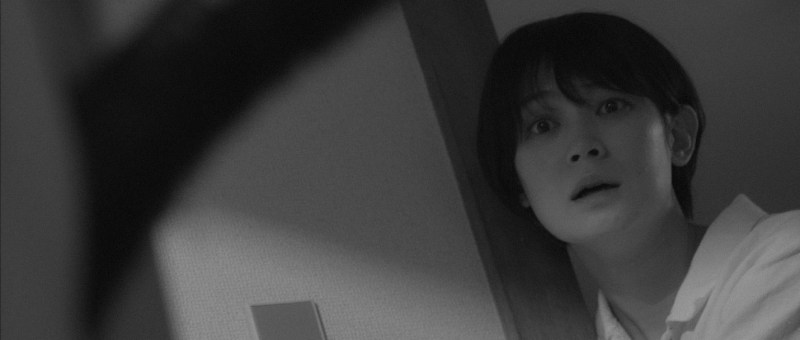

Extraneous Matter – Complete Edition (異物-完全版-, Kenichi Ugana, 2021)

If you suddenly encountered a weird, decidedly alien, octopus-like creature living in your wardrobe what would you do? Would it frighten or intrigue you, would you want to get rid of it as quickly as possible or look after it for the rest of your life? The presence of these strange creatures provokes different responses from each of the heroes of Kenichi Ugana’s Extraneous Matter – Complete Edition (異物-完全版-, Ibutsu – Kanzenban-), an expansion of his earlier short of the same title. Drawing inspiration from the early work of Shinya Tsukamoto, Ugana’s crisp, academy ratio black and white photography makes use of an ironic score mimicking classic Hollywood melodrama lending a mythic quality to this lowkey tale of alien sex fiend invasion and human loneliness. 

For Kaoru (Kaoru Koide), heroine of the first segment, the creature seems to signify her sexual frustration and sense of existential inertia. For her, every day is the same. She wakes up alone, makes herself a cup of coffee and eats a pastry in front of the television which always seems to be carrying news of a celebrity sex scandal, and then starts work with her friends (for some reason working at her apartment) who gossip about their various sugar daddies. Her boyfriend (Shunsuke Tanaka) apparently lives with her, but immediately disappears right after dinner and actively avoids intimacy. Were it not for later events, we might wonder if the creature is somehow a transformation of the boyfriend, Kaoru herself unsure whether it was a dream, first violated but then apparently satisfied by the alien tentacles which later begin satisfying all of her friends. 

If the “extraneous matter” of Kaoru’s life was indeed her unfulfilled desire and internalised shame, then for the barmaid (Momoka Ishida) of the second sequence it’s perhaps a lack of excitement while for the young man (Kaito Yoshimura) who brings a creature zipped into a holdall to a pub to meet his ex-girlfriend (Makoto Tanaka) it’s more a desire for familial intimacy or a sense of commitment that may previously have frightened him. He appears to want to get back together with the young woman, apologising for his past behaviour while explaining that he found the creature in his wardrobe scary to begin with but later became fond of it and is convinced he could raise it with her help, ordering a parfait to feed it because he’s discovered it has a sweet tooth and particularly likes strawberries. He swats the errant tentacles away as if shushing a naughty baby as the woman too begins to coo over it, shovelling cream from the parfait into its mouth with a spoon. 

But then, the extraneous matter of the lives of others can also present a challenge to the social order. Some wish to eliminate the alien threat, a young man working at a factory (Shuto Miyazak) charged with disposing of alien bodies eventually conflicted on discovering one alive sure that he can hear the creature begging him for help. Together with a like-minded colleague (Duncan) he determines to save it and help it return to its people, culminating in an unexpected ET moment which perhaps realigns the “alien” threat with a social other as the two compassionate employees evade the authorities to get the creature to safety despite having been betrayed by their female colleague (Mizuki Takanashi). 

So, what is the “extraneous matter” of our lives, a kind of loneliness, a sense of “alienation”, or of emptiness in an “absurd” world of infinite mundanity? Perhaps all of the above, Kaoru returning to her lonely life apparently missing the strange and unidentified creature only to re-encounter it in an unexpected place and discover it has not forgotten her. Gently ironic, Ugana’s sci-fi-inflected aesthetic begins with grim body horror before progressing into something warmer, for good or ill becoming fond of its alien invaders as compassionate humans refuse to reject them embracing in a sense these “extraneous” sides of themselves they may have previously found disturbing in search of more fulfilling lives. Elegantly composed in its classic academy ratio frame with its ironic bonsai pillow shots and continuing sense of unease, Extraneous Matter nevertheless ends on a note of hope rather than threat even as the invaders apparently lurk among us but bringing with them comfort even in the reflection of our unmet desires. 


Extraneous Matter – Complete Edition streamed as part of this year’s Nippon Connection.

Original trailer (English subtitles)