Tsugaru Lacquer Girl (バカ塗りの娘, Keiko Tsuruoka, 2023)

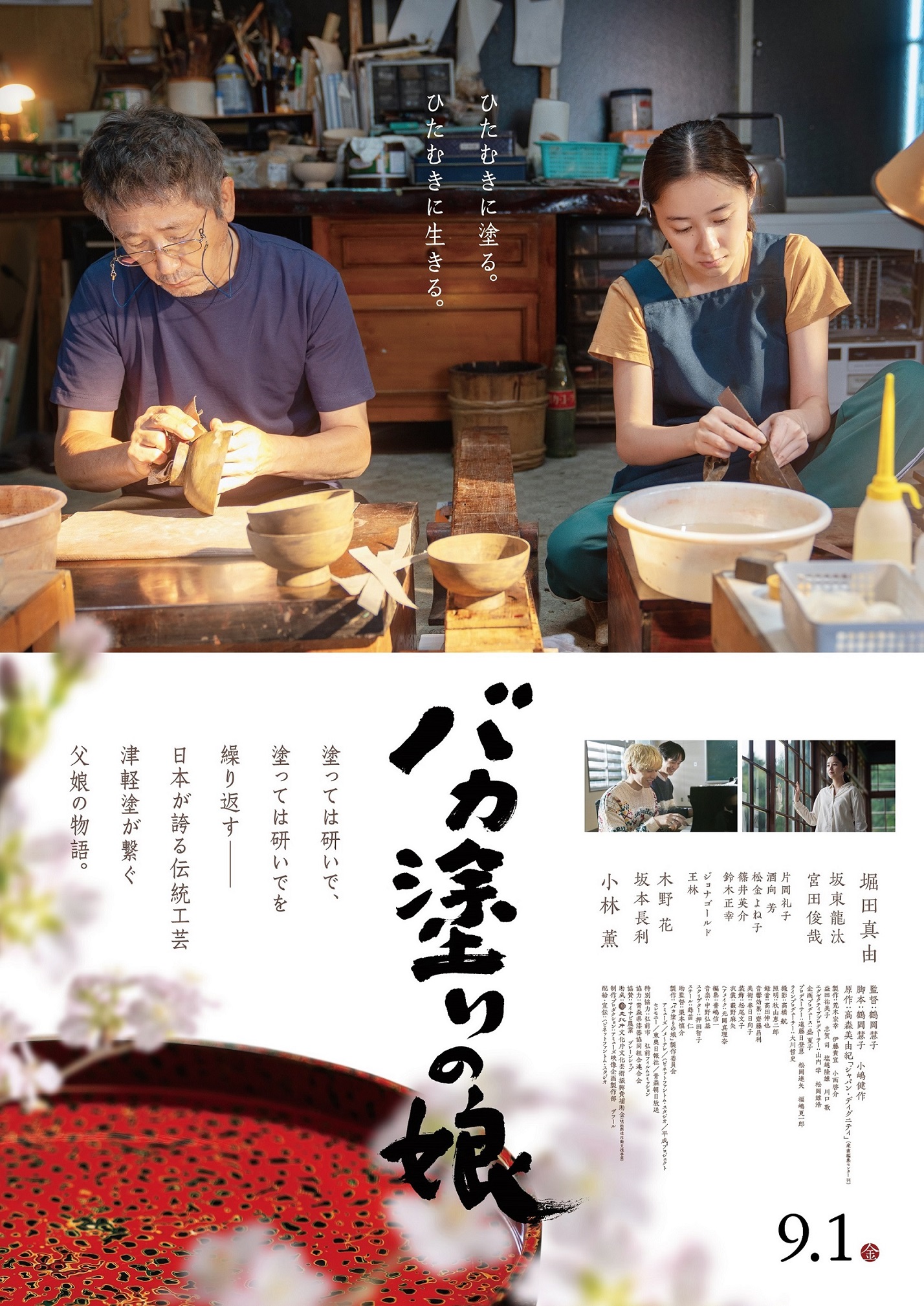
Which traditions should we keep and which should we lose? A young woman finds herself frustrated by outdated gender norms in her desire to take over the family lacquerware business in Keiko Tsuruoka’s gentle rural drama, Tsugaru Lacquer Girl (バカ塗りの娘, Bakanuri no Musume). While her family, save older brother Yu (Ryota Bando) who has already rejected lacquerware, do nothing but run her down and claim she’ll never be a success at anything all she wants to do is devote her life to a traditional craft her father no longer believes has any kind of future. 

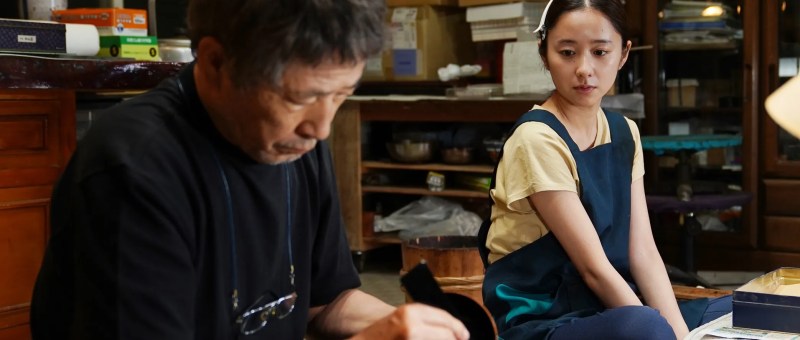
Even so, Seishiro (Kaoru Kobayashi) is dead set on Yu taking over the business to the point that they have become semi-estranged. He calls Miyako (Mayu Hotta) “clumsy” and complains that she has no aptitude for anything unlike Yu who was always good at anything he tried. Miyako too later suggests that she was her brother’s opposite, while he was cheerful and outgoing she is shy and melancholy but then perhaps it’s hard to be cheerful when everyone’s always telling you you’re useless and doing everything wrong. In an interesting parallel, Yu is also trapped by outdated social codes in that he is gay and he and his partner have decided to move to London where they can legally get married and live their life out and proud in a way they feel they cannot do in contemporary Japan. 

Lacking other direction in her life, Miyako has been working a part-time job in a local supermarket which she hates while her father occasionally allows her to help him finish big orders though it’s clear her salary is now their main source of financial support. A local inn keeper who is a good customer of theirs explains to some of his guests that craftsmen rarely construct large pieces such as tables because they are no longer cost effective while fewer young people are willing to take up apprenticeships leaving the traditional art in danger of dying out despite the frequent remarks that everything tastes better out of a lacquerware bowl which is after all in the modern parlance “sustainable” in that it will last for many decades and can easily be repaired if damaged. 

Seishiro doesn’t seem to have a reason for rejecting the idea that Miyako might take over aside from basic sexism in preferring to hand the business over to his first born son. It might be tempting to think that he dissuades her because he thinks there isn’t a future in lacquerware, but if that were the case he could simply retire. Her mother (Reiko Kataoka), who left the family some years ago in part it seems because of her own animosity towards lacquerware and its lack of financial promise, seems to feel much the same comparing Miyako to a more successful cousin who has kids and a high powered job at an international trading firm, telling her that she should be settling down and getting married suggesting that she is simply incapable of becoming a successful lacquerware artist and should at best keep it as a hobby. 

Her mother had also shut down her desire to learn piano as a child by telling her there was no point because she’d never be good at it. Miyako’s decision to prove herself by re-laquering an abandoned piano in her disused school is then an act of rebellion against both parents showing them what she can and will achieve along with the direction she has chosen for her life. Not everyone respects it even if her father begins to come around but really it doesn’t matter because the decision is hers alone whatever anyone else might have said. Far from being insular, the embrace of traditional culture gives Miyako new opportunities and allows her to grow in confidence until she’s finally ready to set off along her own path. Even so, it seems there are some traditions she thinks it would be better to lose, such as her father’s sexism and the homophobia that has forced her brother to emigrate in order to live a happy life just as he is. They call it “fools lacquer” because no one but a fool would go to all this trouble to make a bowl but in many ways that’s the point. Miyako pours all of herself in to the lacquer, piling layer on layer dotted by handfuls of thrown rice that give it its pattern much as she herself is slowly tempered by the world around her.


Tsugaru Lacquer Girl screened as part of this year’s Camera Japan.

Original trailer (English subtitles)
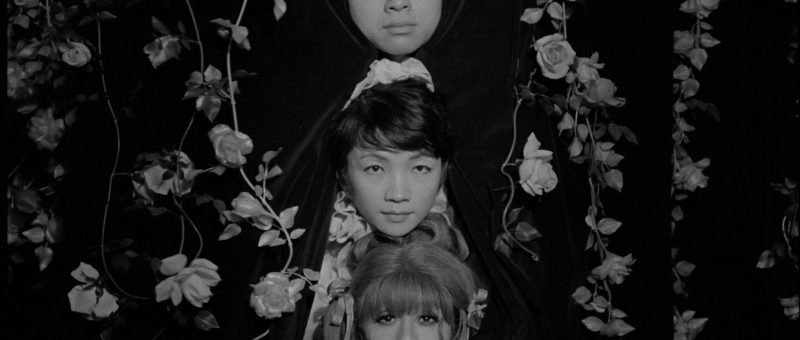
Funeral Parade of Roses (薔薇の葬列, Toshio Matsumoto, 1969)

“The spirit of an individual reaches its absolute through infinite negation” according to the title card which concludes Toshio Matsumoto’s anarchic voyage through the counter culture underworld of late ‘60s Tokyo, Funeral Parade of Roses (薔薇の葬列, Bara no Soretsu). Repurposing Oedipus Rex as mediated through Pasolini as an exploration of the crushing impossibility of true authenticity, Funeral Parade of Roses is also an atypical portrait of a city in transition. Like many a post-war melodrama, it’s a story of Tokyo bar hostesses only we find ourselves not in the comparatively upscale Ginza where unlucky women dream of escape into more conventional lives, but the grungier Shinjuku in which those who have no desire to attain conventionality, of that kind at least, have found a kind of freedom to become their truer selves. 

Our hero, Eddie (Peter), is something of an ephebe pursuing his destiny as a “gay boy” (cross-dressing bar hostess) at bar Genet where he has entered a relationship with the much older proprietor, Gonda (Yoshio Tsuchiya), who is growing tired of his current lover, Leda (Osamu Ogasawara), the bar’s mama-san. At the risk of mixing our metaphors, or at least allegories, in Greek mythology Leda was the mother of Helen of Troy, raped by Zeus in the guise of a swan. In any case, the primary crisis is one familiar from any other bar girl drama where Leda might be the melancholy heroine, facing the tragedy of her fading youth and an increasingly uncertain future. We see Eddie leave an apartment arm in arm with Gonda, a hearse passing ominously in front of them, while Leda looks on with scorn perching in front of a street corner convenience store to confirm that her suspicions are in fact correct. 

Leda is or will be the victim of Eddie’s quest for a place of his own, displaced within a world of displacement. She will eventually find her own kind of escape, dressed in a wedding dress and surrounded by white roses but drenched in romantic tragedy. Eddie meanwhile is plagued by visions of a traumatic past and a feeling of alienation. “I feel abandoned by life” he later complains to a counter culture friend, Guevara (Toyosaburo Uchiyama), who has adopted a strange fake beard in addition to his fake name. In the gallery in which Eddie meets him, a record is playing to remind us that we are each wearing a mask and that perhaps our mask may fit us so comfortably that we have forgotten the shape of our own face. We can never be sure if we are seeing those in front of us as they truly are or merely observing the masks they have chosen to wear. Beneath one mask may lie another, and another, into infinity hiding even from ourselves our truest identity in the truest form of loneliness.

Eddie too is searching for himself, though the implication that his present persona is just that may be an uncomfortable one. To undercut it, Matsumoto frequently breaks the fourth wall to interview some of his non-professional actors and other men in the street in this particular corner of Shinjuku. They tell him that perhaps they don’t have a “reason” for becoming a “gay boy”, only that it’s who they are and have always been and in that it makes them happy (aside from one self contradictory woman who gives answers only filled with nihilistic despair). The central thesis, however, is that an identity only reaches its absolute through its own negation, which is to say that Eddie must destroy himself to become himself. Something which he perhaps does on learning the ironic truth to which he was blind that has led him towards his grim destiny. 

A film critic making an unexpected, meta appearance talks to us of the “cursed destiny of man” while Eddie walks through a burial ground sinking into the sea and casually wishes that the whole country would sink to the bottom of the ocean. A student protestor justifies his use of violence as an essential good because it works towards the end of violence and not its perpetuation, but Eddie’s violence solves nothing and eventually becomes an act of self harm that propels him towards his nihilistic destiny. Yet this is a violent age in which opposition is the only sign of life. Eddie rebels against himself to rebel against the society, a rose wounded by his own thorns, whose only refuge lies in the artifice which mirrors authenticity. 


Funeral Parade of Roses is released on blu-ray in the UK on 18th of May courtesy of the BFI in a new 4K restoration. The set also includes an audio commentary by Chris D, the original Japanese trailer plus the US trailer for the 2017 restoration, and eight Toshio Matsumoto shorts including Nishijin (1961), The Song of Stone (1963), Ecstasis (1969), Metastasis (1971), Expansion (1972), Mona Lisa (1973), Siki Soku Ze Ku (1975) and Atman (1975). The two-disc edition also comes with a 34-page booklet featuring essays by Jim O’Rourke, the BFI’s Espen Bale, Hirofumi Sakamoto with Hiroshi Eguchi, and Koji Kawasaki.

Original trailer (English subtitles)
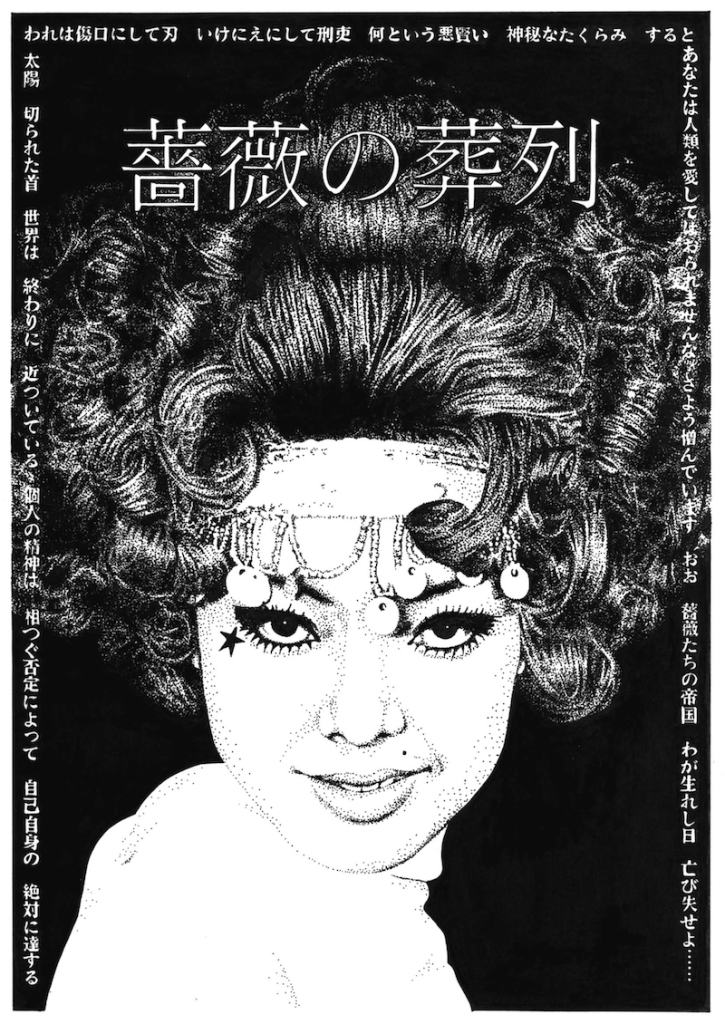
Red Snow (赤い雪, Sayaka Kai, 2019)

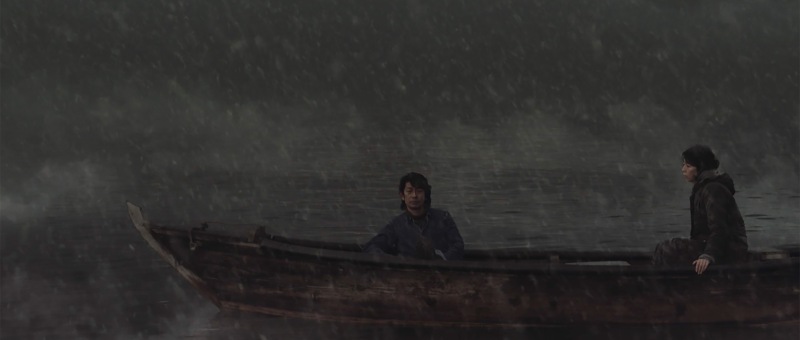
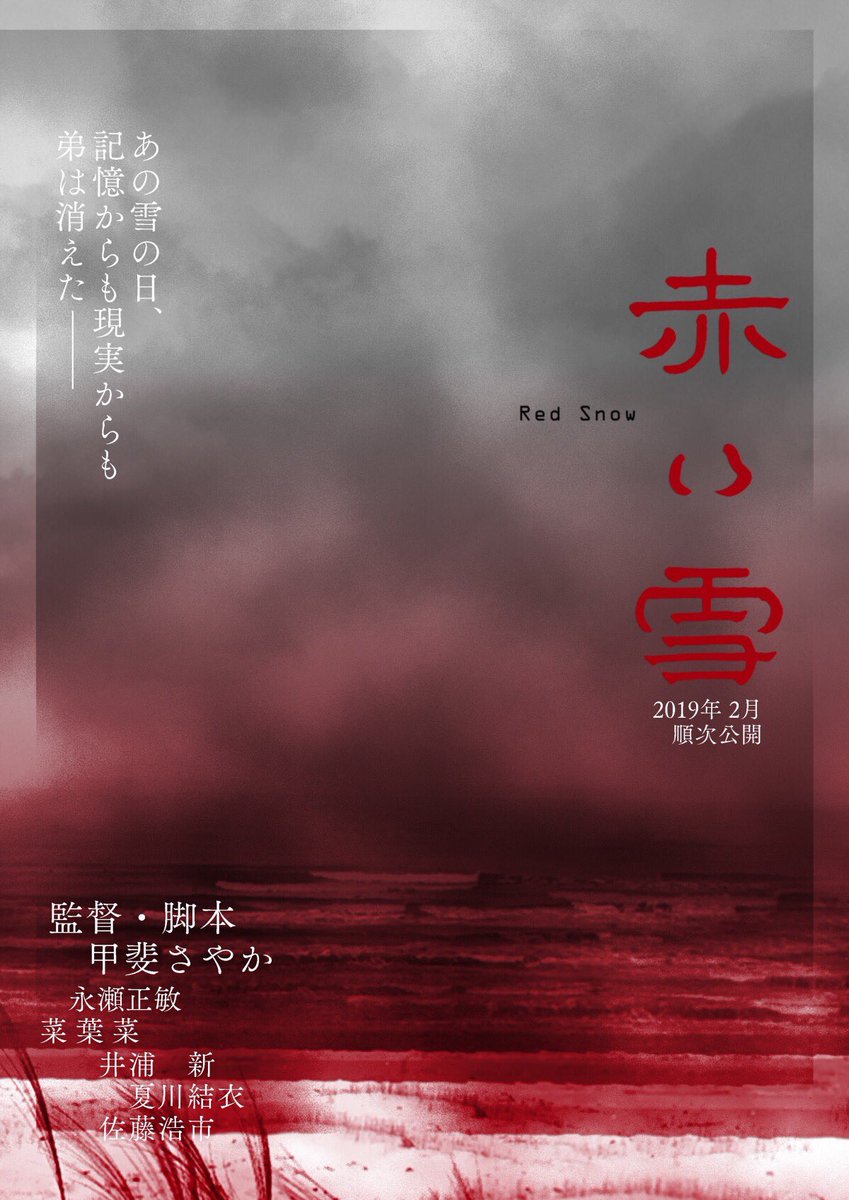
Red Snow poster 2“We’re just pieces of a puzzle” a temporarily deranged woman exclaims to a gloomy seeker after truth in Sayaka Kai’s eerie debut Red Snow (赤い雪, Akai Yuki). Truth, as it turns out is an elusive concept for these variously troubled souls trapped in a purgatorial tailspin on their gloomy island home. When a stranger comes to town intent on unearthing the long buried past, he stirs up deeply repressed emotion and barely concealed anger but finds himself floundering in the maddening snows of a possibly imaginary coastal village. 

30 years previously, a young boy, Takumi, went missing on the way to a friend’s house accompanied by his brother Kazuki who claims he simply disappeared from view in the heavy snow. Sometime later, a child’s remains were found in a burned out building. The prime suspect was a strange woman with a young daughter who escaped the fire in the middle of the night in a suspiciously elegant outfit. Nevertheless, the woman was later exonerated and the truth behind Takumi’s disappearance remained shrouded in mystery.

In the present day, a reporter, Kodachi (Arata Iura), arrives in town with the intention of writing some kind of exposé on the case. He interviews the detective involved and makes contact with Kazuki (Masatoshi Nagase), now a broken middle-aged man who has dedicated his life to perfecting the art of lacquerware. A secondary lead takes him to Sayuri (Nahana) – the daughter of the prime suspect now, in a tragic piece of circularity, an outcast herself and possibly a sex worker in a violent relationship with an older man (Koichi Sato) who may or may not be her pimp.

Each of them has tried to move on from the unresolved tragedy of Takumi’s disappearance, but all appear to have failed. Kazuki dreams of the day his brother vanished right in front of his eyes, seeing a little red jumper lost in the snow but unable to remember anything more. He fears he will never know what happened unless his memory somehow returns, though as his mentor tells him what actually happened and the way you remember it are often different. Waxing philosophical, Kodachi muses that memory is what links the past and future but memory, and therefore life itself, is ambiguous. The “truth” may be unknowable and known at the same time to those who refuse to confront its various contradictions. 

Like the young Sayuri watching through a tiny crack in the wardrobe door where her abusive mother has placed her out of the way of all her “fun”, nobody sees the whole of anything. The young Sayuri morphs into the adult Sayuri and into her mother whom she fears she has become. The only witness to the incident, Sayuri refuses to speak of it though perhaps there’s more kindness in her silence than it first seems even if her unwillingness to remember may also be a kind of self preservation. She too is a victim, but is blamed all the same despite being only a small child powerless to intervene or be held complicit in whatever it is her mother might have done or not done in her quest for survival.

Sayuri remains trapped within the orbit of her now absent mother, herself an outcast in another abusive relationship this time with a sociopathic old man, while Kazuki struggles to accommodate his sense of guilt for something he can’t quite remember. Emotions briefly bubble to the surface, petty resentments and jealousies that pass between all small children but might perhaps have had terrible consequences one snowy night. Sayuri may be right when she insists that they are pieces of a puzzle, each holding tiny fragments of truth that might be assembled into a coherent whole, but also aware that if they did so they may not like the picture that they see.

Eerie and ethereal, the snowy coastal town almost may not exist at all haunted as it is by traumatised souls trapped in a purgatorial cycle of guilt and confusion as they try to piece together the past. Sayaka Kai’s dreamlike, poetic debut is a visually impressive existential mystery in which past and present intertwine leaving our troubled heroes lost in a fog of falling snow unable to access the future through the corrupted pathways of memory.


Red Snow was screened as part of Japan Cuts 2019.

Original trailer (English subtitles)