Terror in the Streets (悪魔が呼んでいる, Michio Yamamoto, 1970)

How much bad luck can one person have before they start thinking someone’s out to get them? Released as part of double bill with The Vampire Doll and based on a novel by Kikuo Tsunoda, Terror in the Streets (悪魔が呼んでいる, Akuma ga Yondeiru) draws inspiration from contemporary folk horror and the paranoia thriller as one young woman finds herself in the crosshairs of mysterious forces seemingly hellbent on derailing her otherwise very ordinary and aspirational existence. 

Yuri (Wakako Sakai) worries that her status as an orphan has set her back in life, attributing her inability to find permanent employment after managing to put herself through university by working as tutor to a societal stigma against people with no families. Up to now, things had been going pretty well. Though she was only a temp, she had a good gig as office admin staff at big company in the city, lived in a modest but homely flat complete with a small television, and was dating her college sweetheart. But then one day her boss looks at her with an odd expression and then abruptly drops the bombshell that he’s terminating her contract without offering a reason why. When Yuri calls her boyfriend he gives her the same look and says he’s breaking up with her, also refusing to give any kind of explanation aside from not wanting to see her anymore. If all that weren’t enough, her landlady then explains that someone else is very interested in her flat and will pay double for it so she wants Yuri out by the end of the month. 

It’s undoubtedly been quite a bad day, but Yuri tries to stay upbeat reflecting that she didn’t particularly like the job anyway and intends to apply for a position as an editor on literary magazine which would suit her better. But after that nothing quite goes to plan and everything she tries to improve her situation backfires until she finally considers taking her own life at railway crossing only to be rescued by a mysterious man, Fujimura (Takashi Fujiki), who appears as her saviour but then convinces her to take some kind of pill to calm her nerves which predictably leaves her dazed and confused. He then takes her back to her apartment and claims they’re legally married, but when Yuri wakes up the following morning he’s dead with a knife in his chest. 

It’s not the first time that Yuri has experienced an apparent gap in her memory which causes her re-evaluate her sense of reality. She’s beginning to feel as if something or someone is out to get her, realising that Fujimura was the same sinister man she’d caught sight of before staring into her window. Meanwhile, she often hears a strange tune played on an ocarina that sounds like a medieval fugue. The film’s Japanese title is “the Devil calls” and it’s not a huge stretch to assume that Yuri’s been caught up in some kind of dark magic or supernatural curse, yet it’s also the collision of outdated and feudalistic notions of class and patriarchy that have her in their clutches. All of these weird men seemingly want to marry her or at least make her theirs with less than romantic overtures while chief among her aggressors Katagiri (Hideji Otaki) describes himself as an Earl and insists that noble blood is the most valuable thing in the world.

But far as she knows Yuri has no noble blood and is alone and friendless as an orphan with only a “distant relative” she mentions in passing who does not live in Tokyo. She has in effect been made a pawn in a cruel and ironic game played by a distant aristocracy which makes sport of the innocent and powerless by wielding the privileges of wealth and class. The only way she can escape is by renouncing her claim on its legacy, declaring herself uninterested in their games or rewards while ceding the prize to another woman who seems to have been driven out of her mind by a similar series of torments that may have lasted her entire adult life. Yamamoto films the contemporary city in an eerie light, a place of greed and darkness inhabited by sinister and shady forces that prey on the innocent and earnest like Yuri but then there is something to be said for the idea that in the end you can’t con an honest man and Yuri’s pure hearted rejection of unearned wealth just might be her salvation.


Original trailer (no subtitles)
Kill! (斬る, Kihachi Okamoto, 1968)

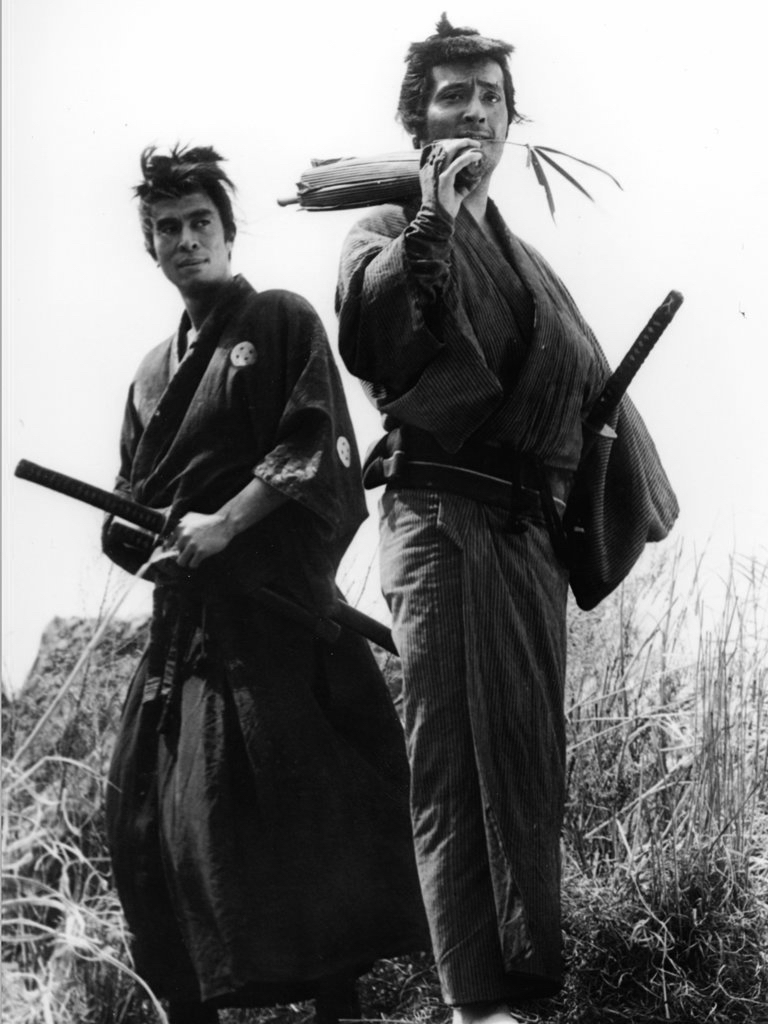
“Samurai aren’t as great as you might think” according to a jaded retainer in Kihachi Okamoto’s Kill! (斬る, Kiru) but it’s a message that the ambitious farmer at the film’s centre struggles to take in. Having been a victim of samurai violence he resolves to become a samurai while a former samurai turned yakuza drifter attempts to show him the hypocritical realities of the samurai life as they find themselves swept into local intrigue when a band of young revolutionaries arrive to cut down a corrupt and oppressive lord. 

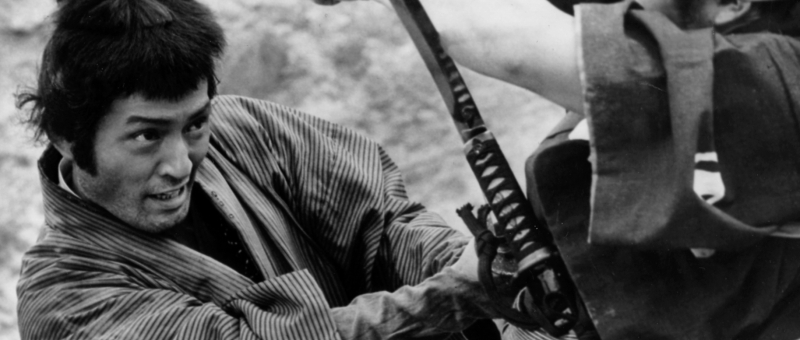
Corrupt and oppressive is perhaps the defining image of the samurai in post-war cinema, but like the film’s title that cuts both ways. Farmer Tabata (Etsushi Takahashi) sold his lands to buy a sword after witnessing peasants cut down during an uprising but he’s decided the best way out of oppression is to become an oppressor and is dead set on achieving samurai glory through the time-honoured method of distinguishing himself in battle. That may prove a little difficult given that his new boss, Ayuzawa (Shigeru Koyama), immediately mocks him for swinging his sword as if it were a scythe. Then again as former samurai Genta (Tatsuya Nakadai) explains to him, if you don’t know what you’re doing you can always just stab people which at the end of the day does rather undermine the idea of samurai elegance in the art of killing. 

Genta keeps trying to tell Tabata that “samurai are no good” but Tabata still wants to be one anyway even after learning that Ayuzawa means to double cross them, hiring ronin to take out the young samurai whose sense of honour he manipulated to eliminate the admittedly corrupt (but aren’t they all?) lord for his own political gain while planning to send in his retainers to finish off the job to ensure there are no witnesses. Genta gave up his samurai status because he was “disgusted” by just this sort of duplicity along with the meaningless codes of loyalty that govern samurai society and caused him to betray a friend who was acting only in the interests of justice. Leader of the ronin Jurota (Shin Kishida) did something similar though in his case for love when his fiancée’s father was condemned on false charges and she and her mother exiled. He wants not land or status but only money in order to redeem the woman he loves from a geisha house and like Genta is under no illusions about the nature of samurai life having figured out most of what’s going on but hoping to emerge with the means to liberate both himself and his wife from samurai oppression. 

Even the elderly chamberlain later rescued by Genta tries to warn Tabata that the samurai life isn’t all it’s cracked up to be, hinting at the ways they are also oppressed by their own code while clearly gleeful to have had the opportunity of stepping into a teahouse for the first time responding to Genta’s request to stay put that if he could he’d like to stay put for the rest of his days. Both former samurai, neither Genta nor Jurota are minded to draw their swords knowing that whatever the outcome it would be unhappy while the young who thought it was their duty to change the world by removing one who brought shame on their names are faced with the realisation that they have been used and their resistance will count for nothing. Even their bond as brothers banding together to achieve a common goal is eventually disrupted by alcohol and petty jealousy.

Genta acts as a kind of chorus, touched by the naivety of the seven samurai holed up in a mountain lodge because they believed in justice, while knowing that the society itself is innately unjust and already beyond redemption. Tabata eventually comes to a similar conclusion having gained samurai status but found it quite literally uncomfortable deciding to shake off his newfound nobility and rejoin Genta as a cynical yet pure hearted wanderer because the only way to escape samurai oppression is to actively live outside it. The final irony is that it’s the elderly chamberlain who eventually sets him, and all they women trapped in indentured servitude at the geisha house, free using samurai gold to enable them to escape a system he himself cannot escape but does not exactly support while Genta enlists the help of local peasants to hold a festival of rebellion to cover the final assault. Marked by Okamoto’s characteristically absurd humour and cartoonish composition along with the eerily gothic emptiness of the deserted ghost town where not even yakuza can survive the film takes on a quasi-spiritual dimension in which Genta and the gang eventually walk out of hell if only into a purgatorial freedom. 


Kill! screens at Japan Society New York on Sept. 2 as part of the Monthly Classics series.

Original trailer (no subtitles)

Too Young to Die (死ぬにはまだ早い, Kiyoshi Nishimura, 1969)

Perhaps more or less forgotten for reasons we’ll come to later, Kiyoshi Nishimura was for a time a successful director associated with Toho’s line of noirish B-movie action dramas. When the Japanese cinema industry entered its decline in the 1970s, Nishimura shifted into similarly themed TV drama and was well respected for his ability to turn in on time and on budget. None of that mattered however when he was engulfed in scandal in 1987 after being caught operating spy cams in the female only area of a public bathhouse bringing his career to an abrupt end. Directing a few more projects under the name Yusai Ito, he sadly took his own life a few years later in 1993 at the age of 61. 

Nishimura’s 1969 debut Too Young to Die (死ぬにはまだ早い, Shinu ni wa Mada Hayai), however, is a masterclass in high tension filmed with shaky handheld set largely in a single location and imbued with a singular irony replete as it is with cosmic coincidences as a collection of customers at a roadside bar are taken hostage by a crazed criminal with a gun intent on finding the lover of the girlfriend he claims to have murdered for her infidelity. The heroes, however, are ennui-filled couple Matsuoka (Koji Takahashi) and Yumiko (Mako Midori) who are in fact not married, or at least not to each other, but carrying on an extra-marital affair which may be on the cusp of fizzling out. A former racing champ who claims he just got bored with the sport one day and now works for a company selling accessories for toy cars, Matsuoka is supposed to drive Yumiko home where she’s expecting a call from her controlling husband, away on a business trip, at 1am. These are all reasons they are unusually nervous about a police checkpoint searching for an armed fugitive, deciding to stop off at a roadside bar for a stiff drink and something to eat. Only, shortly after their arrival a young man (Toshio Kurosawa) in denim enters giving each of the other men intense side eye before shooting a policeman who comes in to make enquiries about the fugitive. 

The unnamed young tough takes the entire bar hostage intent on finding his lover’s lover, overcome with a sense of cosmic irony when Matsuoka calmly points out he may have arrived too early and the man he’s looking for had not yet arrived when he put the place in lockdown. Before the gunman’s arrival, Nishimura introduces us to each of the other customers via the handy device of two teenage girls apparently stranded and asking around for a lift back to the city. A middle-aged doctor (Chuzaburo Wakamiya), apparently a regular, eventually offers to take them but is dissuaded by the barman (Kazuya Oguri) who reminds him he’s been drinking too heavily to take passengers, while a taxi driver (Shigeki Ishida) who seems to be feeling unwell flat out refuses. The other customers are a suspicious looking man in a trenchcoat (Daigo Kusano) sitting in the corner piling matchsticks, and a newlywed couple who we later learn saved up for their wedding for three years, the wife (Nami Tamura) already going through her accounts book irritated by her friends’ decision to graffiti their car and wondering how much it’ll cost to get it cleaned up while the husband (Tatsuyoshi Ehara) disappoints her by wanting to rush home because he’s planning to return to work the next morning ahead of schedule. 

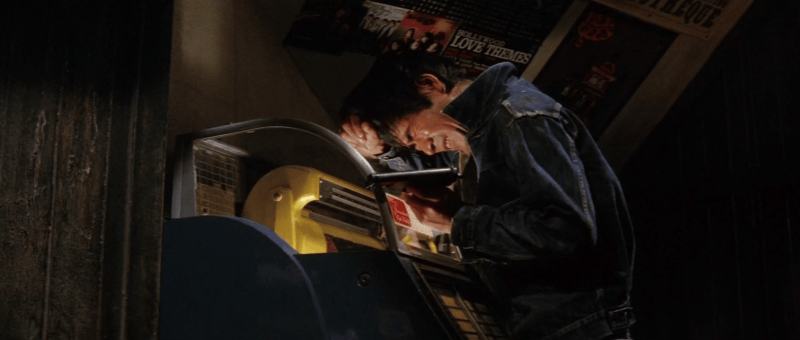
The relationships of the two couples are often directly contrasted, Matsuoka and Yumiko unsure of their connection as adulterous lovers while the newly married couple also seem be under strain even before the traumatic events about to take place. Apparently brokenhearted, the gunman collapses over the jukebox playing a series of melancholy songs about lost love, Matsuoka later darkly musing that perhaps he was only able to kill his lover because he loved her so much. Unlike the other customers, Matsuoka appears entirely unperturbed by their predicament calmly talking to the gunman and even ringing the police to ask them to temporarily stand back so they can evacuate a hostage in need of medical treatment. The gunman sends Matsuoka and the newlywed husband to take the injured party out, taking Yumiko hostage as security while she fears Matsuoka does not value her enough to return though both men do in fact come back rather than abandon their respective women. The newlywed husband, however, later fails a test of manhood when the enraged gunman goes off on a misogynistic rant and tries to force the doctor to rape the newlywed wife to prove that all women are faithless “whores”, the husband reduced to a gibbering wreck cowering in the corner unable to protect his new wife or challenge the gunman’s authority as Matsuoka later does when he orders Yumiko to remove her clothes in front of the other hostages. 

Though Yumiko had feared the affair was on its way out, ironically describing Matsuoka as not so different from her husband while lamenting that their connection seemed to have dwindled, the traumatic experience seems to reinforce the reality of their love as something more than a casual extra-marital fling even as Matsuoka forgives her for not trusting him because their relationship is not founded on the same idea of “commitment” as the married couple. The question for the other customers is how much the lives of others they’ve only just met really mean to them, the two teenage girls deciding to attempt escape while the gunman takes Yumiko hostage to use the bathroom, the doctor edging round the sides as Matsuoka tries to stop them to protect her while the newlyweds similarly waltz towards the door. All the while the TV crackles with an inane variety show complete with its cheerful advertisements while the police apparently have the place surrounded ironically convincing the gunman he has no way out and therefore nothing to lose. A tense meditation on interpersonal relationships, Too Young to Die is not without its share of ironies in strange number of coincidences and misapprehensions as the siege eventually draws to an unexpected close sending our conflicted lovers back into the night if perhaps a little more alive for their brush with death.