Babanbabanban Vampire (ババンババンバンバンパイア, Shinji Hamasaki, 2025)

It turns out immortality’s not all it’s cracked up to be in Shinji Hamasaki’s adaptation of the manga by Hiromasa Okujima, Baban Baban Ban Vampire (ババンババンバンバンパイア). At 450 years old, Mori Ranmaru (Ryo Yoshizawa), one-time lover of Oda Nobunaga (Shinichi Tsutsumi), is working as an attendant in a bathhouse in an attempt to, as he says, “live an ordinary life earnestly,” while staving off the darkness of an existence free of the spectre of death. 

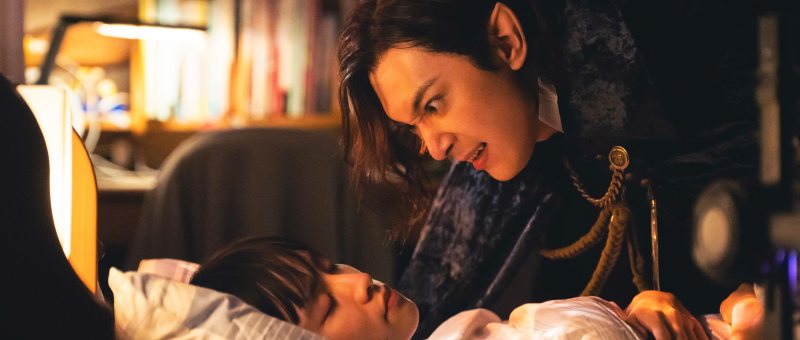
Yet, there is an uncomfortable darkness at the centre of this otherwise humorous and ironic tale in that what Mori Ran is actually doing is grooming a child so that he can enjoy him when he judges that he is “ready.” There’s an obviously unpalatable reading of the film that renders it as an allegory for paedophilia, while there’s also an undeniable poignancy in likening the figure of the vampire of that of a gay man in an oppressive society. Mori Ran accosts his victims in dark alleyways and his assignations with other men are necessarily short and secretive. They also result in death, while Mori Ran describes most of his victims as tainted and disgusting as if echoing an internalised sense of self-loathing. He continues to hold up Rihito (Rihito Itagaki) as a figure of innocence and purity because he once saved his life when he was baking in the heat of an usually hot spring when the boy was only five years old. 

Mori Ran’s internalised homophobia is somewhat mirrored in that of the teacher Sakamoto (Shinnosuke Mitsushima) who is also a vampire hunter but bewitched by Mori Ran and longing to be initiated by him, though Mori Ran declines to give him what he sees as a curse. Imbued with a gothic sensibility, Mori Ran believes that humans are beautiful because they die, while vampirism is debased and ugly. He refuses to condemn someone he admires to his own fate which he describes as a kind of inescapable hell in which he is unable to die. He no longer believes in love, though is haunted by his loss of Nobunaga, and sees humans merely as food. 

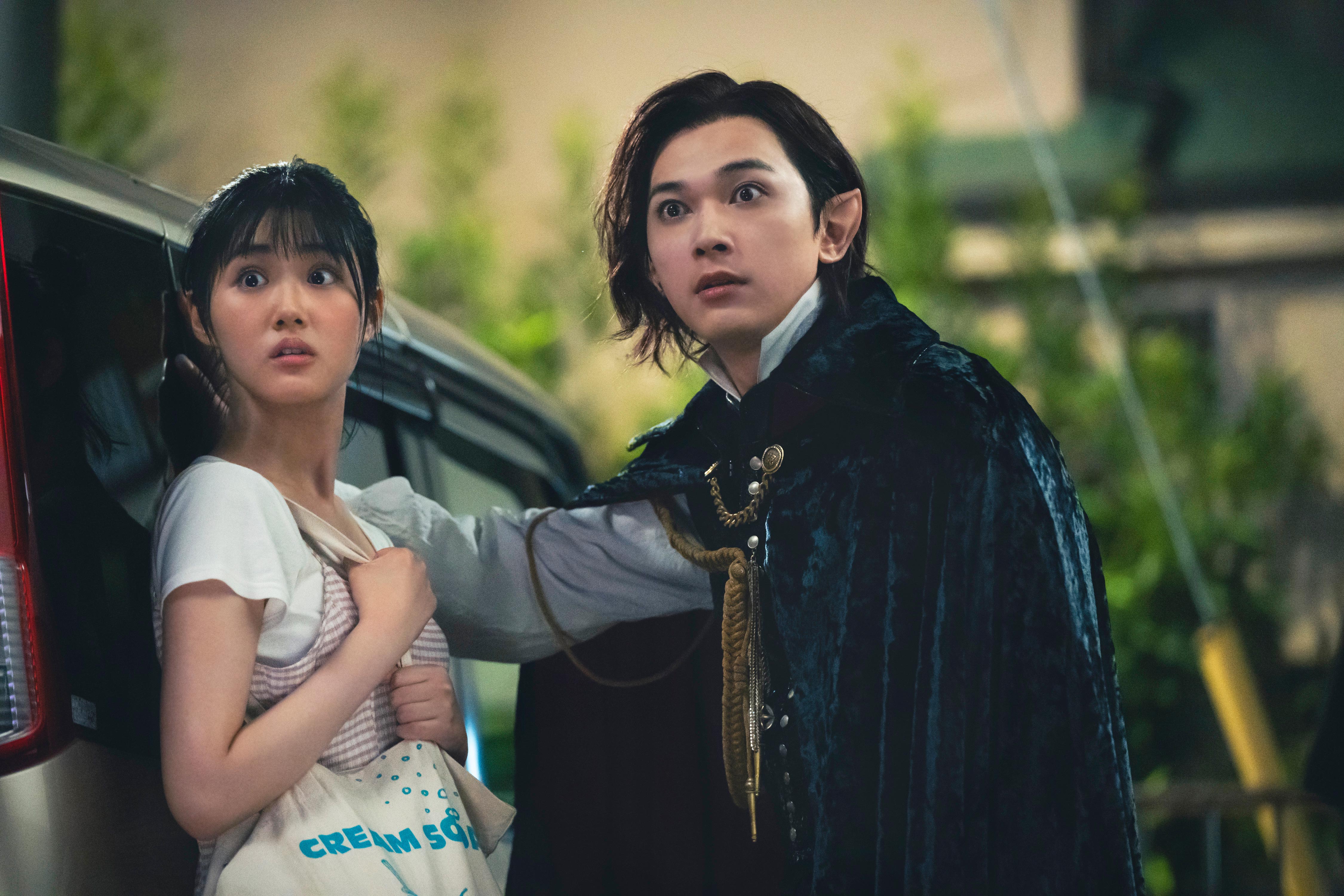
Nevertheless, it seems he has found purpose in his present life of living with Rihito’s family and working in their bathhouse despite convincing himself that he’s only biding his time until Rihito is ripe for the picking. According to Mori Ran, the sweetest blood belongs to that of 18-year-old male virgins which is why his goal of ensuring that Rihito remains virginal and pure is becoming more difficult now that he has entered adolescence. Much of the comedy derives from Mori Ran’s emotional cluelessness and paranoia on discovering that Rihito has fallen for a girl, Aoi (Nanoka Hara), with whom he had a stereotypical meet cute on his way to his high school entrance ceremony. Knowing that he has to nip this in the bud as soon as possible, he pays a visit to Aoi to warn her off but fails to realise that not only did she barely notice Rihito let alone fall in love with him, but that she is actually obsessed with vampires and is keener on him. 

But then again, there’s something additionally troubling about Rihito’s immediate classification of Mori Ran as a “love rival” in the mistaken belief he’s after Aoi too rather than as someone who should probably be reported to some kind of authority. After all, even if he were not 450 years old but the 25 he claims to be, hanging around exclusively with high schoolers is odd and bordering on inappropriate in itself. Having misunderstood his intentions, Aoi also believes that Mori Ran is waiting for her to be “ready,” in a partial recognition that this is wrong because she’s a child but also prepared to wait for the mysterious vampire without considering the implications of his being interested in a 15-year-old girl if that actually were the case. 

Nevertheless, what Mori Ran discovers is really a different kind of love in his gradual integration into the human world and the the friendships he forms not only with Rihito, but Aoi, her muscular brother Franken (Mandy Sekiguchi) who also has a crush on Mori Ran, and the lovelorn teacher Sakamoto, even if he’s still focused on his mission of keeping Rihito pure so he can drink his blood on his 18th birthday. His attempts to prevent a relationship forming between Rihito and Aoi are all countrerprodcuteive and would like end up bringing them together if it were not for the fact of Aoi’s crush on him of which he remains oblivious. The inherently zany humour of the situation with its series of concentric love triangles along with the warmheartedness of Rihito’s homelife when contrasted with the “mysterious” serial killings on the news cannot completely overcome the unpalatable undercurrent of Mori Ran’s pederastic quest, if glossing over it with admittedly delicious irony and absurdism.


Babanbabanban Vampire screens 27th July as part of this year’s New York Asian Film Festival.

Don’t Call it Mystery (ミステリと言う勿れ, Hiroaki Matsuyama, 2023)

Totono once again finds himself at the centre of of conspiracy in the big screen edition of the popular drama based on the manga by Yumi Tamura, Don’t Call it Mystery (ミステリと言う勿れ). Embroiled in what first looks like a family succession drama as he points out recalling The Inugami Family, he soon discovers there’s more in play than might be expected but also that the wounds of the past are slow to heal and often cause people to act in unexpected ways.

In any case, he ends up getting involved care of Garo (Eita Nagayama) who is still on the run following the end of the TV series so unable to help a teenage girl, Shioji (Nanoka Hara), who is one of four grandchildren in line to inherit her grandfather’s legacy if only she can fulfil the bizarre quest he left for them in his will. Her worry is that, as family law dictates one person inherits everything, there will inevitably be deaths and violence involved as the cousins battle each other for the prize of a giant estate near Hiroshima where Totono also just happened to be on a day trip.

Once again, the running gag is that mystery just seems to find Totono who only wants to get on with living his peaceful life as a student eating curry and going to museums though there are some tantalising clues to his own backstory littered through the piece such as his unexpected familiarity with the city of Hiroshima. The case this time as also has a link to Totono’s famously curly hair which only adds to his Kindaichi-esque sense of eccentricity deepened by his reluctance to allow Shioji’s family to do his laundry or to a take a bath in another person’s home. But these foibles are, as he points out to those around him, reflective of a conflict in what is considered considerate behaviour. They think they’re being nice by offering to do his laundry, but he doesn’t want them to so it’s just additional inconvenience for him much in the same way as you if offer someone a lift to the station thinking that’s easier for them and they accept not to cause offence but are secretly disappointed because they were looking forward to the walk.

Totono’s defining characteristic as an accidental detective is indeed his emotional intelligence and ability to pick up on the slightest things that might be bothering those around him, often prone to lengthy monologues that advocate for a more compassionate world and better understanding between people. As the mystery becomes clear, he begins to realise that the parents of the grandchildren were trying to protect them from the toxic legacy of tradition and end the ridiculous family succession drama that apparently led to the deaths of some of their immediate relatives. He gives similar advice to Shoji’s cousin Yura (Ko Shibasaki) on hearing her father tell her that women are happiest as wives and mothers and she should drop what she’s doing to pay more attention to her husband and daughter. Totono takes him to task for his sexist thinking and tells him it’s unfair, advising Yura that she might not unwittingly want to pass these ideas on to her own daughter by suppressing herself to conform to her father’s outdated idea of conventional femininity.

As Totono says, children are like wet cement and the things dropped on them leave their mark for the rest of the child’s life. It seems that the family was in a sense haunted by a child they’d wronged and worried would someday come back to wreak their revenge as a phantasmagorical embodiment of their latent guilt and shame about how they usurped their fortune. What the grandchildren come to realise, is that their late parents did actually understand them and wanted them to be happy following their own paths rather than bound by tradition or outdated notions of properness regardless of whatever happens with the grandfather’s more literal legacy and the buried skeletons it contains. Filled with the same kind of gentle intrigue and mystery along with the compassionate spirit of the TV series and manga, the big screen edition features another difficult case for Totono that also begins to illuminate his own troubled past and the secrets behinds his empathetic soul.


Don’t Call it Mystery screened as part of this year’s Toronto Japanese Film Festival.

Original trailer (English subtitles)

Infinite Foundation (無限ファンデーション, Akira Osaki, 2018)

Sometimes the music finds you when you need it most. So it is for the heroine of Akira Osaki’s wistful coming-of-age drama Infinite Foundation (無限ファンデーション, Mugen Foundation). To better capture the teen experience with an immediate naturalism, Osaki’s cast was provided with no script only a vague outline inspired by the songs of singer-songwriter Cosame Nishiyama and asked to improvise each individual scene. What results is suitably intense tale of complicated teenage female friendships, frustrated ambitions, and fear for the future in which a shy, introverted young woman gradually finds the courage to chase her dreams with the help of an ethereal songstress and unexpected solidarity. 

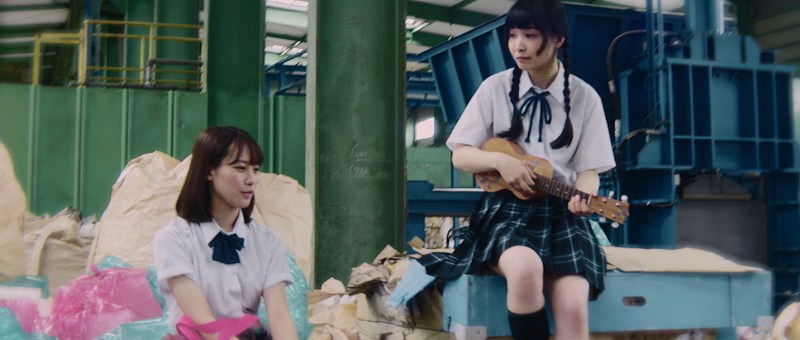
Mirai (Sara Minami), whose name literally means “future”, is a dreamy young girl who thinks she’s not much use for anything so usually idles away her time in school drawing dress designs in her sketchbook when the teacher’s not looking. In fact, she’s technically in summer school catch up, but every time the teacher returns to check on her he notices that she still hasn’t got round to filling in the answers on her maths test. Wandering home one day she hears the gentle strains of a ukulele coming from a nearby recycling plant and strikes up a friendship with a strange girl, Cosame (Cosame Nishiyama), with her hair in long plaits and dressed in a school uniform. Meanwhile, she’s also unexpectedly approached by the stylish Nanoko (Nanoka Hara) who, taken with her beautiful designs, insists that she join the drama club to help them come up with costumes for their imminent production of Cinderella. 

Perhaps Mirai will be going to the ball after all. Before that however she’s still contending with a sense of insecurity while her cheerful and supportive mother (Reiko Kataoka) tries to encourage her to pay more attention to her studies. Pushed towards conventional academic success, Mirai had been a little embarrassed about her love of drawing, particularly as it’s something as “frivoulous” as dress designs which she can’t believe anyone else would value. Rather than hanging out with friends, she spends most of her time sewing in her room, retreating into comfortable fantasy but also lonely and a little bit lost. So when Nanoko is so enthusiastic about her artwork it gives her a much needed confidence boost showing her that someone at least thinks her drawings have value and are not silly or embarrassing wastes of time. 

The drama club, however, is something of a baptism of fire for someone who feels themselves not good with people and at sea with interpersonal relationships. Mirai sticks fast to Nanoko, but Nanoko’s longterm bestfriend Yuri predictably doesn’t like it that she’s abruptly dragged this other person into their shared activity while the other members of the group struggle to relate to her, describing her as difficult to talk to and leaving her sitting in the corner doing her own thing while they get on with rehearsing. The main drama occurs when Nanoko makes a surprising announcement that puts the show in peril. She has a big audition lined up in Tokyo for a part in a film which makes it impossible for her to also star in the play. Nanoko asks for understanding, but does so with a degree of entitlement and superiority that cannot help but annoy her friends. She implies that she’s in this because she’s a real actress, while they’re only messing around in a school play. Mirai isn’t sure where to put herself, her new friend has just betrayed her and now she doesn’t know if they were ever friends at all or she was just using her to increase her hold over the drama club. 

The message that Mirai begins to get is that she may have real talent, but it’s up to her to achieve her dreams. She begins to feel that everything she’s been doing with her life has been superficial and incomplete because she never had the confidence to follow through, living in her own tiny bubble alone in her room for fear of getting hurt out in the big wide world. While the mysterious ukulele player sings her inspirational songs about living with loneliness, Mirai begins to build her infinite foundations towards a more confident future as a young woman determined to fight for her dreams.


Infinite Foundation streamed as part of this year’s online Nippon Connection Film Festival.

Original trailer (no subtitles)