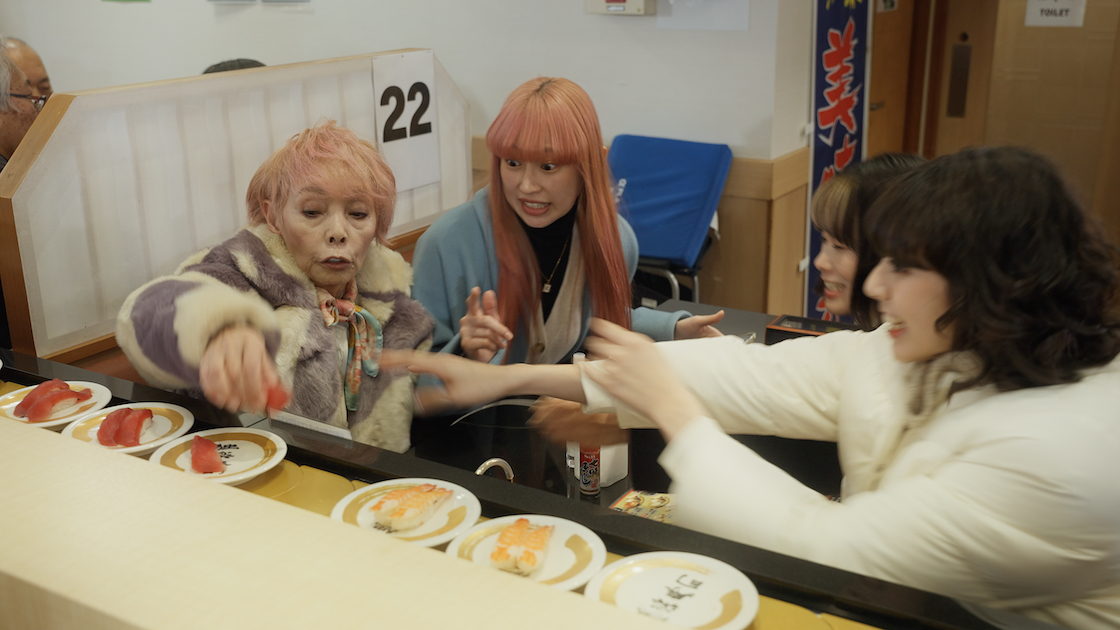
Wash Away (うぉっしゅ, Ikunosuke Okazaki, 2024)

A disconnected young woman begins to rediscover herself while caring for her ageing grandmother who is largely bedridden and has advanced dementia in Ikunosuke Okazaki’s lighthearted indie drama, Wash Away (うぉっしゅ, Wash). In a sense, the heroine is attempting to wash away loneliness but is ironically unable to scrub away her own while filled with a sense of shame and aimlessness in the city working at a soapland and dreaming of a career in real estate.

Soaplands are are legalised form of sex work in which generally male customers can pay pretty young women to give them a wash. Kana has been working at one for some time under the shop name Koyuki and has made a nice life for herself with a swanky apartment but has avoided returning to visit her family and has led them to believe she’s an estate agent. Despite having a maid visit three times a week, her flat is strewn with rubbish and empty fast food containers which hint at her inability to look after herself along with a sense of internalised shame. She looks to her housekeeper, Mrs Natori, as a kind of surrogate mother and is forever giving her expensive gifts and inviting her to stay for dinner in an attempt to circumvent the loneliness she feels in the false connections of her work in which the customers either become over invested in her Koyuki persona or completely forget her once the appointment is over.

As Mrs Natori later points out, it was Kana herself who had largely forgotten about her grandmother Kie whom she had not seen in at least eight years. When her mother, Sanae, has to be hospitalised for a hip operation she asks Kana to watch Kie during the day to which she reluctantly agrees. Despite not having had any recent contact with her, Kana is still disappointed when Kie cheerfully introduces herself on her arrival as if they were complete strangers meeting for the first time, something she continues to do each day that Kana arrives at the house. The irony is that part of Kana’s job is to wash her grandmother in the same way as she washes customers at the soapload though she encounters the same kind of frustrated connection unable to get through to Kie who is lost in time and often incredibly anxious that she’s late for some kind of event where everyone is waiting for her. 

Though she approaches the responsibility seriously, the truth is that Kana is fed up after the first few setbacks and decides to subcontract her care responsibilities by outsourcing to a professional carer telling herself that her grandmother would probably prefer that anyway. Her friend Sumire seems disappointed in her, remarking that perhaps Kie is in a way lucky to get to experience so many things for the first time again and meet the world with a sense of childish wonder such as in her fascination with colourful plastic balls. In an odd way, caring for her grandmother encourages to Kana to start caring for herself, gaining the confidence to speak honestly with someone she assumes won’t remember anything she says but reassured by Kie’s surprising outburst that work is work and she’s no need to feel ashamed of herself if she approaches it with pride whatever her occupation might be. 

This simple act of interest begins to reawaken something in both of them, Kie’s memory and energy seeming to improve in the light of Kana’s determination that she won’t be forgotten much as she hopes she won’t be either in a constant search for connection. Though she may have thought her grandmother had forgotten her, that she was in a sense invisible and faceless to the customers who bought her services, Kana washes away her misconceptions and learns to see herself again in repurposing her work as an act of care. Okazaki lends the world around her an off kilter quirkiness that is at odds with the despair Kana feels and while never shying away from the difficulties of caring for someone with advanced dementia allows the two women to recover both something of themselves and each other through the simple act of reconnection.


Wash Away screened as part of this year’s Osaka Asian Film Festival.

Original trailer (no subtitles)
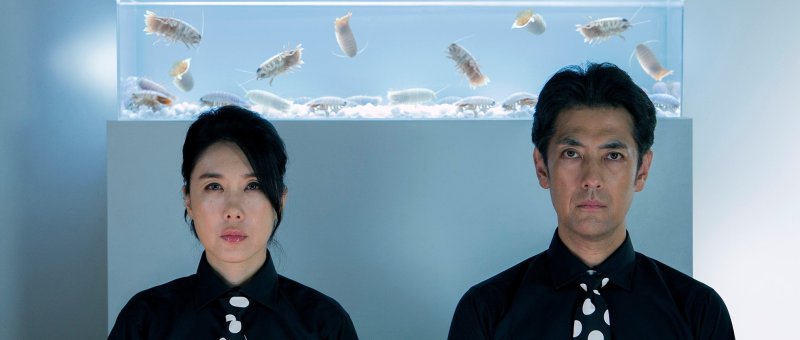
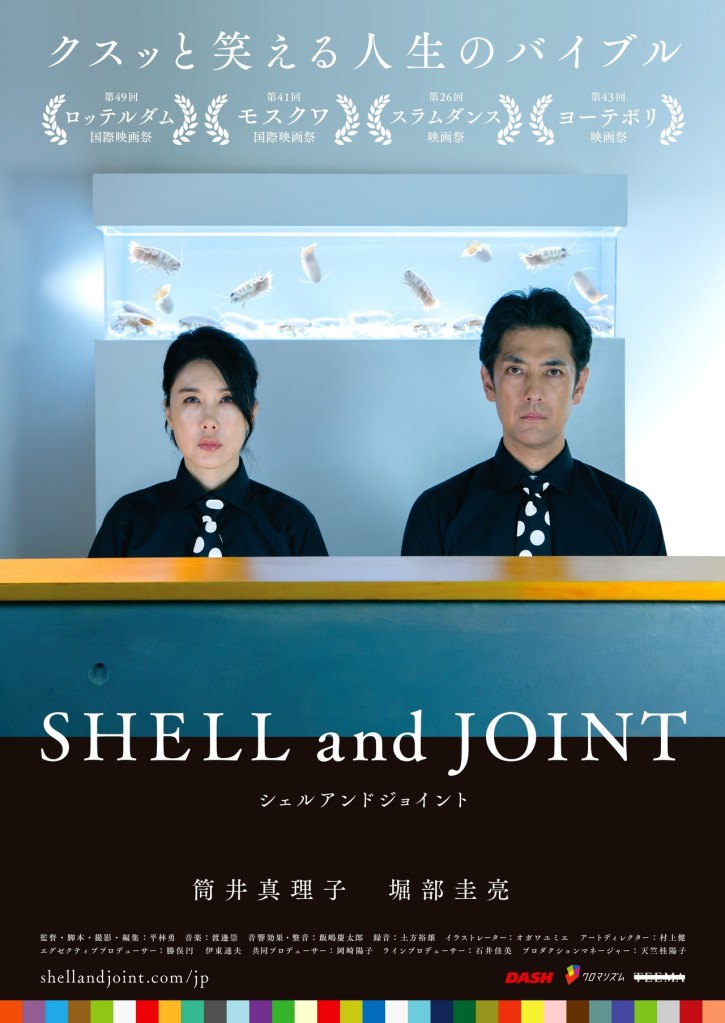
Shell and Joint (Isamu Hirabayashi, 2019)

A capsule hotel is a contradictory space, a hub for compartmentalised pods which are nevertheless joined to form one greater whole. The people who frequent them are usually looking for confined private spaces as if cocooning themselves before emerging as something new, or at least renewed, yet the hotel at the centre of Isamu Hirabayashi’s Shell and Joint is slightly different, a noticeably upscale take on convenience with its stylishly modernist design and well appointed spaces from showering facilities to saunas. It is also, it seems, at the nexus of life and death as its bored receptionists, childhood friends, debate what it is to live and what it is to die. 

Sakamoto (Mariko Tsutsui), the female receptionist, has considered suicide many times but continues to survive. She attributes her death urge not to existential despair but to brain-altering bacteria and is certain that a vaccine will eventually be found for suicidal impulses. While her deskmate Nitobe (Keisuke Horibe) is struck by the miracle of existence, Sakamoto thinks his tendency to adopt a cosmic perspective is a just a way of dealing with his fear of death in rejecting its immediacy. Her suicide attempts are not a way of affirming her existence and she has no desire to become something just to prove she exists, nor does she see the point in needing to achieve. Just as in her bacterial theory, she rejects her own agency and represents a kind of continuous passivity that is, ironically, the quality Nitobe had admired in the accidentally acquired beauty of the pseudoscorpion. 

This essential divide is mirrored in the various conversations between women which recur throughout the film and mostly revolve around their exasperation with the often selfish immediacy of the male sex drive. The creepy “mad scientist” starts inappropriate conversations about sperm counts and his colleague’s impending marriage, offering to loan him some of his apparently prime stock to vicariously father a child with the man’s “cute” fiancée who, in a later conversation with another female researcher, expresses her ambivalence towards the marriage, like Sakamoto passively going with the flow, because men are like caterpillars permanently stuck in the malting phase. Her colleague agrees and offers her “men are idiots” theory which is immediately proved by the male scientists failing to move a box through a doorway. 

A middle-aged woman, meanwhile, recounts the process of breaking up with her five boyfriends who span the acceptable age range from vital, inexperienced teenager to passionate old age through the solipsistic, insecure self-obsessed middle-aged man but her greatest thrill lies in the negation of the physical, remarking that “ultimately eroticism is all mental” while suggesting the ephiphany has made her life worth living. On the other hand, a young man is terrorised in a sauna by a strange guy claiming that he is actually a cicada and simultaneously confiding in him about the strength of his erection along with the obsession it provokes to find a suitable hole in which to insert it. 

“What’s the deal with leaving offspring?” another of the women asks, seemingly over the idea of reproduction. The constant obsession with crustacea culminates in a butoh dance sequence in which lobsters spill their eggs down the stairs of an empty building (much to the consternation of an OL sitting below and, eventually, the security team) while other strange guests tell stories of women who underwent immaculate conception only to be drawn to the water where hundreds of tiny crab-like creatures made a temporary exit. The urge to reproduce, however, necessarily returns us to death and the idea of composition. The melancholy story of a Finnish woman drawn to the hotel because of its similarity to a beehive meditates on the sorrow of those left behind while a fly and a mite mourn their cockroach friend by wondering what happens to his dream now that he has died only to realise that because he told them about it, it now lives on with them. Nitobe wonders what the corruption of the body in death means for the soul and for human dignity, while the images Hirabayashi leaves us with are of a corpse slowly suppurating until only a scattered skeleton remains. Such is life, he seems to say. Life is itself surreal, something which Hirabayashi captures in his absurdist skits of the variously living as they pass through the strange hotel and then, presumably, make their exits towards who knows what in the great cycle of existence.


Shell and Joint streamed as part of this year’s online Nippon Connection Film Festival. Viewers in the US will also be able to catch it streaming as part of this year’s Japan Cuts!

International trailer (dialogue free)