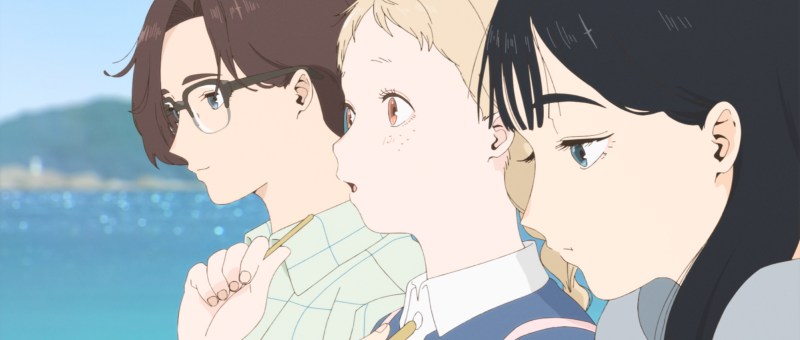
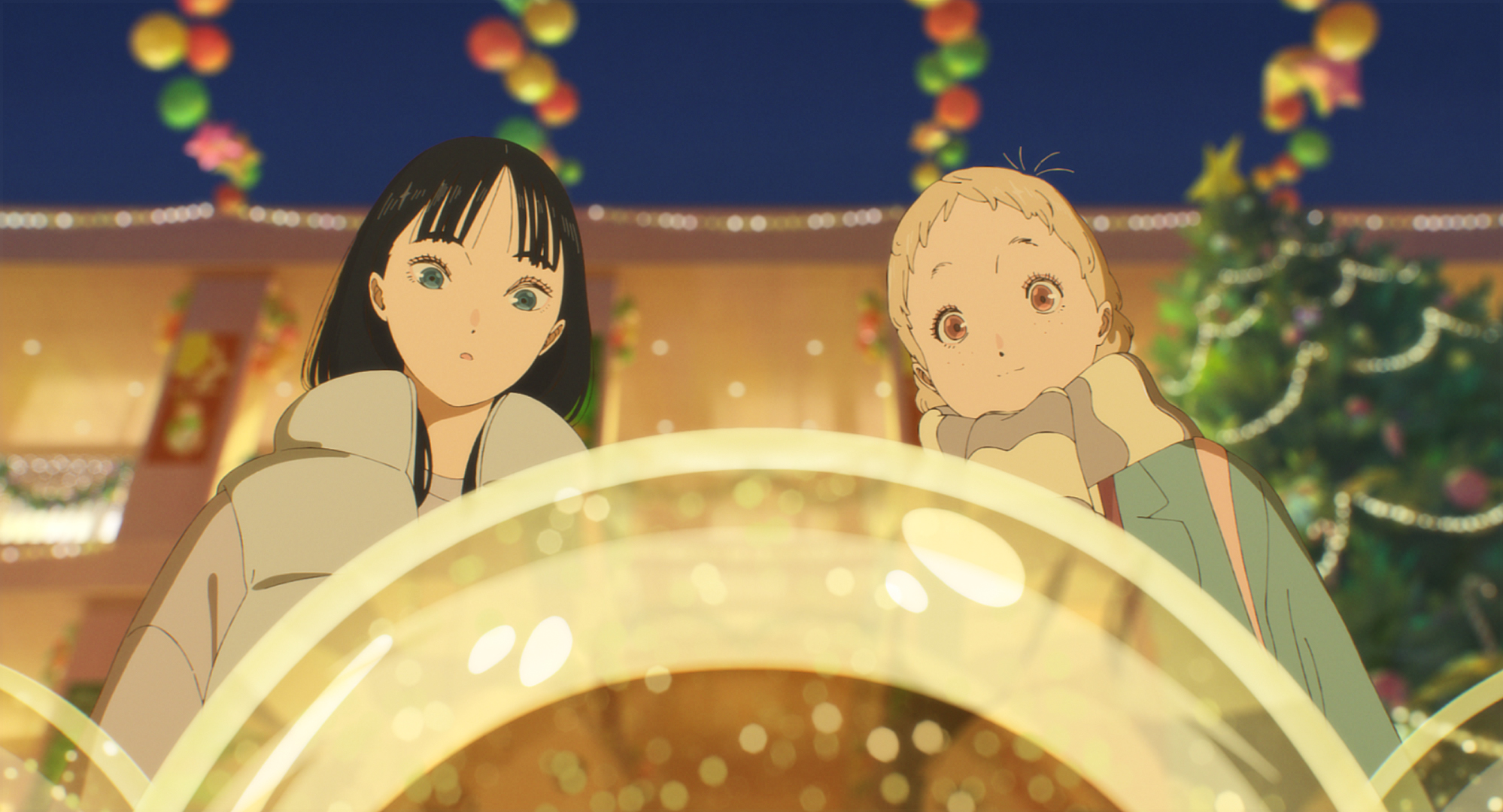
The Colors Within (きみの色, Naoko Yamada, 2024)

“If I could see my own colour, what kind of colour would it be?” the heroine of Naoko Yamada’s The Colors Within (きみの色, Kimi no Iro) asks herself. Yet there’s a curious pun in the film’s Japanese title in that the word “kimi” simply means “you” but it’s also the name of another girl by whom Totsuko (Sayu Suzukawa) is captivated though she doesn’t quite have the ability to articulate her feelings beyond the fact she feels “all sparkly inside”. 

In any case, Totsuko has the ability to see people as colours but largely keeps it to herself in fear that people will think she’s “weird”. Totsuko does indeed appear to be slightly otherworldly, though no one really seems to reject her for her ethereality save perhaps one classmate who describes her as that girl who sits in the chapel on her own all the time. What she’s mostly doing in there is reciting the serenity prayer to find “peace of mind,” and talking to the cool nun at her Catholic boarding school, Sister Hiyoko (Yui Aragaki), who tries probe gently into whatever it is that’s bothering Totsuko but equally avoiding pressuring her reveal anything before she’s ready. Then again, Totsuko may not quite know what it is that’s making her feel uneasy even if she remains upbeat and cheerful with a childlike sense of fun and innocence.

This quality of joyfulness is directly contrasted with the intense melancholy of Kimi (Akari Takaishi) with whom Totsuko becomes fascinated after catching sight of her “beautiful” and “clear” colours. When Kimi disappears from the school it’s rumoured she talked back to a teacher or that they found out she had a boyfriend, but it seems a Catholic education just isn’t a good fit for Kimi so she decided to drop out. Like Totsuko, Kimi has a secret but hers is that she can’t bring herself to tell her grandmother, who attended the same school and is over the moon about her going there, that it isn’t working out for her. What with it being a Catholic school, there’s also the implication that Kimi and also Totsuko may be struggling to define themselves within a repressive environment and reconcile their differences in the intense fear of not only being rejected by their community but damned to hell. 

After Totsuko checks every bookshop in town because someone said they saw Kimi working in one, she accidentally starts a band with her and a boy who just happened to wander in, Rui (Taisei Kido). Rui also has a secret which is his love of music which he fears conflicts with his responsibility of taking over the family medical practice. He isn’t exactly sure he wants this future that’s been forced on him and prevents him from following his dreams. In fact, none of the teens really wants the kind of life their parents wanted for them but they aren’t yet certain of the kinds of lives they do want or really who they are which is why Totsuko is still unable to see her own colour despite clearly discerning everyone else’s.

Through making music together, they discover new ways of expressing themselves and with it growing self-acceptance that allows them to be honest with themselves and others about who they are and what they want. Music in itself becomes an act of holy communion with the universe, a pure communication of one soul to another much like Totsuko’s synaesthetic ability to see people as colours. Even Sister Hiyoko insists that any song that is about goodness, beauty, truth or indeed suffering is itself a hymn and in the end Totsuko’s song is about all those things. Her joy, Kimi’s sadness, and Rui’s confusion coming together in a harmonised symphony as a consequence of “sharing secrets and feelings of love”. This sense of delicacy extends to the animation itself which has a watery, ethereal quality. Produced by Science Saru, this is the first of Yamada’s films not based on existing material and is underpinned by a tremendous empathy for its anxious adolescents as well as their uncertain adults along with a true sense of wonder for a world of colour and light hidden from most but visible to the ever cheerful Totsuko content to dance through life for the pure joy of it even if as she says she wasn’t very good.


The Colors Within screened as part of this year’s BFI London Film Festival and is released in UK cinemas on 31st January courtesy of All the Anime.

Trailer (Japanese with English subtitles)

Images: © 2024 “THE COLORS WITHIN” FILM PARTNERS

Liz and the Blue Bird (リズと青い鳥, Naoko Yamada, 2018)

Liz and the Blue Bird poster 1If you love it, set it free. For most accepted wisdom, but hard to practice. The heroine of Liz and the Blue Bird (リズと青い鳥, Liz to Aoi Tori) finds herself facing this exact dilemma as she puts off facing the inevitable changes in a childhood friendship with adulthood lingering on the horizon. A Silent Voice’s Naoko Yamada returns with another delicate examination of teenage relationships, this time a spin-off to the popular Sound! Euphonium franchise, in which her fragile heroines struggle to address their true feelings as they subsume themselves into the titular piece of music but fail to master it even as it strikes far too close to home.

Our heroine, Mizore (Atsumi Tanezaki), nervously waits outside the school as if too shy to head in alone, eventually trailing along behind the comparatively more extroverted Nozomi (Nao Toyama). The two girls have been tasked with playing a movement known as Liz and the Blue Bird, inspired by a storybook of which Nozomi is particularly fond. Liz, a lonely young woman living alone in the forest, bonds with a mysterious girl who arrives one day and seems to be the human incarnation of the blue bird she longingly gazed at in the sky. Though the two women bond and live together in blissful happiness, Liz begins to feel guilty that her love has trapped the blue bird on the ground and forces it away to fulfil itself in the sky.

To begin with, it’s difficult to tell if Mizore and Nozomi are really friends at all or if Mizore’s painfully obvious longing is a completely one-sided affair. Mizore herself remains hard to read, either intensely shy and anxiously self-conscious or wilfully aloof as she rejects overtures of friendship from some of the other girls and devotes herself to Nozomi alone. Nozomi, meanwhile, is outgoing and gregarious, a natural leader well liked by the other band members and with plenty of (superficial at least) friends though perhaps lonely and confused in her own way. There is a kind of awkwardness between them, a tension neither seems quite able to address, which finds expression in the failure of their musical performance as it continually fails to find its proper harmony.

The story of the blue bird takes on extra significance for each as they cast themselves, perhaps mistakenly, in their respective roles from the fairytale. Talking things over with a sympathetic teacher concerned that she hasn’t turned in her career survey, Mizore declares herself unable to understand the story, not comprehending how Liz could have brought herself to release the blue bird rather than cage it to ensure it would be hers, and hers alone, forever. Fearful that Nozomi will fly away, she wants to tether her close but again does not quite know how. Nozomi, meanwhile, is conflicted. She feels a responsibility towards her friend’s feelings, but is insecure in her own talents and unsure she could follow Mizore on her chosen path even if that was her independent will. In fear of disappointing each other, they begin to pull away rather than face the inevitable end of their peaceful high school days.

Yamada’s camera is painstakingly astute in capturing the awkwardness of adolescent interaction from the slight tension in Mizore’s shoulders as Nozomi draws too close to the way she plays with her hair when nervous, glancing plaintively at hands and calves or the swishing motion of Nozomi’s ponytail, but always hanging back. Unlike Mizore, Nozomi understands the moral of the story but feels the ending is too sad, convincing herself that if the blue bird is free to fly then it’s also free to return. Having been forced to confront their individual troubles, the girls are better placed to see themselves in relation to each other, breaking the tension but perhaps with melancholy resignation as they commit to enjoying their remaining time together in the realisation that they may soon part. A beautifully observed portrait of teenage friendship and awkward adolescent attraction, Liz and the Blue Bird is an infinitely subtle exercise in emotional intensity as its heroines find the strength to accept themselves and each other in acknowledging that they were each made to fly through perhaps not quite yet.


Liz and the Blue Bird was screened as part of the 2019 Nippon Connection Film Festival.

US trailer (Japanese with English subtitles)

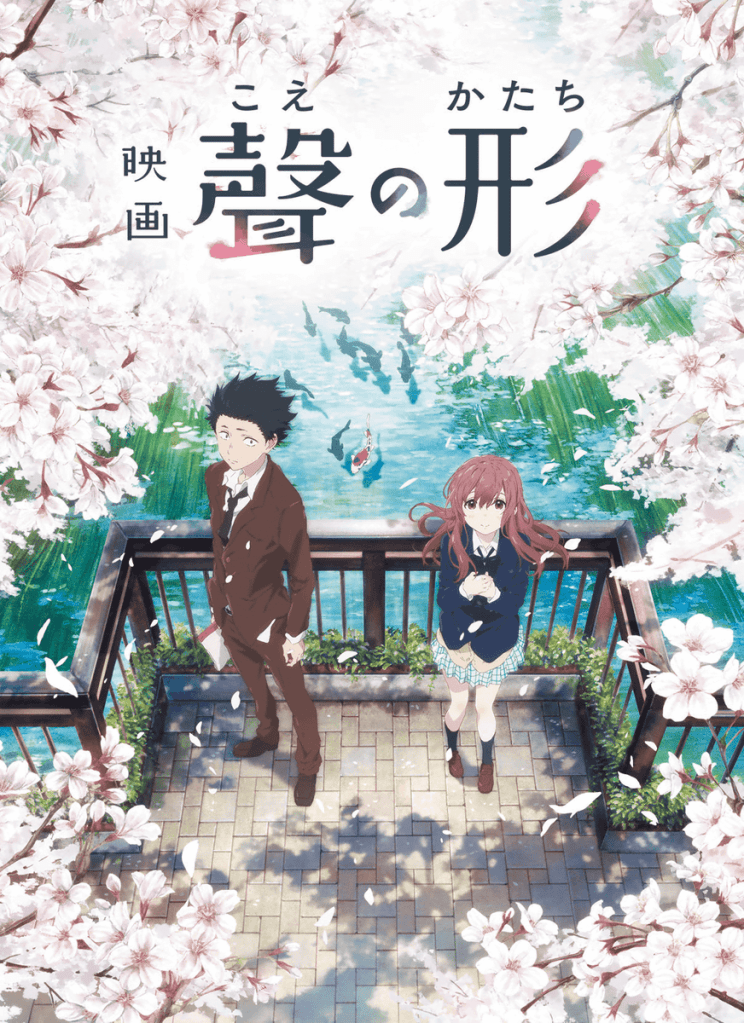
A Silent Voice (聲の形, Naoko Yamada, 2016)

silent-voiceChildren – not always the most tolerant bunch. For every kind and innocent film in which youngsters band together to overcome their differences and head off on a grand world saving mission, there are a fair few in which all of the other kids gang up on the one who doesn’t quite fit in. Given Japan’s generally conformist outlook, this phenomenon is all the more pronounced and you only have to look back to the filmography of famously child friendly director Hiroshi Shimizu to discover a dozen tales of broken hearted children suddenly finding that their friends just won’t play with them anymore. Where A Silent Voice (聲の形, Koe no Katachi) differs is in its gentle acceptance that the bully is also a victim, capable of redemption but requiring both external and internal forgiveness.

Classmates Shoko (Saori Hayami) and Shoya (Miyu Irino/Mayu Matsuoka) are almost mirror images of each other, sharing the first syllable of their names (at least phonetically) but representing two entirely opposite poles. Before Shoko transferred into his school, Shoya was the class clown, behaving disruptively and acting as the leader of a group of mean kids who, if not exactly bullies, certainly exert a degree of superiority over their meeker classmates. Shoko, hard of hearing, remains necessarily quiet, communicating through messages written on a notepad. Though some of the other pupils are fascinated by the novelty of someone like Shoko suddenly appearing, delighting in writing messages back and for and eagerly embracing the opportunity to learn sign language in order to communicate with her more easily, the mean kids, with Shoya as the ringleader, delight in making her life a misery just because they can.

Though some of the other children object to the way Shoya and the others are behaving, they do little to defend their new friend. Some of the more impressionable kids even halfheartedly join in, perhaps feeling bad about it but also enjoying being part of the angsty pre-teen group of nasty kids, but when it all gets too much and Shoko decides to move on everyone is suddenly struck with remorse and a need to blame someone else for the harm they’ve caused. Hence, Shoya gets a taste of his own medicine, ostracised by his peers as the lowlife who hounded a deaf girl out of school. Who’d want to hang around with someone like that?

Humbled, the stigma follows Shoya on into his next school as feelings of guilt and self loathing intensify until he reaches a point at which he can’t go on. Intending to finally end it all, Shoya unexpectedly runs into Shoko again and eventually manages to make a kind of motion towards an apology, attempting to make friends after all this time and making use of the sign language he’s taught himself to show his sincerity.

Isolated both by the continuing rumours of his primary school days and an intense personal feeling of unworthiness, Shoya finds it impossible to interact with his fellow students whose faces are each covered by a large blue cross. Bonding first with another lonely outcast, Shoya’s world begins to open up again but the spectre of his past continues to haunt him. Reconnecting with some of the other kids from primary school he finds that not everyone remembers things the same way they’ve become engraved in his mind. Though a few are anxious to atone, one of his former friends, Naoka (Yuki Kaneko), takes a different approach to the problem in continuing to blame Shoko – for the “attention” her condition attracts, the “requirement” for others to modify their behaviour to suit her, for simply existing in the first place enabling the behaviour which took place (about which Naoka remains unrepentant), and being the root cause that her merry band of friends fell apart.

If it seems like the tale disproportionately focuses on Shoya’s guilt and and redemption rather than Shoko’s suffering the balance shifts back towards the end as the pair truly mirror each other with another suicide attempt forming the climax of the second act. Shoko responds to her often cruel treatment with nothing other than friendliness, smiling with hands outstretched even whilst continuing to receive nothing but rejection. Though she may seem all smiles and sweetness, her overly genial persona is itself an act as she tries to overcompensate for the “burden” she feels herself to be causing through her need for “special treatment”. Eventually, Shoko snaps – firstly in primary school as her well meaning attempts to bring Shoya over to her side fail once again, and then later in a much more final way as she decides that there is nothing left for her in a world which fails to accommodate for difference.

The story of a girl who struggles to be heard, and a boy who refuses to listen, A Silent Voice is a quiet plea for the power of mutual understanding and reconciliation. Director Naoko Yamada and screenwriter Reiko Yoshida bring the same kind of quirky slice of life humour which made K-On and Tamako Market so enjoyable along with the raw visual beauty which has come to define Kyoto Animation to this often dark tale, perfectly integrating the more dramatic elements into the otherwise warm and forgiving world in a believable and natural way. Nuanced, complicated and defiantly refusing total resolution, A Silent Voice is one of the more interesting animated projects to come out of Japan in recent times and further marks out Yamada as one of its most important animation auteurs.


Screened as part of the Japan Foundation Touring Film Programme 2017.

Original trailer (English subtitles)

https://www.youtube.com/watch?v=9aRexOtovXY