Connected (保持通話, Benny Chan, 2008)

A kidnapped woman’s only hope is a distant stranger in Benny Chan’s intense thriller, Connected (保持通話). Inspired by 2004’s Cellular, Chan shifts the action to contemporary Hong Kong with all of its global anxieties but eventually insists that we are all in a sense connected and have a responsibility to each other in the face of corrupt authorities and an increasingly selfish society. In contrast to other techno thrillers, technology is not threat but cure enabling unlikely alliances and facilitating justice both legal and emotional as the heroes work together yet apart to unscramble the shady threat that follows them. 

Mainlander and top robotics engineer Grace Wong (Barbie Hsu) is having a fairly normal day dropping her daughter Tinker off at school before heading into work only to be blindsided by an oncoming truck and stolen away to a secret location. With no clue what’s going on she realises the landline in the shack where they’re keeping her is still connected but one of the goons smashes it before she can get through to anyone. Using her engineering skills she’s able to rewire the surviving bits but can only make random connections which is how she ends up getting through to conflicted debt collector Bob (Louis Koo) who has problems of his own as his son, raised by his sister after his wife’s death, is supposed to be emigrating to Australia this very day and will forever lose faith in his father for his constant disappointments if he doesn’t make it to the airport by 3pm. 

Bob’s buried goodness is immediately signalled by his discomfort with his job as he watches the more violent members of crew harass and intimidate a lone woman and her crying children in an ironic mirror of his son and Grace’s daughter both also in tears while pulled into the orbit of vicious outside forces. Though originally reluctant, assuming he’s on the receiving hand of a prank call, Bob soon comes to realise that Grace and also her daughter are in real danger and after an early attempt to enlist the police fails he is the only one who can save her. Nevertheless, he is torn between conflicting responsibilities, this one to a stranger and the other to his son who has entirely lost faith in him because of his broken promises and internalised shame over the nature of his job. He finds himself doing quite extraordinary things to keep both promises which further mark him out as a “good person”, such as firing a gun at the floor to get the attention of a bored shop clerk who’d been trolling him but then insisting on paying the full amount for his phone charger and not even stopping for the change. 

Even so, there’s further conflict on the horizon when it turns out the crooks, led by a spooky Mainlander, are carrying Interpol badges leaving a huge question mark about what’s really going on, who the good guys are in this situation and whose side everyone else is on. Unthinkable in the current cinematic climate, the spectre of police corruption raises its ugly head though despite having failed to respond when originally hailed wronged hero cop Fai (Nick Cheung) eventually jumps into action after noticing something suspicious enabling Bob to fulfil his heroic missions and followthrough on his promises. 

Filled dry black humour, Chan’s worldview is tinged with an irony that also makes its way into the extremely elaborate action sequences including a car chase that later plows through an entire truck of Pepsi Max, and a flirtatious boyfriend who swears to protect his lady love for all eternity only to run off at the first sign of danger. Yet there’s also an idealistic faith in human goodness in Bob and Fai’s refusal to back down in the face of injustice, each of them somewhat revitalised in their quests to rescue Grace whose engineering skills made the whole thing possible in the first place along with her determination of save herself and protect her family. It really is all connected, the intricate, slow burn mystery gradually revealing itself thanks to the growing connection between the heroes, each of them strangers but stepping up when needed unable to abandon someone in danger while refusing to allow corrupt authority to treat their homeland with such contempt.


Original trailer (Traditional Chinese / English subtitles)
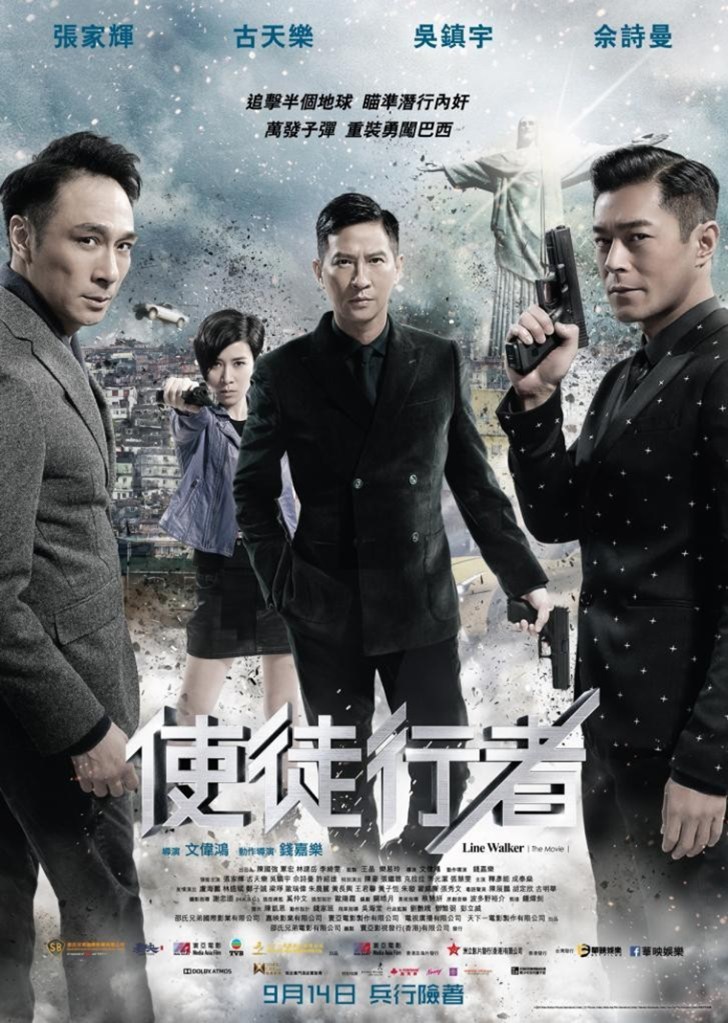
Line Walker (使徒行者, Jazz Boon, 2016)

When sitcoms make the transition to the big screen, they usually do so by going on holiday. Police procedurals are no different as Line Walker (使徒行者), a cinematic outing for a wildly popular Hong Kong TV series, proves by throwing its hat into the global ring with a Brazil bound drug based gang war. Taking more than a little inspiration from the classic undercover cop drama Infernal Affairs, Line Walker joins former undercover officer Ding and her handler Q as they receive a mysterious message from a missing operative identifying himself only as “Blackjack”.

Two years ago (as detailed in the TV series), a top Hong Kong detective, Hong, managed to find just enough time before being murdered to wipe all his data relating to officers currently working deep cover. Ditzy cop Ding (Charmaine Sheh) was one such asset, and together with her boyfriend who is also her boss, Q (Francis Ng), managed to round up and bring in all the other operatives save one whose file was corrupted beyond recovery. Therefore when they receive a message written in Hong’s unique code signed “Blackjack” they are cautiously optimistic.

The trail leads them to a corporatised Triad gang currently engaged in the usual Triad business of petty gang wars over drugs, territory, and power. Shiu (Louis Koo) and Lam (Nick Cheung) are best buds and underlings in the organisation with their eyes on bigger prizes. Making a trip to Brazil to broker a drugs deal the pair get themselves into various kinds of trouble which is only compounded by the “Blackjack” issue and suspicions of a possible mole in the gang.

Ding and Q are the only returning characters from the TV series which has received significant upgrades in the big screen jump with the addition of several Hong Kong superstars including Louis Koo and Nick Cheung. Though the central narrative stands alone, there is a degree of assumed familiarity with the ongoing backstory which is at times frustrating for the uninitiated but never much of a barrier. Line Walker does, however, suffer from the common pitfalls of the TV show making the jump into the cinematic world in that it can’t shake the artificial largeness of the small screen.

After beginning with a broadly comic sequence as Ding chases down Blackjack in a Macao casino whilst making time for slapstick pratfalls along the way, the tone progressively darkens until the final, gritty action based finale. Though the banter between the bickering couple Q and Ding is never less than amusing, Ding’s cutesy airhead routine feels out of place with the general tone of the rest of the film especially as she is also supposedly part of a team of elite undercover police officers.

In attempting to up the ante, Line Walker’s scriptwriters have thrown in twists and turns at every juncture as more and more diehard criminals suddenly confess that they are, in fact, undercover police officers. No one is telling the whole truth as double crosses and betrayals dominate the action with an overt Infernal Affairs homage set in the Olympic stadium. Frankly, it all borders on the ridiculous as plot twist plies on plot twist with predictable regularity though it does at least make things exciting.

Exciting is clearly the name of the game when it comes to the action set pieces which attempt to make the most of the cinematic budget. The most high profile of these are the Brazil set sequences filled with shootouts and car chases not to mention precision timed chain reactions of exploding vehicles used as bombs. The physical fights are impressively visceral but occasionally contrived. In one notable instance two men are attacked by a lone assassin armed only with a knife but almost allow themselves to be stabbed for no reason at all. When they do fight back, they do so one on one rather simply taking down the opponent by overwhelming him with their combined strength.

Caught between comedy crime caper and gritty heroic bloodshed, Line Walker can’t make either approach work leading to an abrupt and unsatisfying, if artistically pleasing, finale. Koo and Cheung do their best as the brothers in crime duo each realising that they can’t quite go through with betraying the other, moving from easy banter in the first half to angst ridden glares in the second, but they’re in a different picture from the sunny world of Ding and Q who are still stuck in the TV screen. Though the overworked plot and variable tone create serious problems, Line Walker does at least offer impressive action with a thin layer of comedy even if it fails to hit its emotional target.


Original trailer (English subtitles)