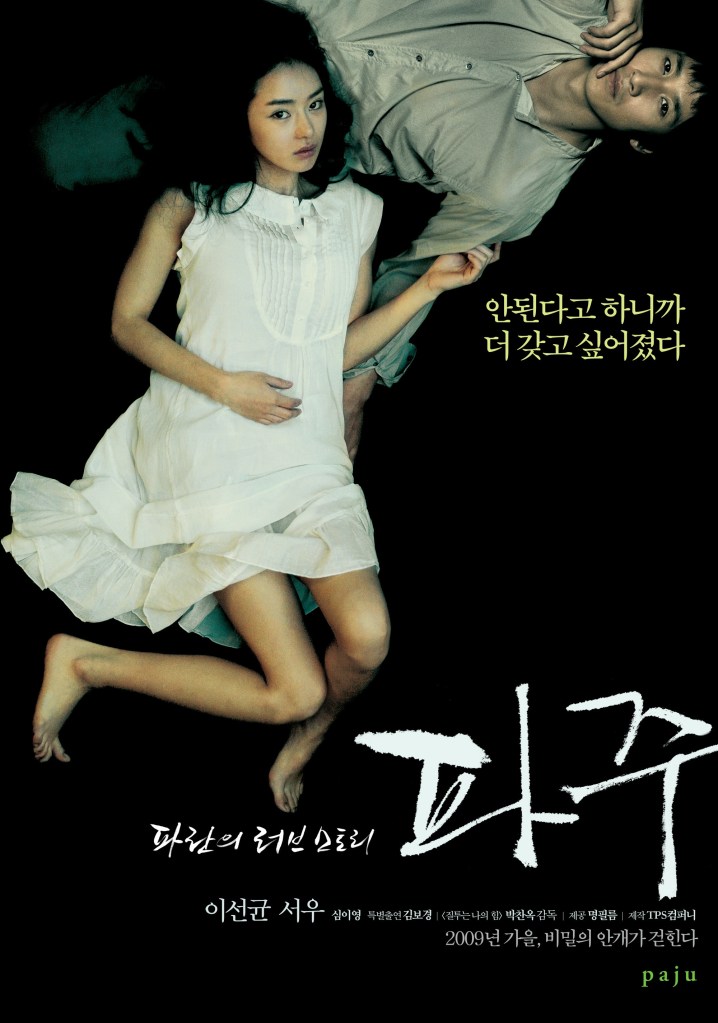
 Paju (파주) is the name of a city in the far north of Korea, not far from “the” North, to be precise. Like the characters who inhabit it, Paju is a in a state of flux. Recently invaded by gangsters in the pay of developers, the old landscape is in ruins, awaiting the arrival of the future but fearing an uncertain dawn. Told across four time periods, Paju begins with Eun-mo’s (Seo Woo) return from a self imposed three year exile in India, trying to atone for something she does not understand. Much of this has to do with her brother-in-law, Joong-shik (Lee Sun-kyun), an local activist and school teacher with a troubled past. Love lands unwelcomely at the feet of two people each unable to make us of it in this melancholy coming of age tale shot through with tragic irony.
To begin at the beginning, eight years prior to Eun-mo’s return from India, Joong-sik is hiding from the police in the home of his first love, now the wife of a comrade who, unlike Joong-sik, is serving time for unspecified political crimes. After Ja-young (Kim Bo-kyung) returns home from failing to see her husband in prison and aggressively ignores Joong-shik, he somehow manages to seduce her only for a tragic accident to befall her young son while the couple are busy in the bedroom.
Guilt ridden, Joong-sik runs away to religious friends in Paju in an attempt to evade the police and the unpleasant domestic mess he’s just created back in the city. Whilst there he meets the teenage Eun-mo and ends up marrying her older sister, Eun-su (Shim Yi-young). When Eun-su is killed in an accident, the pair end up living together as a family but Eun-mo’s growing maturity and Joong-sik’s past traumas conspire to ensure the nature of their relationship is, like their environment, in constant flux.
Joong-shik is a man with an uncertain outlook. Believing himself to be bad, he’s constantly trying to overcompensate in goodness by participating in church activities and getting involved in social activism. His political activity is more born out of a desire to appear to care, than actual caring, as he later confesses to Eun-mo. He got involved because he thought it was “cool”, stayed out of loyalty, and finally continues because he doesn’t know how to stop even though he thinks the struggle is pointless. Joong-shik is man who’s convinced himself he doesn’t deserve what he wants, so he avoids wanting anything at all and has become hollow as a result.
It may be this quality of vagueness that sets Eun-mo’s alarm bells ringing, aside from the obvious intrusion of a stranger into her necessarily close relationship with her older sister who is her last remaining relative following the deaths of their parents. Eun-su seems overjoyed in her unexpected marriage but cracks appear when Joong-shik remains unwilling to consummate the union. Ironically enough, Eun-su has a series of burn scars across her back which she speculates is the cause of Joong-shik’s aversion. Joong-shik does indeed have a habit of “burning” other people – from the accidental scalding of Ja-young’s son to Eun-su’s eventual fiery death of which her scars are a grim foreshadowing. This fear of being the harbinger of misfortune is perhaps why he finds honesty such a difficult concept, even if his main aim is to protect those he truly cares about from being burned by a truth which only he possesses.
With a touch of Antonioni inspired astuteness, Park begins the film in thick fog as Eun-mo attempts to chart her way back home to a town she no longer quite knows. The mist eventually lifts but Eun-mo spends the rest of the film lost in the haze, perpetually prevented from seeing anything clearly. Realising Joong-shik has lied to her about the circumstances of her sister’s death she becomes increasingly suspicious of him just as she’s forced to confront her (she judges) inappropriate feelings for a man who is technically a relative even if she didn’t suspect him of contributing to whatever it is that really happened to Eun-su. Each is hiding something, unwilling to reveal themselves fully to the other, intentionally blurring the world around them and damaging their own vision in the process.
Anchored by a stand out performance from actress Seo Woo in the difficult role of the emotionally fragile Eun-mo, Paju is a sad tale of the corrosive effects of guilt and unresolved longing. Eun-mo has returned home in search of answers to questions to she’s too afraid to ask, whereas Joong-shik has too many answers to questions he never stops examining. Sacrifices are made as Eun-mo and Joong-shik attempt to move forward but once again find themselves facing different directions as Eun-mo looks to the future and Joong-shik to the past. Beautifully shot with an intriguing non-linear structure, Paju is an ambitious indie drama realised with unusual skill and genuinely affecting human emotion.
International trailer (English subtitles) – WARNING! Contains major spoilers.

 Windows on Worlds