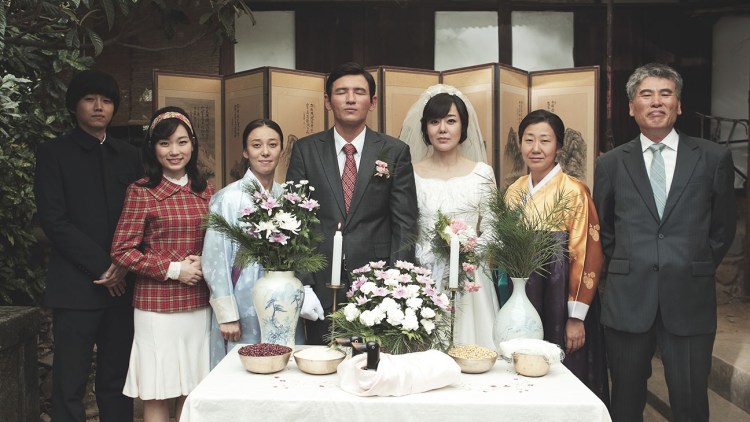
Ode to My Father (국제시장, JK Yoon, 2014)

ode_to_my_father_stillReview of JK Yoon’s Ode to My Father (국제시장, Gukjeshijang) – first published by UK Anime Network.


Of late, we’ve seen a lot of films attempt to trace the history of a nation through the story of one man and his family which ultimately becomes a metaphor for the that of the land itself. Many of these have come from China which shares something of the turbulent history that has affected the Korean peninsula over the last hundred years. In Ode to My Father, director JK Youn has tried to pay tribute both to his own father and to all the fathers of modern Korea who underwent great difficulties and suffered immensely in the hope of building a better, happier, future for their own children.

Mostly we view events from the point of view of Duk-soo – an old man at the beginning of the film who has made a success of himself and is surrounded by a large, loving family though seems to retain a kind of unresolved sadness. When we travel back with him, he’s just a small boy fleeing his homeland with his parents and siblings. As the oldest, he’s put in charge of his sister only to have her cruelly snatched away from him during the final escape. This event colours the rest of Duk-soo’s life as he carries with him both the tremendous guilt of having failed to protect his sister and of losing his father has he went back to look for her. The remaining family members gather together at the small imported goods shop belonging to an aunt which becomes another motif of the film.

Growing into manhood, Duk-soo is now the man of the house with both his siblings and his mother to provide for. Making countless sacrifices which see him abandoning his own dreams and travelling abroad to seek better paid work – first in the coalmines of West Germany and later the warzone of Vietnam, Duk-soo puts his family before himself every single time. Working tirelessly, Duk-soo grows up but inside he’s forever the little boy on a boat watching his father drift away him and desperately hoping he’ll some day miraculously turn up at the shop with a smile and an improbable story.

This is a story of painful separations and the shockwaves they send through the rest of one’s life and of all the lives throughout history. Having fled the Chinese and the communists in the North, Duk-soo and his family are excited about the prospect of being able to go home at the “end” of the war. However, this is a war which is still not technically over, merely suspended by a truce, and Duk-soo will never see his hometown again. Eventually, during the ‘80s, 30 years since Duk-soo was separated from his father and sister, a nationwide campaign is held to try and re-unite family members forced apart by the traumatic events of the 1950s. Entire squares in the city are covered with people desperately looking for each other wearing signs with their relatives’ names and point of last sighting, clothing etc all in the hope of finally finding each other again. Needless to say, some of these people are luckier than others and there are tears of both joy and sadness.

Still, all in all, Duk-soo and South Korea made a success of themselves even if there’s a resulting ache from the great wound which has split the nation in two. Much of the story is universal – a father’s love for his family, but Ode to My Father will obviously speak loudest to Koreans who can identify more strongly with the historical context. Yoon has also injected some humorous incidents involving real life Korean historical celebrities which may mystify international viewers even if they’re sign posted well enough that one gets the gist of it anyway.

Unabashedly sentimental and oftentimes overblown, Ode to My Father nevertheless succeeds in tugging at the heartstrings in all the intended ways. A paean to the post war generation and all that they endured in building the modern Korea that their children could live in without fear or hunger, Ode to My Father is in the end far too sugary but also, it has to be said, affecting.


Reviewed at the London Korean Film Festival 2015.
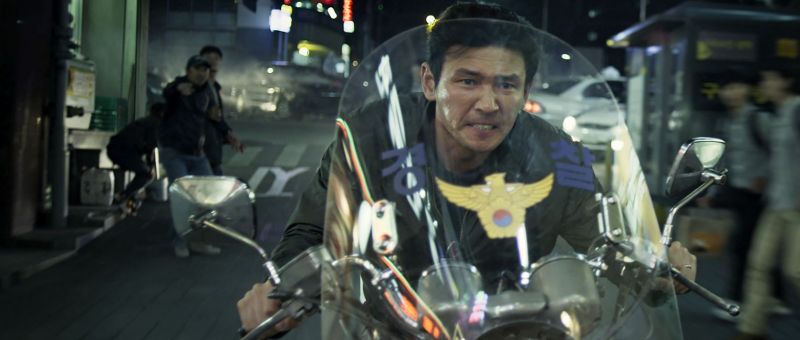
 

Veteran (베테랑, Ryoo Seung-wan, 2015)

1439210220_베테랑1Review of Ryoo Seung-wan’s Veteran (베테랑) – first published on UK Anime Network.


One of the top Korean box office hits of 2015, Ryoo Seung-wan’s Veteran is a glorious throw back to the uncomplicated days of ‘80s buddy cop crime comedy thrillers. A little less than subtle in its social commentary, Veteran nevertheless takes aim at corrupt corporate culture and the second generation rich kids who inherit daddy’s company but are filled with an apathetic, bored arrogance that is mostly their own.

Seo Do-cheol (Hwang Jung-min) is, as one other officer puts it, the kind of police officer who joined the force just to beat people up. He loves to fight and isn’t afraid of initiating a little “resisting arrest” action just to make things run a little more smoothly. However, when he strikes up a friendship with a put upon truck driver and his cute as a button son only to miss a crucial telephone call that eventually lands said truck driver in the hospital, Do-cheol’s sense of social justice is inflamed. After trying to join a trade union, Bae, the truck driver, is unceremoniously let go from his company. On taking his complaint directly to the head of Sin Jin Trading, play boy rich kid Tae-oh, Bae is subjected to the most cruel and humiliating “interview” of his life before apparently attempting to commit suicide after having realised the utter hopelessness of his situation. Incensed on his new friend’s behalf, Do-cheol is determined to take down these arrogant corporatists what ever the costs may be!

Veteran makes no secret of its retro roots. It even opens with a joyously fun sequence set to Blondie’s 1979 disco hit, Heart of Glass. Like those classic ‘80s movies, Veteran manages to mix in a background level of mischievous comedy which adds to the overall feeling of effortless cool that fills the film even when things look as if they might be about to take a darker turn. The action sequences are each exquisitely choreographed and filled with sight gags as the fight crazy Do-cheol turns just about any random object that appears to be close to hand into an improbable weapon.

Make no mistake about it either, this is a fight heavy film. Though Veteran has a very masculine feeling, it is to some degree evened out by the supreme Miss Bong whose high class high kicks can take out even the toughest opponents and seem to have most of her teammates looking on in awe, and the withering gaze of Do-cheol’s put upon wife who seems determined to remind him that he’s not some delinquent punk anymore but a respectable police officer with a wife and child who could benefit from a little more consideration.

Indeed, Tae-oh and his henchmen aren’t above going after policemen’s wives in an effort to get them to back off. Though this initial overture begins with an attempt at straightforward bribery (brilliantly dealt with by  Mrs. Seo who proves more than a match more the arrogant lackeys), there is a hint of future violence if the situation is not resolved. Tae-oh is a spoiled, psychopathic rich kid who lacks any kind of empathy for any other living thing and actively lives to inflict pain on others in order to breathe his own superiority. Probably he’s got issues galore following in his successful father’s footsteps and essentially having not much else to do but here he’s just an evil bastard who delights in torturing poor folk and thinks he can do whatever he likes just because he has money (and as far as the film would have it he is not wrong in that assumption).

He also loves to fight and finally meets his match in the long form finale sequence in which everything is decided in a no holds barred fist fight between maverick cop and good guy Do-cheol and irredeemable but good looking villain Tae-oh. Veteran never scores any points for subtlety and if it has any drawbacks it’s that its characterisations tend to be on the large side but what it does offer is good, old fashioned (in a good way) action comedy that has you cheering for its team of bumbling yet surprisingly decent cops from the get go. Luckily it seems Veteran already has a couple of sequels in the pipeline and if they’re anywhere near as enjoyable as the first film another new classic franchise may have just been born.


Reviewed at the first London East Asia Film Festival and the London Korean Film Festival.