I Haven’t Done Anything (좋.댓.구, Park Sang-min, 2022)

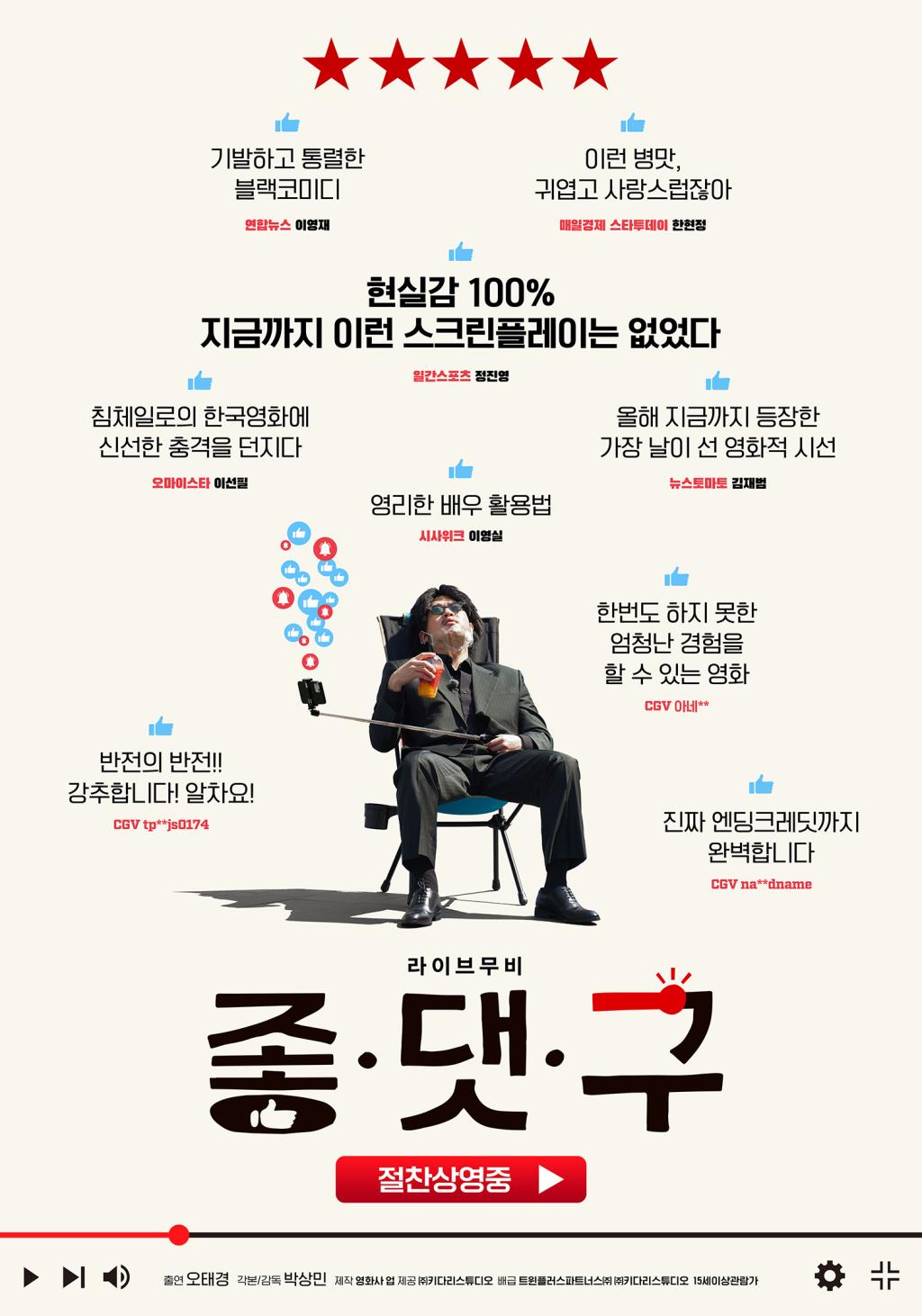
The central irony of Park Sang-min’s meta comedy I Haven’t Done Anything (좋.댓.구, Joh.Daes.Gu) is that a man who remains defiantly silent generates much more interest than the one desperately chasing YouTube success. Adopting a “screen life” aesthetic in which much of the action is told through social media and video screens, the film asks a series of questions about our petty obsessions, online authenticity, media manipulation, and the impossibility of escaping a predetermined image as its embattled hero strives to reinvent himself by his inhabiting most famous role.

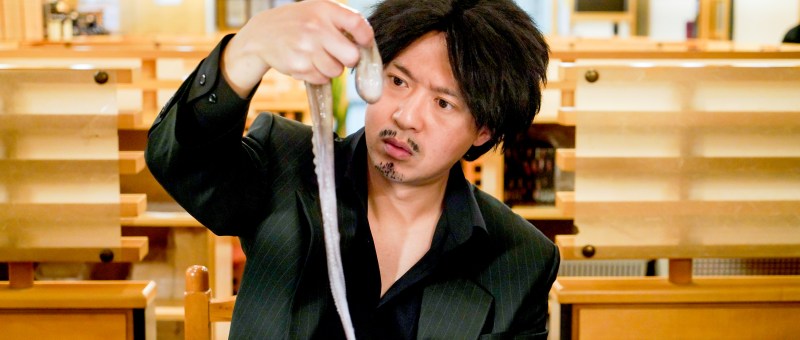
Actor Oh Tae-kyung plays a version of himself who is struggling to maintain his career as an actor having begun as a child star with his most high profile roles including that of the younger Oh Dae-su in Park Chan-wook’s Oldboy. With work thin on the ground, he turns to YouTube but fails to make an impact with content that commenters describe as old hat such as “mukbang” eating videos and unboxings. It’s then that he comes up with the idea of rebranding as “Li’l Oh Dae-su”, dressing up as the protagonist of Old Boy and accepting viewers’ challenges which at one point include him taking revenge on a gang of class bullies by hitting them on the head with a plastic mallet while mimicking the famous corridor fight scene from the landmark drama.

But then, someone else has already shared their screen with us. Going under the name “Bulldog”, a viewer asks Tae-Kyung to solve the mystery behind a man who’s been standing silently in the square with a large sign reading “I Haven’t Done Anything”. Tae-kyung reasonably wonders why Bulldog didn’t just ask the guy himself, but as he explains “Picket Man” refused to answer him. Given the large amount of money Bulldog has pledged for this seemingly simple request, Tae-kyung accepts the challenge but Picket Man continues to ignore him no matter the silly stunts he pulls an attempt to break his concentration. 

Bulldog’s apparently strong desire to know the truth, willing to offer up vast sums of money just to satisfy his curiosity, hints at our own petty obsessions. After all, the cryptic quality of the sign is intriguing. What exactly is Picket Man trying to say, what didn’t he do and who says he did it? Of course, in another way, Tae-kyung also feels he hasn’t done “anything” with his life and stuck in a career morass unable to shed the image of himself as a child actor and young Dae-su in particular. Every time someone offers him another role, he worries that the baggage of his early career follows him and he’s simply not credible as a hardened gangster, for example, if everyone only sees him as the eldest of six siblings in a much loved TV drama or the little boy who grow up to become the schlubby captive Oh Dae-su. 

When the skit becomes an accidental viral hit, Tae-kyung begins to worry that perhaps he’s doing Picket Man a disservice and this kind of publicity isn’t really what he was after though it’s puzzling that he himself refuses to speak about what it is he hasn’t done. What he realises is that Picket Man is much like himself and he’s done to him what others have done to Tae-kyung in reducing him to a single image. How will anyone ever see this otherwise anonymous person as anything other than “Picket Man” now? Tae-kyung has unwittingly exploited him for his own ends and possibly ruined his life in the same way that anyone who becomes a meme is robbed of an identity. 

Then again, in this very meta tale not everything is as we think it is and we ourselves, like the YouTube commenters, are being manipulated by unseen forces. As Picket Man becomes the latest social media phenomenon, other content creators start arbitrarily jumping on the hashtag, randomly mentioning Picket Man to boost their own views while unscrupulous forces also exploit the meme potential to run scams featuring Picket Man’s image. Park carries the meta quality through to interrupting the film with fake YouTube ads and product placement from sponsors that remind us we are being sold something whether we realise it or not and that we might not even realise what the product is or who’s selling to us as the final reveal implies. Nevertheless, there’s a sense of triumph in the success of this heist that’s been pulled on us in the winning self-deprecation of dejected former child star Tae-kyung and his great master plan to shed himself of an otherwise inescapable image. 


I Haven’t Done Anything screens 5th November as part of this year’s London Korean Film Festival.

Original trailer (English subtitles)
Decision to Leave (헤어질 결심, Park Chan-wook, 2022)

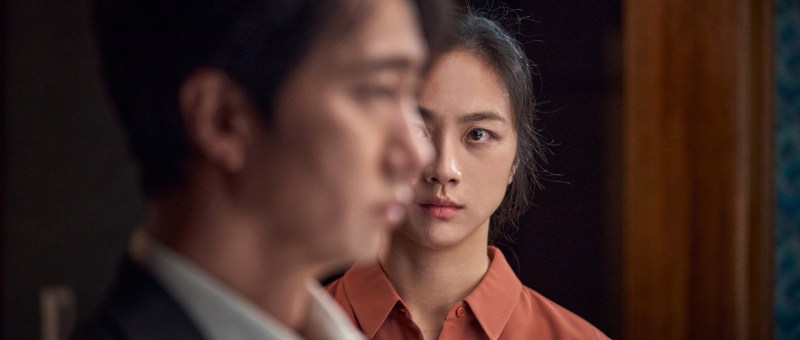
“I went through hell for you but without you my life would be empty” a fugitive murderer asks an insomniac detective to tell the woman he loves, making his own Decision to Leave (헤어질 결심, Heojil kyolshim) which will in fact be one of many in Park Chan-wook’s achingly romantic noir. Tinged with fatalism, the pursuit of love is also one of death and leads inevitably to a kind of haunting from which there is no real escape though you wouldn’t really want one anyway. 

In any case, the detective Park Hae-joon’s (Park Hae-il) sense of reality is already fracturing under the strain of his incurable insomnia. As he tells his partner, it’s not that he can’t sleep because of his obsessive stakeouts, it’s that he goes on stakeouts because he cannot sleep. Unfortunately for him, there have been relatively few murders lately. He wonders if it’s because of the nice weather, as if homicidal rage were being held in check by the gentle art of picnicking which it has to be said has a strange logic to it. Living apart from his wife who is a nuclear engineer in provincial Ipo, Hae-joon prides himself on being a good policeman and is preoccupied by his failure to catch two suspects currently on the run for a vicious murder. When he’s called to the scene of a dead body lying below a cliff, most are ready to rule it a tragic accident or perhaps a suicide but Hae-joon isn’t so sure especially given the unusual behaviour of the man’s much younger widow, Seo-rae (Tang Wei), who appears almost indifferent to her husband’s death and giggles to herself during an interrogation a habit she later claims is born of nervousness and a lack of confidence in her ability to speak Korean having migrated from China. 

Seo-rae’s Korean is perhaps a little better than she makes out, but still we see her repeating lines from romantic dramas on television, lines she later repeats to Hae-joon, while he wonders if her taste for historical romance has lent her Korean its archaic quality. They are each in a way out of time, she remarking that he strikes her as “dignified” to a degree she didn’t expect in a “modern” man while he ironically tells her that he was drawn to her because like him she liked to look at things directly. Yet there’s nothing at all direct about the mysterious Seo-rae whom he suspects of murdering her husband, and though there might be something unspoken directly understood between them their attempts at communication are always frustrated. Not only is there an ever shifting language barrier, but a mediation through text message and voice note or else through the act of being observed at a distance. As they grow closer, Hae-joon allows Seo-rae to listen to his surveillance tapes recorded as he voyeuristically watched her apartment from the rooftop opposite. She immediately deletes them but later does something similar herself, and is finally undone by her inability to delete a potentially incriminating recording because it has come to mean too much to her. 

The pair are in a sense perfectly matched. Hae-joon’s melancholy wife finally exclaims that he needs murder and violence in order to be happy, while Seo-rae admits that she ends up with terrible men like husband because it would take something extreme such as a murder for a good man like Hae-joon to take notice of her. As the couple dance around each other, Park colours their non-romance with shades of the gothic in the repeated motif of the crow feathers each of them find as they work their way towards the apotheosis of their love. As they say every love story is a ghost story and what is love if not an unsolvable mystery? Hae-joon’s sense of reality is forever in flux, Park playfully dressing Hae-joon’s new team and his old team in similar outfits as he segues between fantasy, reality, and memory while trying to parse out an objective truth. Hae-joon’s tragedy may be that he discovers more than he ought to know but not enough to solve the mystery, destined to be haunted by his unresolved cases and the elusive silhouette of lost love lingering silently in the mists of memory. 


Decision to Leave screened as part of this year’s BFI London Film Festival and is now on general release in US & UK cinemas courtesy of MUBI.

International trailer (English subtitles)

Angae (Mist) by Jung Hoon-hee (1967) which is also the title song for Kim Soo-yong’s 1967 film of the same name.

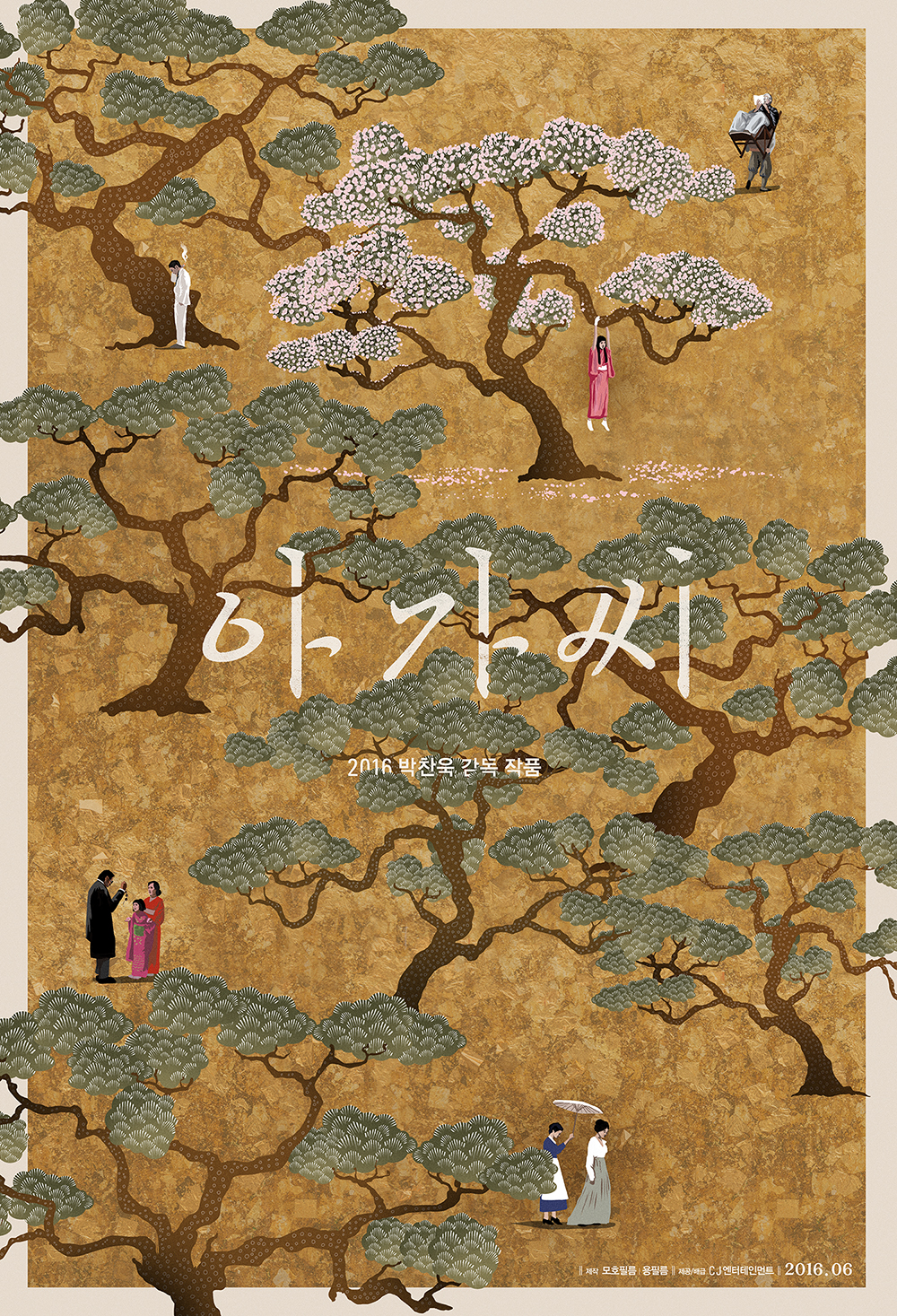
The Handmaiden (아가씨, Park Chan-wook, 2016)

handmaiden.jpgPark Chan-wook has something of a track record when it comes to bending literary sources in unexpected ways – who else would have thought of adding vampires to Thérèse Raquin and actually managed to make it work? In The Handmaiden (아가씨, Agasshi), his first return to Korean filmmaking after Stoker’s foray into American Gothic, Park adapts Sarah Waters’ Fingersmith – a Dickensian tale of love and the multilayered con, and relocates it to 1930s Korea under Japanese rule.

Ambivalent attitudes to the Japanese is a key element exploited by a ruthless conman posing as “Count Fujiwara” (Ha Jung-woo) in order to seduce a lonely heiress. To complete his elaborate plan, he needs the help of pickpocket extraordinaire, Sook-hee (Kim Tae-Ri), whom he will install as a maid in the household so she can subtly sell the virtues of the dashing nobleman to the innocent flower trapped in a well of opulence.

On arriving at the curiously constructed mansion which is an elegant architectural mix of Korean, Japanese, and English country estate, Sook-hee is quite literally out of place in the upperclass environment a world away from her home in a den of petty of thieves doubling as a baby farm. Another thing she had not quite banked on was that her new mistress, Hideko (Kim Min-hee), would be quite so pretty. A serious spanner is thrown in the works as a mutual attraction builds up between the two women who, for reasons which become apparent, are being pulled in separate directions by other desires.

Park retains Waters’ tripartite structure even if he jettisons the final plot reveal for a less intricate tale of liberation and escape. Beginning with Sook-hee’s narrative he introduces us to the first layer of the con but also to Sook-hee and her down and dirty home in the criminal underworld. Chosen by the Count for her supposed lack of intellect and innocent naivety, Sook-hee is not quite at home among her family either. Both believing the promise that the babies they collect and sell in Japan will be going on to better lives and lamenting the cruelty of the whole business in wanting to mother the lot of them, Sook-hee is soft presence yet she also wants to prove herself as adept at criminality as her legendary, now deceased, mother.

It’s this essential warmth which eventually attracts Hideko’s attention. The much talked about tooth filing scene in which Sook-hee takes out a thimble to soften a lacerating sharpness in her mistress’ mouth is not just notable for the oddly erotic quality born of the obvious suggestive motion, unavoidable intimacy created by the closeness of bodies, and the growing desire of fleeting, furtive glances, but for its essential kindness. Moving into Hideko’s perspective for the second chapter, more is learned about her damaged past filled with cruelty and abuse. Orphaned and brought to Japan as a small child by her pornography obsessed uncle so that he might train her to entertain him with readings of erotic literature before he eventually marries her to inherit the family fortune, Hideko has never known anything as simple as unguarded goodness.

Caught up in a long con, the choice remains whether to blow cover and declare one’s hand or play the thing through to the end, however painful it may be. Park takes a different route than in the original novel which makes both of its heroines the victims of someone else’s avaricious plot of revenge against the cruelty of an unequal world, eventually reinforcing their bond by a shared rejection of their victimhood, but even when their passions eventually erupt the lovemaking begins as a another “con” where Sook-hee takes on the role of the Count, “educating” the assumedly “innocent” Hideko in the ways of desire.

Trapped within an oppressive gilded cage of a prison, Hideko has become the embodiment of desire for her cruel and eccentric uncle and the groups of men he invites to listen to her read erotic literature as if reciting a classical play. Complete with sideshows of sex dolls and theatrical scenery, Hideko is forced to act out the scenes from the books as an actress on the stage for an audience rapt in silence. Unable to escape alone, Hideko is offered new hope by Sook-hee’s straightforward outrage which allows the pair to destroy or repurpose the instruments of their oppression for their own pleasure. This is, in essence, their form of revenge in which they simply remove themselves from an abusive environment leaving the men behind to wonder at what’s gone wrong and later to destroy themselves without any additional help.

Filled with a gothic sense of impossible desires and uncertain judgements, The Handmaiden is unafraid of the genre’s melodramatic roots but is all the better for it. Beautifully photographed, this opulent world of swishing ball gowns and gloved hands is undercut by the ugliness of quisling collaborator Kouzuki and his basement of horrors. Erotically charged but ultimately driven by love, The Handmaiden is another unconventionally romantic effort from Park albeit one coloured by his characteristic sense of gothic darkness.


Reviewed at 2016 London East Asia Film Festival.

Original trailer (English subtitles)
The Good News or the Bad News? Stoker, the Grandmasters and Show Box Media

I’m an efficient sort of person generally (not that you could tell from this blog), so I like to start with good news – after all good news doesn’t usually require any further action than being pleased, does it?

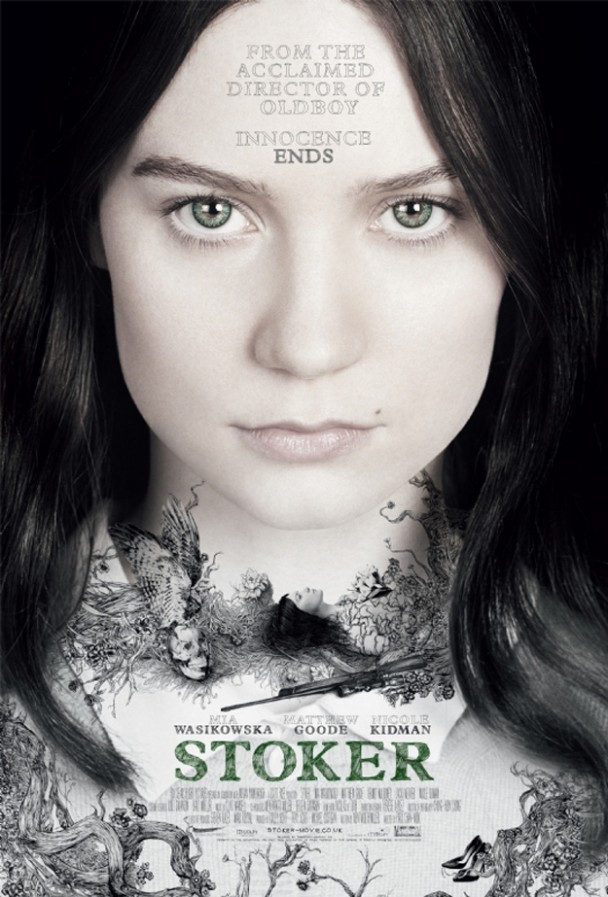
With that in mind, it seems there’s a new UK specific poster for Park Chan-wook’s upcoming English language movie Stoker

Stoker UK poster


We’ve still got the pencil work from the earlier poster, which I loved, plus a strangely creepy headshot of Wasikowka. What is that reflected in her eyes? someone standing in front of window/doorway/unexplained bright lights? I’m really looking forward to seeing this film – I’d be looking forward to the new Park Chan-wook anyway but this seems very promising to me especially as it’s inspired by one of my favourite Hitchcock movies – Shadow of a Doubt.

If you’ve never seen Shadow of a Doubt I’d really recommend you check it out; it seems to fall into the lesser known Hitchcocks for some reason – well the middle group, it’s much better known than something like MR& Mrs Smith but it’s not quite up there with Vertigo and Psycho when people think of his films. Joseph Cotten is really fantastic in it and it’s kind of an early look and the evils lurking in suburbia. Here’s a trailer for those still unconvinced


Now, I warned you, there are some clouds on the horizon. I leave the bad news until last so that I can figure out what to do about it right away but all I can do now is feel sad, it’s a zero sum game this time round. As I speculated here Wong Kar-wai’s The Grandmasters is indeed delayed once more and will now move its opening date to 8th January from 18th December. Oh well, it wouldn’t be a Wong Kar-wai movie without several thousand delays – we all just have to prove how worthy we are by being willing to wait, yes?

and your final bit of bad news? It appears Showbox media, who own CineAsia – primary distributor for Asian action cinema in the UK, have gone into administration. The warning signs were there, they seemed to have stopped communicating and updating their websites and had yet to announce any future release plans for the next few months/next year; they’d also apparently dispensed with Bey Logan whose commentaries on CineAsia’s releases had been a big selling point for UK fans. This has happened before and a solution was found, so maybe it’s not quite over yet but it certainly doesn’t look good. From the above report it seems their strategy of throwing everything they had at the supermarket buyers, licensing films which were likely to appeal to that market at those prices, was not as sustainable as some people had believed. Here’s a trailer for one of my favourite CineAsia releases – Detective Dee and the Mystery of the Phantom Flame. Whatever happens let’s just hope films such as this can still find their way over to the UK market!