Divine Bow (神弓 / 신궁, Im Kwon-taek, 1979)

“From now on we need think only of our children. We can’t pass on shamanism to them. Our children at least should have a bright future” insists a man whose horizons have in one sense been broadened but perhaps in another narrowed following forced immersion in the modern world. A classic “island” film, Im Kwon-taek’s Divine Bow (神弓 / 신궁, Singung) finds a conflicted modern day shamaness reassessing her place in a community which has systemically betrayed her while trying to find a path through the intensity of her grief and sorrow. 

Set almost entirely on the small fishing island of Naro, the film opens with a series of short, static shots of the rainy harbour where an old man sits and strokes his beard wearing traditional Korean dress while a group of seemingly unemployed young men look on listlessly from the boats. It seems the community is in crisis for a number of reasons, the most pressing being a non-existent harvest of fish which they are choosing to attribute to the local shamaness’ refusal to perform the customary rituals. Unmoved by their petitioning, Wangnyeon (Yoon Jeong-hee) advises them to hire her daughter-in-law instead, but for unexplained reasons they only want her, threatening to hire a shaman from a neighbouring island if she continues her policy of non-cooperation. As we will discover, Wangnyeon has her reasons beyond a simple desire for retirement from what is a fairly strenuous job for an ageing woman, but the return of her long absent son Yongban prompts her into a reconsideration of her past and future as well as her place in this community. 

Though the tale is set in the present day, the fishermen are convinced that Wangnyeon’s refusal to conduct the ritual is the reason their harvest has failed, apparently for the first time in 30 years ever since she “retired”. But then they also tell us themselves of more rational reasons they may no longer be able to fish including an oil leak in the surrounding seas and the corrupting influence of larger corporations for which many of them are now reluctantly working. It is precisely this incursion of modernity that has led to all the trouble. Taken off the island, presumably to fulfil his military service, Wangnyeon’s husband Oksu (Kim Hee-ra) observes the modern world during his time in the army and comes to the conclusion that his home culture is backward and superstitious. Hired to perform an important ritual on a neighbouring island for the first time, Wangneyon repeatedly delays the contract to align with her husband’s discharge so he can play drums for her as he always had before. His newfound sophisistication, however, has robbed him of the ability to play. He no longer believes in shamanism and eventually leaves once again to work on a ship in order to one day own a fishing boat of his own. 

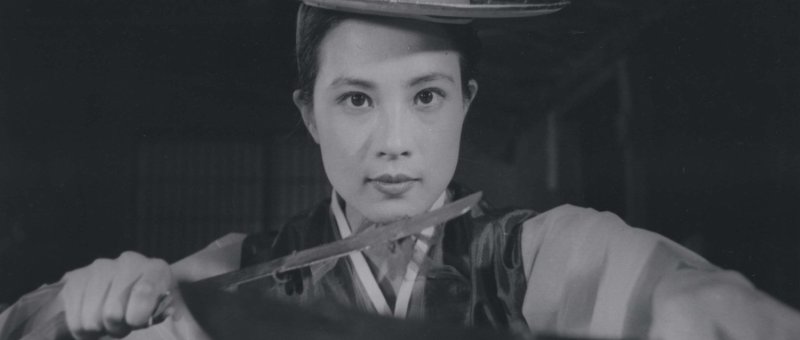
“What does a shaman do if not rituals?” Wangnyeon irritatedly asks her husband, in her case the answer apparently being a defiant nothing. Her refusal is part of her resistance to a world that has repeatedly betrayed her. Yet suffering economically temporarily loses her her son who, perhaps unlike his father, returns after a year of travelling more convinced than ever by shamanism if resentful that his mother has not yet relented and resumed her ritual duties. What we realise is that Wangnyeon has grown weary of her complicated place in the island hierarchy, existing to one side of the rest of the community who view her both with mild disdain and fearful awe. A victim of petty island politics, she takes literal aim at the corruption in her society and purifies it with her “divine bow”, mindful of Yongban’s pleas that her rituals are not just for her but for the many people who need to see them performed. 

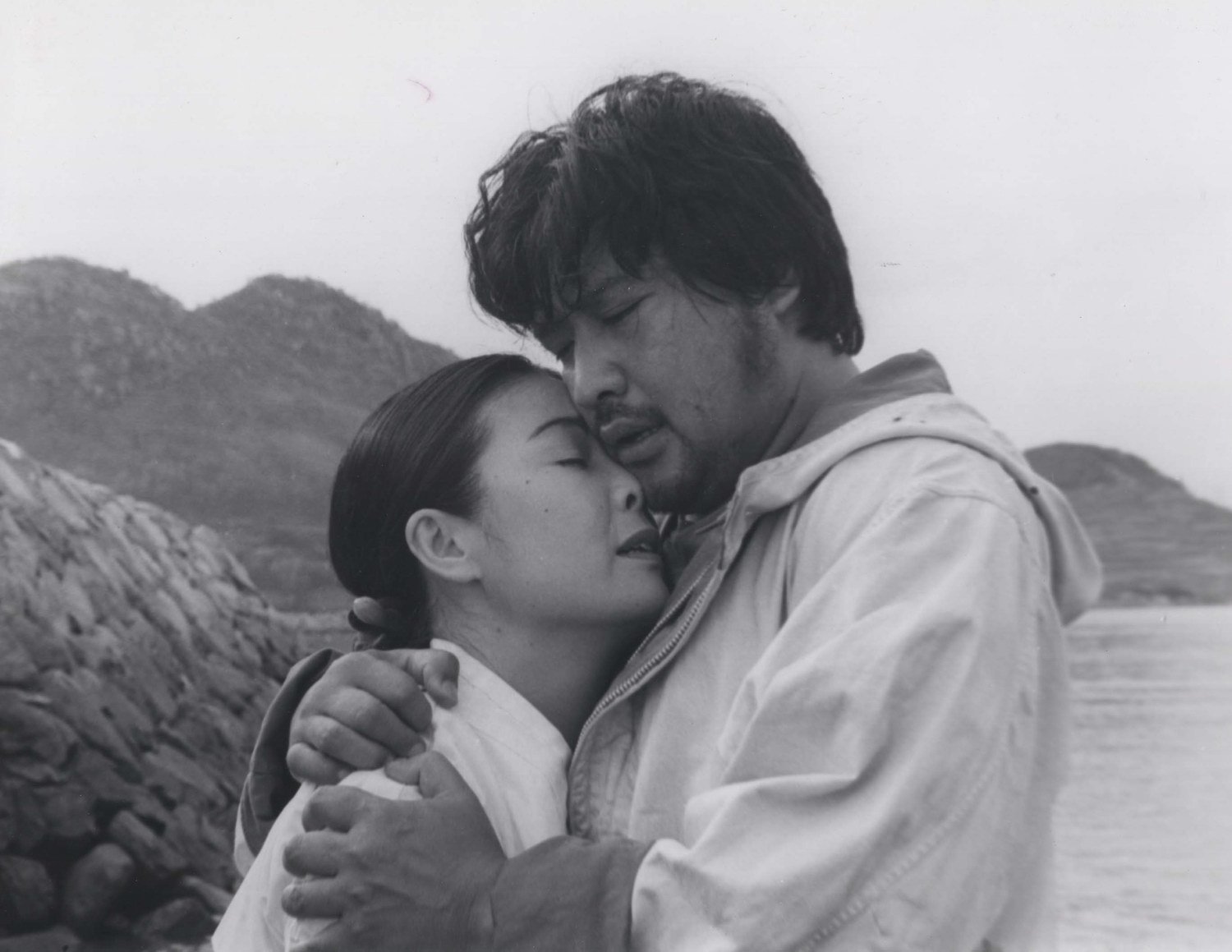
“Everything, everything, everything is a dream” Wangyeon sings, living perhaps in her own ethereal purgatory, her jagged life story revealed to us in a series of fragmentary flashbacks as she reflects on her present predicament while finally understanding what it is she must do, determining to pick up the divine bow once again and reassume her rightful role as the shamanness. Marking Im’s first collaboration with cinematographer Jung Il-sung, Divine Bow is rich with ethnographic detail exploring this small rock pool of traditional culture on an otherwise moribund island subject to the same petty authoritarian corruptions and ravages of an increasingly capitalistic society as anywhere else. 


Divine Bow streams in the UK until 11th November as part of this year’s London Korean Film Festival.

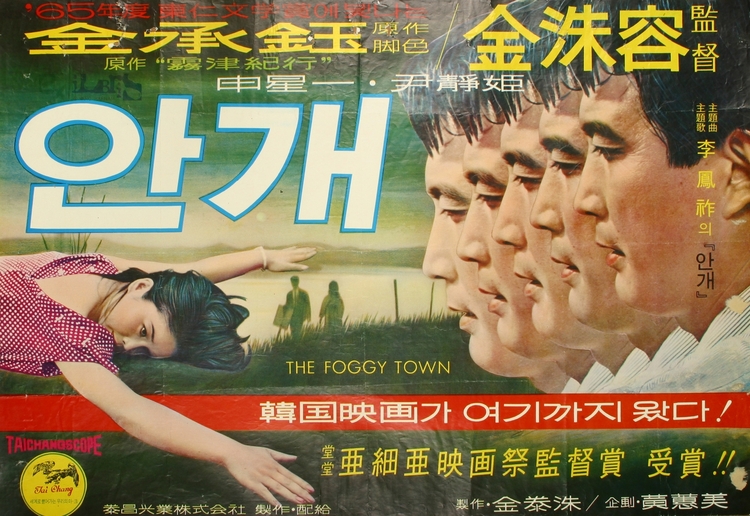
Mist (안개, Kim Soo-yong, 1967)

Mist 1967 posterBy 1967 Korea’s fortunes were beginning to expand. For the young, the future held promise but the nature of that promise was still indistinct. Often considered his masterpiece, 1967’s Mist (안개, Angae, AKA The Foggy Town) was another in the series of literary adaptations for which director Kim Soo-yong had become well known but its avant-garde mise-en-scène and gloomy outlook stand in stark contrast to the heartrending melodramas with which the genre was synonymous. Economic prosperity and superficial success have provoked only emptiness and despair, but a return to source provides little clarity for one harried salaryman lost in the expanding landscape of Korea’s global ambitions.

A poor boy from a remote coastal village, Gi-joon (Shin Seong-il) is now a successful salaryman in the capital where the constant clacking of typewriters, ringing of telephones, and racing of traffic rub at his tired mind. The fact of the matter is Gi-joon is not all that successful – he owes his position to having married the widowed daughter of the CEO. His wife and father-in-law, however, have relatively little faith in his business acumen and so, with the annual shareholders meeting on the horizon, they suggest he get out of the way by paying a visit to his hometown. Gi-joon is not all that happy to be going back, he hated Mujin with its unrelenting fog and general air of existential malaise, but he’s spineless and so he goes, despite himself.

Taking the train, Gi-joon has plenty of time to dwell on his past, literally seeing reflections of his younger self and entering extended flashbacks of memory. Mimicking the stream of consciousness approach of the novel, Gi-joon provides frequent voiceover, introducing his hometown in a less than favourable light as a place which traps its young who yearn to be free of its oppressive boredom. According to the irritated dialogue of two passengers on the bus (which Gi-joon has to take after his lengthy train journey), Mujin is a nothing sort of town where the sea is too shallow for fishing and the fields to narrow for farming, yet the population is large and largely survives on desperation alone, isolated by the oppressive fog that envelops the landscape each and every morning.

Gi-joon characterises the residents of Mujin as petty and materialistic. Having longed to escape, he thought he’d achieved his dreams in Seoul but a trip home forces him to reconsider what it is he’s become. In truth he’s no different from the petty and materialistic villagers he looked down on in their need to look down on each other. Powerlessness has defined his life. As a young man, he resorted to hiding in a cupboard to escape the draft on the orders of his terrified mother and later suffered from weak lungs which made him something of a local laughing stock. Now he’s set for a big promotion in the city but, as his wife reminds him, he wouldn’t even be there if it weren’t for her. Gi-joon’s marriage is one of convenience but it’s clear his wife holds all the cards – a wealthy widow with ambition needs a husband to act as a foil, and a weak willed man like Gi-joon is just the sort to submit himself to her authority in return for the obvious benefits she can offer him. Gi-joon has gained everything he ever dreamed of, but he feels only despair, oppressed by the very system he longed to be a part of.

Back in Mujin his various self delusions are rammed home to him. Trapped once again by the unrelenting fog, he longs to escape from his Seoul life and free himself from the yoke of his marriage and career. Whilst in town he meets up with old friends who introduce him to recent arrival Ha In-sook ( Yoon Jeong-hee) – an opera student turned music teacher who has joined the local school. In-sook is by far the most exciting thing in the extremely boring town, but Gi-joon is worried he’s stepped into the middle of something when he realises his old friend, Park, now a teacher, has a crush on In-sook while another old friend, Cho, now a status obsessed tax inspector, may also have marital designs.

Gi-joon didn’t need to worry about the tax inspector – as it turns out, he thinks he can do better than a mere music teacher and plans to marry up, much like Gi-joon has. Gi-joon bristles slightly at this, as he does to Cho’s lewd story about how he trapped In-sook on an overnight trip and planned to have a fling with her but she managed to get away (much to Gi-joon’s relief). Back home Gi-joon sees reflections of himself everywhere and particularly doesn’t like this alignment of himself with the ugly ambition of men like Cho who only want to lord it over their former friends. More flatteringly he sees his younger self in the depressed, conflicted In-sook who is already going half mad in the stultifying rural town and longs to go back to Seoul. Despite mild qualms about his friends’ feelings, Gi-joon finds himself bonding with the melancholy young woman who again forces him to see himself the way he really is rather than as the idealised personality he’d constructed for himself as a successful Seoul salaryman.

Bonding in their existential loneliness, the two eventually embark on a tender if melancholy affair which, despite their protestations to the contrary, is built on self delusions if not exactly on lies. Gi-joon intends to take In-sook to Seoul, but he won’t, and In-sook knows she won’t leave even if she wants to believe in the possibility of rescue. The world for them is as foggy and indistinct as the mists around the beaches of Mujin. Filled with emptiness and despair, they remain adrift in the post-war society unable to accept the soulless compromises of conventionality but finding no escape from their self imposed prisons.


Available on DVD as part of the Korean Film Archive’s Kim Soo-yong box set. Also available to stream for free via the Korean Film Archive’s YouTube Channel.