Suicide Troops of the Watchtower (望楼の決死隊, Tadashi Imai, 1943)

Produced by Toho and Chosun Film Production Corporation, Suicide Troops of the Watchtower (望楼の決死隊, Boro no kesshitai) was intended as a piece of imperial propaganda promoting a sense of unity between Koreans and the Japanese who had annexed their country in 1910 and thereafter ruled in an oppressive and often brutal fashion. Not that you would know any of that from the film which is directed by committed communist Tadashi Imai while equally surprisingly crediting Choi In-gyu as an “assistant director”, though Choi was already an established and successful director of colonial films such as Tuition (1940) and Angels on the Street (1941). 

Like Tuition the film is almost entirely in Japanese, Korean having been banned onscreen by this point, though small smatterings of Korean are heard in the background. The film is set in 1935, but there are signs visible at certain points reminding people to “use only the national language,” eg. Japanese, though one of the Japanese officers has apparently learned Korean to better communicate with the local community. Likewise, though Korean actors also appear in the film, they are mainly in smaller parts with the most prominent roles being played by well-known Japanese stars. Nevertheless, Korean characters have not generally taken Japanese names, but are referred to by the Japanese reading of the Chinese characters with which their names are written. Thus, the sister of the Korean border patrol officer who is killed is referred to as Eishuku (played by Korean actress Kim Shin-jae), rather than as Yong-suk. Meanwhile, another man remarks that if he called himself “Hayashi” he might feel more Japanese, while his wife has become accustomed to wearing Japanese kimono.

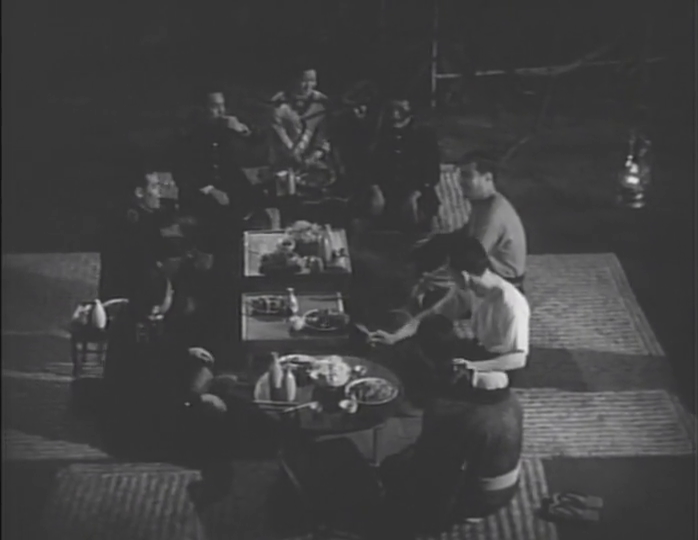
The earliest scenes of the film capture the idyllic pastorality of the Korean landscape and are intended to extend a degree of exoticism to the mainland Japanese audience who are likely less familiar with Korea or Korean culture. This is also true of the early scene in which members of the border patrol hold a welcome party for Asano (Hideo Saito) which takes place at a traditional Korean home. The men eat and drink outside sitting at low tables while the Japanese soldiers attempt to learn a Korean folksong taught to them by Kin. These scenes seek to paint colonial life as a more genial form of cultural exchange brokered by friendliness and respect even though in reality expressions of Koreanness are generally discouraged while the people are brutally oppressed and economically exploited. 

Unlike some similar films, however, Suicide Troops of the Watchtower presents Korean and Japanese people as equals who are fighting for the Japanese empire together. Though they are also portrayed as simple, rural people, the Koreans are never seen to be stupid or incapable and are overall honest and kind if grateful to the Japanese border patrol officers for protecting them from the bandits. In some surprising ways, the film at times presents a more progressive view of society than might be expected as the border patrol is universally supportive of Eishuku’s desire to become a doctor with one of the officers selling off his rice field to ensure she can continue her education after her brother’s death. The implication might be that this is an opportunity afforded to her by the “civilising” force of Japanese colonialism, but she is nevertheless encouraged to become an independent working woman who will also use her skills in support of the empire. 

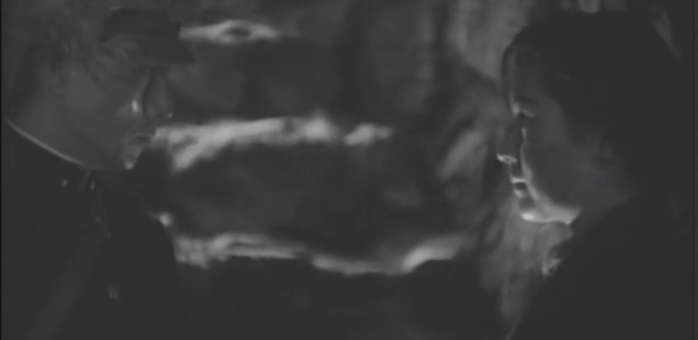
On the other hand, the Chinese characters seen in the film are all played by Japanese actors and are generally viewed with a degree of suspicion. Cafe owner Wanryu (Ichiro Sugai) has crossed the border expressly to escape the violent bandits of Manchuria, but is still mistrusted by the border patrol despite repeatedly pledging his loyalty to them. When a man in stereotypical Chinese dress with a wounded arm turns up in Wanryu’s cafe and ends up killing officer Kin when challenged, suspicion falls on Wanryu. The Chinese population has essentially been characterised as the “other” and the force against which the Japanese and Koreans are unified, which somewhat undermines the final pronouncement that the bandit problem has been solved by the elimination of the border now that Japan has conquered Manchuria. 

Though they are described as “bandits” and it is said that they have been pushed into Korean territory by Japanese soldiers pursuing them, it easy to read these insurgents as Korean Independence fighters many of whom had gone into exile in China, particularly in Shanghai. Wanko, the estranged son of Wanryu, is not just a young man who ran off to live a life of banditry, but a guerrilla fighter resisting Japanese imperialism. His eventual conversion born the desire to avenge the death of his father at the hands of bandit leader Koryo who meant to kill Wanryu fearing he had betrayed them by warning his father of the imminent attack, is then depicted as a kind of homecoming as border patrol chief Takatsu (Minoru Takada) agrees to release him so that he can fight alongside them. 

To that extent, it might seem surprising that the film makes the bandits seem so powerful to the degree that they pose a genuine threat the security of the empire. Their assault is staged in a way that resembles Hollywood westerns. At the film’s conclusion, it really appears as if all is lost and the border patrol will be wiped out by the bandits, partly because they are clearly understaffed which would seem to be a strategic failure on the part of the authorities. Takatsu’s ever capable wife Yoshiko (Setsuko Hara) is seen lugging weaponry around bearing out the all hands on deck mentality. At the lowest moment, Takatsu gives his pistol to his wife with the intention that she use it on herself when they are overrun while the Korean residents make similar plans with a new mother preparing to smother her baby if the need arises. 

In the end they are saved by the timely arrival of reinforcements thanks to the efforts of the new arrival Asano who had been unable to cope with the harsh life on the border and was determined to quit. Even the one Korean who had subversively complained about being exploited as free labour by the entitled Japanese occupiers chips in to help so that the bandits are eventually defeated by the united force of Koreans and Japanese officers fighting side by side. Even so, the closing speech insists that the colonial authorities will now continue with their ideal of bringing “order” to Korea. Commander Takatsu proves his commitment by giving up  the opportunity to return home to see his dying mother, while his wife becomes a maternal figure to the local community. Released in 1943, the film is perhaps an advocation for unity born of increasing desperation as Japan suffered repeated defeat and domestic strain, preparing its audience for the necessity of defending themselves against a similar onslaught while suggesting that all must work together to save the nation.

Rainy Days (장마, Yu Hyun-mok, 1979)

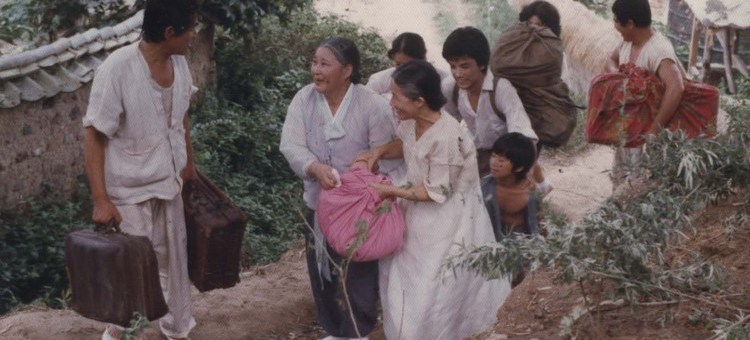
Rainy Season posterOften regarded as an “intellectual” filmmaker, Aimless Bullet’s Yu Hyun-mok returns to one of his central preoccupations in 1979’s Rainy Days (장마, Jangma). Released close to what would be an abrupt end to the oppressive and authoritarian rule of Park Chung-hee (which would be followed by another repressive military regime), Yu’s literary film falls into the anti-communist subgenre though Yu is careful to reframe his tale not as one of left versus right but of right versus wrong and of the dangerous gulf in-between. As it would in 1979, the political wind shifts without warning and then reverses itself leaving few untouched by the chaos and confusion of a government in flux. Rainy Days is a season of silence and tension, waiting for the sun but weathering a storm which may never end.

In the early 1950s, a family moves from Seoul to stay with relatives including Dongman (Choi Yong-weon) – the grandson of the older woman who is coming to live with her daughter’s family along with her university educated son Giljun (Kang Seuk-woo) and student daughter Gilja (Ju Hae-kyeong). Towards the end of the war, Maternal Grandmother (Hwang Jung-seun) has a prophetic and traumatic dream of trying to pull her own tooth which she interprets as a warning that Giljun, a serving soldier fighting for the South, has been killed in action. Sure enough, the next day a telegram arrives carrying the dreadful news back to the family. Maternal Grandmother tries to comfort herself as best she can, pretending to have grown used to the news thanks to her dream but in reality heartbroken and distraught by the loss of her only son.

Meanwhile, Dongman’s other uncle, the son of Paternal Grandmother (Kim Shin-jae), is off fighting for the North as a communist partisan hiding in the mountains. Suncheol (Lee Dae-geun) was once so kind hearted that as a boy he released the fish he caught in the local river, but when the communists took his village he was quickly seduced by their recently acquired power. While Giljun was forced to hide in a makeshift hollow covered by leaves in the woods, Suncheol was busy getting in with communists and though he claims to want to protect his family eventually informs on his brother-in-law only to find it blowing back on him when they doubt his commitment to the cause in not having turned the “Southern Sympathiser” in sooner. A simple man, Suncheol joins the communists and turns on Giljun as a reaction against his feelings of inferiority in the face of urban sophistication. Suncheol is cheerful and goodhearted, broadly liked by those around him, but he is also like a child who acts on impulse and takes things too far without considering the consequences of his actions just as he does when instigating a little “mob justice” against a villager who had tried to crack down on the trafficking of illegal moonshine much to the consternation of his neighbours.

The central conflict is dramatised by the sparky relationship between the two grandmas who have each passed into the age in which it becomes appropriate to voice one’s concerns openly without particularly caring how those views will be received. Paternal Grandmother, having opened her house to Maternal Grandmother and her children, feels herself to be in a position of superiority and is often wilfully unkind to her guests, offering a series of truly unforgivable words to the bereaved Maternal Grandmother who has, quite reasonably, cursed all the communists who are responsible for the death of her son. Seeing as Paternal Grandmother’s son Suncheol is a communist partisan she takes exception to this which provokes a fierce, accidentally political family row which may be eternally irreparable.

The North is, however, beaten back and the village retaken by the South. Suncheol is now a fugitive hiding in the mountains who has killed many men and fears he will not be forgiven even if he gives himself up to the authorities in the hope of rejoining his family. Proud Paternal Grandmother remains proud of her brave son, refusing to believe what they say about the partisans and secretly hoping for a resurgence of the North though like Maternal Grandmother before her she cannot say these words plainly for fear of getting into trouble with the authorities. When Suncheol makes a brief visit back to the family home, broken and desperate, to float the idea of turning himself in, it has grave consequences for little Dongman who is tricked into to informing on his uncle and earns the wrath of Paternal Grandmother in the process. Maternal Grandmother, however, has had more time to come to terms with her grief and is sympathetic to her grandson’s plight, knowing that he is just a child and did not understand the consequences of his actions.

Played by the wonderful Hwang Jung-seun, Maternal Grandmother becomes the heart of the drama. Having lost everything – her only son, her life in Seoul, her hopes for the future, she remains stoic, repeating the mantra that everything is fine because she knew all along how it would be. Following her painful outpouring of grief and war of words with Paternal Grandmother she comes to terms with her situation and tries to carry on as best she can with warmth in her heart. She even tries to forgive Paternal Grandmother and expresses sympathy for her as another mother losing a son in a stupid and senseless war. Paternal Grandmother cruelly pointed out that Maternal Grandmother would have no son to perform her funeral rites, but it is Maternal Grandmother who eventually performs the shamanistic ritual at the film’s conclusion in place of Paternal Grandmother, provoking a reconciliation of the two women and a banishment of the rancour which had existed between them.

Focussing tightly on the realistic emotions of the contemporary villagers who hold no particular political views but are caught in the middle of a war and simply trying to survive, Yu dramatises the tragedy of division not in a question of “good” Southerners, and bad “Communists”, but of bereaved grandmothers and broken families, ruined futures and fractured pasts. Yet once again he departs from the tragic ending of the novel for one which allows hope for the future. Little Dongman, put on house arrest by his irritated father, is finally allowed to go out to play with the other village children, rejoicing in the sunny skies and beautiful forrest scenery, returning to a childhood idyll now free of wartime confusion.


Available on DVD as part of the Korean Film Archive’s Yu Hyun-mok boxset. Also available to stream via the Korean Film Archive’s official YouTube Channel.

Mist (안개, Kim Soo-yong, 1967)

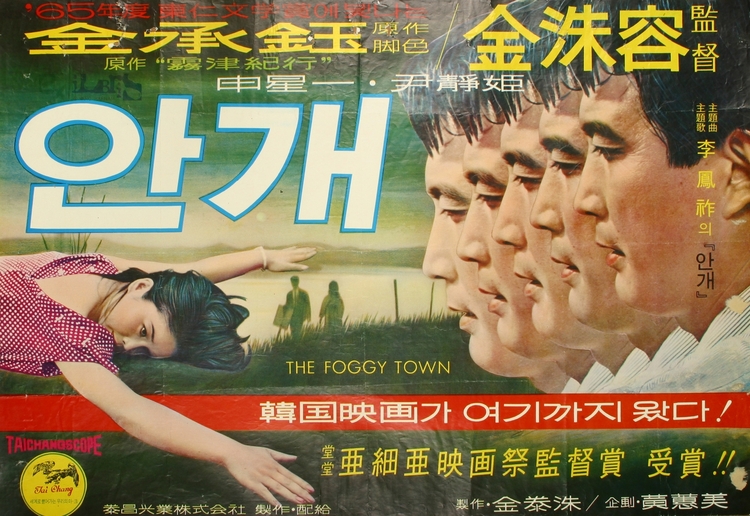
Mist 1967 posterBy 1967 Korea’s fortunes were beginning to expand. For the young, the future held promise but the nature of that promise was still indistinct. Often considered his masterpiece, 1967’s Mist (안개, Angae, AKA The Foggy Town) was another in the series of literary adaptations for which director Kim Soo-yong had become well known but its avant-garde mise-en-scène and gloomy outlook stand in stark contrast to the heartrending melodramas with which the genre was synonymous. Economic prosperity and superficial success have provoked only emptiness and despair, but a return to source provides little clarity for one harried salaryman lost in the expanding landscape of Korea’s global ambitions.

A poor boy from a remote coastal village, Gi-joon (Shin Seong-il) is now a successful salaryman in the capital where the constant clacking of typewriters, ringing of telephones, and racing of traffic rub at his tired mind. The fact of the matter is Gi-joon is not all that successful – he owes his position to having married the widowed daughter of the CEO. His wife and father-in-law, however, have relatively little faith in his business acumen and so, with the annual shareholders meeting on the horizon, they suggest he get out of the way by paying a visit to his hometown. Gi-joon is not all that happy to be going back, he hated Mujin with its unrelenting fog and general air of existential malaise, but he’s spineless and so he goes, despite himself.

Taking the train, Gi-joon has plenty of time to dwell on his past, literally seeing reflections of his younger self and entering extended flashbacks of memory. Mimicking the stream of consciousness approach of the novel, Gi-joon provides frequent voiceover, introducing his hometown in a less than favourable light as a place which traps its young who yearn to be free of its oppressive boredom. According to the irritated dialogue of two passengers on the bus (which Gi-joon has to take after his lengthy train journey), Mujin is a nothing sort of town where the sea is too shallow for fishing and the fields to narrow for farming, yet the population is large and largely survives on desperation alone, isolated by the oppressive fog that envelops the landscape each and every morning.

Gi-joon characterises the residents of Mujin as petty and materialistic. Having longed to escape, he thought he’d achieved his dreams in Seoul but a trip home forces him to reconsider what it is he’s become. In truth he’s no different from the petty and materialistic villagers he looked down on in their need to look down on each other. Powerlessness has defined his life. As a young man, he resorted to hiding in a cupboard to escape the draft on the orders of his terrified mother and later suffered from weak lungs which made him something of a local laughing stock. Now he’s set for a big promotion in the city but, as his wife reminds him, he wouldn’t even be there if it weren’t for her. Gi-joon’s marriage is one of convenience but it’s clear his wife holds all the cards – a wealthy widow with ambition needs a husband to act as a foil, and a weak willed man like Gi-joon is just the sort to submit himself to her authority in return for the obvious benefits she can offer him. Gi-joon has gained everything he ever dreamed of, but he feels only despair, oppressed by the very system he longed to be a part of.

Back in Mujin his various self delusions are rammed home to him. Trapped once again by the unrelenting fog, he longs to escape from his Seoul life and free himself from the yoke of his marriage and career. Whilst in town he meets up with old friends who introduce him to recent arrival Ha In-sook ( Yoon Jeong-hee) – an opera student turned music teacher who has joined the local school. In-sook is by far the most exciting thing in the extremely boring town, but Gi-joon is worried he’s stepped into the middle of something when he realises his old friend, Park, now a teacher, has a crush on In-sook while another old friend, Cho, now a status obsessed tax inspector, may also have marital designs.

Gi-joon didn’t need to worry about the tax inspector – as it turns out, he thinks he can do better than a mere music teacher and plans to marry up, much like Gi-joon has. Gi-joon bristles slightly at this, as he does to Cho’s lewd story about how he trapped In-sook on an overnight trip and planned to have a fling with her but she managed to get away (much to Gi-joon’s relief). Back home Gi-joon sees reflections of himself everywhere and particularly doesn’t like this alignment of himself with the ugly ambition of men like Cho who only want to lord it over their former friends. More flatteringly he sees his younger self in the depressed, conflicted In-sook who is already going half mad in the stultifying rural town and longs to go back to Seoul. Despite mild qualms about his friends’ feelings, Gi-joon finds himself bonding with the melancholy young woman who again forces him to see himself the way he really is rather than as the idealised personality he’d constructed for himself as a successful Seoul salaryman.

Bonding in their existential loneliness, the two eventually embark on a tender if melancholy affair which, despite their protestations to the contrary, is built on self delusions if not exactly on lies. Gi-joon intends to take In-sook to Seoul, but he won’t, and In-sook knows she won’t leave even if she wants to believe in the possibility of rescue. The world for them is as foggy and indistinct as the mists around the beaches of Mujin. Filled with emptiness and despair, they remain adrift in the post-war society unable to accept the soulless compromises of conventionality but finding no escape from their self imposed prisons.


Available on DVD as part of the Korean Film Archive’s Kim Soo-yong box set. Also available to stream for free via the Korean Film Archive’s YouTube Channel.