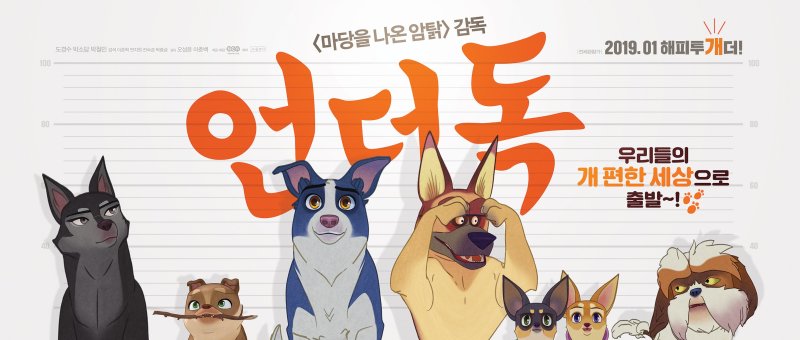
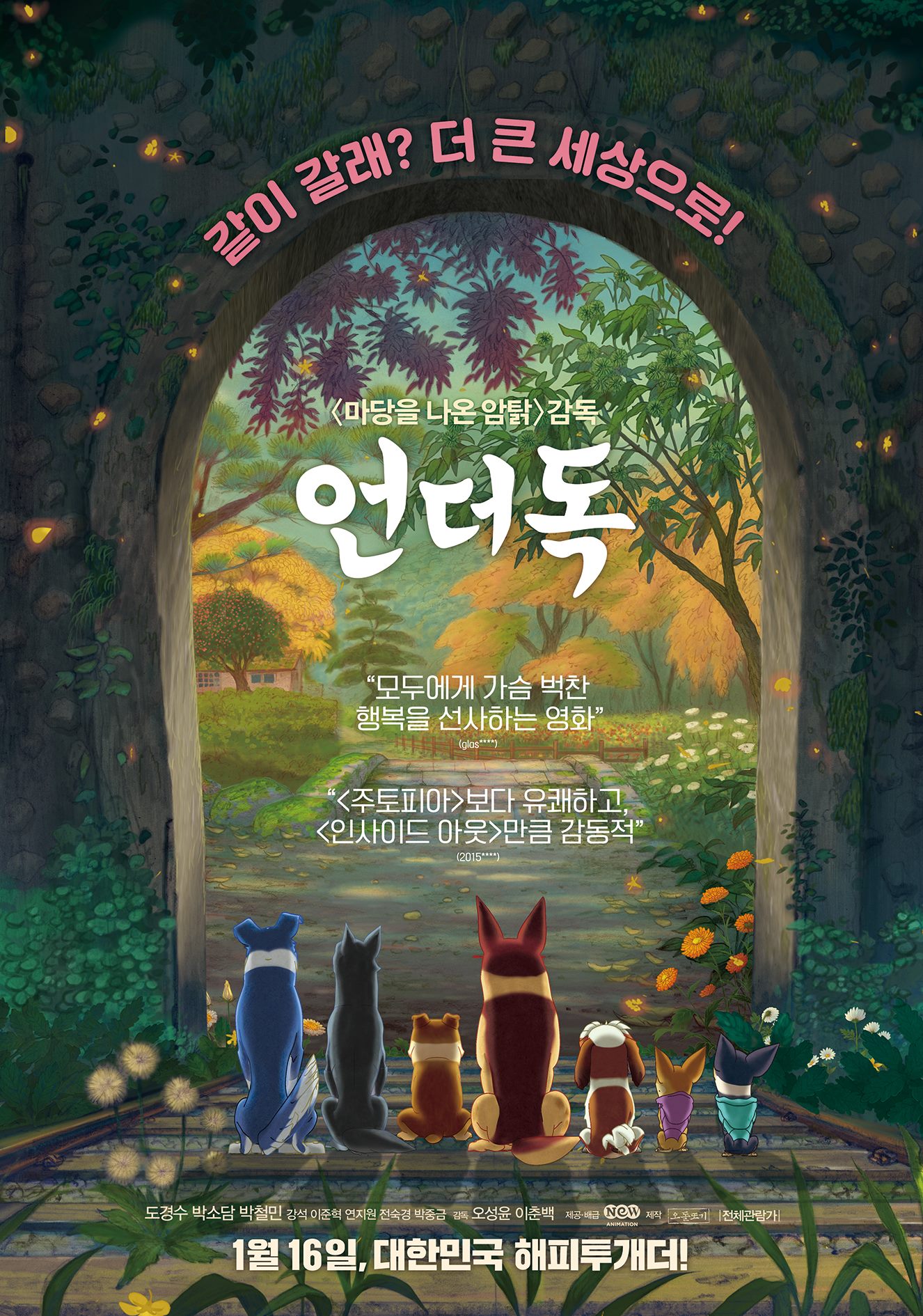
“If you want freedom, you need to know how to survive” according to a wise old hound in Korean animation Underdog (언더독), produced by the team behind Leafie: A Hen into the Wild. A somewhat subversive tale of an individualistic desire for total freedom outside the walls of an indifferent society, Underdog also celebrates the power of friendship and family while following our oppressed canines all the way into the ironic paradise of the DMZ, a literal cage but one guarded on either side and guaranteed free of human cruelty.
Our hero, Moong-chi (Do Kyung-soo), is a loyal family dog who has been raised as a domestic pet and knows nothing of life outside his apartment. Unfortunately, however, his owners bought a cute and tiny puppy without considering that he would eventually grow into a sizeable dog and so they no longer want to look after him. Heartless and irresponsible, Moong-chi’s owner drives him out into the forrest and leaves him there with a bag of kibble, seemingly aware that a domestic dog lacks the knowledge to survive in the wild. Pining and naive, Moong-chi fully expects his owner will be back to fetch him but eventually realises he’s been abandoned after meeting up with a small pack of other dogs in the same position and witnessing another car pull up and push a sick dog out of the passenger side before driving off.
Trying to survive together while taking refuge in a derelict house in an abandoned part of town, the dogs lament their dependency on humans who have after all broken their hearts and then betrayed them. As they weren’t born wild, they’ve been deprived of their natural way of life, corrupted by a false civility that leaves them totally at the mercy of humans for the sustenance they need to survive while lacking the skills to hunt or forage for food other than that already discarded by the townspeople. Opinions within the group are divided with some fully accepting that they have no other option than to depend on humans despite the danger and duplicity they present, and others longing to find a place that’s free of humankind where they can truly be free to live as nature intended.
For a children’s film, Underdog is entirely unafraid to be explicit in exploring exactly what “as nature intended” means, the ultimate goal of the dogs being to shift away from anonymous kibble towards tearing apart other kinds of wildlife with their bare teeth including cute bunnies and strangely scary deer. An early conflict arises between the abandoned domestic strays from the town and the true wild dogs from the mountain who complain that their hunting grounds and living environment are forever shrinking thanks to urban encroachment of which the strays are a minor symptom. The strays fear the mountain dogs for their ferocity, while the mountain dogs resent the strays for their neutered domesticity. Yet if they want to find freedom and a place free from human cruelty they’ll need to work together to get there.
Meanwhile, the gang find themselves continually stalked by a psychotic dog catcher (Lee Jun-hyuk) who, paradoxically, relies on the exploitation of dogs for his livelihood yet vows to wipe them all out, particularly keen on bagging Moong-chi’s potential love interest mountain dog Ba-mi (Park So-dam) with whom he has a history. Bringing in the full horror of puppy farms and questionable ethics of a commercialised pet industry, not to mention dog fights and the meat trade, Underdog asks some uncomfortable questions about the unequal co-dependencies of animals and humans which will probably fly over the heads of the younger audience, but in any case insists on the right of wild animals to run free while simultaneously acknowledging the ability to choose to remain at the side of humans when the gang run into a kindly couple running a small animal sanctuary way out in the country living a more “natural” way of life free of the petty oppressions which mark urbanity.
Nevertheless, the gang have an extremely ironic destination in mind in heading for the one place on Earth where human violence is not permitted, a buffer zone against the folly of war. Apparently seven years in the making Underdog boasts beautifully drawn backgrounds and an unusual 2D aesthetic that falls somewhere between cute and realistic while featuring scenes and themes that will undoubtedly prove distressing to sensitive younger viewers. Nevertheless, it presents a universal message of freedom and independence as well as solidarity among the oppressed as the abandoned dogs band together to find their path to paradise where they can live the lives they want to live free of human interference.
Underdog streams in the UK 6th – 9th November as part of this year’s London Korean Film Festival.
International trailer (Korean with English subtitles)
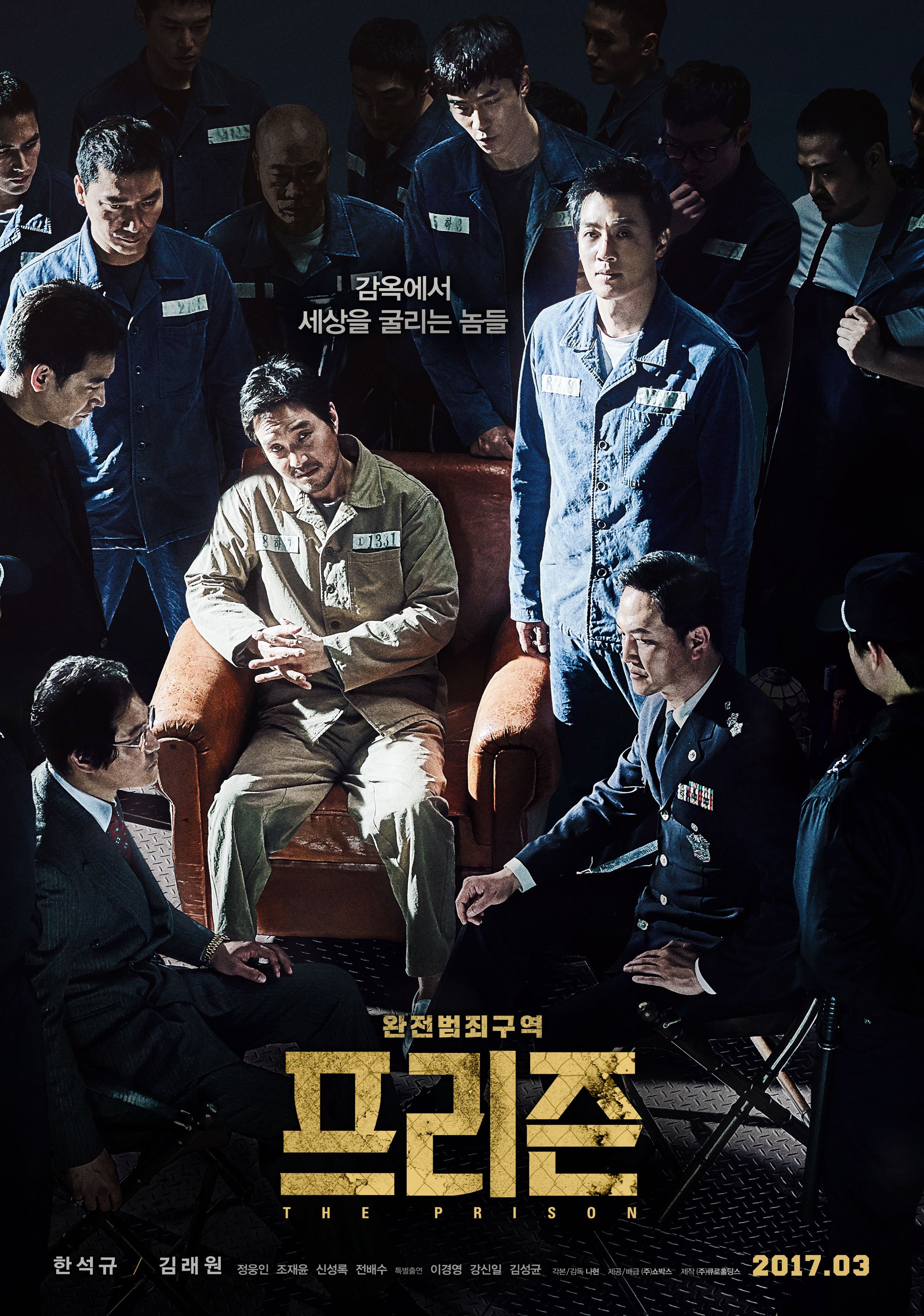 Prison can be a paradise if you’re doing it right, at least if you’re a top gangster in the movies. Na Hyun’s The Prison (프리즌) paints an interesting picture of incarceration and the way it links into his nation’s infinitely corrupt power structures. When investigators wonder why a crime spree suddenly came to an end, one of the frequently offered explanations is that the perpetrator was most likely arrested for another crime but what if you could turn this obviously solid alibi to your advantage and get those already behind bars to do your dirty work for you?
 Windows on Worlds