
Lost in Forest (山中森林, Johnny Chiang, 2022)

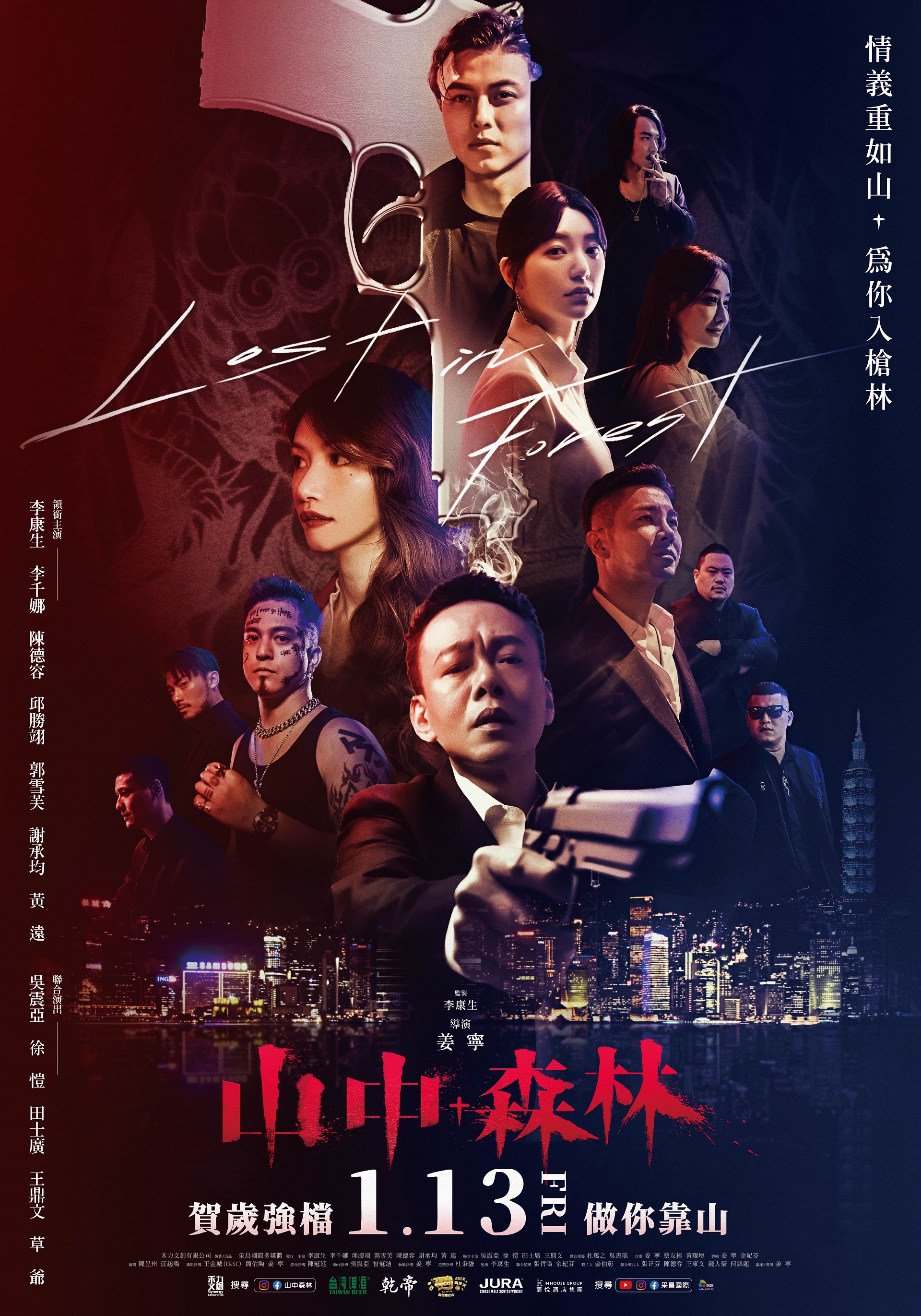
History repeats itself for a former gangster recently released from prison in Johnny Chiang’s melancholy neo-noir, Lost in Forest (山中森林, Shān Zhōng Senlín). Set in a neon-lit Taipei, Chiang’s moody crime drama finds its hero displaced in the modern society unable to look either forward or back while meditating on all he’s lost and another less corrupt vision of his home city as symbolised by his late father’s missing sausage bike and the changing back streets where it was once parked.

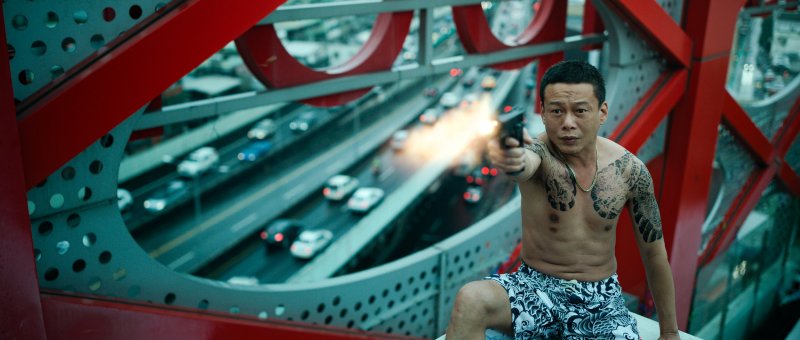
This Taipei is however a less wholesome place as suggested by Chiang’s frequent cuts to Christian churches and the giant neon crosses that sit above them as if looming in judgement on the chaos below. 12 years previously, Sheng (Lee Kang-sheng) opened fire on rival gang members who’d kidnapped his best friend and comrade Seagull (Angus Hsieh) who has now taken over the outfit while he’s been inside. Customarily, Seagull should have had someone come to meet him on his release, but Sheng exits the prison alone and is given a lift back into the city by the entourage collecting his prison buddy Ji despite the fact they are headed to an entirely different part of the country. Without a phone and not knowing where the gang even is anymore, all Sheng can do is hole up in a hotel until he finds out what’s going on. All of which suggests that despite his sacrifice, Seagull may not be particularly glad to reunite with him.

The conflict exists on three levels. Sheng must necessarily doubt his old friend Seagull, especially on realising that his new business model involves exploiting vulnerable women by pressing them into debt via high interest loans and then forcing them into sex work, while simultaneously worried about his guys who claim they have not been well treated while Sheng was away. But then it also becomes clear that much like many contemporary Taiwanese crime dramas, the real villain is institutional corruption as Seagull’s alliances with corrupt politicians and shady businessmen continue to destabilise the underground society thanks to the machinations of anarchic street punk Monkey (Sean Huang) who engineers a gang war by giving the businessman’s son a kicking as leverage in a dodgy land deal. 

On the one hand, Sheng watches history repeat itself as a handsome foot soldier, Chenghao (Prince Chiu), vacillates over leaving the gang for his respectable girlfriend Alice (Puff Kuo), while on the other Sheng becomes attached to sex worker Jing (Lee Chien-na), one of Seagull’s exploited women working for him to pay for her father’s medical bills. Sheng’s former lover tells him that if he really cared about her, he shouldn’t have sacrificed himself for Seagull just as Chenghao shouldn’t put himself in harm’s way out of a pointless sense of loyalty for a gang that has no real loyalty to him. Before his release, the prison warden had advised Sheng not to let his sense of loyalty get the best of him, but as he says Sheng no longer has much of anything else. His parents died while he was inside, the woman he loved married someone else, and Seagull can’t even remember what he did with Sheng’s dad’s sausage bike which is his only path back to a more wholesome existence. 

In a certain sense he’s powerless, unable to escape the inexorable pull of gangland karma until finally forced to reckon with the destabilising force that is Monkey to restore some kind of order and undermine the system of corruption that has arisen between underworld thuggery, local politics, and big business. The warden had also pointed at the fish in his tank and asked Sheng if it was happier in there or back in the sea but Sheng had merely said that it’s up to the fish to decide, hinting that in a certain sense it’s all the same and it’s just that one prison is bigger than another. At least the fish gets fed and is kept safe from predators even in its lonely isolation, which might be more than can be said for Sheng who can never truly escape his past even as he tries to free Chenghao and Jing from a similar fate. A melancholy mood piece, Chiang shoots night-time Taipei as a land of neon emptiness set against a classic jazz score that echoes Sheng’s deadpan ennui in a modern world of electronic smoke and rueful nihilism in which there is no escape from karmic retribution. 


Lost in Forest screens in Chicago April 16 as part of the 16th season of Asian Pop-Up Cinema.

Original trailer (Traditional Chinese / English subtitles)

As We Like It (揭大歡喜, Chen Hung-i & Muni Wei, 2021)

“It’s the crazy madness we call love” according to a series of bemused bystanders in Chen Hung-i and Muni Wei’s modernist take on the Shakespeare play, As We Like It (揭大歡喜, Jiēdàhuānxǐ). As the reframing of the title implies, no longer pleasing “you” but “we”, Chen and Wei’s all-female adaptation is an attempt to reclaim the stage taking a swipe at the Elizabethan prohibition on actresses while undermining the notion of a gender binary as the various lovers pursue their romantic destiny in defiance of heteronormative ideas of sex and sexuality. 

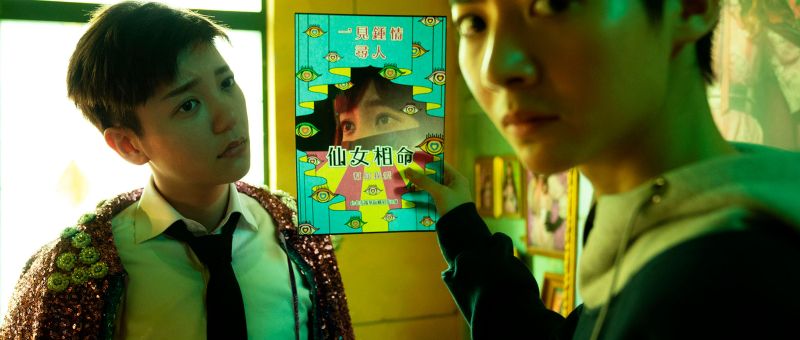
Rather than palace intrigue, however, the force which sends Rosalind (Puff Kuo) into the forest is romantic failure coupled with filial and financial anxiety. Her father, the Duke, has been missing for seven years and will shortly be declared dead at which point his company will be divided between the father of her best friend, Celia (Camille Chalons), and a random young man named Orlando (Aggie Hsieh) she was previously unaware of. Hoping to locate him, she winds up at a street fight in which she becomes Orlando’s eyes and he falls in love with her at first sight. For unclear reasons and drawing inspiration from traditional Taiwanese opera, Rosalind then decides to pose as a man, taking the name of Roosevelt, and later teaming up with Orlando in the hope of finding the Duke. 

Despite its best intentions, the awkward irony at the centre of As We Like It is that it accidentally ends up re-inforcing the patriarchal ideology it otherwise seeks to critique in that Rosalind’s romantic adventure turns out to be a series of manipulations at the hands of her long absent father. A romantic exile, it is she who remains unsure of her feelings, unwilling to admit the possibility that she is finally in love with Orlando and hiding behind the mask of masculinity in order to test her would-be-lover’s sincerity. The strange scavenger hunt the pair are forced to follow in order to find their way to the Duke amounts to a forced courtship, each of the pitstops another level up in terms of romantic intimacy culminating in an oddly eroticised ear cleaning date. While Orlando vacillates over whether it’s OK to fall for a boy because he reminds you of a girl, Rosalind is tasked with rediscovering her faith in romantic love which she does but only after talking to her father first. 

Celia, by contrast, seizes her own agency by defiantly seducing sometime antagonist Oliver (Joelle Lu) and becoming pregnant by him even before marriage. In this instance, Oliver is still the villain attempting to steal the business, even going so far as to send his thugs to chase Orlando down, the implication being that Celia’s love softens and then corrects him so that he might reconcile with his brother. Yet the final showdown introduces a new villain in the figure of Charles (J.C. Lei), Oliver’s chief thug apparently harbouring an unrequited crush on his boss and therefore extremely resentful of Celia. Yet her taunting of him asserting that hers is the final victory because she has done what Charles never could in conceiving Oliver’s child seems to fly in the face of the film’s otherwise egalitarian views on love, negating not only same sex love but also love between those unable to produce children uncomfortably heading back into a gender binary which makes maternity the essence of womanhood. This message is perhaps undercut by the closing moments in which Oliver and Celia argue about whether to buy boy clothes or girl clothes for the baby only for the shop assistant to advise a neutral white and cede the “choice” to the child in time but nevertheless seems an odd means of defeating the spectre of the unexpected antagonist driven to a dark place by the “madness” of love. 

Love’s “madness” may be the central theme though the sense of a world turned upside down is undermined by Celia’s maintenance of her position as a princess rather than relegation to the role of a peasant even as it affords her unexpected agency over the surprisingly pliable Oliver. The world’s uncanniness is fulfilled by its unreachability, set in an “internet-free” district of near future Taipei enhanced with frequent onscreen graphics where people send each other “slo-express” letter-pressed telegrams in place of “text messages” delivered by the human touch, implying perhaps that our increasingly depersonalised society is actively frustrating the path to love even while the idea of the idyllic and utopian Forest of Arden seems to have been co-opted by venal developers. Nevertheless, journeys end in lovers meeting to quote another play and love’s madness is eventually cured in its fulfilment. 


As We Like It screens on July 8 and streams online in Switzerland until July 10 as part of this year’s Neuchâtel International Fantastic Film Festival (NIFFF). Readers in London will also have the opportunity to see As We Like It at Genesis Cinema on 16th July courtesy of Chinese Visual Festival & Queer East

Original trailer (English subtitles)