Rewrite (リライト, Daigo Matsui, 2025) [Fantasia 2025]

A mysterious transfer student arrives from the future. You have 20 wonderful days with him, but then he must return to his own time. He tells you that he came back to meet you and experience your time because of a book you will write, and your future self also shows you the book, tells you you did indeed write it, and that everything’s going to be okay. But in 10 years’ time, when you’re your “future self”, you from the past does not show up to get any of this information. Did something go wrong? Is the timeline crumbling? Or did you just imagine all this as a manifestation of “youth”?

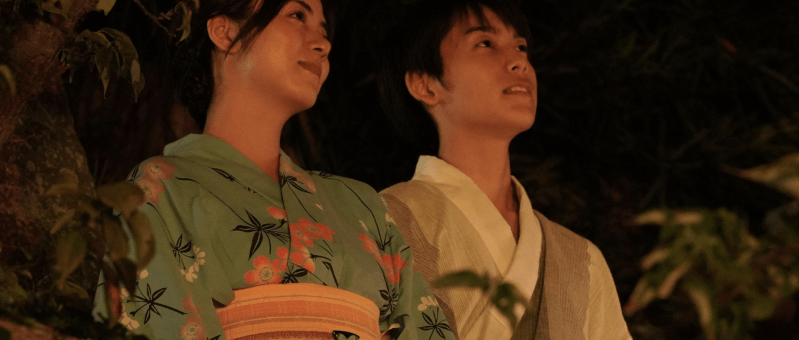
When this happened to her, Miyuki (Elaiza Ikeda) believed that she was “the heroine of that summer,” but the truth is of course that she was always the heroine of her own life and had the right and power to make her own choices. Adapted from the novel by Haruka Honjo, Daigo Matsui’s Rewrite (リライト) is, like Obayashi’s The Little Girl Who Conquered Time, about the dangers of nostalgia and the over romanticisation of youth. What Miyuki gradually comes to realise is that one of the formative experiences of her teenage years may not have been unique or special but happened to literally everyone and changed them too in ways that were not always good. Because she met Yasuhiko (Kei Adachi) from 300 years in the future, she became a writer. But it remains true that her first few books weren’t about him at all. She always had the talent and the inclination. The impetus of destiny was only what gave her the confidence to pursue it. She knew she could, because she already had.

Yet, she’s in her hometown to close a loop on this unresolved romance of her youth despite having built a good life for herself as a successful author with a nice husband she met during the course of her work who is caring and supportive of her career. At the high school reunion she’s cajoled into going to, her former classmates sing the song they were practising for choir, “Cherry” by Spitz, which is also about “rediscovering each other, some day, same place,” echoing Yasuhiko’s cryptic claim that they’d meet again “in the future” (whose he doesn’t say) hinting at the way these feelings have been left hanging with only a yearning for the past and a painful nostalgia in their place. What Miyuki really has to ask herself is if she’s the person she wants to be in the present and is who she is because of the choices she made independently rather than solely because she was trying to fulfil the destiny given to her Yasuhiko.

To do so, she must face the fallacy of the “chosen one” mentality. The film rams this home in the parallel story of one of Miyuki’s classmates who tells her that she wasn’t chosen but actively chose to accept a kind of destiny rather than simply going along with it and that Miyuki too could “rewrite” the past if she wanted. In effect, this is what she’s already done as her husband implies when he repeatedly asks her if the book is “fiction”. Of course, it is, though she believed it not to be because it’s rooted in nostalgia and the personal myth making of the idealised romance of her youth. Matsui too plays with this sense of nostalgia in moving the setting of the story to Onomichi to mimic that of Obayashi’s The Little Girl Who Conquered Time and making frequent visual references to the 1983 film along with casting Toshinori Omi, the original boy who leapt through time, as the class teacher at the 10 years later reunion.

But the truth remains that Miyuki must learn to let go of the past, or else take mastery over it by rewriting her own story to accept that, as her husband says, the past and present are all hers. She can write anything and can finally leave her own time loop by writing her way out of youthful nostalgia and accepting something more like an objective reality along with the life she has now which appears to be happy and successful. Scripted by Makoto Ueda who has a long history of time-travel themed movies from Summer Time Machine Blues to River, Matsui’s poignant drama is shot through with irony and in constant dialogue with pop culture touchstones from the Obayashi film to Shunji Iwai’s Love Letter, while at the same time insisting that while you are the main character in your own life, you’re not the only one and a hundred stories are going on at the same time as yours. What really matters is not hanging on to the memories of an idealised past, but to live the life you want in the present for as long as this particular loop lasts.


Rewrite screened as part of this year’s Fantasia International Film Festival.

Original trailer (English subtitles)
Our Huff and Puff Journey (私たちのハァハァ, Daigo Matsui, 2015)

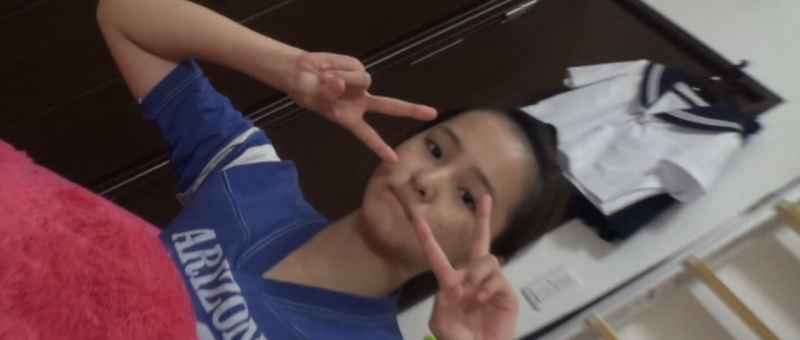
Generally speaking, teenagers aren’t really known for their ability to think things through. If the four high school girls at the centre of Daigo Matsui’s Our Huff and Puff Journey (私たちのハァハァ, Watashitachi no Haa Haa) had stopped to think things through, they’d never have gone on their completely mad, actually quite dangerous, road trip to Tokyo by bicycle but then perhaps adolescence is all about completely mad, actually quite dangerous things a thinking adult would automatically reject. 

Like Matsui’s earlier anthology film, How Selfish I Am!, Our Huff and Puff Journey is essentially a promotional video for the band Creephyp whose music features prominently throughout. The girls are all devoted fans who take band loyalty incredibly seriously and having seen them in concert in their hometown of Fukuoka decide that they need to chase them to the final leg in Tokyo the only problem being they’re teenagers with no money and Fukuoka is a thousand miles away from the capital. Setting off with a great deal of excitement (and total secrecy from their parents), they run out of puff by Hiroshima and end up dumping the bikes to hitchhike the rest of the way. 

It’s after Hiroshima that the novelty and sense of freedom begin to wear off as the cold, hard reality of their plan begins to hit home. Matsui turns the film on its head a little, still proceeding from the point of view of the teenage heroines but revealing how dangerous a place the world can be for a naive high school girl. At one point, they try to get jobs at a hostess bar despite being under age to earn a little money only two of them are deemed not pretty enough and sent home which further strains their already fracturing relationship. Though some of the drivers who give them rides are nice and just want the girls to get where they’re going safely others are not, such as the young man (Sosuke Ikematsu) who transgressively kisses the gang’s leader Settsun for the thrill of trying it on with a high schooler seconds after she gets off the phone with her boyfriend who quite understandably disapproves of the gang’s Tokyo-bound adventure. 

Of course he already knows a lot of what’s going on because the girls keep posting pictures from the trip online including those of them hanging out in clubs and bars. They obviously assume their parents won’t be checking Twitter, but nevertheless soon discover that social media can be a double-edged sword. Though they’d got some interest posting about their mad bicycle trip, an attempt to appeal to netizens for help when they run out of options goes south when they’re widely mocked online as a bunch saddos who’ve taken devotion to their favourite band far too far. It’s this that provokes a major schism when Chie decides to message a band member directly to ask for help with Fumiko left distraught to think that they might have made him worry or feel guilty, aside from hugely embarrassing themselves, only to discover that Chie only came along for a fun trip and doesn’t even really like Creephyp while Fumiko feels she really might die if they don’t make it to the concert. 

Matsui switches between the low-grade handheld of the gang’s video camera and his own his own more abstracted perspective but generally allows the girls to speak for themselves in a manner that feels authentically adolescent and suggests their obsession with Creephyp is at least in part a means of escape from the pressures of their lives with each of them thinking about life after high school. What they discover through their trip maybe a sense of life’s dead ends and disappointments, and that decisions made impulsively rarely work out the way you hoped they would. Looking out at the darkened city Fumiko laments that nothing seems to have changed despite the concert having begun, while later making another impulsive decision that also spectacularly backfires. Even so, Matsui allows them the final thrill of arrival at Shibuya Scramble, four young girls from rural Kyushu taking in the streets of the capital while knowing they will soon have to return to the “reality” of their high school lives and anxiety of what lies ahead. 


Our Huff and Puff Journey screened as part of this year’s Nippon Connection

Original trailer (no subtitles)

Just Remembering (ちょっと思い出しただけ, Daigo Matsui, 2021) [Fantasia 2022]

A communication breakdown gradually erodes the love of a young couple in Daigo Matsui’s melancholy romantic drama, Just Remembering (ちょっと思い出しただけ, Chotto Omoidashita Dake). Inspired by Jim Jarmusch’s Night on Earth, Matsui’s city vistas are drenched in loneliness and regret made all the deeper by the enforced isolation of the coronavirus pandemic while echoing the sense of rueful nostalgia that draws the fated lovers back together but unites them only in their shared sadness. 

Told in a non-linear fashion, the film follows taxi driver Yo (Sairi Ito) and lighting technician Teruo (Sosuke Ikematsu) through the course of five year relationship picking up on each of Teruo’s July 26th birthdays as time ticks by with a weary fatalism expressed by an ever present wall clock. As the film opens, a lonely Teruo celebrates a birthday alone watching Night on Earth which we later learn to be his favourite film, a poster adorning the wall above his bed, and something of a touchstone in his relationship with Yo who is like Winona Ryder in the movie a woman who drives a taxi. Echoing the film’s title, each of them repeatedly encounters reminders of their time together from forgotten hair clips to outdated profile pictures that hint at the unresolved nature of their failed romance. In a park that leads to Teruo’s apartment, a man (Masatoshi Nagase) is often seen sitting by a tree waiting for his wife to arrive he says from the future. The man and his wife may perhaps represent an older version of Teruo and Yo though in contrast to his absolute faith and willingness to wait it’s uncertainty and an inability to reckon with intangible feeling that eventually disrupt their connection. 

Awkward and anxious, Yo struggles to express herself in words yet is unable to understand the world without them whereas Teruo communicates through dance and feels words to be largely unimportant unable to fully convey thoughts and emotions. The pair are indeed the most connected when they’re dancing, the otherwise shy and subdued Yo captivated by Teruo’s movement and dropping her guard to dance spontaneously in a quiet back alley while the street guitarist who forever connects them plays quietly behind. When Teruo injures himself and is left unable to dance, it destroys his ability to communicate and places an unbearable strain on the relationship as he retreats to lick his wounds unwilling to bother Yo with his mental and physical pain while she resents the distance he places between them and reads his reluctance to burden her as a fault line in their romance. She tells him that however he may change her feelings won’t, which only sounds to him as if she only loves an abstract idea rather than the reality while he too fears that she won’t like the him that that isn’t a dancer because not even he really knows who that Teruo may turn out to be. 

It’s telling in a way that the central love confession occurs in a taxi that’s being driven by someone else, a bemused older man who encourages the pair that it’s best to say what you want to say while you can and literally stops time for them by pausing the meter as twinkle twinkle little star echoes ironically in the background. Yo says she likes her taxi job because she has a desire to travel but not the ability to choose a destination and driving the taxi allows her to feel as if she’s on the way to something though she’s only following her passengers’ instructions. Her essential trait is passivity, feeling lost and aimless in her life and often allowing others to make her choices for her save when she follows the advice of a lovelorn barman (Jun Kunimura) who tells her that sometimes you have to chase after what you want only to later be disappointed when the wounded Teruo fails to chase after her. The barman tells her that she doesn’t understand love, and perhaps she doesn’t unwilling to trust her romantic destiny while perhaps neither does Teruo, always somehow waiting while gazing at visions of love on ordinary street, high school girls gossiping about boys, an elderly couple helping each other down the stairs, and a mother carrying her infant son. 

It’s tempting to view their romance as doomed because they speak different languages while their continual role reversal suits neither of them very well, Yo quite literally in the driving seat but by her own admission having no idea where they’re going while Teruo struggles to communicate with her in terms she can understand. Yet they also share moments of true connection and vulnerability in which they are each understood by the other in a way they may never be again that leaves each of them with a lingering loneliness and regret for their failed romance. Love is an escape route, according to the wise old barman, but it’s one that continually eludes the two lovers who like the like man at the park are trapped in a state of perpetual waiting for a far off resolution. 


Just Remembering screened as part of this year’s Fantasia International Film Festival.

Trailer (English subtitles)