The Trap (罠 THE TRAP, Kaizo Hayashi, 1996)

At the beginning of the final instalment of the Maiku Hama trilogy The Trap (罠, Wana), a strange-looking man dressed in a long overcoat and wearing a mask to hide a facial deformity tries to hire Maiku (Masatoshi Nagase) to look for himself. It’s a decidedly odd moment, and it seems that Maiku, who takes every job that comes, turns the man down because it’s just too weird though in a way his refusal to grant his request may contribute to the unfolding tragedy. If previous instalments saw Hayashi in Nikkatsu Noir and Fukasaku territory, this time around he seems to be channeling Seijun Suzuki in his intensifying surrealism and bold use of colour.

Indeed, in one sense, this is a tale of doppelgängers. We first see the strange man lurking outside the cinema standing so still that until he slowly turns his head we assume he is a statue. What we later realise is that he wanted Maiku to look for someone who was making use of his identity along with perhaps returning to him his own. Nagase too is playing a double role and Maiku is also searching for himself eventually confronted by the fact the man he’s been looking for has his own face. 

Nevertheless, as the film opens Maiku is riding high. He’s doing very well financially after making a name for himself saving a child from a burning building. His sister Akane has got into a prestigious college, and he’s fallen in love with a woman from the post office, Yuriko (Yui Natsukawa), who is mute but can hear. By contrast, box office lady Asa remarks that nothing good’s happened since Maiku got his police commendation for saving the child adding to the sense that things are going far too well for Maiku and probably quite likely to plunge the other way. There’s currently a serial killer on the loose who’s abducting young women, drugging them, and posing their bodies in public places. Unfortunately, Yuriko becomes a target for the killer(s) after a moment of kindness to someone who was being bullied in a park. 

An orphan raised in the church, Yuriko seems to be the embodiment of an otherwise absent purity. She tells Maiku off for gambling and generally tries to improve him as a person while he later acknowledges her willingness to sacrifice herself for others perhaps even at the cost of her own life. Her forgiving nature might help her overcome the fact that Maiku and the detectives effectively use her as bait on two separate occasions swooping in to save her only in the nick of time. This moral dichotomy reinforces a sense of tension in the city in which good and evil co-exist on different planes just as past and present had in the previous film and further transforms Yokohama into a mystical, haunted place of ever present dangers. 

The sense of surreality is further heightened by the casting of actor Tetta Sugimoto who starred in Stairway to the Distant Past as the man in red but here seems to be playing an idealistic rookie cop, again countering the cynicism of detective Nakayama (Akaji Maro) who just wants to cut corners and get the job done rather than get it done right. Thus when Maiku is framed as the killer, Nakayama indulges in his long standing grudge against him and is determined to nail Maiku despite rookie Kozu’s insistence that he couldn’t have done it because they were together at the time. When even fingerprints can be faked, there is no such thing as reliable evidence.

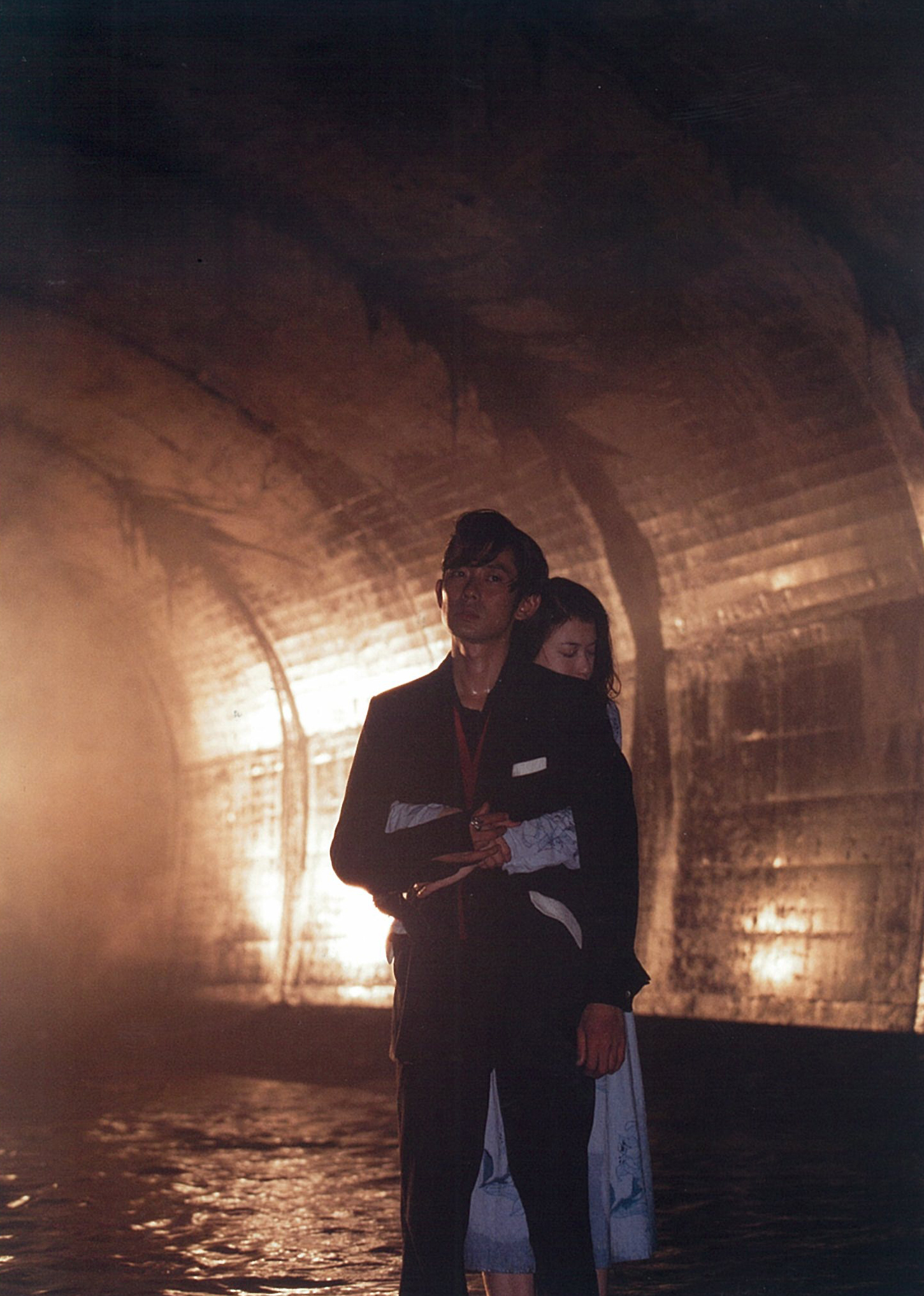
Hayashi once again makes fantastic use of colour from the expressionistic storm to the eerie, dreamlike closing sequence in which Maiku must face himself and battle his demons before being saved by the angelic Yuriko. Taking place in an atmospheric sewer tunnel, the climax has an oneiric atmosphere and surrealist edge as Miku confronts this man who has his own face only to lose the image of him at the critical moment and thereafter seemingly disappear himself. The moments after also have an unreal quality, a poster for the film we’re watching, The Trap, positioned behind Asa at the counter and Hai-Ping’s letter from the first film seemingly playing as part of the film screening in the cinema causing us to wonder if this too is a dream or fabricated future for one who will not return. Dark and disturbing in its implications, coloured by the real terror of living of Japan in the mid-90s which had just experienced a devastating earthquake and unprecedented terror attack, the film nevertheless displays the warmth of the Yokohama we’ve come to love with its cast of charming characters and cheerful atmosphere despite the eerie emanations at its centre.


The Trap screens 19th October at Japan Society New York.

Original trailer (no subtitles)

Pigs and Battleships / Stolen Desire – Eureka MOC Blu Ray Review


contains mild spoilers

 Pigs and Battleships, Shohei Imamura’s 1961 absurd portrait of the transformation of a small fishing port during the American occupation is a biting indictment of postwar society. Kinta (Hiroyuki Nagato), the young would be Yakuza, is excited when he is given responsibility over the gang’s latest asset – a herd of pigs, which they plan to fatten up and sell back to the Americans at an inflated price. His girlfriend, Haruko (Jitsuko Yoshimura), is unhappy about his connection to gang and constantly urges him to get a proper job. Kinta, however is unwilling to do this because he doesn’t want to end up like his father, sacked from his long time factory job after becoming ill, or be just another ordinary low age worker living hand to mouth. He seems to want to be something, someone more than that but also seems unable to do anything about it other than follow the gang. He likes the respect and the feeling of being the big man that the gang affords him but is unable to see that it’s illusionary, his status is only that of expendable fall guy in a petty gang of punks. Haruko’s family on the other hand are unhappy with her relationship with Kinta and constantly urge her to become the kept mistress of a wealthy American who’s shown an interest in her. For obvious reasons this isn’t something Haruko is very interested in doing but her mother’s quite violent instructions are becoming harder and harder to defy. Eventually Kinta agrees to go with Haruko to an uncle in another town who might be able to find them work, after he’s completed one final gang related task which he hopes will provide them with money to take with them. However, predictably things do not go to plan and the young couple’s hopes are frustrated.

There are only really two things going on in this town, the pigs and the battleships. Everyone is completely (and quite desperately) dependent on the Americans, they drive the entire town’s economy. The red light district in which the film is set is dedicated to catering for the foreigners on shore leave, and most of the women in the picture are engaging in either casual or outright prostitution, encouraged by their petty yakuza boyfriends or families. Even our heroine Haruko at one point, angry with Kinta but also with her family, decides to give this a go with disastrous results which leads to one of the most masterful shots of the film – the much praised spinning top shot which perfectly articulates the chaos and horror of that terrible situation. The entire town has become like pigs running toward a feeding trough, the final scene of the town’s women running to greet the newly arrived ship, desperate for attention and the material benefits that attention might bring. The only hope in this final scene is with Haruko finally leaving her overbearing mother, defiantly marching straight ahead through this crowd of baying women to start again in a new town, with a proper honest job away from all these corrupting influences.

Pigs and Battleships is a masterful film and in fact quite darkly humourous, highly recommended  for anyone interested in the history of Japan or Japanese Cinema. The Blu Ray release from Eureka’s Masters of Cinema series is top notch, the picture quality is mostly excellent  as is the soundtrack (the disc comes with optional English subtitles which are also very good).

Also provided is Imamura’s debut feature for Nikkatsu, Stolen Desire, the story of a middle class young man (also played by Hiroyuki Nagato) who ends up joining a traveling Kabuki (though leaning more and more towards burlesque elements) group, not so far away from the directors own youthful experiences. This is a more typical Nikkatsu B Movie, a ribald comedy with jokes about randy peasants, vain/difficult actors, misplaced love and the sort of tensions present within a traveling group  of artists who’ve hit upon slightly low times. However there are the uniquely Immamura elements that lift this above the rest, the documentary like opening for example and the genuine warmth with with he paints the earthy peasants in all their unbridled vitality. This is the first time this film has been available commercially available with English subtitles in the West and is definitely well worth seeing, its transfer, whilst not quite as strong as that of Pigs and Battleships is certainly very good. There is the odd cut or damage in the frame and the image is certainly a bit softer but it’s still an excellent transfer given the nature of the material. Both releases are accompanied by a booklet containing essays by Tony Rayns about each film which are very useful and informative. This is another fantastic release from MOC, very much deserving of a place in every collection. Fantastic.


Masahiro Shinoda’s Pale Flower (Kawaita Hana) Criterion Collection Blu Ray

Masahiro Shinoda’s 1964 film Pale Flower (Kawaita Hana) is a total break from the romanticised yakuza films that had been common prior to its release. Heavily influenced both by American Film Noir and by the French New Wave, Shinoda’s gangster underworld is dark and empty. There maybe pretty girls and oh so shiny fast cars but these yakuza spend their off time in bowling alleys and in other ordinary daily pursuits not so different from your average salaryman. As the film begins we meet recently released Muraki (Ryo Ikebe) who is traveling back to Tokyo having completed a three year sentence for committing a murder ordered by his gang boss. We hear him reflect less than fondly on his crime, but at the same time wonder why he’s been punished for ‘slaughtering one of these stupid animals’ which crowd around him, seemingly barely alive. On arrival he pays a visit a to an old girl friend who seems to be much more fond of him than he is of her. Then he goes gambling and sees the young, beautiful but perhaps just as empty as he is, Saeko (Mariko Kaga). Presumably from a wealthy background, Saeko spends her nights gambling vast sums of money, little caring if she wins or loses, living only for the brief thrill of chance. Together Mariko and Saeko wander aimlessly through night time Tokyo desperately trying to find some kind of meaning to this chaos but pushing each other ever further down into a spiral of thrill and transgression.

Shinoda’s direction and Masao Kosugi’s photography are really fantastic here. The Noirish light and shadows perfectly depict this murky, uncertain and claustrophobic world the protagonists are constrained by and totally establish this mood of alienation which is so central to the film. This is further assisted by the wonderful score provided by Toru Takemitsu. Relying heavily on dissonance and incorporating exaggerated or found sounds – tap dancing over the sound of the cards for example, the score brilliantly brings out the underlying menace of this environment. Indeed, the sound design is one of the most distinctive attributes of this film and is extraordinarily important in establishing the mood. The final set piece accompanied by a section from Purcell’s Dido and Aeneas is absolutely pitch perfect and has obviously become hugely influential.

This new blu ray release from the Criterion Collection is absolutely stunning, the picture quality and clarity are excellent. The contrast in the black and white photography is beautiful to behold. The remastered lossless sound is also richly delivered, with no problems of audibility. This fascinating film is a must for any fan of Japanese Cinema, Film Noir or New Wave. Highly recommended.

Attack the Block – Review

In Joe Cornish’s debut feature film, Attack the Block, aliens have suddenly begun to crash land on a South London estate, and following their first encounter with the inhabitants are definitely not coming in peace. It’s Bonfire Night, and nurse Sam (Jodie Whittaker) is walking home later than expected. Finishing a phone call she encounters one of those things we all dread in such occasions, a gang of rowdy youths blocking the road. She crosses over, some of them follow her, she decides to keep going when the leader of the gang approaches and asks for the phone, she hesitates and he releases a flick knife. Now he wants her purse, and her ring, but the ring won’t come off so he tries to force it and knocks Sam to the ground. Just then something appears to fall onto an adjacent car and explode. What was it, a firework maybe? The thugs approach but whatever it is wounds their leader and takes off, so off for revenge they go and our whole sorry tale begins.

This film looks absolutely fantastic, and its direction is totally assured especially for a first time filmmaker. Technically speaking everything about it is impressive and Joe Cornish has definitely succeeded in transferring into a new medium with immense skill, marking himself out as someone to watch. However, there are times when the film does not quite come together, or perhaps just narrowly misses out on transcending good to great, notably the end which is very abrupt (but perhaps in keeping with the nature of the film). The cast of mostly unknowns who make up our group of anti-heroes all give very fine and convincing performances, especially Moses, the leader whose arc is most central to film, excellently played by John Boyega. The depiction of life on the estate feels very authentic, down to the inclusion of current street slang and the film avoids patronising either its characters or the audience with stereotypical or reactionary attributes. There are a few misfires, such as Luke Treadaway’s middle class stoner, loser, zoologist desperately trying to fit into this concrete jungle and ending up becoming a walking plot point and inconsistent comic relief. Similarly Nick Frost’s small role is sometimes more of a distraction than anything else. That said, this is definitely the most enjoyable and accomplished British film for quite some time. If it doesn’t quite live up to some of the hype it’s not through want of trying and it will be surprising if this doesn’t end up becoming another cult hit in years to come!

13 Assassins – Review

Takashi Miike, perhaps best known (at least around these parts) for the disturbing horror/romance Audition, never one one to confine himself to the same genres, finally turns his attentions to the traditional samurai epic. In remaking the 1963 movie of the same name, Miike has made something that honours the chanbara tradition but also succeeds in giving it his own unique twist. The plot is standard samurai fare, an evil lord, Naritsugu, rising in influence feels free to indulge his every whim on his powerless subordinates, this includes rape/murder/child murder/mutilation/outright barbarity. Finally other lords grow weary of him, some committing suicide in protest and it is decided  that Naritsugu must be removed, however his personal forces stay loyal to the samurai code and to their lord. Enter Shinzaemon Shimada, a world weary samurai eventually convinced to take on the task of eliminating Naritsugu, who then gathers twelve other men to become the eponymous thirteen.

So far, so Seven Samurai. However, Miike’s usual quirks and personal touches are very much in evidence, if slightly more reserved than we’ve seen before. Surprisingly, much of the gore that’s been associated with Miike is often just out of shot, with prime place being given to the sound of the terrible acts taking place. We don’t see the lords committing suppuku, or Hara-Kiri, we hear them, the sound of the knife tearing through their flesh, of a head coming off and rolling away, and the effect is so much more terrible. In fact the entire soundscape of the film is very impressive, steel clashing with steel, arrows flying with total clarity and we never lose sight of where we are. The final battle scene is remarkably well done, it never drags and Miike keeps such tight control that even through all the chaos of the battlefield, the audience is never allowed to get lost. Any fan of Miike or of the samurai genre would regret missing this, a very notable addition to both groups.

Thor 3D – Review

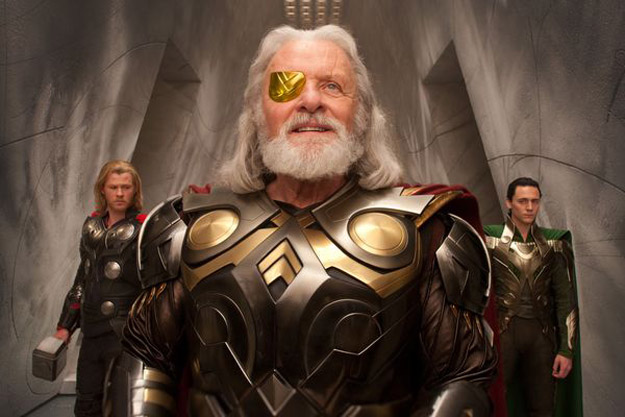
Thor, the major motion picture, is of course based on the Marvel comic series, itself inspired by Norse mythology with more than a little good humour thrown in.  There has been, so we learn, twenty or so years previously a terrible war between the Asgardians and the Frost Giants, which has resulted in a long held truce but evidently also resulted in distrust and mutual fear. Back to the contemporary action, we fast forward to THE MIGHTY THOR’s day of celebration which is mysteriously interrupted by a Frost Giant incursion, designed to take back their source of power which the Asgardians are holding as a part of the truce. Outraged by this personal affront and public embarrassment, discouraged by his father and egged on by his mischievous brother Loki (Tom Hiddleston), Thor sets out with his trusty band of friends to wreak his revenge on the Frost Giants. Unaware of what a spectacularly stupid idea this is, Thor is reprimanded by his wiser father Odin (Anthony Hopkins) and finally cast down to Earth for his arrogance and vanity. Chaos ensues. The film is enjoyable enough with a number of interesting aspects: family drama, sibling rivalry, old secrets etc; but strangely this doesn’t seem to make the film anymore engaging and the character drama never really grips. It’s quite difficult to really care about any of the characters except perhaps Loki whose back story is given tremendous weight through the fantastic performance of Tom Hiddleston. This leads me onto another problem with the film which is that I constantly felt as if I were watching the set up for another movie (which of course in a lot of ways I was), I kept recognising well known actors in tiny parts and thinking ‘oh he/she is probably important in another of these movies’ which will probably be very nice when they’re all done but was a bit distracting here. somehow, aside from the fairly standard origins nature of the plot, a lot of the action felt inconsequential and just prologue for the next one. Most of the action sequences are very well done and entertaining, most of the CGI is very good (notice I’m saying ‘most’), the design of Asgard seems to owe a lot to OZ but the production design seems very well thought out and well realised. A word on the 3D though, it’s really not worth it. This film does not need to be in 3D, the 2D version of the film very likely looks vastly superior, the 3D adds nothing at all here. Ultimately the film is alright, if a bit bland and finally a bit flat, you’ll enjoy it while you’re there but then probably forget you’ve even seen it afterwards.