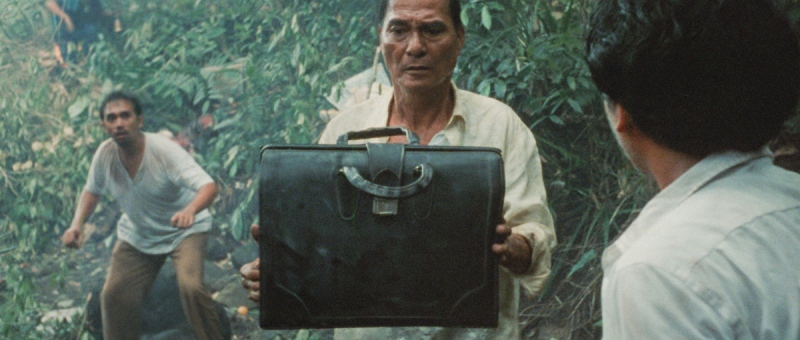

If you “found” a fancy bag full of cash and the guy who was carrying it obviously won’t be needing it anymore, what would you do, hand it in, or take it and keep quiet? Many would have little problem with option two, though as someone later points out sometimes big money can be a big problem. Rarely seen on its release during the martial law era, Abbo Q. Dela Cruz’s Joyful Mystery (Misteryo sa Tuwa) is both a tale of human greed and selfishness and of the thinly veiled feudalistic corruptions of an era.
Clearly dated to the 19th August, 1950, the film opens with a raucous celebration for the baptism of the village chief’s youngest son Tiko (Kenneith Hutalla) which is all too soon disrupted by the harbingers of doom in the form of an aircraft trailing black smoke that duly crashes right into the forest in which we saw the villagers living and working throughout the social realist title sequence. The villagers rush to the scene, but once there they quickly start looting the wreckage largely ignoring the handful of bodies thrown out of the bisected plane despite the theoretical possibility that at least some of them may still be alive. The trouble starts when three men pick up a fancy briefcase belonging to “an American” and are spotted by a fourth man, a soldier, Castro (Lito Anzures), who claims to have found the briefcase first and laid claim to it. Soon after, the local mayor (Mario Taguiwalo) arrives with two Chinese businessmen who’ve come looking for their colleague who, they claim, was carrying a large amount of money intended to fund their business project.
Despite the happy scene of the opening party at which it is assured there is food enough for everyone, it’s clear that the lure of the loot has exerted a corrupting force over the previously close village as each family attempts to hide whatever it was they took from the crash site for themselves so they won’t have to share. The three men, village chief Ponsoy (Tony Santos Sr.), problematic libertine Mesiong (Johnny Delgado), and earnest young man Jamin (Ronnie Lazaro), agree to share out the contents of the bag equally, all harbouring different dreams from a comfortable life in the city to owning a horse and the ability to get married, but are nervous about Castro, making a pact they won’t give up the money no matter what happens.
That turns out to cause more of a problem once the authorities start looking for the bag. Captain Salgado (Robert Antonio), perhaps for obvious reasons the only incorruptible figure to be found, suspects that someone may have found the money already and decided to keep it, while the mayor admits he might have done the same, eventually entering into a pact with Castro to steal the bag from the villagers and split the contents between them. Living comfortably in the city, the mayor cares little for his co-conspirators, planning to blame the Huk rebels living in the forest for any negative fallout and otherwise making a patsy out of Castro to ensure he won’t have to part with too much of the money.
At a loss for what to do, the villagers’ wives automatically suspect the mayor is involved, innately distrustful of authority figures, even doubting the captain whom they otherwise believe to be good and just. We’re repeatedly told that villagers are greedy mercenaries, they don’t agree to help the army with the bodies from the crash until offered money (nor do they seem worried about the fires) despite the fact that they will obviously encourage the encroachment of wild animals such as rats which are later seen to be enough of a problem that the mayor again offers a bounty on their heads in an effort to get the villagers involved in culling them. Yet we can also see that they’re trapped by a series of changing though outdated social codes in which the feudal relationships between peasants and landowners have crumbled but the farmers have been hung out to dry at the mercy of corrupt political figures such as the venal mayor and distrustful of the revolutionary Huk whose opposition to the feudal legacy they fail to understand. You can’t blame them for taking the money because they’re in desperate need and there are no other mechanisms by which they might improve their circumstances. It’s desperation rather than greed which begins to turn them against each other as they jealously guard the opportunity hidden in the money which points towards a better life for themselves and their families.
Perhaps ironically, the film begins with a baptism and ends with a wedding which is to say that it travels anti-clockwise to come full circle as the villagers once again dance and celebrate, perhaps uncomfortably vindicated in their moral failing even as they “win” in overcoming the systemic corruption which otherwise oppresses them. Their victory however is only to a point, the social realism of the title sequence is repeated in the credits, the farmers returning to the forests just as they always have and perhaps always will no matter what illusionary dreams they might have had of escape fuelled only by the promise of misbegotten riches.
Joyful Mystery streamed in its recent 4K restoration as part of this year’s San Diego Asian Film Festival.
Restoration trailer (English subtitles)
 Lav Diaz has never been accused of directness, but even so his 8.5hr epic, Heremias (Book 1: The Legend of the Lizard Princess) (Unang aklat: Ang alamat ng prinsesang bayawak) is a curiously symbolic piece, casting its titular hero in the role of the prophet Jeremiah, adrift in an odyssey of faith. With long sections playing out in near real time, extreme long distance shots often static in nature, and black and white photography captured on low res digital video which makes it almost impossible to detect emotional subtlety in the performances of its cast, Heremias is a challenging prospect yet an oddly hypnotic, ultimately moving one.
 Windows on Worlds