(Ab)normal Desire (正欲, Yoshiyuki Kishi, 2023)

There’s a pun embedded in the Japanese title of Yoshiyuki Kishi’s heartfelt drama (Ab)normal Desire in that first character in the word for “sexual desire” (seiyoku, 性欲) has been replaced by one that can be read the same but has the meaning of “correct”, or “proper”. But “normal” is also relative construct that implies conformance with the majority even if that may not actually be the case. As one of the protagonists later remarks “everyone is pervy” though they themselves feel such a degree of shame and otherness that it’s largely prevented them from living any kind of life at all.

In that sense it may be hard to understand why a fetish for water would invite such severe self-loathing in that it causes no harm to others if admittedly resulting in ridicule if exposed. Then again, society can be a fierce watchdog. Department store shop assistant Natsuki (Yui Aragaki) is taken to task by her pregnant colleague who refuses to take her seriously when she says she’s not really interested in getting a boyfriend before giving her a lecture about her biological clock. Though Natsuki appears uninterested in her vacant prattling, the woman later becomes upset and harshly tells her that she was only trying to be “nice” because she felt “sorry” for her and that making people be nice to you in this way is actually a form of harassment which, whichever way you look at it, is some particularly twisted logic.

Her alienation seems to stem from the fact that she feels “abnormal” and that her fetish for water is a part of herself she must be careful to hide. Her parents watch a news report on Tokyo Rainbow Pride and marvel at the idea that there are now choices other than marriage and children but even among the young there remains confusion and shame amid an inability to reconcile the seemingly opposing concepts of “normality” and “diversity” as they struggle to define themselves. A plan to have a male dancer who usually dances in a masculine style dance in a more feminine way backfires when he points out that asking someone to dance in a way they don’t want to doesn’t really do much to advance “diversity”.

But diversity isn’t considered an ideal by all and parents of young children find themselves confused and conflicted when their kids begin to reject conventionality at an early age by asking to withdraw themselves from school and instead focus on other kinds of education that align with their interests. Challenged by his wife about why he never listens to their son’s concerns, prosecutor Hiroki (Goro Inagaki) replies that he should “just be normal” and later describes people who are “unable to live normal lives” as bugs in the system which must eradicated. A symbol of lingering authoritarianism, Hiroki is an intensely conservative man obsessed with properness who thinks it’s his job to decide which crimes everyone is guilty of rather than make any attempt to understand the world around him outside of binary terms like right and wrong or normal and abnormal. When his assistant passes him information on fetishes as a potential explanation for the case of a man who repeatedly steals taps, he simply rolls his eyes and dismisses it.

Yet he perhaps has his own fears and internalised shame as evidenced by his outrage on discovering that another man has been coming to the house to help his wife with tech setup for their son’s new outlet in livestreaming and not only that, he was able to blow up the balloons that Hiroki himself failed to inflate. It’s his rigid authoritarianism that eventually alienates his wife and son who come to see him only as an oppressive bully unable to accept anything that differs from his own definition of “normal”. Finally, he’s the one who is isolated, imprisoned by his own repression and lack of understanding or unwillingness to accept those around him.

Even so, despite its positive messages that no one should feel themselves alone or that society has no place for them the film muddies the waters by introducing fetishes that are necessarily problematic in that they cause harm to others who do not or cannot consent and could not and should not be accepted by mainstream society though oddly those that have them seem to feel less shame only fearing being caught because acting on their desires is against both moral and judicial laws. In any case, in discovering togetherness, that they are not alone, those who feel their desires to be “abnormal” can begin to ease their loneliness and find a place for themselves in an often judgemental world.


(Ab)normal Desire screened as part of this year’s Toronto Japanese Film Festival.

Original trailer (English subtitles)

N@NIMONO (何者, Daisuke Miura, 2016)

Nanimono posterGrowing up is a series of battles in Japan. Exam hell soon gives way to the freedom and liberation of university but students know that their carefree days of youth and discovery will be short lived. Job hunting is done en masse and takes place in the final year of study (or even before). The process of securing a work placement is much the same as deciding on which school to apply to – attending job fairs to meet with representatives, getting hold of brochures, talking to anyone and everyone you know about the various reputations of the big firms, and then figuring out what your best bets are. Many companies run written exams which are then followed by group interviews in which the applicants are made to answer humiliating questions in front of their fellow candidates. What this all amounts to is a gradual erasure of the self in order to become the perfect hire, making the same tired phrases sound interesting in an effort to say all the right things whilst trying not too seem calculating or too bland.

The group at the centre of Daisuke Miura’s adaptation of the Naoki Prize winning novel by Ryo Asai, N@NIMONO (何者, Nanimono, AKA Somebody / Someone), know this better than most. Protagonist Takuto (Takeru Satoh) used to be interested in theatre but has abandoned his dreams of the stage for the mainstream route into company life while his friend Kotaro (Masaki Suda) has played his last gig as the lead singer of a rock band, died his hair black again, and got a smart haircut in preparation for interviews. The boys are still good friends and roommates despite the fact that Takuto has long been carrying a torch for Kotaro’s former girlfriend, Mizuki (Kasumi Arimura), who has just returned from studying abroad. Mizuki is good friends with another girl, Rica (Fumi Nikaido), who happens to live upstairs from the boys and suggests that the four of them all get together to compare notes on the job hunting process. Rica lives with her boyfriend (still somewhat unusual in Japan), Takayoshi (Masaki Okada), who is working as a freelance journalist and is disdainful of the others’ passage into the regular workaday world but later tries to get into it himself.

There is a kind of sadness involved in this process, even if no one seriously thinks about fighting back. Everyone wants to get their foot onto that corporate ladder to become “someone”, at least in the eyes of society. There are a lot of rungs on the ladder to success, and if you miss your footing it’s near impossible to get it back – you’ll wind up one of the many crowded round the bottom staring up at the top even if you don’t want to admit it. University is the last time time there is real scope for indulging one’s personality before the corporate life takes hold – thus Takuto and Kotaro both accept that their artistic pursuits have to go in their quest for a regular middle-class life even if they inwardly struggle with their decisions to “sell-out”.

Takayoshi thinks of himself as above all this. He asks himself what all of this is for, why people put themselves through this humiliating ritual just to be locked into a nine to five that makes them miserable and turns them into soulless drones. There’s an obvious answer to that, and Takayoshi’s refusal to take it into account borders on the offensive, as does his often patronising attitude to those actively engaged in the job hunting process, but his hypocrisy is eventually brought home to him when he turns down a project to work with another artist because he thinks their work isn’t good enough. Maybe there’s courage in just putting something of yourself out there, even if it isn’t very good, rather than sitting at home looking down on everything and critiquing everyone else’s life choices whilst getting nothing done yourself.

It’s this conflict between interior and exterior life in which N@NIMONO is most interested. Main character Takuto begins as the everyman, depressed and stressed by his job hunting odyssey but aloof isolationism soon reveals itself as a kind of cowardice and self-involvement born of insecurity as he takes to a “secret” Twitter account for acerbic comments on his friends’ lives, sarcastically taking cruel potshots safe in the knowledge of his anonymity. Takuto’s entire concept of himself is a construction as his eventual descent into abstraction shows us in recasting his interaction with his friends as an avant-garde theatre show in which he finally begins to see the various ways his resentment of others is really just a way of expressing dissatisfaction with himself. This inability to fully integrate his own personality is offered as the final reason he hasn’t managed to find employment – his insincerity marks him out as a poor prospect. Takuto’s final realisation that he is unable to successfully answer the standard interview question “define your own personality in under one minute” for the perfectly sensible reason that the task is impossible kickstarts his own journey to a more complete life, even if it doesn’t do much to help the countless other “someones” out there hammered into a standard sized holes as mere cogs in the great social machine.


N@NIMONO seems to have been screened under the English titles of both “Somebody” and “Someone” but “N@NIMONO” is the one that features on the title card of the English subtitled Hong Kong blu-ray.

Original trailer (no subtitles)

https://www.youtube.com/watch?v=Ti0TMOtvUYI

The Kirishima Thing (UK-anime.net review)

thekirishimathingThis is from a million years ago but it was caught up in the queue at UK-anime.net and has only just been liberated! Also I wrote this when I was deathly ill (festival fever is a real thing!) so I’m not entirely sure it’s completely coherent. Anyway, have at it – The Kirishima Thing reviewed at Uk-anime.net


What’s up with that girl, why is everyone crying?

Must be the Kirishima thing again, right? It’s got everyone all riled up.

Hey, what exactly happened with that? Where is Kirishima?

You didn’t hear?! Kirishima quit the volleyball team! And nobody’s heard from him since, doesn’t answer calls, doesn’t answer texts – he’s in the wind….

Damn, man, that’s cold! Wonder what happened….

What happened with Kirishima, why he’s upped and quit the volleyball team quite suddenly right after having been made captain and with the team on course to win a big championship actually turns to out be almost totally irrelevant. We may speculate on why someone might just do that but we can never really know. What is important is that Kirishima’s unpredictable action causes a seismic wave to rip through the social structure of his class. With Kirishima gone, everyone else starts to question their own place in the social hierarchy – are they really where they want to be, where they ‘belong’ within the all important high school pecking order? Some threaten to move up and others down but will anything be the same ever again?

The ‘cool’ kids are in the ‘going home’ club or possibly ‘in a sports team but blowing off practice’, the next level are ‘kind of in a club because it’ll look good on my application forms (it’s not like I like it or anything)’ and then at the bottom we have the geeky guys and girls who are really into their club activities – exemplified here by the downtrodden film club. When Kirishima just quits and effectively demotes himself from the A crowd by quitting the volleyball team nobody’s really certain of anything anymore – what’s cool, what’s not, what do I care? The volleyball team feel betrayed by their captain’s absence, the cool boys are puzzled and uncertain without their leader to look to, the popular girls doubt their status now the alpha guy isn’t around and the film club….carry on as normal and try to ignore all the silly drama going around the school.

However, there are those in the higher echelons who maybe feel they don’t belong there. One of the cool girls has a secret liking for ‘geeky’ films but is frightened of becoming ‘one of them’ and losing her ‘popular’ status. Another girl, nominally one of the cool girls both hates and admires her friends for their vacuity and refusal to see whats going on around them. She is the only who really sees what’s going on everywhere, but even she too is afraid of losing her position. The most troubled and changed though is Hiroki, Kirishima’s ‘best friend’ who nevertheless didn’t know anything about his friend’s decision. Half in half out of the baseball team, he’s trapped between the cool world of the going home club and the slightly less cool one of being able to do something very well. The only people who aren’t really affected are the film club who are, to some extent, too invested in their own sense of inferiority to really notice what’s going on everywhere else.

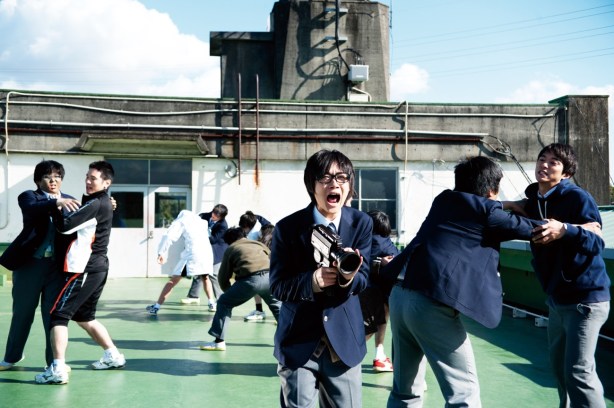
The film club  are in some ways the heart of the film as they both refuse to see and ultimately document the social fracturing that’s going on within the school. They seem to think themselves very hard done by -‘they’re always winning’ complains one boy after they find a location they want to use already occupied and later ‘I won’t cast them when I’m a director’ about the annoying popular clique who’ve just been laughing at them loud enough for them to hear before they’ve even gone past. However, they are the key to the film’s climactic roof top confrontation scene as the film club’s high school zombie invasion movie is rudely interrupted by the popular kids’ desperate search for Kirishima. This leads to a day of the dead style zombie fantasy sequence as the film club zombies devour the unwitting volleyball stars and popular girls which is the highlight of the film. The intermingling of the two groups which would never normally have anything to do with one another finally forces the ramifications of the Kirishima thing to come to a head. In some senses it clears the air; the tensions have boiled over and worked themselves out. However, for some the outcome is far from clear and they remain trapped between levels of high school cool.

The Kirishima Thing is certainly not for for those who like a lot of action, zombies aside, or something with a heavier plot element, but as an ensemble character study it excels. As an allegory for the wider problem of conformity/social norms vs individuality and self recognition in the adult world it’s certainly a very apt parable but all of the characters concerned are very well drawn and each afforded a degree of sympathy and understanding. The Kirishima thing strikes a more realistic tone than the director’s previous films (Funuke: Show some love you losers!, Perfect Nobara) which took place in a world of heightened reality but still has a strongly comic tone. An extremely nuanced and layered tale, The Kirishima Thing may require multiple viewings to completely appreciate but it’s certainly well worth the investment in time.


Also look out for fellow queue inmates Kumiko the Treasure Hunter and Tale of Iya which, I am assured, will shortly become eligible for parole.