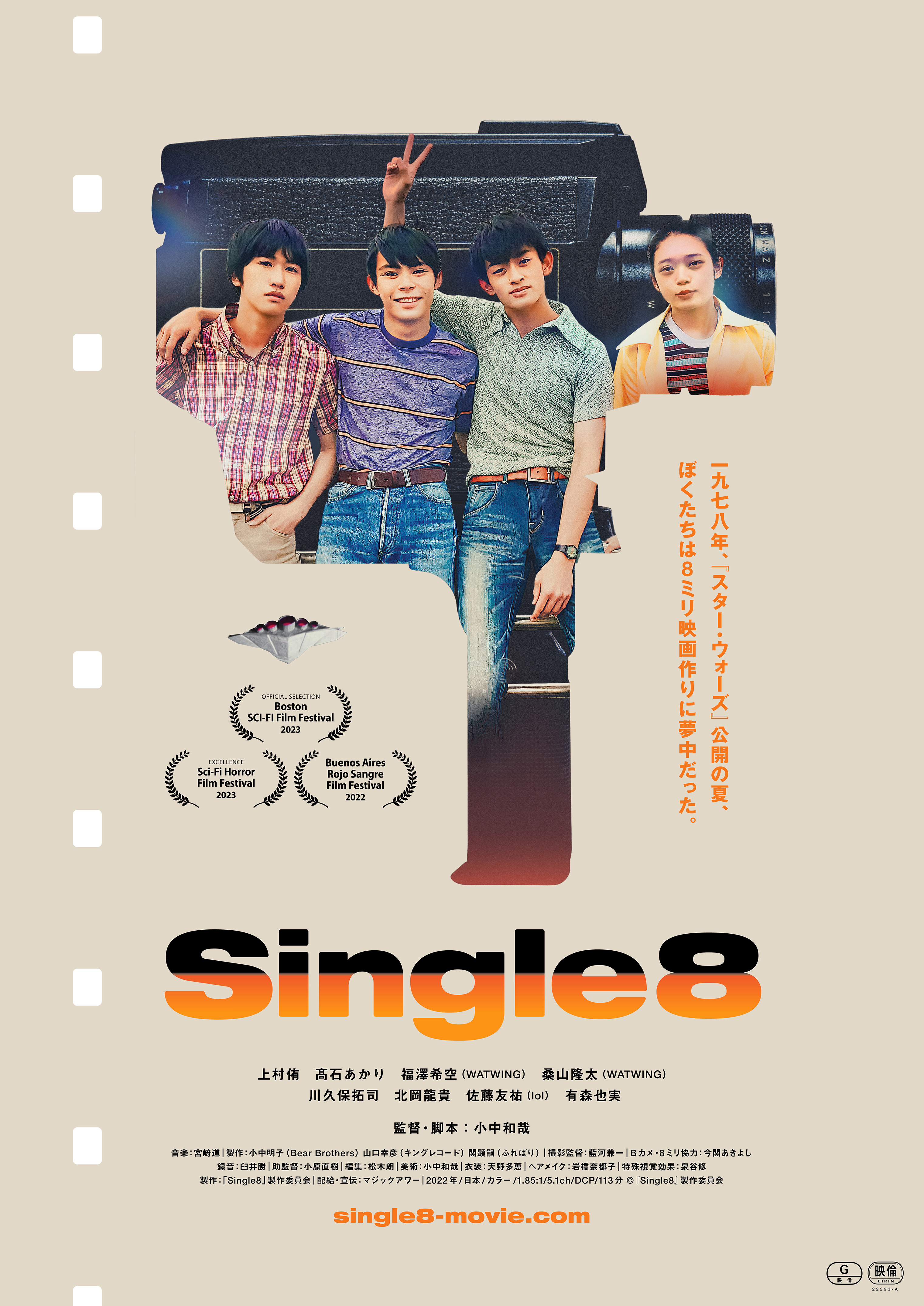
Single8 (Kazuya Konaka, 2023)

In a lot of ways, it’s never been easier to make a movie. You can capture sound and image with your phone, edit and add special effects on an ordinary laptop with no particular need for professional grade software or equipment. But on the other hand, perhaps there’s something that’s been lost now that you don’t need to work so hard to overcome technical limitations. Kazuya Konaka’s auto-biographically inspired high school drama Single8 follows hot in the heels of It’s a Summer Film! in pairing the classic summer adventure movie with filmmaking nostalgia while looking back to a now forgotten era of analogue creativity. 

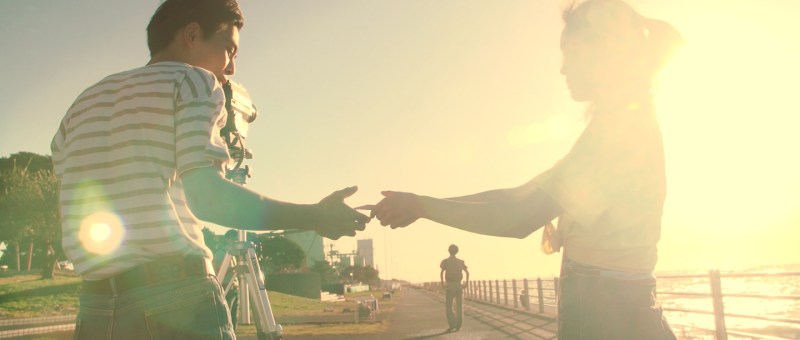
Set in the summer of 1978, the film opens with an homage to Star Wars which has captured the imagination of diffident high school boy Hiroshi (Yu Uemura). Hiroshi is not so much a film buff as special effects enthusiast and is particularly obsessed with figuring out how Lucas achieved the overwhelming sense of scale in his spaceship model shots. Aimed only with a regular, consumer-level 8mm camera, he teams up with a friend, Yoshio (Noa Fukuzawa), to experiment and thanks to the advice of the guy at the camera shop (Yusuke Sato) eventually manages to recreate the scene with a surprising level of dexterity. His new found confidence leads him to suggest they continue with the film as the class project for the upcoming school festival which will be the last of their high school lives. 

The snag is that Hiroshi hadn’t thought much beyond recreating the shot. His previous short film had been called “Claws” and was basically Jaws only with a bear. When people ask him what the film will be about, he looks at them quizzically as if it hadn’t really occurred to him that the plot would be important or something anyone would be interested in. It’s only by teaming up with another student, Sasaki (Ryuta Kuwayama), who actually is a film buff that they begin to come up with their own ideas even if they’re also often influenced by other science fiction films and tokusatsu television series. In a meta touch, the students openly discuss scriptwriting theory remarking that the most important aspect is how the protagonist evolves between the first scene and the last. The film itself and the film with in a film attack this in a similar way, with Hiroshi eventually deciding to end on a note of ambivalence in which it is clear that something has changed if perhaps not obviously. Now no longer quite so diffident, he steps into the role of a director and proudly declares that his next film will be even better than this one. 

Similarly, Konaka avoids falling into the trap of an overly neat conclusion in allowing events to play out in a more natural way than we would usually expect them to in a movie even if Hiroshi is eventually able to win over even the most obnoxious of his classmates, Yoshida. Through making the film together, each of team members including Hiroshi’s crush Natsumi (Akari Takaishi) who plays the film’s heroine grow in confidence and come to understand something of themselves while otherwise having fun and making friends across the last summer break of their teenage lives. The film is a collaborative effort and made with a true sense of generosity with a university student friend of the camera shop guy helping out with special effects by literally carving them directly into the film itself and the high school band Natsumi manages also agreeing to provide the score. 

A true tribute to the charming world of DIY filmmaking in the pre-digital era the film has has a charming nostalgic quality which is only enhanced by the fact that the film within the film, which is eventually shown in its entirety, is actually very good and quite touching in its earnestness. Konaka includes clips of the few of his own 8mm films over the closing credits which adds a meta note to the film’s message that “people should fix their own mistakes” even if there is also an irony in the insistence that they should look to the future rather than obsessing over the past. Using frequent screenwipes as a visual homage to Star Wars but also of course to The Hidden Fortress which inspired them, Konaka’s retro teen drama ends on a similarly ambiguous though less melancholy note than the film within a film filled with a sense of possibility for a new world of creativity which is only just beginning. 


Single8 screened as part of this year’s Nippon Connection. It will also be screening in New York on 30th July as part of this year’s JAPAN CUTS.

Original trailer (no subtitles)

Images: ©Single8 Film Partners
The Burning Buddha Man (燃える仏像人間, Ujicha, 2013)

“There are many strange things happening in this world” according to the mysterious young woman who appears in the brief live action sequences bookending Ujicha’s debut feature, The Burning Buddha Man (燃える仏像人間, Moeru Butsuzo Ningen). Who is she? One of the “space people” mentioned in the accompanying voice over which also points out that humans are hard to trust seeing as they don’t even trust each other, or merely a stand in for the omnipotent artist sitting down as she does and looking over her creation her butler dutifully waiting at her side? Who can say, it’s just one of many mysteries at the heart of Ujicha’s beguiling retro sci-fi/horror Buddhist conspiracy thriller animated in his now trademark and equally retro “gekimation” style. 

Taking place in the director’s native Kyoto, the action opens with a strange, alien-like creature breaking into a temple and firing some kind of laser from a phallic device on his belt directly into the head of a colossal Buddha statue. The couple who look after the family-run temple, mindful of their duty to protect their ancestral legacy, are perturbed and politely ask the creature to stop but are later caught in the crossfire when the statue suddenly disappears leaving only their bottom halves behind. Cue the arrival of teenage daughter Beniko (Yuka Iguchi) in her school uniform who is quickly taken in by weird old monk Enju (Minori Terada) who explains that he’s an old friend of her parents and that the theft of the statue is part of a spate of similar heists across the Kyoto area perpetrated by a crazed cult who are apparently intent on “rescuing” neglected Buddha statues from “disrespectful” modern people. Staying with him in his temple, however, Beniko starts to have doubts especially after encountering the strange-looking children who run wild in the grounds Enju claims are “disadvantaged” kids he’s taken in after they were abandoned by their parents because of their odd appearances, not to mention an encounter with Enju’s sculptor grandson Enji (Ryuki Kitaoka) who suddenly frees a small dog apparently trapped inside the uchiguri cavity of an Buddhist statue after being caught in the range of the “Matter Transference Device” used by the thieves to teleport the neglected icons to “safety”. 

A weird tale of spiritual fusion, The Burning Buddha Man’s villains have apparently forgotten all their Buddhist teachings and become “addicted” to melding with statues in order to harness their power and become all powerful beings. Beniko, however, is still pure of heart and is not after revenge for what happened to her parents but to save the wrongdoers by making them “reform”. To do so, however, she’ll have to undergo an apparently reversible transformation herself as well as journeying to another world where, she discovers, her elderly catatonic grandmother (Chisako Hara) has apparently been in training for just such an eventuality for the last couple of decades. “It’s easy just to kill them” Beniko later explains, “but no one can get out from their suffering that way” apparently hoping to undo some of the pain in the world caused by this strange new technology through an act of healing. 

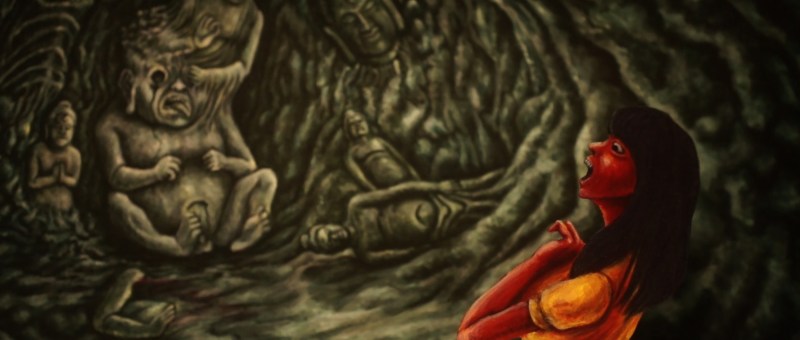
As showcased in the live action intro/extro sequences in which the young woman painstakingly assembles and then disassembles her world, pausing briefly to look admiringly at a figure perhaps representing herself before handing it back to her gloved butler for safekeeping, Burning Buddha Man’s aesthetics consist of a series of beautifully painted backdrops and paper cut out puppets of its strange cast of characters which include a gang of Giger-esque biomechanical former Buddhist monks rendered monstrous by their experiments in spiritual enhancement. Amping up the body horror quotient, real liquid often oozes from their mouths made sickening in its viscosity while blood later fills the screen. Yet for all that there’s a strangely childlike glee in the macabre grimness as the wholesome heroine and her pure-hearted friends push back against the corruptions of hyper-religiosity and spiritual madness hoping to restore rather than destroy but ultimately finding themselves forging a purifying hellscape that ends only in fire (and a peculiar kind of sludge making its way towards the drain of all humanity). Deeply strange yet strangely charming Ujicha’s Buddhist body horror conspiracy thriller is undeniably dark but also imbued with a sense of ironic playfulness in its truly bizarre cosmology.


The Burning Buddha Man is available on blu-ray in the UK courtesy of Third Window Films in a set which also includes Ujicha’s second feature Violence Voyager as well as a selection of shorts.

Original trailer (English subtitles)