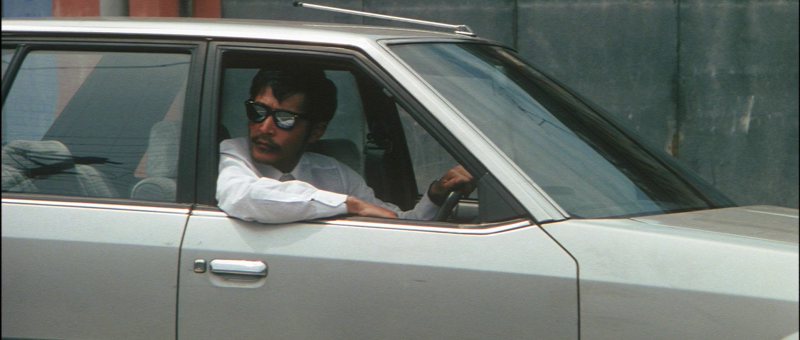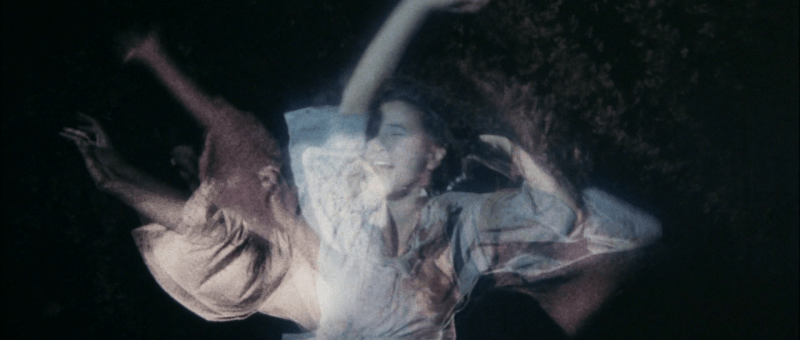
The Inferno (地獄, Tatsumi Kumashiro, 1979)

No one can escape from their sins according to the ominous voiceover that opens Tatsumi Kumashiro’s loose reimagining of Nobuo Nakagawa’s Jigoku, The Inferno (地獄, Jigoku). Then again, some of these “sins” seem worse than others, so why is it that a woman must bear a heavy burden for adulterous transgression while the man who killed her seemingly suffers far less? Perhaps hell, in this case, is born of conservative social attitudes more than anything else besides the darker elements of the human heart such as jealousy and romantic humiliation. 

Those negative emotions are however as old as time as reflected in the folk song which opens the film about a young couple, though not the young couple currently onscreen, who are eloping because their incestuous desire is not accepted by the world around them. The connection between the couple onscreen might also be deemed semi-incestuous for Ryuzo (Ken Nishida) has run off with the wife of his brother, Miho (Mieko Harada), who is carrying (what she claims to be) Ryuzo’s child. Unpei (Kunie Tanaka), the brother, finally catches up with them and shoots Ryuzo with a shot gun. Miho tries to escape, but her foot is caught in a bear trap and Unpei decides to leave here there to die, while Ryuzo’s jealous wife Shima (Kyoko Kishida) later does the same. The body is found by local hunters, and in a strange miracle the baby is born from Miho’s dead body while Miho is dragged to hell for her “sins” where she learns that her baby has been born in hell but remains above. Not knowing what to do, the locals give the baby, Aki, to Shima but she obviously doesn’t want it and so swaps it with a foundling thanks to a weird old man, Yamachi, coming to love this other child, Kumi, as a daughter. 

This is quite literally a tale of the sins of the parents being visited on the child, the 20-year old Aki (Mieko Harada) later lamenting that she has no identity of her own and is solely a vehicle for her mother’s revenge. Though she apparently ends up in the same rural town “by chance” knowing nothing of her past, she resembles her mother physically and discovers she has some of her talents such as an innate ability to play the shamisen. What she also has is a trance-like lust that bewitches the men around her, though this is in a sense complicated by the fact it does not seem to be of her own volition so much so as a manifestation of her mother’s curse. Thus she ends up sleeping with the vulgar younger brother of the man she actually likes, Suchio, who in truly ironic fashion is actually her half-brother. She describes herself as having her mother’s “tainted blood”, while Shima later adds in a degree of class and social snobbery revealing that Miho had been a geisha Unpei unwisely fell for and was unworthy even of being a maid in their upper-middle class household let alone the wife of the second son. 

For all of her resentment, Shima is otherwise a loving mother to her sons and even to Kumi whom she is able to accept as a daughter in a way she would never have accepted Aki who was after all an embodiment of her husband’s betrayal. Colder and more austere than Aki or Miho would seem to be, she clings to the mummified body of her husband kept in a secret vault as a secret triumph over her humiliation laughingly remarking that now he’s hers forever and will never cheat on her again. Even if she left Miho to die, Shima does not particularly resist her fate well aware that her son has fallen for his half-sister (which probably wouldn’t have happened if she hadn’t swapped babies) and merely hoping Aki can be convinced to leave town alone rather than plotting any more drastic action. 

But the inferno of hell envelopes them all, crying out for retribution as the cycles of repressed or inappropriate attractions repeat themselves. Kumi realises that her love for her brother, Suchio, is actually not inappropriate because they are not related after all but is then consumed by her own hell in realising that he does in fact love his biological half-sister but is uncertain if he accept damnation in order to pursue it. What she, Miho, and Aki are punished for is female sexual desire aside the arguably taboo qualities of its direction though in hell it seems men are punished for this too, or more accurately for giving in to it, in a way they often aren’t in the mortal realm. “They cut their own flesh and blood for the vision of a woman in the future,” the guide explains as the brothers and Unpei literally climb over each other reaching for an illusionary representation of Aki/Miho at the top of the tree. In the mortal world they do something similar, grappling with each other, mired in competitions of masculinity as mediated through sexual dominance, conquest, or humiliation. 

Yet Aki’s path to hell is also a confrontation with her femininity and her search for an identity as a woman by reuniting with the birth mother who died before she was born. Kumashiro’s visions of hell are terrifying and outlandish, a giant land in which the dead are thrown into a huge meat grinder they then have to push themselves. For the sin of eating meat, others are condemned to spend eternity eating human flesh. Miho has lost all sense of reason and is incapable of recognising her daughter seeing her only as another source of food but there is a kind of rebirth that takes place even if it’s only once again to be born in the underworld. Surreal and harrowing, Kumashiro’s eerie land of giant demons and shuffling corpses does indeed suggest that as the opening titles put it we all live our lives alongside hell.


Original trailer (no subtitles)
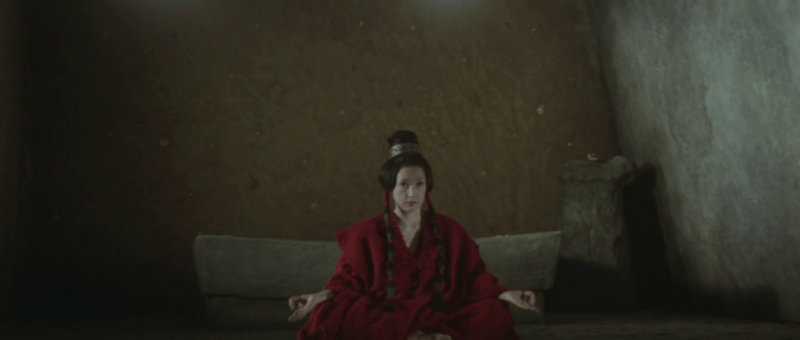
The Phoenix (火の鳥, Kon Ichikawa, 1978)

The people of early Japan contemplate different visions of immortality in Kon Ichikawa’s sprawling adaptation of the first chapter in Osamu Tezuka’s manga series, The Phoenix (火の鳥, Hi no Tori). Featuring a mix of animation and live action, the film takes place in an ancient, pre-modern Japan in which just about everyone chases the mysterious fire bird in belief that drinking its blood will confer eternal life. They each want it for different reasons, some more to stop someone else getting it than for themselves but all discover that there are other ways of living on than the strictly literal. 

Broadly speaking the film takes place during the era of possibly mythical sorceress queen Himiko (Mieko Takamine) who rules over the nation known as Yamatai which is the name given to a kingdom in Japan in ancient Chinese sources. Himiko wants the phoenix because she fears that her power is founded on a youth and beauty which has begun to fade while the people are beginning to lose faith in her magic, not least because her rule is oppressive and authoritarian. She also fears that should the Chinese emperor drink the phoenix blood first, they will forever be under his yoke yet the seal that confers her rule was in fact given by him so perhaps they are already. Her brother, Susano (Toru Emori) whom she also fears may usurp her, enlists famed hunter Yumihiko (Masao Kusakari) from the state of Matsuro to help them capture the phoenix seeing as the two nations have some kind of treaty. Yumihiko says he doesn’t really care about that, but ends up helping anyway.

In any case, Matsuro is soon overrun in a surprise attack by warlord Jingi (Tatsuya Nakadai) from Takamagahara who is set on colonisation, which is in its way another bid for “immortality” if culturally rather than literally. After all, he claims “I will implant our civilisation in these lands” before explaining that “not even the greatest kings live forever” but history will. Meanwhile, Yamatai doctor Guzuri (Ryuzo Hayashi) is washed up on the shores of remote kingdom Kumaso where Uraji (Masaya Oki) is hunting the phoenix in the hope of saving his seriously ill wife Hinaku (Reiko Ohara). Uraji is soon burnt to a crisp by the Phoenix’s light, but Guzuri is able to save Hinaku using “modern” medicine, that is by applying “blue mould” which as the onscreen text explains contains penicillin. Perhaps feeding someone mould doesn’t sound much more scientific than the bizarre folk medicine proposed by the witchdoctor which involves rubbing the severed heads of cats and ravens together and putting fish bones on the patient’s head while burning their buttocks, but it works which is not exactly a means of “immortality” but does promise the ability of temporarily overcoming death without the Pheonix’s help. 

But medicine can’t help you with an invasion, and when the Yamatai suddenly turn up and raze the village to get better access to the phoenix after realising it lives in a nearby volcano only Hinaku and her brother Nagi (Toshinori Omi) survive. Hinaku reluctantly remains with Guzuri and vows to rebuild her kingdom through childbirth vowing that she will enable the survival of Kumaso by passing her culture on through successive generations. Uzume (Kaoru Yumi), a dancer from Matsuro, later says something similar to Jingi in reminding him that “women have their own weapons” and he will “never be able to destroy life” as an abstract concept. There might be something a little uncomfortable in the implication that the phoenix is an allegory for childbirth in suggesting that one body is born in the ashes of another, but it is in the end the continuity of a lifecycle which wins out as the natural order of things. In the film’s concluding moments, the son of Hinaku and Guzuri in a sense experiences a kind of rebirth as, guided by the phoenix, he climbs out of the cave in which he has lived all his life and gazes at the vast expanses of a new world all around him. 

Ichikawa originally trained as an animator and includes several animated sequences throughout the film from cartoonish special effects when an elderly courtier bangs his head to a trio of foxes dancing to pink lady. His visual design is also heavily influenced by Tezuka’s manga with the young boy Nagi in particular striking Tezuka-esque poses and otherwise resembling Astroboy who does in fact make a surprise appearance in a brief animated sequence in which Nagi is kicked by a horse. Similarly, the conflicted general Saruta (Tomisaburo Wakayama) later gains a ridiculous Tezuka-style nose after being locked in a room filled with wasps, and Ichikawa’s vistas sometime echo the centrefold of a manga with the heroes reduced to tiny figures dwarfed by the majesty of the landscape. Even so, a rain-soaked battle pays ironic homage to Seven Samurai, while Ichikawa otherwise keeps violence to a minimum. The heads are chopped off horses and fall like cushions, entirely bloodlessly, but there is also a scene of implied attempted rape which may be out of keeping with the otherwise family-friendly approach. Despite the sense of defeat which may colour some of the closing scenes, the film ends on a note of optimistic wonder in a new journey for humanity emerging from scenes of desolation towards a bright new world. 


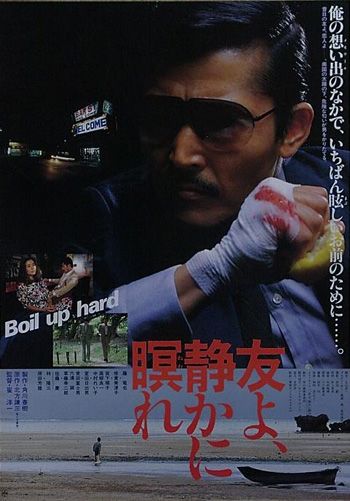
Let Him Rest in Peace (友よ、静かに瞑れ, Yoichi Sai, 1985)

“There are times when you need to stand for something” according to an ultra masculine avenger giving a few lessons in manliness to the already defeated teenage son of a friend. A noirish, stranger in town affair, Yoichi Sai’s Let Him Rest in Peace (友よ、静かに瞑れ, Tomo yo, Shizukani Nemure) locates itself in an awkward frontier landscape, moribund small-town Okinawa seemingly devoid of life now that the Americans have pulled out and moved on. The Americans have, however, been “replaced” by beefed up corporate thugs backed by yakuza muscle and corrupt police. Sometimes you have to take a stand, if only to show them that you won’t be pushed around because if you give in once you’ll never be free. 

Disgraced doctor Shindo (Tatsuya Fuji) has come to Okinawa in search of the Freein, but every time he tries to ask someone for directions, he is met with intense hostility, the last man even telling him “You shouldn’t go there, that place is no good”. This is not because the Freein is mostly home to a collection of brassy sex workers, but because its owner and Shindo’s old friend whom he has come to help has become a local pariah. Sakaguchi (Ryuzo Hayashi) is currently in jail because he apparently went crazy and started waving a knife around at construction magnate Shimoyama (Kei Sato). As Shindo quickly finds out, Shimoyama is in the process of buying up the whole town and Sakaguchi is the last remaining hold out. As such, he is hated by most of the other residents and the subject of persistent harassment by Shimoyama goons who have not only thrown bricks through the windows but gone so far as to kill his son’s dog, later kidnapping the boy to put pressure on the pair of them. 

What’s not lost on Shindo is the extent to which Shimoyama’s corruption has already seeped into the town. Meeting Sakaguchi’s son Ryuta (Makoto Mutsuura) by chance, Shindo takes the boy to see his dad but is again met with hostility by the local bobby, Tokuda (Hideo Murota), who tells him that “Shimoyama Construction is the savour of this town”. “There’s no other company that is so giving”, he goes on, “to have the employees of a company like that working here, I can’t have a wild man like Sakaguchi running about”. According to Tokuda, Sakaguchi is the odd man out, an inconvenience to all those around him who believe in Shimoyama and are trying to save the town. Tokuda looks sheepish when Shindo asks him why he’s so into Shimoyama, confirming the mild suspicion aroused by his improbably fancy watch. 

Tokuda’s warning is however borne out by the townspeople who continue to shun and ignore Shindo while the other kids mercilessly bully Ryuta, calling him the “craziest kid in Japan” and calling for his dad to get the death penalty despite the fact that all he seems to have done is aggressively wave a fruit knife at the wrong person. The local cafe owner describes him as an embarrassment and accuses him of holding out to get more money. After all there’s no future in this tinpot town which seems to exist in the ruins of the post-war era and Shimoyama is already offering triple the going rate so Sakaguchi is only being greedy and selfish. Komiya (Ryoichi Takayanagi), the bellboy, if you could call him that, at Freein, spins it slightly differently, explaining that no one supported Shimoyama in the beginning but they’ve all been harassed themselves and have long since given in. Shindo convinces Ryuta to talk about his kidnapping, but Ryuta tells him that on his return he told his father they should leave, that it was pointless to resist. Shindo asks him if he’s ever been in a fight, but the boy asks what the point is if you know you’re going to lose, “the strong are always strong”. 

That kind of defeatist thinking is anathema to Shindo’s conception of manhood. Despite his father’s incarceration, Ryuta is too afraid of being kidnapped again to go to school. Trying to be nice about it, Shindo calls him a coward for telling his father to leave even though he wants to stay because he allowed himself to be threatened into sumbmission. He tells him that he has to stand up for himself, report his kidnapping to the police. Ryuta tells him he’s crazy, the police are in on it, but Shindo counters that it’s worth trying to get his father out of jail because if they don’t they’ll never know. Ryuta snaps back that he knows already, and indeed bottles his chance when Shindo manipulates Tokuda into “helping” him oppose Shimoyama’s cult-like hold over the town.  

Shindo might not be that much better, he’s prepared to fight dirty, getting hard evidence of Tokuda’s corruption and trying to use it against him but even these methods prove ineffective against such a vast and entrenched mechanism of control. Shindo also realises that Shimoyama’s minion Takahata (Yoshio Harada) is another old university classmate, a member of the boxing club, bringing this widening drama down to the level of three men who went to the same prestigious university but all ended up here, pretty much at rock bottom. Though ironically enough Shindo’s broody silence and dedication to his friend have a few of the women wondering if he might be gay, his preoccupation is with a failure of masculinity. He doesn’t think Shindo was actually capable of threatening anyone, and knows that he had reasons that he might have wanted to try and sort this out sooner rather than later. His son’s words pushed him over the edge. He used his body as a weapon, tried to make Shimoyama damn himself, but his efforts were frustrated. Shindo acknowledges that “saving” his friend might look quite different than one might think, inadvertently teaching young Ryuta a few problematic lessons about what it means to be a man. Still, the town might have been “saved” in one sense at least in being freed of this particular oppressor. A stand has been taken, and a man’s self worth restored, but as Sakaguchi’s wife (Mitsuko Baisho) points out even while fully understanding the codes by which the men around her live, what is to become of those left behind?


TV spots (no subtitles)