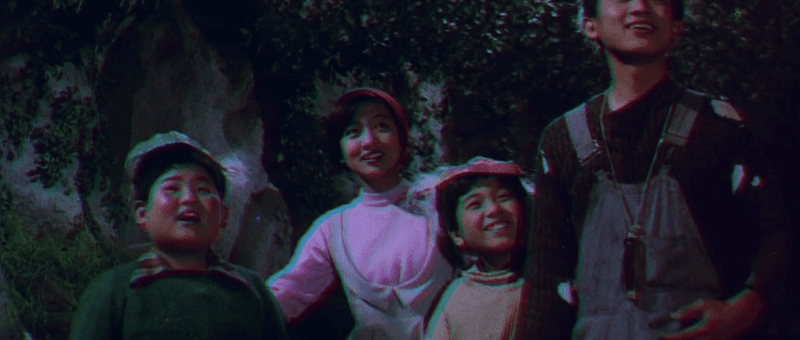

An incredibly surreal musical kids adventure, The Green Music Box (緑はるかに, Midori Haruka ni) saw the film debut of future Nikkatsu star Ruriko Asaoka who in fact took her stage name from the character she plays in the movie. She was born in Manchuria in 1940 as Nobuko Asai (she retains the first character of her surname but the second “oka” or “hill” is also inspired by the “faraway” in the Japanese title). Her father was a political secretary but the family was extremely poor and her entry into the film world came about through an open audition for the role of Ruriko in the film adaptation of a serialised novel for children by Makoto Hojo which would be produced by Takiko Mizunoe and directed by Umetsugu Inoue. Junichi Nakahara who handled the costume design for the film personally picked Asaoka out from the 3000 applicants reportedly saying “this is the girl” after seeing her in makeup.
A classic children’s adventure movie, the film nevertheless has a strong theme of loneliness and displacement as each of the young protagonists either has no parents or has in some way been separated from them. Ruriko’s father is a scientist who left for a research project in Hokkaido a year previously and has since stopped responding to her letters. Missing him, Ruriko uses a green music box he had given her as a present as a means of floating off into a surreal dream world on the moon filled with children dressed as bunny rabbits who sing and dance with her. Later she teams up with a trio of orphans who have left their orphanage in search of adventure as well as another girl a little younger than herself, Mami (Noriko Watanabe), who has run away from the countryside to look for her mother in Tokyo. At the film’s conclusion all the children have happy family homes, Mami now living with her mother and the three boys adopted by Ruriko’s family meaning that she’s no longer lonely with her brothers now beside her as they all take a trip to the moon and a nation ruled by love, justice, and peace.
Before all that, however, Ruriko and her mother are kidnapped by a spy, Tazawa (Kenjiro Uemura), claiming to be a colleague of her father’s. Explaining that Professor Kimura (Minoru Takada) has been taken ill, he bundles the pair into a car but takes them to a secret lab in the middle of nowhere where Kimura is being held and attempts to use them to blackmail him into giving up the scientific research he burned on learning that Tazawa belonged to a foreign power explaining that his creation could greatly benefit the world if used peacefully but cause great destruction if not. He manages to sneak the key to his research into Ruriko’s music box and tells her to escape with it though at the film’s conclusion he’ll decide to burn it anyway resolving that it’s too dangerous were it to end up in the wrong hands.
Such dark events are not exactly unusual in children’s films, though the level of violence is surprising. Ruriko’s mother is taken off and hanged by her wrists while the foreign spies whip her. Though much of it occurs off screen, the whip cracks and screams are audible to Ruriko and her father while we also see her spin and twist, writhing in agony before falling silent perhaps having died as Ruriko comes to infer from the eerie quiet. Later, during the chaos at a circus which is also a front for international espionage a large goon slams the head of one of the children, Fatty (Hideaki Ishii), repeatedly into a table though he appears relatively unhurt and soon fights back cartoonishly by hitting him on the head with an iron bar.
It’s not really clear why the spies operate out of a weird circus which is also seemingly guilty of copyright infringement given the various Disney-inspired papier-mâché masks lying around, but it is strangely scary for something meant to entertain small children including a surreal performance by Frankie Sakai in a brief cameo as a clown beckoning the kids towards the circus tent. The film was also Nikkatsu’s first colour movie using the short-lived Konicolor method and has a slightly sickly, washed out effect that lends an additional layer of discomfort to the brightly decorated circus environment. In any case, Ruriko and her friends are eventually able to triumph, regaining the music box and even convincing the police that the circus guys really are foreign spies even if it’s partly down to the otherwise unexplained reappearance of her parents who are in fact alive and well. In some ways melancholy, appealing to a sense of loneliness in post-war children who either may have become orphaned or are otherwise separated from their parents, the film ends on a more hopeful note in championing the sense of family that emerges between the children themselves through generational solidarity in offering a happy ending that might seem overly optimistic but nevertheless returns the kids to the kingdom of the Moon Queen and a happy world of love, justice, and peace.
 Windows on Worlds