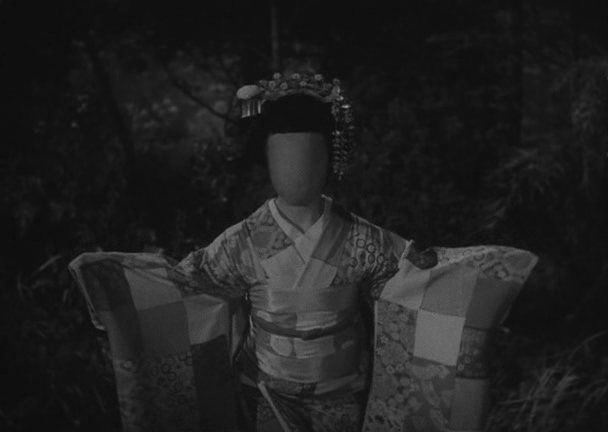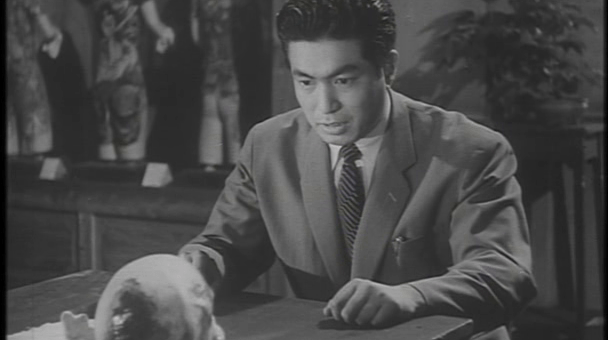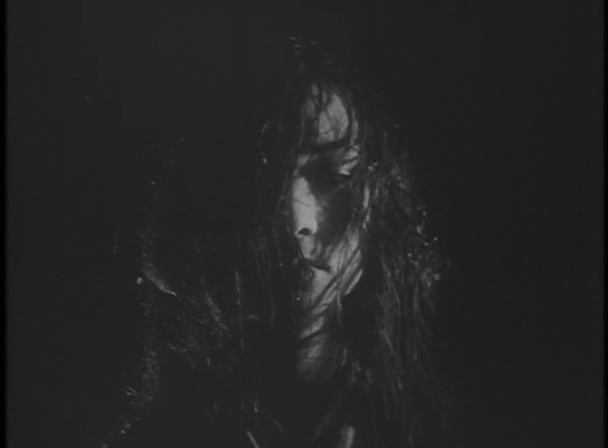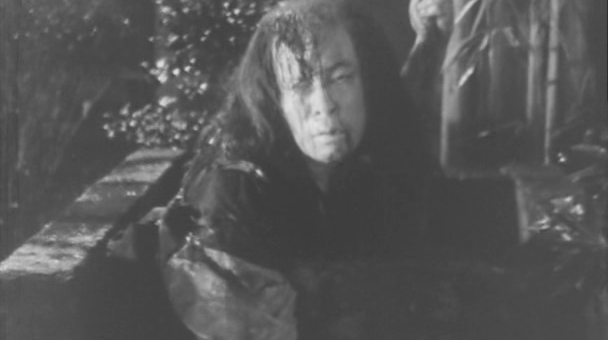
The Mother Tree (怪談乳房榎, Goro Kadono, 1958)

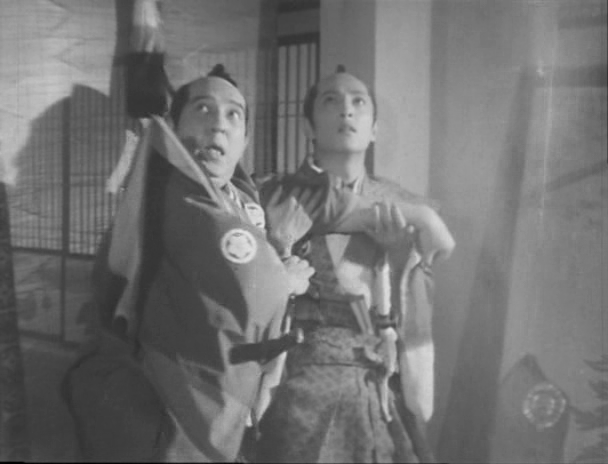
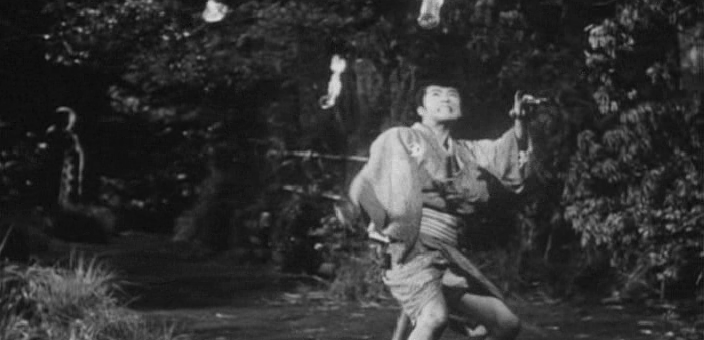
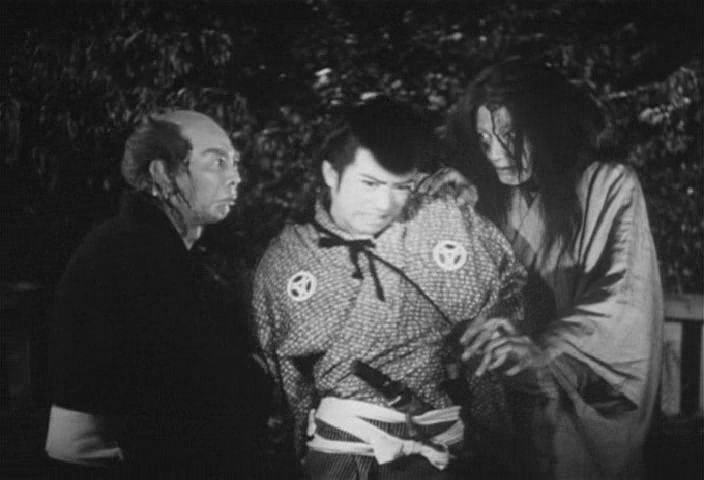
An amoral ronin worms his way into the home of a famous painter with the intention of stealing his wife in Goro Kadono’s eerie tale of ghostly revenge, The Mother Tree (怪談乳房榎, Kaidan Chibusa Enoki). As might be expected, it doesn’t go particularly well for him. He is, though, perhaps a symbol of the latent fear of social interlopers and those displaced within the Edo-era class system. Namihei (Asao Matsumoto) claims that he was let go by his master for being too interested in painting, though is otherwise focused on short-term gains and causing destruction.

Shigenobu (Akira Nakamura) is said to be “the greatest artist in Edo”, and is certainly very much in demand. He is father to an infant son, Mayotaro, and husband to devoted wife Kise (Katsuko Wakasugi). He appears to be a good man, if a little scatterbrained and hugely overworked, which is one reason why he was grateful to take on a pupil. The irony is that both Kise and the family’s maid Hana (Keiko Hasegawa) remark on what a nice guy Namihei is and how glad they are to have him in the household. He’s even good with the baby who apparently likes to be held by him. All of which suggests that he might have actually had talent for painting and could probably have succeeded Shigenobu, in time, if hadn’t been such a terrible person. 

Unfortunately, however, Namihei reminds Shigenobu that he promised to paint a freeze for a temple some distance away and had sort of forgotten about it. An impulsive soul, Shigenobu decides he’d better leave right away if only to shake off this sense of unfulfilled obligation that’s been plaguing him. He entrusts the women of the household to Namihei in his absence and has no reason to fear any harm may come to them while he’s away. Namihei, however, attempts to rape Kise as soon as he leaves. Though she resists him, he threatens to kill her son and she is forced to give in to a prolonged period of sexual exploitation.

This is actually quite a dangerous move on Namihei’s part considering that the penalty for adultery under Tokugawa law is death, which might be why he finally ends up killing Hana after she witnesses Kise being abused and tries to help her. Namihei evidently doesn’t have a long-term plan for how all this is supposed to pan out and panics on hearing that Shigenobu will be returning much earlier than he expected. The irony may be that Shigenobu intended to paint eyes that might see into the next world and eventually becomes a vengeful ghost after being brutally murdered by Namihei, though was unable to see his treachery. Evidently never having read a ghost story himself, Namihei dumps the body in a pond, which is all but guaranteed to come back and haunt him. “Though you kill me, I will not die,” Shigenobu curses, vowing that he cannot pass on while his dragons lack eyes. 

What might be surprising is that neither of the vengeful ghosts blame Kise for her plight or seek revenge against her. The rage of a vengeful ghost can often be indiscriminate, but both Shigenobu and Hana seem to understand that Kise has been abused by Namihei and only submitted to him out of maternal devotion in the desire to have her son. Namihei’s transgression aims at straight at the concept of motherhood and with it the entire social order. Having displaced Shigenobu, Mayotaro now seems a nuisance to him. He believes he’s conquered Kise by fear and no longer needs this leverage to control her now her husband is dead.

It is mainly fear that causes people to behave in strange ways. Namihei orders their servant Shosuke (Hiroshi Hayashi) to kill Mayotaro, telling Kise that he is to be sent to a noble samurai family that will assist in his social advancement. Kise seems to go along with this, despite having sworn to raise Mayotaro to take revenge. Shosuke is unable to resist after Namihei threatens him with death, but places Mayotoyo by the Mother Tree which had once nourished him. Following her husband’s murder, Kise’s milk had dried up in shock as if echoing this attempt on her maternity which was then restored by the ancient natural authority of the tree. 

That it’s the Buddhist priest that becomes a figure of moral authority and goodness positions Buddhism as the counter to the amoral nihilism of men like Namihei. Having been struck by Namihei, Kise leaves her son in the priest’s care who will raise him not for revenge but peace and forgiveness. This might run counter to the Shinto-inflected role of the Mother Tree as a symbol of the power of nature, but ultimately suggests that true righteousness is found in Buddhism and its values. Namihei pays for his amoral venality after being tormented by spirits appearing as flaming orbs. Japanese ghosts rarely harm humans directly, but cause them to hurt themselves through fear and madness. That he ultimately kills Kise despite Shigenobu’s telling her to raise their son suggests that she is being punished too, though none of this was her fault and it is really she who puts end to Namihei’s reign of terror. With his death, order is, in a sense, restored as Shigenobu returns to put the eyes on his dragons who can indeed see a better world free of greed or cruelty. 

Ghost Stories of Wanderer at Honjo (怪談本所七不思議, Goro Kadono, 1957)

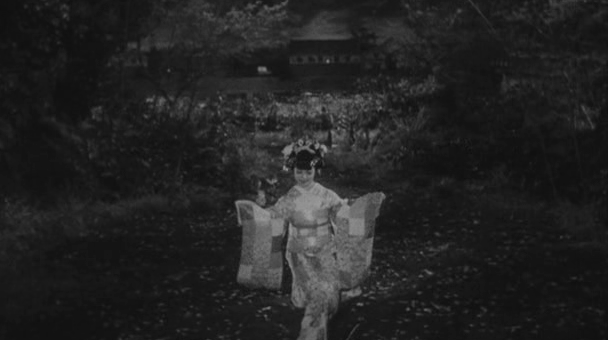
Ghost Stories of Wanderer at Honjo (怪談本所七不思議, Kaidan Nana Fushigi) seems to have become mistitled somewhere along the line seeing as the Japanese is something more like The Seven Wonders of Honjo, an area of Tokyo that had a reputation for gloominess during the Edo era. The “seven wonders” are a collective name for a series of local ghost stories, of which there may actually be more than seven, which were popular fare for rakugo tales and other forms of storytelling. Though the film opens with a brief rundown of the seven wonders which it weaves into the tale, it is more of a revenge drama that throws in the appearance of popular yokai such as Rokurokubi, Kasa-obake, and Hitotsume-kozo.

The yokai emerge to scare a pair of fishermen who were about to ignore a ghostly voice telling them to leave the fish they’d just caught in the river behind, but what the fishermen really seem to object to is the presence of a tanuki who makes a habit of tricking the local people. After becoming fed up with them, the locals hunt down the tanuki and are about to turn it into soup when a wealthy nobleman, Komiyama (Hiroshi Hayashi), arrives and buys the tanuki from them which he then frees. Komiyama tells the tanuki to stop bothering the villagers in return and continues home after marking the anniversary of his wife’s passing and the departure of his son who is going out into the world.

The tanuki later appears in the form of a beautiful young woman to tell Komiyama that she is grateful for his saving her life and will always protect him. Unfortunately, however, Komiyama gets into trouble on the night of a tanuki ritual, so she doesn’t make it in time to save him from a dastardly plot by his disinherited nephew to murder him for his money. She can, however, help his son Yumenosuke (Juzaburo Akechi) exact revenge and put a stop to the amoral Gonkuro’s (regular Shintoho villain Shigeru Amachi) reign of terror.

As in many tales like these, it’s Gonkuro who is real terror threatening chaos in the ordered Edo society while being unable to conform to his proper role in life. Before the film begins, Komiya has already disowned his nephew for being a wastrel. Gonkuro says that he’s come to pay his respects to his late aunt, but Komiyama suspects he’s after money again which he’ll spend on drink, women, and gambling. There is a direct contrast being drawn between the good son Yumenosuke and Gonkuro, though it’s Yumenosuke who apparently becomes seriously ill while on his travels preventing his speedy return until his desire for revenge enables him to overcome his illness. 

Meanwhile, Komiyama has recently married again to a younger woman, Sawa (Akiko Yamashita), who turns out to be a former lover of Gonkuro’s. Though she at first resists, she’s bullied into resuming a sexual relationship with him which she then carries on enthusiastically. She and Gonkuro seem to be symbols of the evils of the age in their lack of properness and humanity. Not only does Sawa cheat on her husband, but even goes along with Gonkuro’s murder plot to kill him and inherit his money.

Though the tanuki fails to save Komiyama and is generally depicted as an untrustworthy trickster, it is a kind of guardian of these virtues in standing behind Yumenosuke as a source of righteousness. Komiyama’s act of kindness will eventually be repaid, while Gonkuro’s attempt to triumph over the moral order represented by Komiyama will be denied. Having dispatched Komiyama, Gonkuro occupies an awkward class status as a usurping lord and even tries to rape Yumenosuke’s betrothed Yae during an expressionist storm as a means of asserting his triumph over his cousin. Sawa meanwhile does something similar by flirting with and then potentially entering a sexual relationship with their servant Gosuke (Saburo Sawai) in full contravention of the social order. Their attempts to get rid of the tanuki by praying her away are a means of reasserting control and dissolving the rules of human morality that they feel constrain them.

In that sense, the tanuki and yokai are not particularly frightening but a constant presence that enforces a moral order defined by humanity and compassion. The two fishermen are only spooked because they ignore the disembodied voice telling them to leave the fish, not because they heard it in the first place. The tanuki, meanwhile, are mainly seen dancing as part of their ritual rendered as ghostly figures not quite of this world. They appear not to do anything that could be considered more than irritating even when messing with locals and definitely don’t deserve to get made into soup. The message seems to be that being good and kind might not save you personally, but it will eventually pay off, and is after all, the right thing to do as man can only thrive when living in harmony with nature and the supernatural world rather than attempting to transcend it through immorality like the selfish and thoughtless Gonkuro.


The Military Policeman and the Dismembered Beauty (憲兵とバラバラ死美人, Kyotaro Namiki, 1957)

The Military Policeman and the Dismembered Beauty (憲兵とバラバラ死美人, Kenpei to Barabara Shibijin) was apparently a substantial hit on its release, though to modern eyes at least it doesn’t quite live up to the salaciousness of its title. In fact, it seems a little more interested in reassessing the militarist past while attempting to rehabilitate an authoritarian power and reframing it as good and compassionate unlike the corrupted killer who is selfish and ambitious to the extent that he’s literally poisoning the militarist wells. 

What we’re first introduced to, however, is a rather familiar tale of a soldier who’s gotten a girl pregnant but now won’t marry her mainly because he’s onto a good thing with a pretty girl from a prominent family so his girlfriend’s in the way. Though we see a prelude to the murder, we don’t get good a look at the soldier’s face (though we do hear his voice) which on one level hints at the generalised violent threat of the militarist machine but is also a neat plot device that allows us to into the crime but still maintains the mystery. When we do see the actual killing, it’s surprisingly frank for the time period and disturbing in its sexual charge though there is no gore involved save a grisly discovery in yet another well. 

The killing occurred shortly before the regiment left for Manchuria, which seems to be one way the killer sought to move on and leave his crime behind. The first hint of the corruption is discovered by a gang of new recruits as yet unused to the militarist machine. They notice that the water in the well in the barracks is bad, but are at first bullied and insulted by another soldier who’s been there longer and gives them a rather priggish speech about the sanctity of the regimental water. What they discover is that the water tastes bad because there’s a dismembered torso in there and has been for the last six months. One has to wonder why the culprit would think this a good place to hide a body given the risk of discovery and increasing suspicion but as it turns out no one is all that interested. The Military Police aren’t that keen on investigating themselves, and then we get the familiar conflict between the local cops and the specialists as a top investigator, Kosaka (Shoji Nakayama), is assigned to investigate the crime and insists on doing so thoroughly rather than just beating their favourite subject into a false confession. 

Kosaka is then posited as a nice Military Policeman, an emissary of legitimate authority rather than bumbling provincials who are ridiculous and self-serving not to mention incompetent and resentful. We’re told repeatedly that Kosaka is prepared to work with the civilian police unlike the other military policemen who insist on militarist primacy and refuse to allow the detectives onto the base to investigate. He’s a representative of a less authoritarian age that looks forward to the democratic future, but he is also a part of that organisation himself no matter how different he may seem to be and cannot escape the overarching structures of militarism. Nevertheless, his edges are further softened by a nascent romance with the middle-aged innkeeper at his lodging house while his assistant is after her sister, a childhood friend who can’t stop calling him by his old nickname. 

The two of them investigate scientifically, making frequent trips to the pathologist to discuss theories and evidence though Kosaka is eventually guided towards the solution after seeing the young woman’s ghost. The local military police meanwhile fixate on another soldier who has a reputation for using sex workers, one of whom has recently disappeared, though Kosaka thinks the man is a just a crook with what modern viewers make think of as a sex addition that sees him steal supplies from the kitchen to sell in order to finance his visits to the red light district. The military police whip him in an oddly sexually charged manner to try to get him to confess, but he maintains his innocence. One of the motives for the murder was seemingly that the victim planned to expose the affair, taking her concerns to the killer’s superior officer in an effort to force him to marry her which would have ruined his career prospects in what is supposed to be an organisation of honourable men. Unlike Kosaka who shares his name with the writer of the novel the film is based on which may have been inspired by true events, the other military police are largely like the killer, arrogant, selfish and unfeeling though all Kosaka himself represents is a supposedly more benevolent authority that for his niceness may not actually be all that much nicer.


The Ceiling at Utsunomiya (怪異宇都宮釣天井, Nobuo Nakagawa, 1956)

Crime does not pay for a series of conspirators at the centre of Nobuo Nakagawa’s supernaturally-inflected historical tale, The Ceiling at Utsunomiya (怪異宇都宮釣天井, Kaii Utsunomiya Tsuritenjo). As the title implies, Nakagawa’s ominous jidaigeki is inspired by a historical legend in which a retainer supposedly attempted to assassinate the shogun through the rather elaborate device of a mechanical ceiling designed to crush him as he slept. In actuality no such thing took place, the shogun changed his route and subsequent investigations of Utsunomiya Castle found no sign of a false ceiling, yet the story took on a life of its own as local folklore. 

In this version of the tale, conspirators Councillor Kawamura (Ureo Egawa) and local yakuza Kagiya (Masao Mishima) are conspiring to depose Tokugawa Iemitsu (Yoichi Numata) in favour of his brother, manipulating Lord Honda (Shuntaro Emi) of Utsunomiya Castle by convincing him that his clan will prosper when the other retainers fall in behind the new shogun. The pair have arranged for nine talented craftsmen to be shut up in the castle to install “the mechanism” in time for the arrival of the shogun who is due to stay at the castle on his way to Nikko. Meanwhile, Kawamura is also intent on sleeping with the daughter of head carpenter Toemon (Yoji Misaki), Ofuji (Konomi Fuji), whom chief minion Tenzen (Tetsuro Tamba) is supposed to kidnap once the workmen have gone into isolation in the castle. Righteous samurai Ryutaro (Hiroshi Ogasawara) however, an undercover shogunate bodyguard, begins to disrupt their plan saving Ofuji while bonding with a friendly bar hostess, Onobu (Sachiko Toyama), and secret princess forest woman Oshino (Akemi Tsukushi). 

The plot represents in itself a malfunctioning of the feudal order in the essential weakness of Lord Honda, the ambition of his underling Kawamura, and the cruel greed of Kagiya. As the two men conspire, Kagiya jokingly laments that he isn’t a samurai while Kawamura reminds him that if the plan comes off he’ll be fantastically rich. Kagiya, a yakuza who sends his thugs to extort protection money from the local market, is representation of the threat of the rising merchant class whose financial power presents a challenge to the authority of the samurai. Toemon, meanwhile, a master craftsman, is manipulated into participating in the plan because he is in debt to Kagiya, later promised that he too will be “promoted” in being given permission to carry a sword little knowing that Kawamura and Kagiya not only plan to kidnap and rape his daughter but never intend to allow any of the craftsmen to live because they simply know too much. 

The Ceiling at Utsunomiya is not a ghost story in the manner for which Nakagawa is best known but it certainly plays like one, Kagiya eventually haunted by the figure of a betrayed Toemon which in turn leads him to a self-destructive attack on Tenzen and his eventual demise collapsed over his ill-gotten gains, a koban falling from his hand. Greed and violence will only repay in the same, the weak-willed Lord getting his comeuppance from the ever confident shogun even if he himself coolly stands back while others risk their lives to protect him. Even so, the eventual operation of “the mechanism” is intensely startling, the ceiling abruptly collapsing with alarming ferocity though one wonders what the advantage is in such an expensive, elaborate contraption aside from its ironic symbolism when the point of a sword will do. 

Then again, the heroic Ryutaro is almost assassinated while crossing a river via zip wire later fished out of the river by sullen forest woman Oshino, first encountered hunting birds with darts but later revealed to be the illegitimate child of samurai parents who fell foul of political intrigue. In a sense this revelation emphasises the restoration of the political order, Ryutaro permitted to fall in love with Oshino because they are of the same social class, while the romance between Ofuji and craftsman Yoshichi (Kotaro Sugiyama) also comes to fruition eliding the minor class difference between them in allowing the boss’ protege to marry the now orphaned daughter. Onobu meanwhile pays heavy price for her misplaced love for Ryutaro, denied romantic fulfilment in her liminal existence as a bar hostess. In any case, the corruption is exorcised and the normal order resumes reinforcing the hierarchical shogunate society with each of the players back in their rightful positions and possessing new hope for the future as Ryutaro and the shogun continue their tour while their former comrades kneel at the roadside. 


The Lady Vampire (女吸血鬼, Nobuo Nakagawa, 1959)

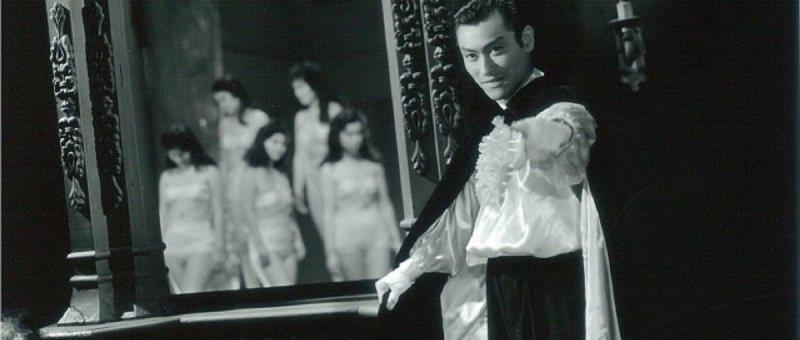
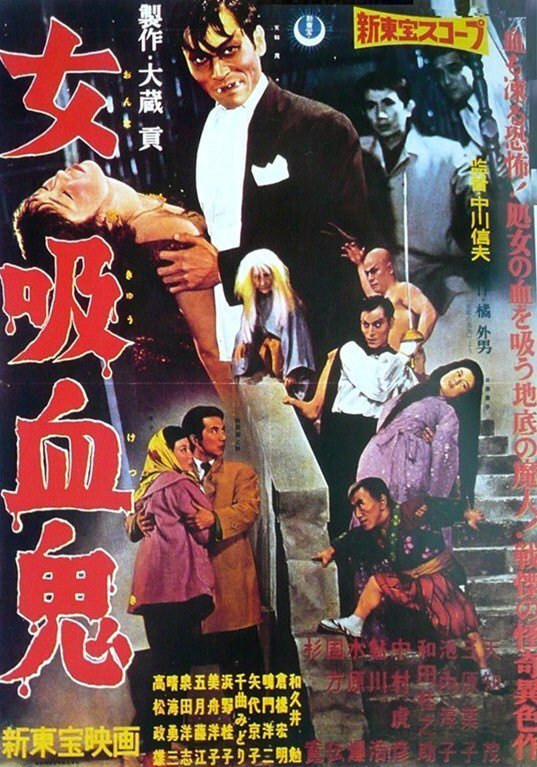
Three years after the Vampire Moth, Nobuo Nakagawa returns to the realms of bloodsucking adventure with the misleadingly titled The Lady Vampire (女吸血鬼, Onna Kyuketsuki). The only “vampire” on offer here is male, though his victim is indeed a “lady” in being the descendent of a noble family apparently the subject of a mysterious curse which, along with her resemblance to a beautiful ancestor, makes her so attractive to the sensitive, artistic bloodsucker at the tale’s centre. Heavily influenced both by Hammer Horror and Universal’s monster films from the ‘30s, Nakagawa plays fast and loose with his mythology while indulging in a common though problematic association between vampirism and Christianity.

Beginning in high style, the film opens with a driver escorting ace reporter Tamio (Takashi Wada) to the birthday party of his fiancée Itsuko (Junko Ikeuchi) for which he is already very late. The driver stops the car believing he has hit a woman pedestrian, but she seems to have vanished. Later, Tamio spots her wandering around near Itsuko’s home, while Itsuko brings darkness into her party by accidentally cutting her finger and getting a suspiciously large amount of blood on her cake. This alarms Itsuko’s father Shigekatsu (Akira Nakamura) because it reminds him of something that happened right before his wife, Miwako (Yoko Mihara), mysteriously disappeared 20 years previously. 

Of course, the mystery woman turns out to be none other than Itsuko’s long lost mother who is discovered in a long disused room by her extremely confused husband. To everyone’s consternation, Miwako looks exactly the same as she did 20 years ago and for the moment is more or less catatonic. The doctors can’t explain it, and no one is quite sure what to do about this miraculous development. Itsuko stops to make sure Tamio isn’t going to put any of this in his paper, fearful that people will think of her mother’s condition shamefully as a disease or a deformity. Paying a visit to a local art gallery, the pair are shocked to discover that the prizewinning work by a previously unknown artist seems to be a nude painting of Miwako and begin investigating to find out if it has some connection to her disappearance and present vacant state.

Meanwhile, a “fiend” is making trouble in the modern city. The artist behind the painting, using the name Shiro Sofue (Shigeru Amachi), is a brooding, dapper young man in a dark fedora and sunshades with a white scarf fashionably tied around his neck. We learn that he has an extreme aversion to moonlight because it makes him go crazy, feasting on the poor hotel maid who was only trying to make his stay as comfortable as possible. Aided by his dwarf minion Tiny (Tsutomu Wakui), Shiro (not his real name), puts the body neatly outside like a room service tray and pleads ignorance when the police, and crime reporter Tamio, arrive to investigate the heinous murder. The same thing happens again in a Ginza bar where, for reasons not quite obvious, Tiny starts making trouble and smashes a window letting the moonlight in sending Shiro into a murderous rage where he slashes six women with Tamio watching from the sidelines. 

Shiro steals the painting back and delivers it to Shigekatsu where Miwako eventually sees it and regains her memories. At this point, Shigekatsu enlightens us about the “Matsumura curse” which dates back to the 17th century and the rebellion of Shiro Amakusa who led Japan’s secret Christians in revolution against the Shogunate but was defeated. His troops were massacred and he himself was beheaded as a traitor. The Matsumuras are apparently direct descendents of the Amakusa clan and so have “cursed” blood. “Shiro Sofue” is not Amakusa Shiro but a lovelorn retainer, Takenaka, who coveted the princess Katsu but was unable to have her. When she asked him to take her life to save her from the Shogunate forces he complied, but then drank her blood out of love for her and apparently became an immortal being with the occasional urge to sustain himself with the blood of other young women. 

How this became a “Matsumura” curse or really what the curse supposedly refers to is unclear, especially as Takenaka isn’t even part of the family but a lesser retainer damned by love for an unattainable princess. Like subsequent Japanese vampires, the “curse” is directly linked to Christianity. Takenaka’s sales patter uses heavily ritualised language he likens to a “baptism” . “Accept my love, and you will live forever in eternal, unfailing youth” he tells his victims after drugging them with sweet smelling flowers and dragging them back to his underground castle which is built in the Western gothic style and, ironically, filled with crosses. This vampire makes good use of mirrors and has co-opted religious imagery for his own ends. Later we see that he has attempted to find an eternal mate several times before, turning his victims into fleshy statues by placing a gold cross on their heads in the same way a Taoist priest might stop a hopping vampire with a Buddhist sutra. The final of these is a direct echo of the archetypal Virgin Mary statue found at Christian churches all over the world. 

Through this, the “curse” is rendered a foreign import existing outside of and presenting a direct threat to traditional Japanese culture, again aligned somewhat problematically with Christianity by way of an overly literal interpretation of ritual. The  settings too are predominantly Western – the European-style mansion, hotels, bars, and galleries, while Takenaka dresses in a billowing white shirt and cape, living in a stone “castle” built in a cave, and eventually fighting with a fencer’s rapier rather than a katana. His minions, however, have a slightly more diverse flavour in addition to Tiny with a giant mute bald man providing security and a witchy old woman looking like she’s just walked out of Throne of Blood dispensing advice with a seemingly more “Japanese” context. As usual, Itsuko becomes mere bait hysterically running around the castle chased by Tiny while intrepid reporter Tamio heroically battles both the bald man and Takenaka himself until the police finally arrive and bring “order” to this orderless place. The young free themselves from an ancestral curse and prepare to move on, no longer burdened by “bad blood” as they watch the past dissolve while preparing to move into a freer future. 


Mr. Shosuke Ohara (小原庄助さん, AKA Ohara Shosuke-san, Hiroshi Shimizu, 1949)

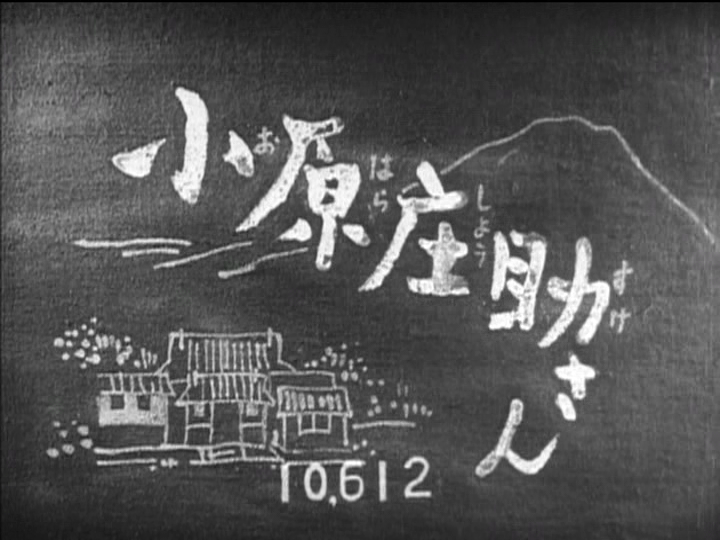
vlcsnap-2016-09-25-01h34m07s636Ohara Shousuke-san (小原庄助さん) is the name of a character from a popular folk song intended to teach children how not to live their lives. The Ohara Shosuke-san of Aizu Bandaisan has lost all his fortune but no one feels very sorry for him because it’s his own fault – he spent his days in idleness, drinking, sleeping in, and bathing in the morning. The central character of Hiroshi Shimizu’s 1937 film has earned this nickname for himself because he also enjoys a drink or too and doesn’t actually do very much else, but unlike the character in the song this a goodhearted man much loved by the community because he’s a soft touch and just can’t refuse when asked for a favour. An acknowledgement of the changing times, Shimizu’s Mr. Shousuke Ohara is a tribute to the soft hearted but also an argument for action over passivity.

If you turn up one day and ask for directions to the Sugimoto household, everyone will look at you with confusion but if you ask for Mr. Shousuke Ohara everyone will gladly walk you over and introduce you. Saheita Sugimoto (Denjiro Okochi) is the head of a once proud samurai household but his fortunes are far from those of his ancestors. Despite his pecuniary difficulties, Sugimoto is good hearted man who wants to help everyone that he can (out of a sense of altruism rather than duty or vanity). Consequently he is deeply in debt and nearing bankruptcy yet he can’t give up any of his three vices – drinking, gambling, and generosity.

The nature of the changing times is at the centre of this 1949 film. As Sugimoto is fond of telling people, his noble house used to stand for something but all of that historical influence is next to meaningless now. Though Western dress is not uncommon, the village is pretty much as it’s always been – children play in the fields and Sugimoto travels everywhere by donkey. Other than the tale of Sugimoto’s fall from grace, the central narrative concerns an election for a new village chief. Yoshida, a youngish man, wants Sugimoto’s support for his election campaign. His main campaign policy is modernisation – the introduction of electricity, modern transportation and communications, as well as greater cultural involvement starting with opening Western style ballroom dance classes for the children. Unfortunately his policies are not that firm and his motto seems to be “I’ll do that first!” to all aspects of his plan which is not very encouraging but still the desire is very much to move away from old fashioned village life towards a more sophisticated urbanism.

This of course also means an end to the inherited influence of idle nobleman such as Sugimoto. Though he’s a kind man who likes nothing other than helping other people, Sugimoto has been a passive steward, more consumed with his own idle pursuits than with making an active attempt at leading the village. This passivity has contributed to his downfall as he’s neglected the business of maintaining his own fortune. After taking out numerous loans which he only ever uses to help the villagers, Sugimoto has let the estate which ancestors founded, and which he was supposed to look after in the names of all that have gone before and all were to come after him, slip away. The ultimate failure and a disgrace to his ancestors, this loss of the ancestral home is an unforgivable betrayal yet there is something in Sugimoto which seems to regard it as right and proper that it should go.

Change is coming to the village, even if it isn’t coming with the speed that a young man like Yoshida may be hoping for. Change is also coming to Japan which is in the progress of rebuilding itself anew following long years of folly followed by confusion. There is no room for genial idleness anymore. “If you can work honestly with your hands you can make a living”, Sugimoto tells two would-be-burglars that he invites in for a drink as a apology for not having anything left for them to steal, but means the advice more for himself than anyone else. It’s time to say goodbye to Shousuke Ohara and the burden of inherited privilege and chart a new course as Seihata Sugimoto. Finishing on another of Shimizu’s much loved road shots, Sugimoto, like his nation, walks confidently along the road to an uncertain future yet he is not alone as he goes and may make something of himself yet.