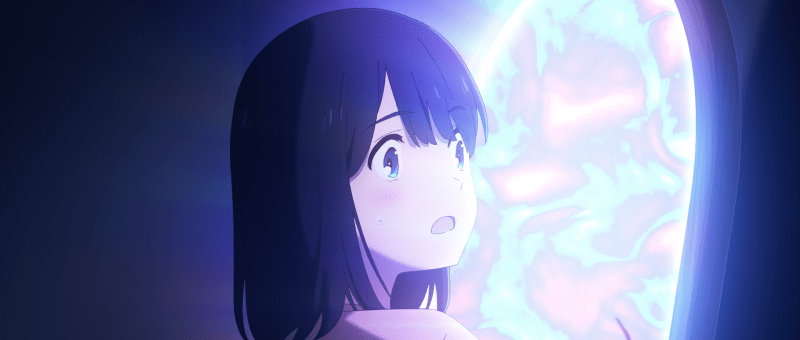
Lonely Castle in the Mirror (かがみの孤城, Keiichi Hara, 2022)

Kokoro isn’t “lying” when she complains of a stomach ache to avoid going to school, it’s just that it’s the anxiety she feels at the prospect that is making her physically ill. Based on a novel by Mizuki Tsujimura, Keiichi Hara’s fantasy-infused anime Lonely Castle in the Mirror (かがみの孤城, Kagami no Kojo) explores the effects of school phobia in uniting a series of teenagers who each for one reason or another have turned away from education often because of bullying or the rigidity of the contemporary schools system. 

As we discover, Kokoro (Ami Toma) gradually stopped going to school after her life was made a misery by manipulative popular girl Sanada who operates a small clique of bullying minions yet appears all sweetness and light with the teaching staff. Unable to fully explain what’s been going on, Kokoro largely remains at home while her understanding mother (Kumiko Aso) explores opportunities in alternative teaching and tries to support her as best she can. Though the film is very sympathetic towards Kokoro and the children in insisting that it isn’t their fault they can’t attend school but the fault of an unaccommodating system, it perhaps misses an opportunity to fully commit to educational diversity when the end goal becomes getting Koroko back in class undaunted by the presence of her bully. 

Nevertheless, it offers her another outlet when the mirror in her bedroom suddenly becomes a magic portal that transports her to a fantasy fairytale castle where she meets six other school phobic teens who are all dealing with similar issues. A young girl in wolf mask informs her that they have until the end of the school year to locate a key which if turned will grant one, but only one, of their wishes. When the key is turned, they will all lose their memory so it’s unclear if they will know whether or not the wish was granted but in any case are left with a choice between achieving their dreams and the new friendships they’ve formed at the castle. The issues that plague each of them are various from bullying to dealing with grief, purposelessness, a feeling of not fitting in, parental expectations, and an implication of sexual abuse at the hands of a close relative. As the Wolf Queen tells them “collaboration is beautiful” and it is the connections they forge with each other that give them strength to go back out into the world while each vowing to pay it forward and make sure to stand up to injustice by protecting other vulnerable kids like themselves when they’re able to. 

Even so, Kokoro takes her time on even deciding whether or not to use the mirror and for some reason the castle is only open business hours Japan time. If they stay past five they’ll be eaten by wolves! Many things about the fantasy land do not add up and Kokoro begins to worry that it’s all taking place in her head, her new friends aren’t really real, and she’s being driven out of her mind by the stress of being the victim of a campaign of harassment she can’t even escape by staying home minding her own business. But through her experiences she is finally able to gain the courage to speak out against her bullying while supported by her steadfast mother and an earnest teacher who is keen to find the best solution for each of her pupils rather than trying to force them back into a one size fits all educational system. 

In any case, Kokoro’s quest is to find her way back through the looking glass to rediscover her sense of self and take her place in mainstream society free of the sense of loneliness and inferiority she had felt while being bullied by Sanada and her clique of popular girls though in an ironic touch the film does not extend the same empathy to her or ask why Sanada has an apparent need to need to pick a target to destroy. A variable animation quality and occasional clash of styles sometimes frustrate what is at heart a poignant tale of finding strength in solidarity and learning to take care of each other in a world powered more by compassion than an unthinking devotion to the status quo.


Lonely Castle in the Mirror screened as part of this year’s Nippon Connection.

International trailer (English subtitles)

Weathering with You (天気の子, Makoto Shinkai, 2019)

weathering with you poster 2Some might say much of life is learning to weather the storm, but when the storm is literal as well as metaphorical it’s easier said than done. Following his 2016 mega hit Your Name, Makoto Shinkai’s Weathering with You (天気の子, Tenki no Ko) opts for much of the same but grafts an additional layer of anxiety onto the lives of his precarious teen heroes who are left largely adrift, betrayed by corrupt adult society and plagued by doubt and despair in a world which, it seems, is trying to drown them in existential hopelessness.

16-year-old Hodaka (Kotaro Daigo) has run away from his parochial island home for the bright lights of Tokyo. Beyond disconnection from his parents and small-town ennui, he never gives much of a reason why he’s so determined not to go back, but tries to make a go of it in the city with all the prideful naivety of an adolescent young man. What he discovers is that, because of laws in place to protect him, he can’t support himself honestly as an independent teen, ironically placing him firmly at risk in shady Kabukicho but it turns out that you can’t even get a job as a host in a sleazy bar without proper ID. Just when he’s hit rock bottom, Hodaka is given new hope when a friendly employee at McDonalds decides to gift him a burger just because she can see that he’s hungry.

Hodaka describes the BigMac as the best meal he’s ever tasted, because he’s tasting kindness in an environment which has turned out to be far more hostile than he’d anticipated. He tries to repay that kindness when he spots the girl out in Kabukicho being manhandled by a gangster trying to coax her into a love hotel, threatening him with a gun he picked up from the rubbish bin outside a club. The girl, Hina (Nana Mori), ends up saving him again, but the rescue originally backfires because of Hodaka’s problematic adoption of the gun. He regains Hina’s sympathy by throwing it away, allowing a genuine connection to arise between them, especially when he discovers that Hina has an unusual power – she can stop the rain with the power of prayer.

It’s the height of summer, but it hasn’t stopped raining since Hodaka arrived in Tokyo. In fact, it’s just about time for Obon when the departed souls of long gone relatives are able to return. Hina apparently became linked with the sky after praying at a shrine during her mother’s illness, but if the gloominess of the heavy skies and constant rain is a reflection of her unhappiness, it’s one belied by superficial cheerfulness even though her life is just as hard as Hodaka’s. In addition to trying to support herself on the kind of money you can make as a teenage part-timer, she’s also responsible for her younger brother Nagi (Sakura Kiryu) which is why, perhaps, she was tempted by that gangster’s offer of big bucks to be made in Kabukicho.

Hodaka too looks for familial connections, moving in with a middle-aged man who saved his life during the storm that brought him to Tokyo. Like Hina, Keisuke (Shun Oguri) is also drowning in grief, in his case for a beloved wife killed in an accident, while dealing with separation from his daughter who has been taken in by her grandmother in disapproval of Keisuke’s scrappy lifestyle. It’s working for Keisuke’s occult-themed magazine that leads Hodaka to recognise Hina as a “Sunshine Girl”, but also to learn that such “weather maidens” were once common in ancient Shinto Japan and mostly met a bad end. A fortune teller makes it clear that exercising the kind of power that Hina has is likely to deplete her capacity for life, a mild irony in that it’s the inability to feel alive that these rains seem to symbolise.

Ironically enough, both teens met their destiny because they were chasing the light – Hina drawn to a rooftop shine illuminated by an improbable ray of sunshine in the rain, and Hodaka longing to find his place in the sun and resolving to live inside the light that Hina casts. Eventually, Hodaka is forced to make a decision and comes to the conclusion that he can accept Hina for all that she is, that she doesn’t need to be the “Sunshine Girl”, she can feel what she feels and the world will cope. He will weather the storm along with her.

Meanwhile, the spectre of real world climate change looms in the background. Hodaka’s decision necessarily means he has chosen to drown the world to save his love. Faced with the gradual submergence of the city of Tokyo, an old woman waxes philosophical, remembering that back in Edo most of this land was underwater so perhaps it’s just going back to the way it’s supposed to be. Hodaka is swayed but unconvinced. Still young, he is very invested in the idea that he has changed the world, for good or ill, seizing his agency as path out of his despair. But Shinkai’s messages are mixed. Hina continues to pray, but Hodaka comes to the conclusion that the world has always been messed up so perhaps all you need to do is learn to live in it and the rest will figure itself out. As much as it’s true that the problems of climate change should not rest on the young, who are blameless, it is perhaps irresponsible to advocate cautious indifference. Hodaka remains wedded to the idea that he’s made a choice and his choice has changed the world, while beginning to realise that changing the world is not his responsibility, or at least not his alone and not in that way. He has, however, found a way at least to live with all his choices, undefeated by the rain.


Original trailer (English subtitles)