One Last Love Letter (人はなぜラブレターを書くのか, Yuya Ishii, 2026)

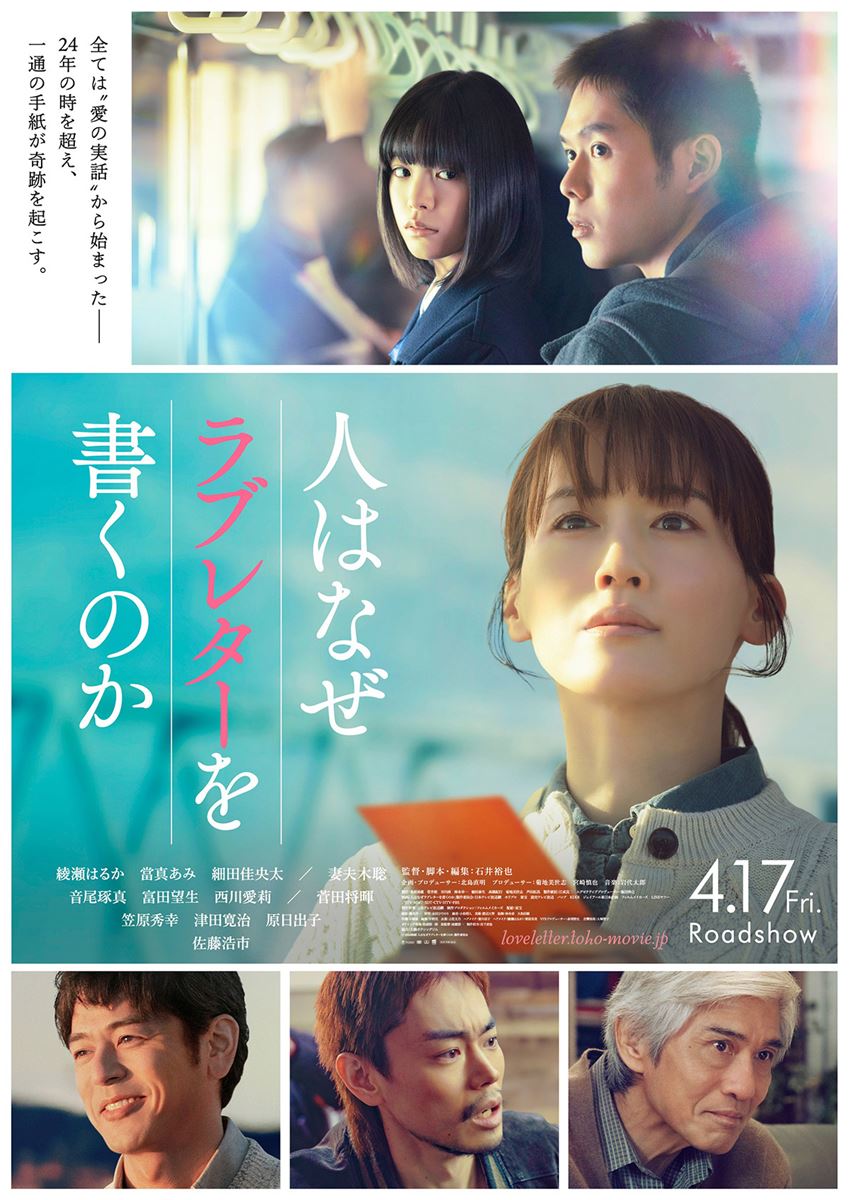
“Why do people write love letters?” is the question posed by the Japanese title of Yuya Ishii’s latest film, which turns out to be less about romance than the regret that stems from things left unsaid. Love letters, it seems to say, are written more for the writer than the recipient, but can, at the same time, bring about a sense of closure or peace of mind in having communicated something that would otherwise have lingered as an unresolved mystery.

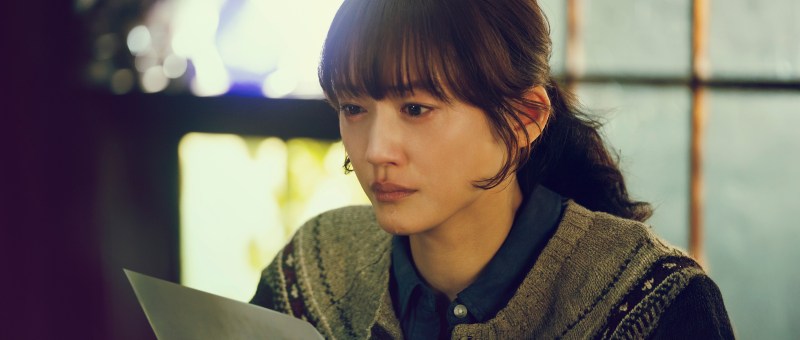
The film is inspired by a real-life incident in which a bereaved family received a letter over 20 years after their teenage son’s death in a train accident from a middle-aged woman who’d had a crush on him at the time but never got a chance to say anything. It is, of course, also drawing inspiration from Shunji Iwai’s seminal 90s romantic melodrama Love Letter in which a young woman sends a letter to her late fiancé she doesn’t expect to be delivered only to get an unexpected reply. After receiving some upsetting news about a medical condition and being reminded of her own first love by her teenage daughter Mai’s (Airi Nishikawa) eerily similar experience, Nazuna (Haruka Ayase) is prompted to write a letter to Shinsuke (Kanata Hosoda), a boy she liked on the train, but eventually decides against sending it, only for it to end up being delivered anyway.

Her medical prognosis is, in some ways, the reason that Nazuna writes the letter, knowing that Shinsuke is already dead, and that writing it will allow her to sort out her own feelings. She says in the letter that there is no one else that she can talk to, though she has a husband and daughter she otherwise struggles to communicate with. She too afraid to tell her daughter that her medical condition has declined and is living in a kind of limbo state with something left permanently unsaid. To begin with, there are hints that Nazuna’s marriage is unhappy with her husband Ryoichi (Satoshi Tsumabuki) a perpetually gloomy presence who stays out late drinking alone after work presumably to avoid coming home. Likewise, his gruff instructions to Nazuna that she should give up her vegetable garden and cafe business come off as patriarchal and controlling, though his irritation later seems to be an expression of the pressure lack of communication is placing on the family unit. He wanted Nazuna to give up her vegetable garden out of consideration for her physical condition, but phrased it badly, and later changes tack to help out as he and Mai harvest the vegetables together. 

In that sense it’s a little ironic that it’s Mai who is the open communicator and directly asks her mother for romantic advice having also fallen for a boy on the train, though one in her class at school. Nazuna’s letter brings comfort to Shinsuke’s parents precisely because he had been an uncommunicative son and parts of his life remained a mystery to them. Shortly before his death, he had begun to open up, but they are still left with regret that they did not have the opportunity to talk more and left many things unsaid. It’s this realisation that prompts Nazuna to have a serious discussion with her daughter about her health and implications for the future, reducing the sense of distance and anxiety caused by a lack of communication and allowing them to come together as a family.

In the end, the daughter’s first love turns not to be such a big deal and is quickly forgotten in favour of the central messages of making sure you say everything that needs to be said while you can still say it rather than being left with lingering regrets. Mai comes to see her mother less as the “random weed” of her name, and more as a hardy plant that can grow anywhere meaning that Nazuna is still somewhere close by watching over her, so she feels secure in her maternal legacy and family history as she begins to embark on her own story. In its own way, the film itself is a kind of love letter from a daughter to a mother that brings its own kind of healing in bringing the past full circle.


One Last Love Letter screened as part of this year’s Toronto Japanese Film Festival.

Trailer (English subtitles)

Immersion (忌怪島/きかいじま, Takashi Shimizu, 2023)

Technological anxiety was at the heart of millennial J-horror, but perhaps the more things change the more they stay the same. Takashi Shimizu’s latest ghost story Immersion (忌怪島/きかいじま, Kikaijima) sees a grudge-bearing spirit cross over from the virtual world neatly suggesting we take our monsters with us into our simulacra and to that extent the brave new world is not so new at all. Then again, the hero thinks he desires a private world but paradoxically wants to share it and eventually discovers that what he craves is connection.

Tomohiko (Daigo Nishihata) has accepted a job as a programmer helping to build a new virtual world exactly replicating a remote island. He is greeted by his boss, Ide, in the digital space, but shortly after his arrival discovers that she died some time previously along side a man she may have been experimenting on in a project exploring brain syncronicity. When Tomohiko enters the virtual world he is confronted by strange and dangerous visions which suggest there’s a threatening bug in the system. Soon enough, the data breaks loose and somehow awakens in our world.

What no one knows is how a vengeful ghost got in the machine in the first place, though a shinto priestess later likens the new digital space to the “over there”, a perfect simulacrum of our world existing on another plane where spirits and their victims gather. Then again, it seems the problems are mainly on this side with an old man mocked by children and shunned by society because his mother suffered some kind of mental illness and was filled with a lust that was taboo at the time. The man’s mother is linked to the legend of Imajin, a slave raped by her master whose wife then took against her causing her to become a vengeful spirit who drove people out of their minds.

The purpose of the new world Tomohiko is creating isn’t clear, but it’s certainly very well resourced. The implication seems to be that the virtual is already haunting us and we can’t be sure of what we’re “really” experiencing and what we’ve been primed to experience. Tomohiko increases “the reality” of the virtual space by coding to it to activate “real” sense memories such as the smell of the sea or the feel of the sand. He can’t be sure if he’s the ghost in this world or the other while remaining aloof and diffident, unable to communicate effectively with his teammates. Tamaki, the estranged daughter of the dead man asks him if he doesn’t like people, to which he has no real answer though she replies that she doesn’t really like them either. What he realises is that doesn’t really want a world of solitude, but to be with others though it seems it might not matter whether in a “real” or virtual space.

But in contrast to all this modernity, the island is a traditional community with a strong interest in shamanistic lore and ritual. Tomohiko says he doesn’t really believe in any of that stuff, but is still prepared to go along with the shamaness’ advice in order confine the vengeful spirit to another world even if it means sacrificing the virtual space they are trying to build. Perhaps the message is that this kind of technological advance is dangerous and hubristic, unleashing forces we are ill-equipped to understand and would not be able to quell. As the shaman implies, you have to close the door from this side and not the other, which is a serious problem for the engineers who find themselves struggling to destroy the portal of a Torii gate in both spaces while the ghost continues to wreak watery vengeance.

Shimizu conjures an atmosphere of lurking dread in which digital ghosts haunt us in reflections of the ancient past even as our reality is destabilised by the overlay of the virtual. Tamaki reflects that the island is like a ghost town with few figures on the streets save themselves though they too sometimes appear like lingering spirits. What they discover may be a kind of refuge or escape, but perhaps not in the way we might expect while vengeful ghosts aren’t quite so easy to exorcise as they might once have been.


Immersion screened as part of this year’s London East Asia Film Festival.

Original trailer (no subtitles)

Lonely Castle in the Mirror (かがみの孤城, Keiichi Hara, 2022)

Kokoro isn’t “lying” when she complains of a stomach ache to avoid going to school, it’s just that it’s the anxiety she feels at the prospect that is making her physically ill. Based on a novel by Mizuki Tsujimura, Keiichi Hara’s fantasy-infused anime Lonely Castle in the Mirror (かがみの孤城, Kagami no Kojo) explores the effects of school phobia in uniting a series of teenagers who each for one reason or another have turned away from education often because of bullying or the rigidity of the contemporary schools system. 

As we discover, Kokoro (Ami Toma) gradually stopped going to school after her life was made a misery by manipulative popular girl Sanada who operates a small clique of bullying minions yet appears all sweetness and light with the teaching staff. Unable to fully explain what’s been going on, Kokoro largely remains at home while her understanding mother (Kumiko Aso) explores opportunities in alternative teaching and tries to support her as best she can. Though the film is very sympathetic towards Kokoro and the children in insisting that it isn’t their fault they can’t attend school but the fault of an unaccommodating system, it perhaps misses an opportunity to fully commit to educational diversity when the end goal becomes getting Koroko back in class undaunted by the presence of her bully. 

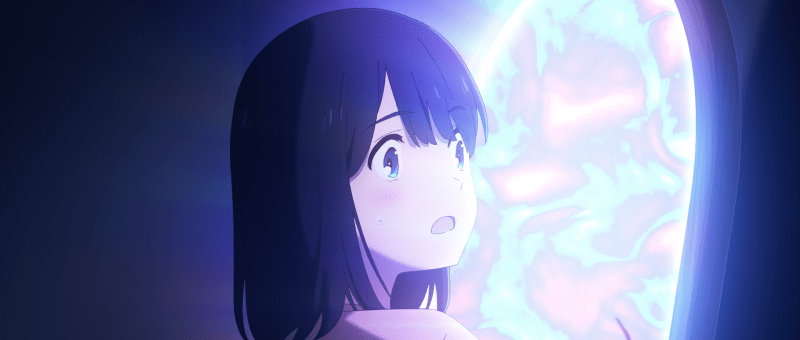
Nevertheless, it offers her another outlet when the mirror in her bedroom suddenly becomes a magic portal that transports her to a fantasy fairytale castle where she meets six other school phobic teens who are all dealing with similar issues. A young girl in wolf mask informs her that they have until the end of the school year to locate a key which if turned will grant one, but only one, of their wishes. When the key is turned, they will all lose their memory so it’s unclear if they will know whether or not the wish was granted but in any case are left with a choice between achieving their dreams and the new friendships they’ve formed at the castle. The issues that plague each of them are various from bullying to dealing with grief, purposelessness, a feeling of not fitting in, parental expectations, and an implication of sexual abuse at the hands of a close relative. As the Wolf Queen tells them “collaboration is beautiful” and it is the connections they forge with each other that give them strength to go back out into the world while each vowing to pay it forward and make sure to stand up to injustice by protecting other vulnerable kids like themselves when they’re able to. 

Even so, Kokoro takes her time on even deciding whether or not to use the mirror and for some reason the castle is only open business hours Japan time. If they stay past five they’ll be eaten by wolves! Many things about the fantasy land do not add up and Kokoro begins to worry that it’s all taking place in her head, her new friends aren’t really real, and she’s being driven out of her mind by the stress of being the victim of a campaign of harassment she can’t even escape by staying home minding her own business. But through her experiences she is finally able to gain the courage to speak out against her bullying while supported by her steadfast mother and an earnest teacher who is keen to find the best solution for each of her pupils rather than trying to force them back into a one size fits all educational system. 

In any case, Kokoro’s quest is to find her way back through the looking glass to rediscover her sense of self and take her place in mainstream society free of the sense of loneliness and inferiority she had felt while being bullied by Sanada and her clique of popular girls though in an ironic touch the film does not extend the same empathy to her or ask why Sanada has an apparent need to need to pick a target to destroy. A variable animation quality and occasional clash of styles sometimes frustrate what is at heart a poignant tale of finding strength in solidarity and learning to take care of each other in a world powered more by compassion than an unthinking devotion to the status quo.


Lonely Castle in the Mirror screened as part of this year’s Nippon Connection.

International trailer (English subtitles)