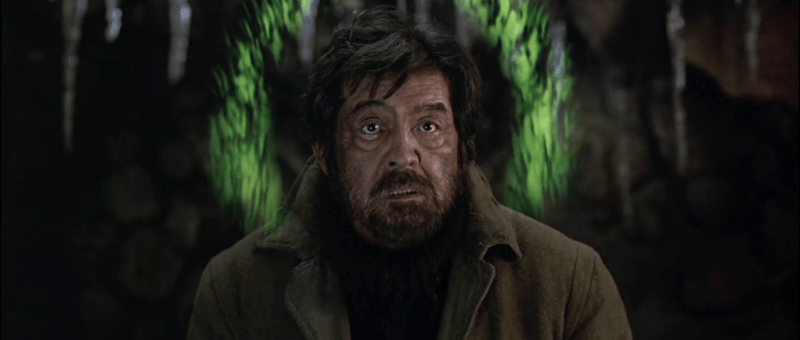
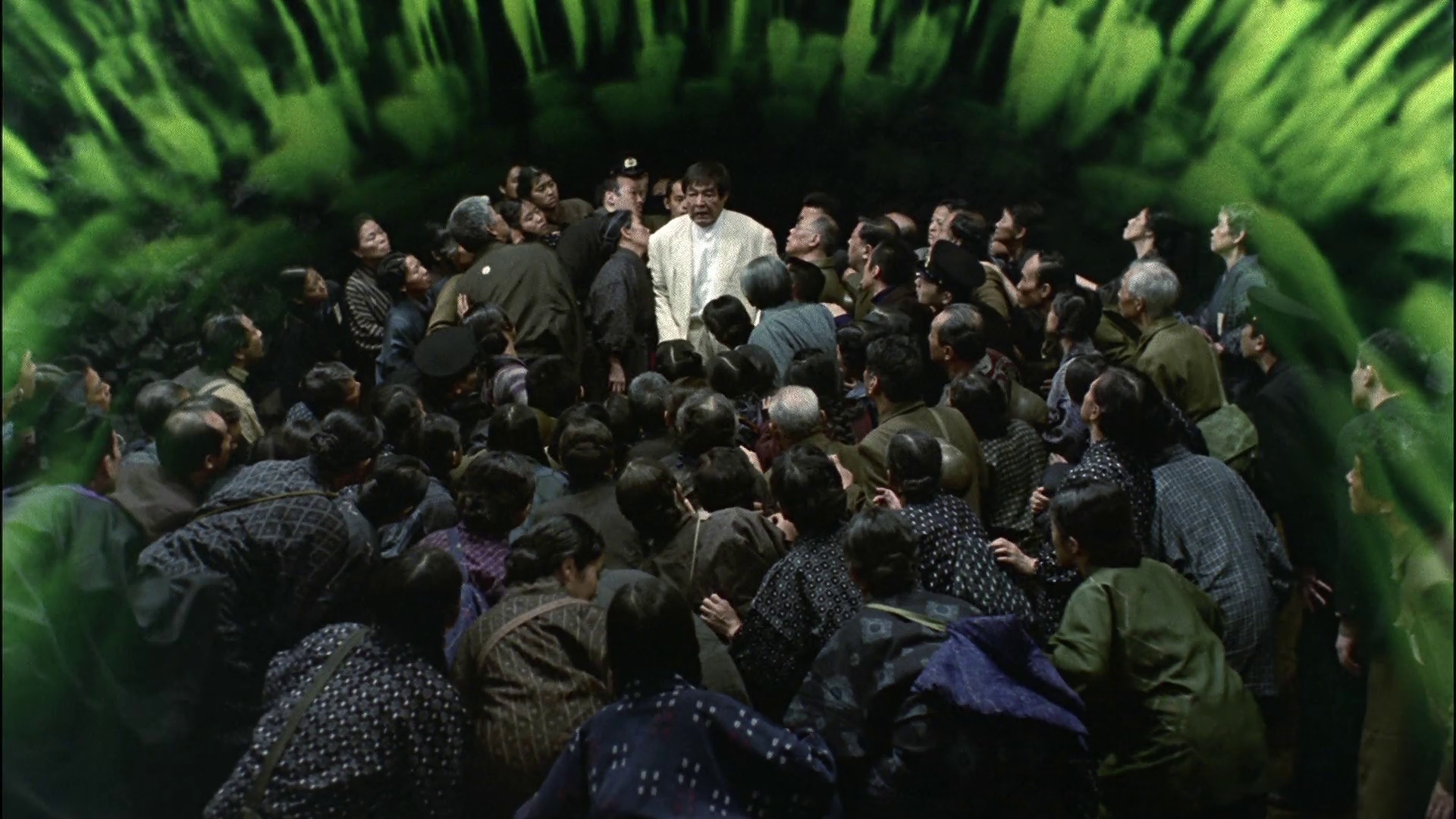
At the end of the increasing surreal trial which concludes the play within a play in Kei Kumai’s Luminous Moss (ひかりごけ, Hikarigoke), the protagonist turns to the people of the court and asks them to look at him. He wants to know if they see the ring of light around his head that looks like the luminescent plants inside the cave where he spent three months or so after being shipwrecked in the middle of the war. His plea is as much to ask what would you have done and if we can ever really judge him when we ourselves have never been faced with his dilemma.
It is however a dilemma many were faced with, and one tacitly suggested in other earlier films such as Kon Ichikawa’s Fires on the Plain though at that point too taboo and painful to address openly. In the framing sequence which bookends the film, an author visits a town in Northern Hokkaido in search of inspiration and is guided to a cave, now reachable by a roadway built after the war, where luminous moss grows. The man who takes him, a headmaster (Rentaro Mikuni), also tells him of an incident which took place there in which four shipwrecked men swam to shore and took refuge within the cave. Only the captain (also played by Rentaro Mikuni) survived, making a perilous trek across the ice a few months later when his food source depleted and he was left with no other choice.
The middle of the film is presented as a flashback, but actually the play the author is writing based on the investigations of the headmaster who says that he increasingly came to sympathise with the captain because of his own experiences as a prisoner of war in Siberia. Hachizo (Kunie Tanaka), a middle-aged father to a large family who refuses to eat the corpse of the first man to die, Gosuke (Tetta Sugimoto), because he promised him he wouldn’t, describes the captain as a “resourceful man” in both positive and negative senses of the word. He assumes the captain is already calculating when the current supply will run out, and when his own body will have consumed, leaving him with a dilemma about what to do next. The captain is in no real doubt about the necessity of eating Gosuke’s flesh and feels no guilt about it, after all he died of natural causes after consuming seawater and is now, in the captain’s view, simply meat so not eating him is just a pointless waste. Perhaps the situation would be different if he had killed him deliberately in order to eat him, but on the other hand it would not really be advantageous to do so given that the captain’s end goal is surviving until the end of the winter when it will be possible to return to the mainland. Thus he waits for his men to die and leaves the rest up to fate.
The situation only comes to light when a wooden box is washed to shore containing the bones of Private Nishikawa (Eiji Okuda), whom the captain did actually kill but accidentally while he was trying to commit suicide so that the captain would not be able to eat him. Nishikawa is originally a thorn in the side to the stranded men, a brainwashed militarist who insists they must survive out of loyalty to the emperor. He refuses to eat Gosuke’s corpse on moral grounds, but is eventually unable to resist unconsoled by Hachizo’s well-meaning advice that he should tell himself he did it for the emperor. Knowing that he did it solely for his own survival shatters his illusions of himself as a loyal subject and fractures his sense of identity. He cannot live with himself having eaten human flesh, while as the captain says those who were going to die were always going to while those who must survive must to everything to do so.
Thus at his trial, in which he appears to have lost his mind, he stresses that though he does not object to the legal process or its consequences he will not feel himself to have been judged by the prosecutor (Hisashi Igawa) as he has never eaten human flesh nor had his own flesh eaten. While in the cave, Hachizo had claimed to see a glowing ring around Nishikawa’s face which he attributed to a folk belief that such a ring resembling the green glow of luminescent moss was a signifier of his guilt visible only from a certain angle and for a short time only to those who look for it. It’s this ring that captain asks others to look for at his trial, to show him the signifier of his own guilt so that he may himself accept it. But then he may actually have a point that those who have never experienced what he has experienced are incapable of judging him. At the critical moment, the trial is interrupted by an air raid, there after becoming increasingly surreal as the location is shifted back to the cave as if it were all taking place within the captain’s mind.
The prosecutor tries to attack him for attempting to blame it all on nation and society, suggesting that his actions have disgraced all of Japan and brought shame on the emperor about whom the captain makes an inappropriate remark suggesting that the emperor too is human and merely “enduring” his circumstances. Pressed to explain himself, the captain only says that he is “enduring” many things and that during his time in the cave he simply “endured”, doing what seemed to him the only thing he could do. The prosector points out that Hachizo refused and chose death, while Nishikawa attempted suicide to atone for his actions, asking what right the captain had choose survival but the only ones who can really judge him the three men he cannibalised each of whom appear as (almost) silent ghosts whose judgement cannot be interpreted.
Though the film is not as visually striking as others in Kumai’s earlier career, he succeeds in conjuring a sense of primeval eeriness in the swirling mists and oddly shaped icicles of the cave while avoiding any sense of gore in the act of cannibalism itself which might otherwise unbalance the ethical dimensions he wishes to address. In the closing sequence, both the writer and the headmaster are positioned behind the bars which now protect the moss as if this kind of primal impulse could really be restrained or tempered by our civility. After the death of Gosuke and given the objections of the other two men, the captain suggests waiting a day or two to see how long their “human feelings” could hold in the face of their survival, the answer perhaps being less than you’d hope and about as long as you’d expect.
 Windows on Worlds