The Boy and the Heron (君たちはどう生きるか, Hayao Miyazaki, 2023)

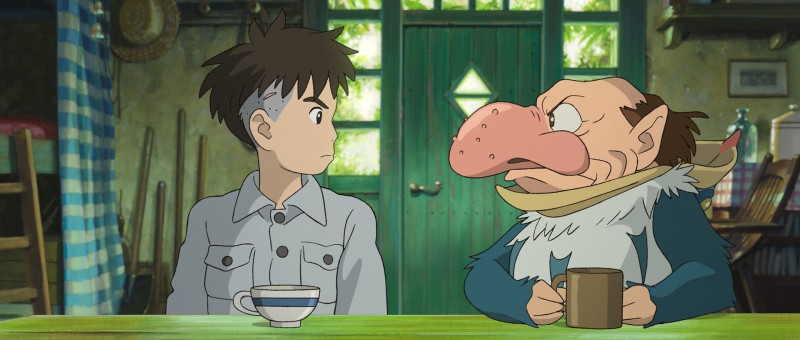
Sales of Genzaburo Yoshino’s 1937 novel How Do You Live? (君たちはどう生きるか, Kimitachi wa Do Ikiru ka? went through the roof when it was announced that the no longer retired Hayao Miyazaki would be directing a new film with the same title. Predictably, Miyazaki’s film turned out not to be an adaptation at all, or at least not a literal sense, but was intensely interested in the question not so much how do you live but how will you? Will you allow the past to make you bitter and live in a world of pain and resentment, or will you choose to live in a world of peace and beauty free of human malice?

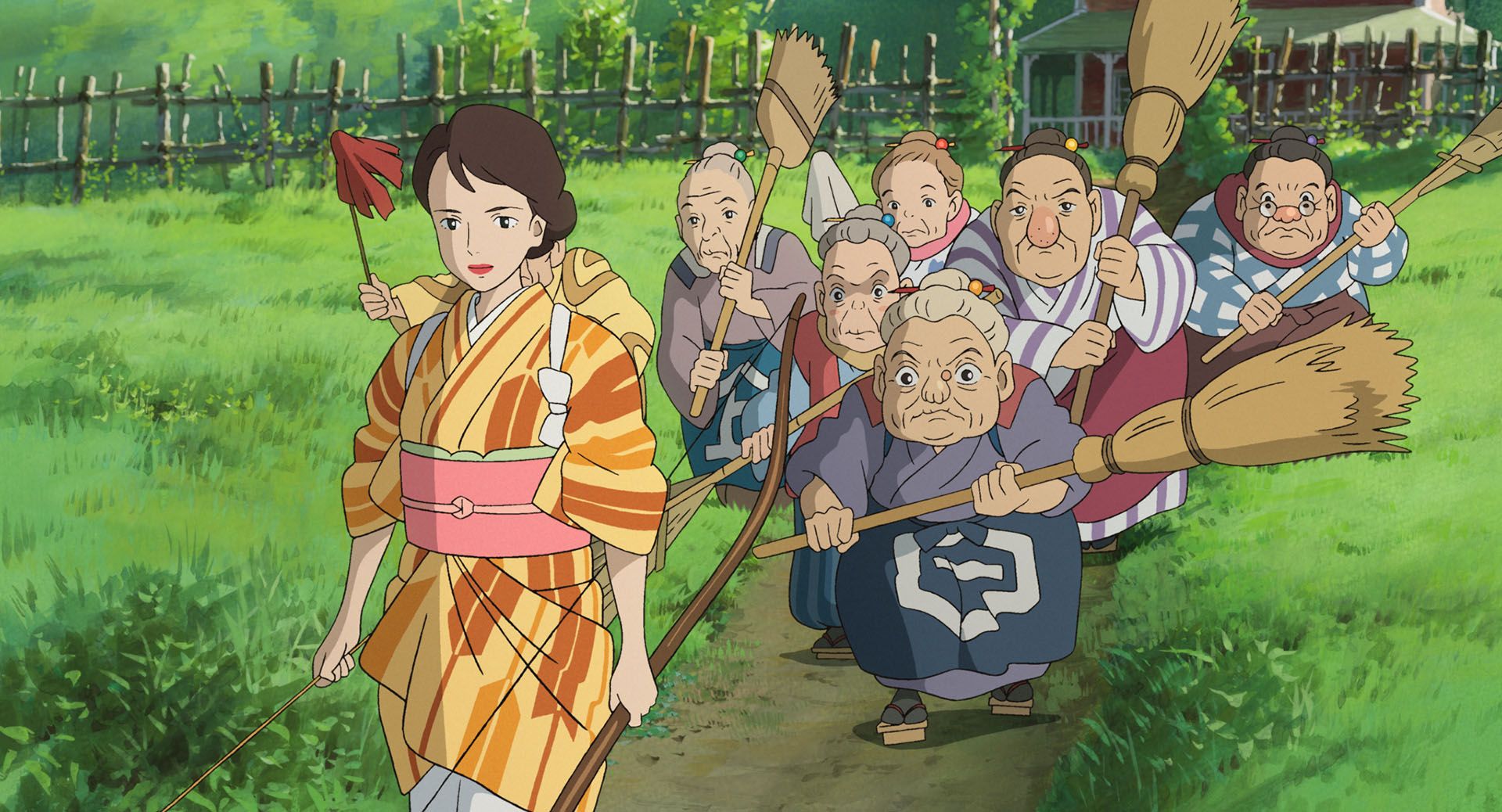
These are of course the questions faced by a post-war generation, the children of Miyazaki’s own era who came of age in a time of fear and suffering. Mahito (Soma Santoki), the hero, loses his mother in the firebombing of Tokyo. He runs through a world of shadows to save her from the flames but of course, he cannot. A year later everything has changed. His father has remarried, taking his mother’s younger sister Natsuko (Yoshino Kimura) as his new wife. Natsuko is now pregnant which suggests the relationship began some time ago though Mahito knew nothing of it and had no recollection of ever having met Natsuko before being sent to live in her giant mansion in the country more or less untouched by the war. 

It’s here that Mahito’s own malice rises. He is polite, if sullen, but cannot warm to his new stepmother and resents his father’s relationship with her. Perpetually bothered by a grey heron (Masaki Suda) his first thought is to kill it, crafting a bow and arrow from bamboo and one of the heron’s own feathers. Shunned as the new boy at school he hits himself on the head with a rock while his father, Shoichi (Takuya Kimura), comically vows revenge and lets him stay home. As he points out, there’s not much “education” going on anyway with most of the students pulled away from their studies for “voluntary” labour in service of the war effort in this case agricultural. 

Shoichi has moved to the country to open a factory which it seems produces canopies for fighter planes which is all to say that he is profiting from the business of war, though transgressively referencing the failure in Saipan over breakfast with the mild implication that it might work out alright for him. There is after all a grim reason they’ll be in need of large numbers of aircraft parts in the near future. Mahito’s dark impulses are directly linked to those of militarism and the folly of war. When he finally enters the tower of madness apparently constructed by a great-uncle who went insane through reading too many books, he discovers that his enemies are an ever expanding clan of fascistic, man-eating parakeets led by a Mussolini-like despotic leader attempting to manipulate the Master of the tower. 

Inside the tower is a land out of time, a place for those already dead or in essence an eternal past. It’s here that Mahito is presented with a choice, how will he live? Will he choose malice and destruction, or will he choose to leave and build a new world of beauty and peace above? In many ways, the important point is that the choice is his as it is ours, that we are free to decide and that our choices create the world in which we live. Through his adventures in the tower, Mahito begins to come to terms with his situation and resolves to accept Natsuko as a mother and make friends of those he once considered enemies. When the tower itself crumbles, it takes with it the last vestiges of authoritarianism and tyranny.

Prompting his epiphany, Mahito discovers a copy of How Do You Live? in his room, a present from his late mother inscribed to the grown-up Mahito. He is surrounded by the world’s ugliness, forced into a surprisingly graphic fish gutting session that leaves him wiping away blood, recalling his profusely bleeding head injury and the scar it will forever mark him with. Pelicans imprisoned in the other world meanwhile tell him that they have no choice but to behave as they do for the Master of the Tower neglected to put enough fish in the rivers intending them to destroy rather nurture new life while their young too learn all the wrong lessons. Yet there is beauty and strangeness here too, along with kindness and humanity. Boundlessly inventive, Miyazaki couples surrealist visions of murderous birds and the hellish scenes of a city on fire with Mahito the only figure visible in his pale blue school uniform darting through the soot and the shadows. A vivid symphony of life, the film may in its way be about grief and the pain of moving on but finally discovers a kind of serenity in an accommodation with the present and the eternally unfinished question of how you yourself will live. 


The Boy and the Heron screened as part of this year’s BFI London Film Festival.

Egoist (エゴイスト, Daishi Matsunaga, 2022)

If love is unselfish, is it really love at all? Based on a semi-autobiographical novel by Makoto Takayama, Daishi Matsunaga’s deeply moving romantic drama Egoist (エゴイスト) asks if all love is in the end transactional and if to deny its “selfishness” is akin to denying love itself because it would mean denying a basic human need for connection and reciprocity. In the end, perhaps selfish is what we should be with love because we are always running out of time and if we aren’t careful it will slip away from us unnoticed.

An “extreme realist”, fashion editor Kosuke (Ryohei Suzuki) is already full of regrets and many of them linking back to the early death of his mother from illness when he was only 14. It’s clear that his financial wealth helps to fill an emotional void but also that he’s lonely and longs for a sense of family that’s long been absent from his life. He rarely visits the conservative hometown where he was bullied for being different, and seems to have a strained relationship with his widowed father (Akira Emoto) who doesn’t know that Kosuke is gay and continues to ask him about getting married and settling down. Early on in his courtship with Ryuta (Hio Miyazawa), a personal trainer he met through a friend, Kosuke remarks that he’s never met a lover’s mother before hinting at the landmarks of a relationship such as marriage that LGBTQ+ people often miss out on in a conservative culture in which such things cannot always be discussed openly.

Later, Ryuta’s mother Taeko (Sawako Agawa) tells Kosuke that knew from that first meeting that they were more than just friends and was happy that her son had someone he loved who loved him regardless if they were a man or a woman. But just when the relationship had seemed to be blossoming, Ryuta had abruptly tried to break up with Kosuke explaining that he had been involved in sex work since his early teens in order to support his mother who was unable to work due to illness. Now that he’s experienced real romantic love he finds sex work “painful” but has no other means of supporting himself and so gives up love for economic necessity. “I’ll buy you,” Kosuke unironically counters adding a note of literal transactionality to their relationship which is already fraught with disparity in the respective differences in their ages along with Kosuke’s wealth and Ryuta’s poverty. 

Kosuke later describes his gesture as “pure”, something he’d previously called Ryuta while also remarking that he found him too “polite” in bed and would rather he be a little more “selfish”. In a way it’s altruistic, he isn’t really trying to trap Ryuta into a compensated relationship only to help him while simultaneously ensuring that he stays in his life. His wealth fills a void, but it’s by giving pieces of it away that he feels that void decreasing. Kosuke first gives Ryuta gifts for his mother, knowing that it’s easier for him to accept them because doing so is unselfish when the gift is for someone else. Even so as he later acknowledges sometimes the gift is more for himself than the recipient, a means not of manipulation but of healing. Kosuke claims not to know what love is and largely mediates it through money along with additional acts of care, but as Taeko later tells him it doesn’t really matter if he doesn’t know because they felt his love anyway. 

Matsunaga frequently cuts backs to visual motifs such as door numbers, envelopes, and dropped coins to hint at the transactionality of love but eventually reflects that love is an act of exchange in which the desire to be loved is an essential component. Kosuke eventually asks his father how it was for him when his mother was dying and he recalls a conversation in which she said she wanted to leave him because she couldn’t bear to see him suffering for her, a request which could in itself be read as “selfish” even in its “selflessness” with his reply implying that it’s alright to be selfish in love because in way it might be its ultimate expression. Filming with handheld realism, Matsunaga captures the rhythms of contemporary gay life along with the easy giddiness of burgeoning romance and the poignancy of profound loss tempered only by a fleeting feeling of warmth and the jealous memory of a “selfish” love. 


Egoist screens in Frankfurt 9th June as part of this year’s Nippon Connection.

International trailer (English subtitles)

The Tale of Nishino (ニシノユキヒコの恋と冒険, Nami Iguchi, 2014)

tale of nishinoEvery love story is a ghost story, as the aphorism made popular (though not perhaps coined) by David Foster Wallace goes. For The Tale of Nishio (ニシノユキヒコの恋と冒険, Nishino Yukihiko no Koi to Boken), adapted from the novel by Hiromi Kawakami, this is a literal truth as the hero dies not long after the film begins and then returns to visit an old lover, only to find her gone, having ghosted her own family including a now teenage daughter. The Japanese title, which is identical to Kawakami’s novel, means something more like Yukihiko Nishino’s Adventures in Love which might give more of an indication into his repeated failures to find the “normal” family life he apparently sought, but then his life is a kind of cautionary tale offered up as a fable. What looks like kindness sometimes isn’t, and things done for others can in fact be for the most selfish of reasons.

Ten years prior to his death in a traffic accident, Yukihiko Nishino (Yutaka Takenouchi) has taken a (former?) lover and her little girl out for drinks and parfait at a lovely seaside cafe. The woman, Natsumi (Kumiko Aso), declines the offer of dessert but Nishino orders two anyway – one for himself and one for the little girl, Minami, though it seems neither of them really wanted one anyway. An odd flirtation exists between the adults but Nishino laments his ability to gain exactly what this situation might look like from the outside – a “normal” family. He wants to get married, have a daughter of his own, but his relationships always end in failure. Natsumi tells him why – he always gives women exactly what they want, which sounds good, but really isn’t.

Nishino’s problem is that he’s almost irresistible to women, but sooner or later they all leave him. He believes he has an almost telepathic ability to figure out what it is women want from him coupled with an intense need to satisfy their innermost desires. Ironically enough, it’s this strange kindness that eventually leads to his death when he runs into an old friend at a crowded marketplace. Excited to see him she calls and waves, dropping her shopping and losing one of her crutches in the process. Rushing to help, Nishino does not see an oncoming van and is run over. Quite literally the story of his life.

Reappearing as a ghost he attempts to pay a visit to Natsumi, having jokingly promised to do so while they were dating. Natsumi, however, is nowhere to be found and so Nishino is left to exorcise his demons with the now teenage Minami (Yurika Nakamura) who decides to attend his funeral in case her long absent mother decides to pay her respects. It’s here that she begins to learn a little of Nishino’s sad romantic history courtesy of an older woman who became a friend and confident rather than a lover (and consequently remained in his life a little longer).

The problem is, Nishino’s desire to be eternally helpful means that he’s always pulled in more than one direction. A slow burn affair with shy and retiring superior Manami (Machiko Ono) looks as if it could be the one, but she eventually points out to him that he’s not the sort of man who can have the life he craves because he never fully commits to any one person and never truly loves anyone. His irresistibility apparently even extends to one half of the lesbian couple from next door though, notably, not the half you’d expect.

Nishino first gets to know Tama (Fumino Kimura) and Subaru (Riko Narumi) when their cat, Nau, invites himself over, after which the feline Subaru decides to do the same, flirting away with her uptight girlfriend presumably going crazy in an adjacent room. Subaru is Nishino’s opposing number, the kind of girl that gets everything done for her, but there are obvious cracks in the strained relationship between the two women and it’s the neurotic Tama he finally bonds with after an unusually perceptive conversation over convenience store ice cream. Nishino, as he later puts it, is faithful in mind if not in body but satisfying immediate desires is not always the best idea. Trying to provide comfort, Nishino adds even more confusion to a messy situation and, even if it perhaps works out for the best, Nishino is left alone once again.

A botched proposal leads Nishino to let slip the real reason for his boundless desire to please – it’s because he’s lonely. Desiring to keep these women around him, he gives them whatever it is they want to stay. Just like Tama has effectively relegated Subaru to the same level as their cat – giving in to her every demand in the terror that she will leave, Nishino loses the women he loves by embracing his selfish desire to keep them rather than acting in their best interests and recognising the true depth of love which may not always work out in his favour. The interfering spectre of old girlfriend Kanoko (Tsubasa Honda) who can’t let go even though the relationship is over is a lingering hangover of this tendency as she too cannot seem to commit and wants to keep Nishino as a backup plan, resenting his interest in other women yet not willing to make a permanent decision to stay with him.

A whimsical fable of a man looking for love in all the wrong places, The Tale of Nishino is a long, melancholy journey through modern relationships in which not just romantic but platonic and familial love find themselves under the microscope. As Manami points out, you can’t share loneliness – Nishino’s need to be needed eventually drives a wedge between himself and everything he wanted. Natsumi’s words of wisdom for her injured daughter offer only that romantic love necessarily ends, whereas a mother’s love for her child is ever lasting even if it does not necessarily look that way. Iguchi’s style is typical of the “quirkier” end of Japanese indie, shooting with a deadpan abstraction, but the slight feeling of alienation works well with Nishino’s ultimate refusal to bare his heart in a more “straightforward” manner. A bittersweet story of love lost and found, Nishino may have given up the ghost but perhaps he did find that family after all, in a way, even if it was not his own.


Original trailer (no subtitles)