Penalty Loop (ペナルティループ, Shinji Araki, 2024)

Time loop cinema has made a resurgence in Japan of late, but Shinji Araki’s Penalty Loop (ペナルティループ) is not quite what you’d assume it to be rather a meditation on the grieving process in a constant process of recycling rage and hurt day after day. When his girlfriend is murdered and her body is found dumped in a local lake, Jun becomes obsessed with the idea of revenge and turns up at the killer’s place of work where he poisons his morning coffee and then stabs him to death in his car before poetically dumping his corpse in the same lake where disposed of Yui’s (Rio Yamashita) body.

The weird thing is, that Jun (Ryuya Wakaba) wakes up the next day to discover it’s still 6th June and he has to do the same thing all over again. Rather than switching up his methods, he simply repeats the process but it turns out the Killer (Yusuke Iseya) is also aware they’re trapped in a loop and starts trying to avoid being killed. Before too long, the men have begun to trauma bond over their shared despair of being trapped in this constant cycle of retribution and become almost friends in an absurdist, existential meditation on the fallacies of justice and revenge. The killer and his indirect victim are locked in this cycle together and, the film seems to suggest, can only escape it through a process of healing and forgiveness rather than Jun’s futile attempts at revenge by killing the killer over and over again.

It is though somewhat perplexing that Jun never asks the Killer why he killed Yui and shows no real curiosity in his motives only asking him if he killed a lot of people. Yui also seems to have been mixed up in a concurrent conspiracy which the film does not go into or was in fact locked into her only cycle of despair and futily as the Killer suggests in volunteering that Yui wanted to die anyway, telling him that she had nothing to live for and was filled with emptiness. Of course, perhaps it’s simply the case that a kind of justice has already taken place in the “real” world and that Jun already knows why Yui was killed but simply wants a more personal kind of revenge to satisfy his hurt and anger, or that the Killer would not really be able to tell him much anyway because we can’t be sure he’s “real” or just a character existing for the purpose of Jun’s revenge no different from a dummy punch bag.

A strange, grinning man (Jin Daeyeon) is often seen observing the two men and later becomes irate on hearing Jun state that he no longer plans to kill the Killer but seems to have befriended him instead. His presence hints at a wider authoritarian presence that feeds off Jun’s negative emotions and forces him to continue vengeance long after he has tired of it. At this point, his killings become less violent. Rather than the poison and a knife, the bloody struggle in the car and the clinical process of bagging the body to be dumped in a lake, Jun uses a gun and the Killer patiently allows himself to be killed so that the cycle can continue. Further revelations suggest that the loop is less cosmic than commercial and Jun is constrained by a contract he signed for something that is supposed to be a kind of therapy the ethics of which would be very debatable, as would the offer of a secondary “rehab” programme on his completion of the process though how he, a man with no apparent income who lives in a room that already resembles a prison where he builds model houses that express the life he might have liked to give Yui, would be able to afford all this.

In any case, it’s true enough that Jun is imprisoned by his grief and powerlessness and his desire for vengeance is an attempt to free himself though in the end he can only do it by abandoning his rage and violence and finding empathy for the killer with whom he is trapped in this hellish cycle of grief and retribution. Araki lends his quest a dystopian air, taking place largely in some kind of hydroponic facility which otherwise exists only for the purposes of Jun’s revenge. Strangely quirky in its absurdist humour and bleak in some of its implications the film otherwise suggests that forgiveness is the only path out of grief for the cycle of vengeance will never really end.


Penalty Loop screened as part of this year’s Nippon Connection

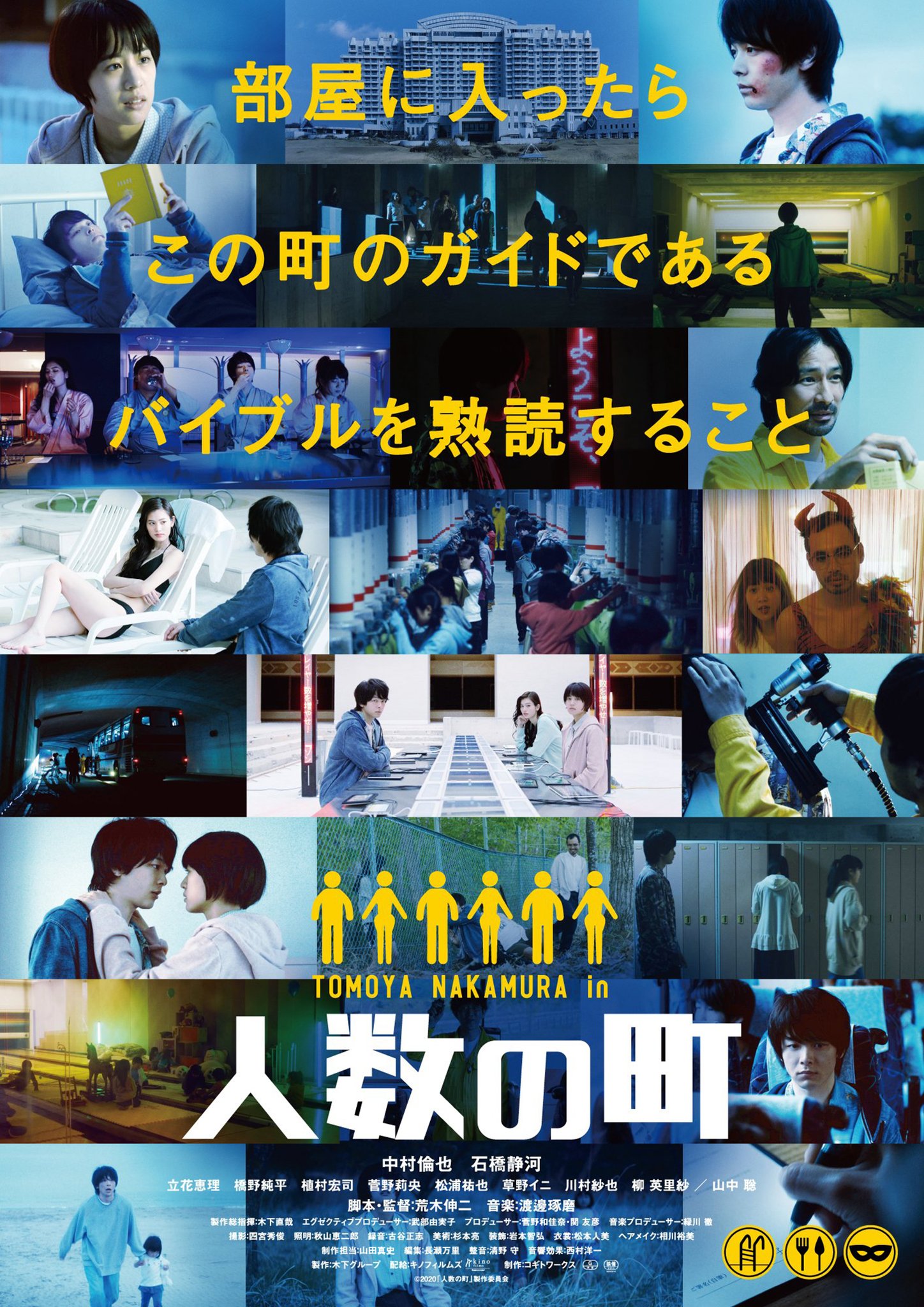
The Town of Headcounts (人数の町, Shinji Araki, 2020)

“You’re free now, so the world is more beautiful” the hero of Shinji Araki’s dystopian thriller The Town of Headcounts (人数の町, Ninzu no Machi) is unironically told by a mysterious saviour even as a watchtower lingers on the horizon behind him. Modern Japan, it seems to say, is no paradise but is it worth trading your identity and existence for the guaranteed satisfaction of your basic needs? Freedom, happiness, and love may be nebulous concepts which mean different things to different people, but in the end leading a satisfactory life might just come down to what it is you decide you can live without. 

The nameless protagonist later credited as Aoyama (Tomoya Nakamura) describes himself as an “average joe” who has “a weak will” and doesn’t “belong anywhere in society”. While being beaten up by a loanshark, he’s unexpectedly rescued by the miraculous appearance of the mysterious “Paul” (So Yamanaka), a middle-aged man dressed in an orange jump suit who tells him there’s a place he can go where’d he fit right in. After a lengthy bus ride, he finds himself a new resident of “The Town” where those like him who for one reason or another felt themselves rejected by mainstream society can live in ease and comfort, only as he later discovers he is unable to leave. Should he walk too far beyond the fence, the microchip in his head activates a sonic wave of painful and disabling distortion. 

Somewhere between a utopian cult commune and a penal colony occupying a disused conference centre, The Town is a free love society which insists that equality is possible and that freedom and peace are more than mere dreams. Family creates inequality, so The Town’s Bible says, so residents must live alone. Pregnancy is prohibited, while children brought into the compound are separated from their parents and raised in a communal nursery. All basic needs, food, warmth, shelter and even sex, are otherwise guaranteed though the residents are expected to “work” to earn them, performing often pointless tasks parasitically underpinning modern capitalism such as writing meaningless product reviews in return for treats, or performing as stooges to create hype around new store openings. Aoyama’s sense of morality is however shaken when he’s asked to commit electoral fraud by repeatedly voting for a chosen candidate with stolen ballots, later recruited as a crisis actor in a fake terrorist incident intended to further influence an election in the wake of a corruption scandal. 

In The Town, he’s told his existence is meaningful and given a place to belong. Yet he has to surrender his name, known as “Dudes” residents must greet each other ritualistically only by the word “fellow” followed by some kind of compliment. All his needs may be met, but he’s forbidden to fall in love, can never marry or have a family, and it does seem troubling that there are no elderly people around even if some suggest there are other “Towns” just for them. Some might say, The Town is way is a way for mainstream society to get rid of all the people it doesn’t want or feels have no value. Araki throws up frequent title cards featuring various statistics such as the numbers of homeless people, bankruptcies, unemployment etc along with brief flashbacks to whatever it was that brought residents to The Town from being thrown thrown out of a manga cafe after attempting to live there to being almost choked to death by debt-collecting yakuza suggesting there’s little “freedom” in the rigid contemporary society and most particularly for those unable or unwilling to live by its rules.  

In The Town rules are few, and you’re well looked after, but you can’t leave and though it seems like an individualist paradise where you’re free to satisfy each of your physical desires you have no further control over your existence. As one resident puts it, “life here is kind of weightless”, perhaps a relief for some but a crushing existential crisis for others. Aoyama realises that in The Town he rarely feels angry, but perhaps he feels nothing much of anything else, either. Just as he’s starting to adjust, his feelings of unease are strengthened by the arrival of a young woman who apparently had no previous societal issues but has come to The Town in search of her younger sister whom she failed to help despite knowing she was trapped in an abusive relationship. Unlike Aoyama, Beniko (Shizuka Ishibashi) claims not to have felt much of anything in the regular world, unsure even what love is and unimpressed by the beautiful vistas of freedom that are supposed to define The Town, but doesn’t want to stay and be rendered a mindless drone exploited by mysterious forces for whatever purpose they may choose.

What Aoyama realises he craves is the love and companionship of a conventional family life. “We want to support each other and work hard. Love each other and live together” he explains to a non-plussed Paul who seems to pity him, his simple desire at once at odds with the values of The Town and perhaps equally unobtainable in contemporary Japan. In the end, the only “freedom” he may find lies in complicity with one system or another, becoming an oppressor as one of the oppressed. The question is what sort of life is most satisfying, freedom from the anxiety of hunger and cold, or the freedom to love and live fully in manner of your choosing. The modern society may not grant you either, and both perhaps have their costs. A bleak dystopian thriller, Araki’s steely drama features innovative production design and slick direction mimicking the hero’s sense of disaffection with detachment and a total lack of resistance to the otherwise bewildering world of The Town but saves its real sense of confusion for the state of the modern society and the fate of those who survive on its margins. 


The Town of Headcounts streams in the US March 15 – 19 as part of the 12th season of Asian Pop-Up Cinema.

Original trailer (English subtitles)

Every Day a Good Day (日日是好日, Tatsushi Omori, 2018)

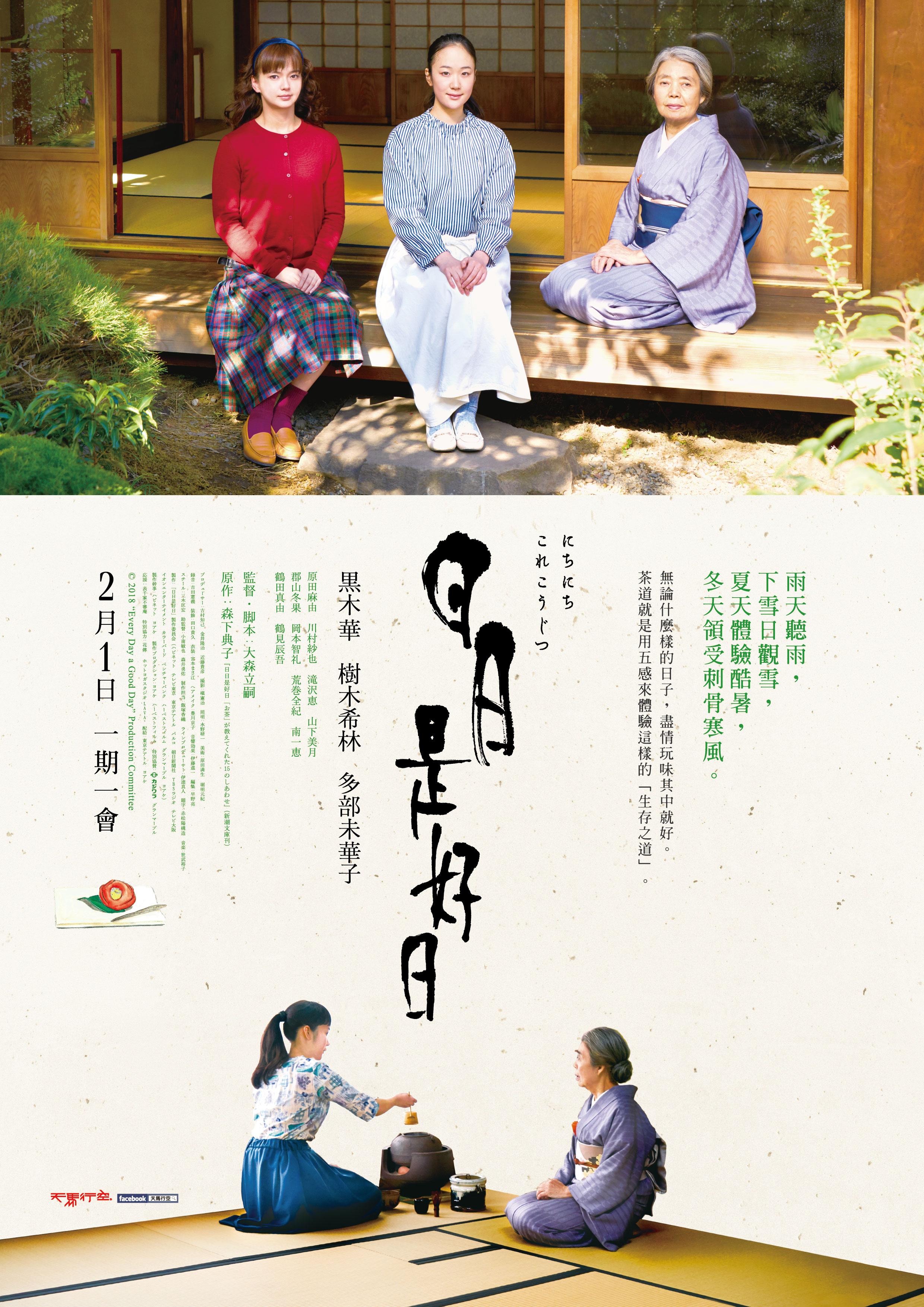
Everyday a good day posterTatsushi Omori burst onto the scene in 2005 with the extremely hard-hitting and infinitely controversial The Whispering of the Gods before going on to build a career on chronicling the unpalatable facets of human nature. He does have his lighter sides as the delightfully whimsical Seto and Utsumi proves, but even so he might be thought an odd fit for directing an adaptation of a series of autobiographical essays detailing one woman’s personal growth over a 20 year period spent perfecting the art of the Japanese tea ceremony. Every Day a Good Day (日日是好日, Nichinichi Kore Kojitsu) is, however, like much of his previous work, a story of youthful ennui and existential despair only one in which it turns out that the world is basically good once you agree to embrace it for what it is.

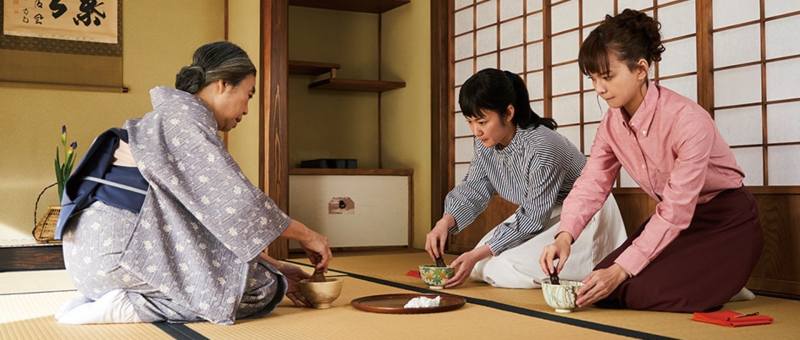
The film opens in 1993 with the heroine, Noriko (Haru Kuroki), a confused college student unsure of the forward direction of her life. Often ridiculed by her family for being clumsy and neurotic, Noriko compares herself unfavourably with her glamorous cousin Michiko (Mikako Tabe) who has come to the city from the country to study and appears to have her whole life already mapped out with a confidence Noriko could only dream of. A turning point arrives when she’s talked into accompanying Michiko to learn tea ceremony from a kindly old lady, Mrs. Takeda (Kirin Kiki), who lives nearby. Despite regarding tea ceremony as something fussy and old fashioned that only conservative housewives aspire to learn, Noriko begins to develop a fondness for its formalist rigour and continues dutifully attending classes for the next 24 years.

“Carry light things as if they were heavy, and heavy things as if they were light” Noriko is told as she clumsily tries to carry an urn from one room to another, though like much of Takeda-sensei’s advice it serves as a general lesson on life itself. Mystified by the entire process, Noriko and Michiko make the mistake of trying to ask practical questions about why something must be done in a particular way only for Takeda-sensei to admit she doesn’t know, it simply is and must be so. To look for that kind of literal meaning would be a waste of time.

Of course, she doesn’t quite put it that way. As Noriko later realises, some things are easy to understand and need only be done once. Other things take longer and can only be understood through a weight of experience. Just as she was bored out her mind by La Strada at 10 but moved to tears at 20, the discrete pleasures of the tea ceremony are something only fully comprehended when the right moment arrives. What was once empty formalism becomes a framework for appreciating the world in all its complexity, embracing each of the seasons as they pass and learning to live exactly in the moment in the knowledge that a moment is both eternal and transient.

Noriko continues to feel herself out of place as she witnesses those around her progress in their careers, get married, or go abroad while she remains stuck, unable to find a direction in which to move. Even tea ceremony occasionally betrays her as new pupils arrive, depart, and sometimes wound her newfound sense of confidence by quickly eclipsing her. Nevertheless, the calm and serenity of ritualised motion become a place of refuge from the confusing outside world while also offering a warmth and friendship perhaps unexpected in such an otherwise ordered existence.

Over almost a quarter of a century, Noriko’s life goes through a series of changes from career worries to romantic heartbreak, learning to love again, and bereavement, while tea ceremony remains her only constant. She may not yet have discovered the path to happiness, but perhaps has begun to reach an understanding of it and believe that it might exist in some future moment – as Takeda-sensei says, there are flowers which bloom only in winter. In any case, what she’s learned is that sometimes it’s better not to overthink things and simply experience them to the best of your ability while you’re both still around. Every day really is a good day when you learn to slow down and truly appreciate it, living in the moment while the moment lasts in acknowledgement that it will never come again.


Every Day a Good Day was screened as part of the 2019 Udine Far East Film Festival.

Original trailer (English subtitles)