Kyu-chan, Draw Your Sword (九ちゃん刀を抜いて, Masahiro Makino, 1963)

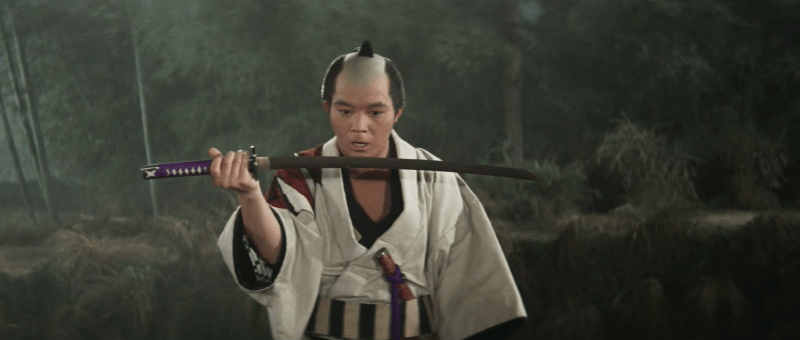
Kyu Sakamoto was a hugely popular singing star in the 1960s best known internationally for the smash hit Ue wo Muite Aruko (Sukiyaki) which, somewhat incongruously, features in this jidaigeki comedy, Kyu-chan Draw Your Sword (九ちゃん刀を抜いて, Kyu-chan Katana wo Nuite), directed by one of the masters of the samurai movie, Masahiro Makino. Adapted from the novel by Ippei Okamoto, the film is essentially a vehicle for Sakamoto as indicated by the inclusion of his name in the title even though he plays a character called “Sangoro”.

The joke is that Sangoro is incredibly lazy and can hardly lift his head off the pillow while his ageing parents are struggling to feed themselves. If they don’t find a way to get him working soon, they’ll all starve to death but Sangoro seems incapable of understanding. The parents try to think up various jobs he could do without having to exert himself and eventually come up with Kyokaku, or “town knight”, a man about town of the Edo era somewhere between street tough and vigilante. In fact he even ends up meeting some legendary characters such as Banzuiin Chobe (Eitaro Shindo) who became a kind of Robin Hood figure in later literature standing up for the common man against the abuses of the samurai class. 

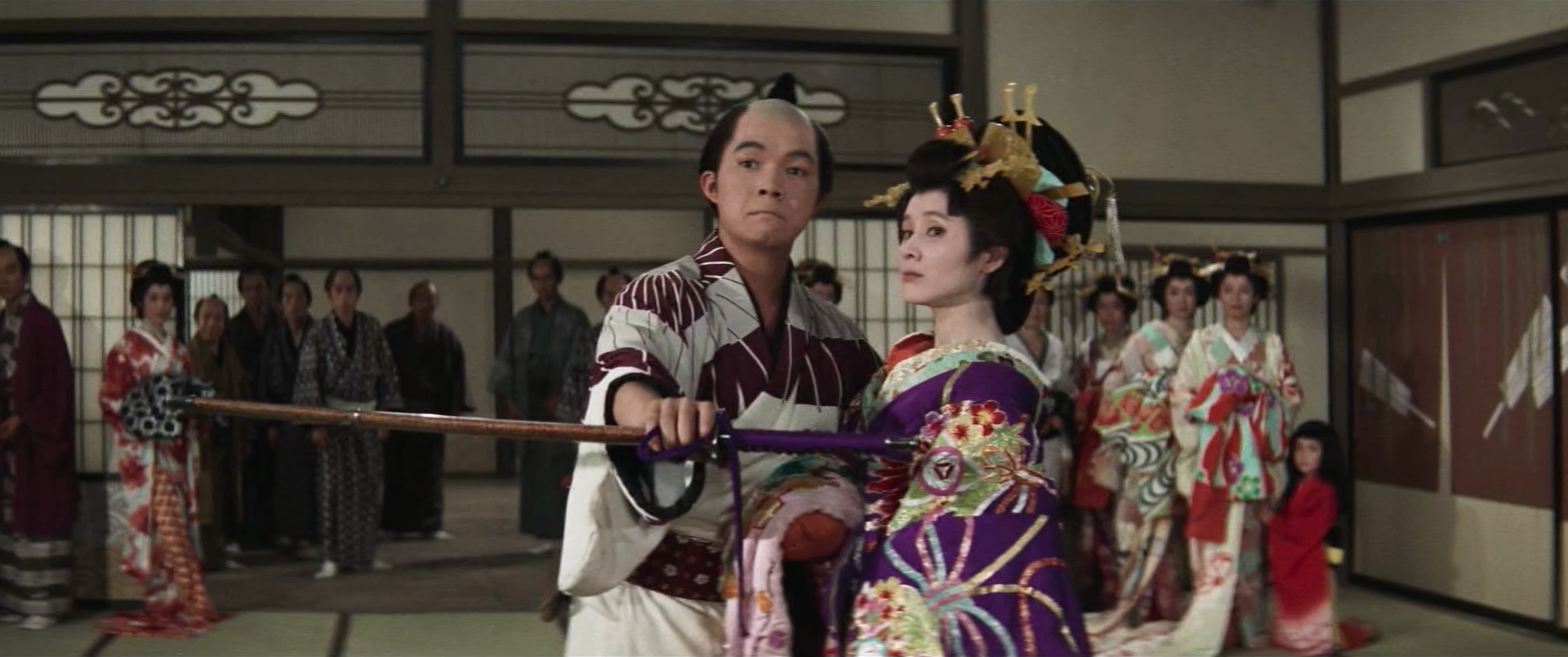
When he goes off to the city to become a Kyokaku because he figures starving to death would be too much effort, Sangoro’s father cautions him not to be too lazy to draw his sword even though it’s rusty and unlikely to do much damage. Sengoro does, however, take his ambition seriously and is keen to make a name for himself in Edo which he first does by becoming the blood brother of Gonbei (Chiyonosuke Azuma), one of Banzuiin’s men. Though his clumsy attempts to fight him don’t bode well for Sangoro’s career, Gonbei takes him on precisely because he’s fun to have around even if he is a bit useless and sometimes you need guys like that too. Introducing him to area’s top courtesan Takamado (Yoko Minamida), they hope to set the cat among the pigeons with a local gang that’s been harassing them led by the irritating Mizuno (Fumitake Omura) and Shirogoro (Koshiro Harada).

Though the film may be, in a way, a sort of satire poking fun at aimless post-war youth that lacks ambition in comparison to their parents’ generation who bore the brunt of wartime privation. Naive and childish, Sangoro is a well-meaning bumbler, but Takamado unexpectedly likes him precisely for these qualities. She hates men like Mizuno who are obsessed with proving their masculinity and finds it refreshing that Sangoro is not afraid to show his weakness. Just like Gonbei, she appreciates him not for his command of the sword or imposing air of authority, but simply because he’s an uncomplicated good person and fun to be around.

Mizuno and Shigoro are, by contrast, cruel and abusive Tokugawa vassals, who, it’s implied, have a habit of murdering sex workers during their New Year endurance tests. Sangoro is keen to save a young woman, Omitsu (Yumiko Kokonoe), after her father did him a favour and explained he needed 25 ryo to buy back her contract after she agreed to sacrifice herself to get the money for her mother’s medical treatment. Which is to say, she’s the opposite of Sangoro. It turns out that Takamado has a sad story of her own staged by Makino using kabuki-esque sets and effects to dramatise her flashback as she explains her samurai father took his own life after a prisoner he was watching disappeared. Though in another film this might lead to a violent confrontation challenging the evil samurai, in this version a bizarre misundersanding is revealed to have caused the death of Takamado’s father leading to another act of levelling as the supposed villain agrees to give them his secret recipe for pickles with an exclusive license to manufacture it for three years before it’s essentially made open source for the good of the people. Thus Sangoro essentially becomes a shopkeeper and releases both Omitsu and Takamado from their position as indentured sex workers, restoring both their birthright and their freedom basically by being nice and the right kind of righteous while Mizuno and Shigoro just end up embarrassed when all their posturing and obsession with their samurai status appears to mean little in a world in which the merchant has indeed become king.

River Washes Away the Moon (残月大川流し, Yasushi Sasaki, 1963)

River Washes Away the Moon posterTimes are changing fast in Edo. Hibari Misora reunites with director Yasushi Sasaki for another jidaigeki adventure only this time one with much less song and dance and fewer tomboy antics for the often spiky star. Set in 1868 in the immediate aftermath of the fall of the Tokugawa Shogunate, River Washes Away the Moon (残月大川流し, Zangetsu Okawa Nagashi) is, in its own way, a story of revolutions, personal and political, as sides are picked and alliances forged in midst of a city in flux.

Edo, 1868. The Tokugawa Shogunate has been drummed out of the capital by the collective forces of Satsuma, Choshu, and Tosa but a new regime has yet to solidify itself. While some remain loyal to the Tokugawa cause, others join the new imperial armies leaving Edo a fractured state in which loyalists are on the run and violence rules the streets. Meanwhile, ordinary Edoities are trying to go about their everyday business. Ogin (Hibari Misora), an orphan, is a member of a pickpocketing gang run by a cruel mistress who metes out extreme punishments to those deemed to have transgressed her stringent rules, most often by trying to keep some of the money for themselves rather than hand it to the bosses for “redistribution”. Ogin is good at pickpocketing, but she has a noble heart and feels sorry for the country bumpkins who often become her prey. The madame wants her to take over the gang, but she wants out of the criminal life as soon as possible.

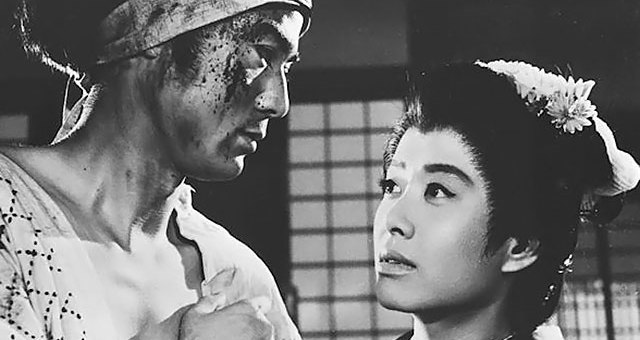
With things the way they are, the the loyalists ask the pickpockets for a favour – steal the shoulder badges off the Imperialist mercenaries so they won’t be able to return to their camps. The madame declares herself apolitical and declines but Ogin, a true child of Edo, feels quite differently and is only too keen to support the loyalists in whichever way she can. She gets her opportunity when a wounded soldier, Shinzaburo (Yoshitomo Ogasawara), creeps into the house she hides out in to get away from the gang. Ogin bravely hides Shinzaburo from the Imperialist troops and then hides him again when he returns sometime later after another battle with a lost little girl in tow. The pair grow closer, but Shinzaburo is under the impression Ogin is a wealthy merchant’s daughter and has no idea she is a poor orphan forced to pick pockets on the streets in return for safe harbour.

Unlike many of Misora’s jidaigeki heroines, Ogin is a much more “feminine” figure – she never gets to do any fighting of her own and the (extremely subdued) romance with Shinzaburo becomes the film’s main focus. She is however steadfast and bold. She stands up to her madame as much as feels she is able and is desperate to extract herself from the criminal world. As an orphan without any other means of support, however, her options are limited and even when she tries to do good it’s thrown back in her face.

Even Shinzaburo whose ideals one would hope to be more compassionate is after all a loyalist and not a revolutionary. His ideals are conservative if bending towards the moral good and therefore when he finds out what Ogin really is their connection is broken, he loses respect for her and though she never lied to him he blames her for the life she was forced to lead. A man like Shinzaburo might have lost his place, but he’s never known the kind of hardship a woman like Ogin has had to endure and the concepts are alien to him.

After getting her heart broken by Shinzaburo, Ogin finds the strength to break away from her criminal family by becoming an itinerant musician which gives Misora a chance to sing another song – her only other musical number is a full on set piece taking place during a community show held to raise money for orphans and possibly reunite dislocated people with their families in the process. Nevertheless Misora delivers an impressive performance as the continuously lovelorn Ogin, convinced that her world is limited by the circumstances of her birth and only latterly realising she has the power to change her fate (if for the slightly dubious reasons of proving herself worthy of Shinzaburo). Ogin opts for her personal revolution while Shinzaburo opts for a political one. By 1963 the winds of change were indeed blowing through Tokyo once again, though if there are any political messages to be found in River Washes Away the Moon they are fairly subtle and lean more towards compassionate living and finding the strength to live by your principles than advocating for direct agitation as the best path towards a fairer world.


Hibari’s musical numbers (no subtitles)