The Lost World of Sinbad: Samurai Pirate (大盗賊, Senkichi Taniguchi, 1963)

Seemingly drawing influence from the series of Arabian fantasy films from Hollywood, Senkichi Taniguchi’s Lost World of Sinbad: Samurai Pirate (大盗賊, Dai Tozoku), sees the director reunite with Toshiro Mifune who had made his debut in the director’s Snow Trail which could not be more different from this crowd-pleasing adventure movie. The film is loosely based on the life of 16th century merchant Luzon Sukezaemon who eventually fled to Cambodia after all his possessions were seized by Hideyoshi Toyotomi and he was condemned on some trumped up charges.

The film’s opening scenes perhaps reflect this incident as Luzon (Toshiro Mifune) is branded a pirate and set to be burned at the stake, narrowly escaping after bribing an official with drugs. Resentful, Luzon decides he might as well become a pirate after all as he’s pretty sick of Japan and fancies seeking his fortune on the open seas only his ship is quickly destroyed in a storm and all his crew killed while the treasure he was carrying is seized by the fearsome Black Pirate (Makoto Sato). Washing up in a mysterious place aesthetically a mashup between South East Asia and the Middle East, Luzon is cared for by a hermit and then becomes embroiled in intrigue on finding out that the tyrannical king has been seizing local women in exchange for unpaid taxes and imprisoning them within his harem.

Luzon’s dreams are for riches and status so his sudden discovery of a love of justice is a bit of a surprise, but then he’s also most interested in the princess Yaya (Mie Hama) because he spotted one the necklaces from his treasure chest around her neck which suggests she might have a lead on the Black Pirate. Princess Yaya is engaged to a prince from the Ming kingdom which threatens a wider kind of geopolitical destabilisation should anything go wrong with this marriage which is a distinct possibility seeing as the corrupt Chancellor (Tadao Nakamaru) has been colluding with an evil witch to kill the king and seize the kingdom.

Rather than a pure pirate movie the film contains fantasy elements such as the presence of a Western-style castle which is clearly modelled on the one from Disney’s Snow White along with a weird hermit whose powers are weakened every time he sees an attractive woman. It is not, however, the kind of tokusatsu the English title bestowed by the US release implies as it contains no real monsters instead focussing its special effects on the magic used by the witch, who can turn people to stone with her eyes, and the hermit who can turn himself into a fly or disappear in a puff of blue smoke. Despite the prominent inclusion of SFX master Eiji Tsuburaya these effects are repeated several times are really the only ones featured in the film. 

In any case, what’s in play is famous merchant Luzon’s redemption arc in which he recovers the treasure but gives it back to the people, symbolically abandoning his dreams of wealth and status for something a little more community minded in vowing to sail the seven seas pursuing justice throughout the world. Having been a victim of authoritarianism in Japan, he rises up against tyranny abroad while teaming up with a group of local bandits and several times proudly proclaiming himself as Japanese though in a movie conceit everyone speaks his language including the Black Pirate who is later exposed as a snivelling fool tricked by the Chancellor on the promise of a chance to marry the Princess Yaya. Most of the derring do is reserved for the final sequence in which Luzon and the bandits storm the castle to defeat the evil chancellor but the screenplay also packs in genre elements such as trap doors and secret dungeons which keep Luzon busy as he does his best to overthrow an oppressive regime if only to put the rightful king back on the throne in the hope that might be better. Taniguchi certainly makes the most of his elaborate sets and costumes, creating a sense of tempered opulence along Middle-Eastern themes while adding a touch of the mythic in the attempt to weave a legend around the real life figure of Luzon Sukezaemon as a bandit revolutionary selling dreams of freedom on the sea as a pirate more interested in justice than money in otherwise corrupt society.
Beast Alley (けものみち, Eizo Sugawa, 1965)

In the opening title sequence of Eizo Sugawa’s Beast Alley (けものみち, Kemonomichi), a thick blob of inky blackness gradually expands over an aerial view of the city until it obscures it entirely. The title card which then appears is written in plain white, but will reappear at the film’s conclusion this time ashen as if it too had been singed by the deeply ironic flames with which the film ends. Based on a novel Seicho Matsumoto and scripted by The Beast Shall Die’s Yoshio Shirasaka, the film similarly takes an incredibly cynical view of the modern post-war society in which it is revealed the militarists are still basically in charge and presiding over a deeply corrupt social order. 

The big bad, Kito (Eitaro Ozawa), says as much when he states the need for reforming the nation’s “rotten political system” by which he means post-war democracy. Kito made his made his money doing deeply dodgy things in Manchuria in addition to running an exploitative coal mine in Japan. Now mainly bedridden, he basically runs the country as a far-right political fixer working in tandem with big business and the yakuza who have traditionally been big supporters of conservative and nationalist forces. Early on we see one of his underlings negotiating with politicians to ensure that Taiyo Roads will be hired be hired for a large scale construction project planning to put highways all the way through Tokyo. As we later discover, he’s prepared to go to great lengths in order to achieve his goal, going so far as to have a sex worker murdered to implicate the uncooperative CEO of a rival construction film into resigning by threatening to frame him for the crime so they can install their stooge in his position. 

It’s into this world that everywoman Tamiko (Junko Ikeuchi) is drawn while working as a hotel maid at a traditional Japanese inn. Trapped in a bad marriage to a man who is also bedridden yet still attempts to rape her when she returns home to find him in bed with the housekeeper, Tamiko longs for escape and is therefore ripe for the picking when approached by Kotaki (Ryo Ikebe), the manager of an upscale Western hotel, to join him in an unspecified enterprise which will apparently make her very rich. The only catch is that she will have to “get rid” of her “dependent”, which she probably wanted to do anyway, by burning down her house with him inside it. Once she’s done this, there is no turning back for her even if she had not developed complicated feelings for Kotaki who is both her salvation and damnation. 

Tamiko’s husband had failed to give her the comfortable life that he had promised, something which she thinks Kotaki can deliver even if it requires her to become the plaything of Kito whom does she actually seem to like even if aware of the precarity of her position and still in thrall to Kotaki. Leaving the hotel so abruptly was however a strategic error as it arouses the suspicious of (originally) earnest cop Hisatsune (Keiju Kobayashi) who quickly realises that Tamiko set the fire to kill her husband. Though he seemed to be motivated by justice, Hisatsune too is soon corrupted explaining to Tamiko that he has become cynical and jaded. Years of police work have shown him that true criminals know how to break the law and get away with it so he can’t do anything about them, but “good” people, like he implies Tamiko, are pushed into crime by desperation and are easily caught. Tamiko wields her sexuality against him by agreeing to a tryst, though when it doesn’t go to plan he tries blackmail and then rape before she, ironically, manages to escape from his bungled crime. 

Hisatsune’s corruption is gradual and self serving. He starts with suspicion, tailing Tamiko in the interests of justice but also because he desires her, before stumbling on the conspiracy, putting the pieces together, attempting to use them for his own gain and trying to blow a whistle mostly out of resentment. Kito’s reach is all encompassing. Hisatsune is warned off investigating certain aspects of the crime by his senior officers and is then fired on Kito’s instructions for fiddling his expenses after harassing Tamiko. He tries to give his findings to his boss but it goes nowhere and then tries the press but is given the brush off, the editor his reporter friend refers him to gently implying he’s just a crank with an axe to grind. Of course, it turns out that the reporter is already in league with dodgy lawyer Hatano (Yunosuke Ito) who is Kito’s right-hand man. 

The connections between the three men, Kotaki who was once a communist, Hatano, and Kito go back to Manchuria and the corruptions of militarist era which it becomes clear has never really ended. Kito has only one rival and it’s another faction of the conservative ruling party who are probably just waiting for him die. Attempts are made on his life and they don’t go well for those who make them. Even if Hatano hoped to simply inherit an empire he, as he points out, put in much of the work to build he is sorely mistaken while Tamiko may intellectually understand that Kito’s death would place her in a precarious position but carries on regardless. “You never know who will betray you in this world” Kotaki laments, echoing Kito’s later claim that his Buddhist statues are the only ones will never betray him even as sleeps next to a statue of Aizen Myo whom he ironically claims protects mankind from their lust and desire. 

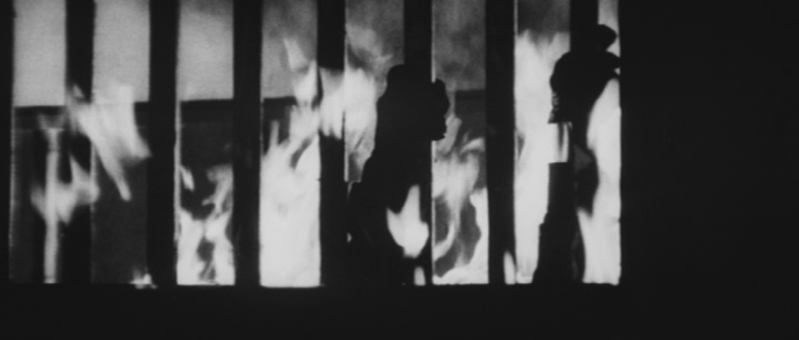
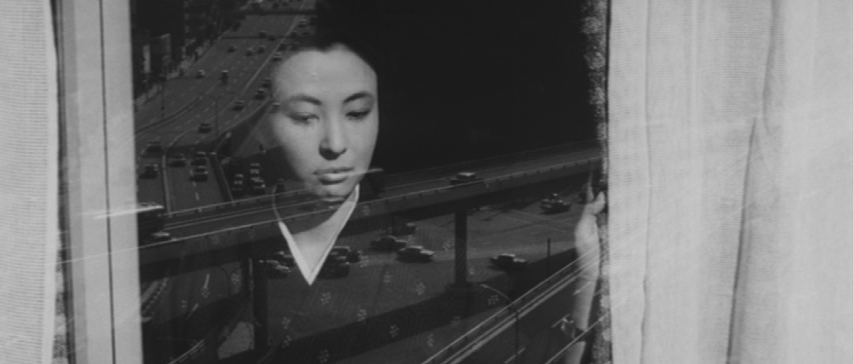
It could be said that desire is Tamiko’s undoing, but as Hisatsune had suggested perhaps you couldn’t blame her for longing to be free of the bedridden husband who had not delivered what he promised her. As she said, she was doing what could to survive even if you’d think she’d know putting on a ring taken from the finger of a murdered woman is akin sealing your own fate. Sugawa shoots with a noirish sense of dread, tracking Tamiko with her coat drawn up around her face as she tries to leave the scene of her crime, and makes the most of his fiery imagery before ending on a note of cynical laughter amid the inescapable hell the of post-war society. 


Original trailer (English subtitles)

Lone Wolf and Cub: Baby Cart at the River Styx (子連れ狼 三途の川の乳母車, Kenji Misumi, 1972)

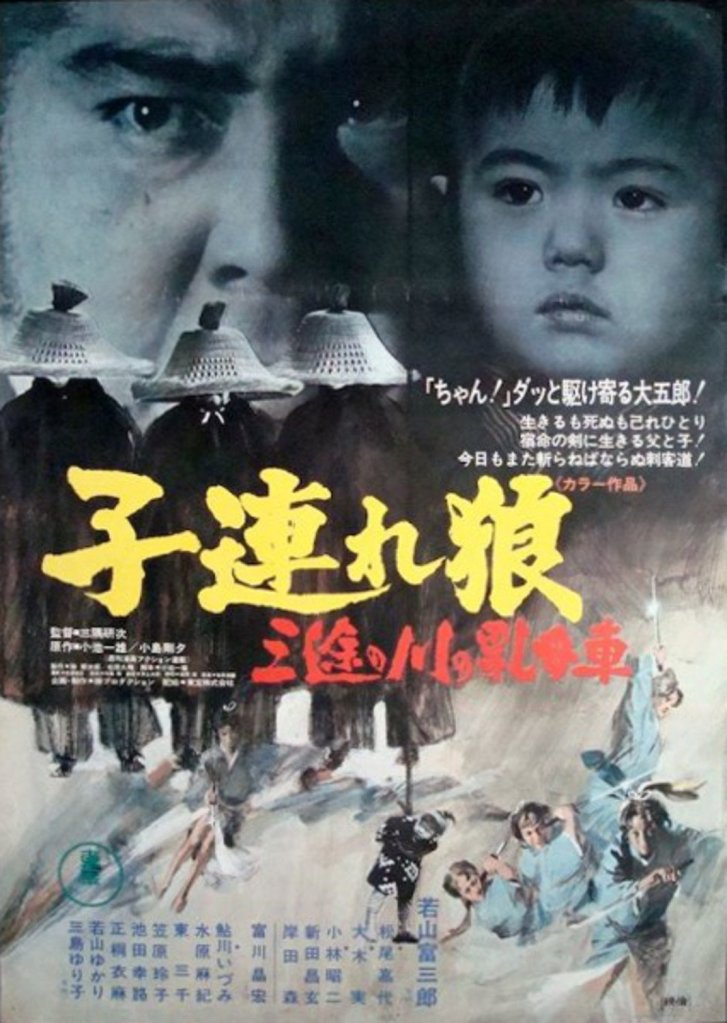
baby-cart-at-river-styxThe first instalment of the Lone Wolf and Cub series saw the former Shogun executioner framed for treason and cast down from his elite samurai world onto the “Demon’s Way” on a quest to clear his name and avenge the murder of his wife whilst caring for his young son, nominally also on the path of vengeance alongside his father. As far as progress goes, Ogami (Tomisaburo Wakayama) has made little other than dispatching a few of his enemy Yagyu foot soldiers and earning himself 500 ryou by ridding a spring town of some pesky gangsters. Well trained genre fans will correctly have guessed that chapter two in this six part series, Lone Wolf and Cub: Baby Cart at the River Styx (子連れ狼 三途の川の乳母車, Kozure Okami: Sanzu no Kawa no Ubaguruma), contains more of the same as Ogami trudges onward pushing his son Daigoro (Akihiro Tomikawa) in a bamboo cart earning a living by way of the sword with his sights set on the Yagyu stronghold.

After swiftly despatching a series of Yagyu agressors, Ogami and Daigoro procede along the Demon’s Way, jointly earning their living as hitmen for hire. The procedures for hiring the Lone Wolf and his Cub are complicated – talismans are positioned on the road calling for their services, and if the pair are interested, they’ll build a trail of rocks to indicate a meeting. Their mission this time is in the name of a put-upon clan whose income stems from a unique dyeing technique, only they’ve been “underestimating” their takings to avoid unfair taxation by the Shogun. Another clan found out about their practices and sent in undercover agents to agitate among the workforce who were already feeling oppressed and misused. The elite samurai took out most of the ringleaders, but their foreman has run off and taken refuge with a neighbouring clan who claim to know nothing about him. Ogami’s job is to kill the manager before he reaches the Shogun and blows the whistle on everything and everyone.

In addition to the Hidari brothers – a trio of skilled ronin acting as bodyguards to Ogami’s target, Ogami also has to contend with the Yagyu currently still angry over the foot soldiers he dispatched in the first film. Now that they know Ogami is not a man to be taken lightly, they’ve handed over the assignment to their crack troop of female ninja led by the expert swordswoman, Sayaka (Kayo Matsuo).

As in the first film the action scenes are impressively choreographed if filmed with a degree of absurd whimsy. Sayaka attempts to ambush Ogami by having her women hanging out in the country performing normal tasks such as washing daikon at the riverside, only the daikon are filled with knives and these are no ordinary housewives. Ogami is not fooled and quickly despatches the full complement of female warriors with ease (and a little help from Daigoro and his well equipped cart), leaving him to face Sayaka one-to-one. Their battle ends in a stalemate in which Sayaka effects a daring ninja escape (from her kimono no less) to retreat to fight another day.

As much as Ogami is on the road to hell, he maintains his honour – as do his opponents, the Hidaris, who take the time even whilst trapped on a burning boat to explain to him that they have no particular grudge towards Ogami and mean him no ill will. They will though respond without mercy if attacked. Unfortunately, Ogami will have to do battle with them as they stand between himself and his target but his philosophy is broadly the same. He will be ruthless in the execution of his mission but is not a ruthless man and will attempt to leave bystanders out of his quarrels.

This oddly stoical quality of his threatens to turn Ogami into something of a wandering heartbreaker as once again he attracts the admiration of a woman, this time his closely matched rival Sayaka, just as he had the prostitute in the first film. Though determined to gain revenge for her fallen clan members, Sayaka is uncomfortable with her clansmen’s plan to kidnap Daigoro and use him as bait to trap Ogami. As the plan offends her honour, she frustrates it at a crucial moment, allowing Ogami to escape with Daigoro in hand. Later following him and trying again to assassinate Ogami during his flight from the aforementioned burning boat, Sayaka finds herself rescued by the very man she was trying to kill. Though misunderstanding Ogami’s rough tearing off of her wet clothes – ever uncommunicative, Ogami is simply trying to prevent her dying of hypothermia and borrow some of her body heat to help himself and Daigoro do the same, Sayaka eventually finds herself literally and figuratively “disarmed” by her target.

Heading back into the world of the spaghetti western, the final fight takes place in the desert with enemies buried in the sand itself. Misumi’s approach is even more psychedelic this time round in which he has Ogami fighting shadows and even more elaborate blood sprays striking the camera as heads, limbs, ears and fingers are severed with glee abandon. The mood shifts slightly as one fallen warrior is allowed a long dying monologue about the sad wail emanating from his fatal wound and his lingering feelings of jealously that he was never able to inflict the kind of elegant kill which Ogami so effortlessly effected on him. Still, the road is long. Ogami remains on the Demon’s Way seemingly no closer to achieving his goal and with a trail of fallen enemies and broken hearts stretching out behind him, but continue he must, pushing his baby cart onwards towards hell in search of both redemption and revenge but with no guarantee of finding either.


Original trailer (intermittent German subtitles only)