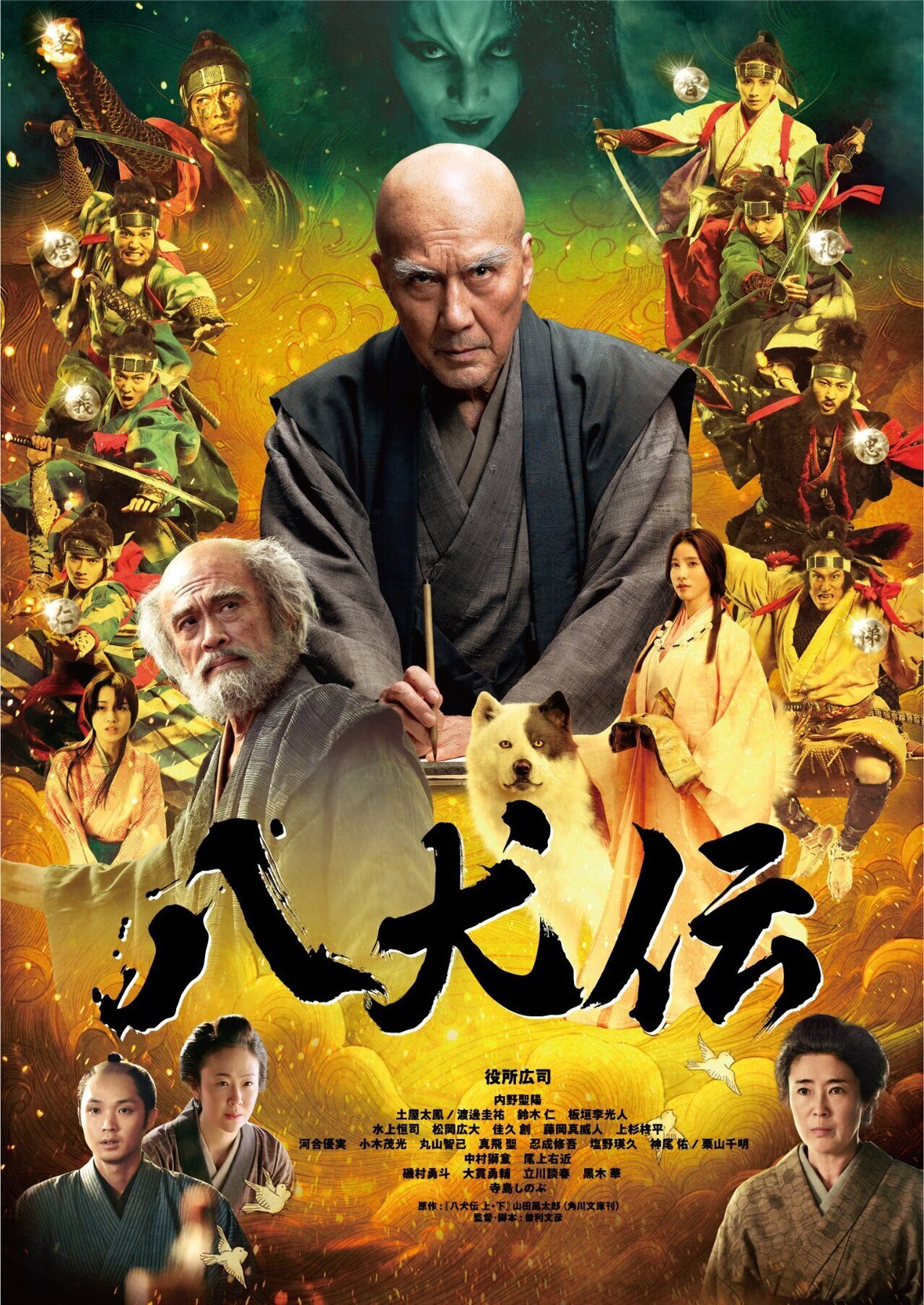
Hakkenden (八犬伝, Fumihiko Sori, 2024)

Kyokutei Bakin thinks he’s a hack who writes inconsequential pulp that will be forgotten faster than yesterday’s headlines. He’d never believe that people hundreds of years later would still be talking about his work. Yet he may have a point in his conviction that people crave simple stories where good triumphs over evil specifically because the real world is not really like that and a lot of the time the bad guys end up winning. But does that mean then that all his stories are “lies” and he’s irresponsible for depicting the world not the way that it is but the way he wants it to be? 

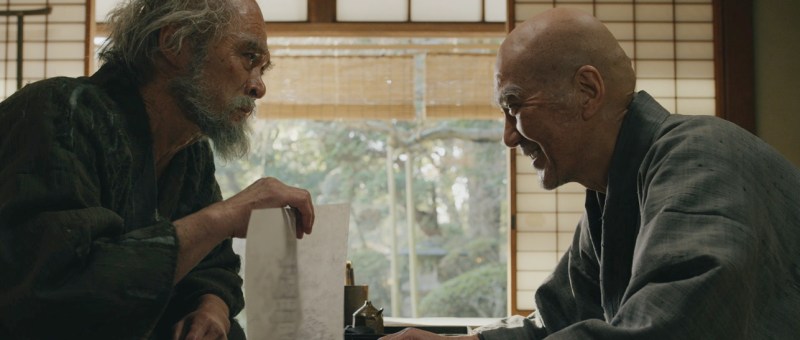
Fumihiko Sori’s Hakkenden (八犬伝) is on one level an adaptation of the famous tale probably most familiar to international audiences as The Legend of the Eight Samurai, and also a story of its writing and the private doubts and fears of its author. In dramatising the tale, Sori plays fantasy to the max and revels in Bakin’s outlandishness. An unusually picky Hokusai (Seiyo Uchino), Bakin’s best and he claims only friend and unwilling collaborator, points out that his use of guns is anachronistic because they didn’t come to Japan until 60 or 70 years after the story takes place but Bakin doesn’t care. He says people don’t notice things like that and all they really care about is that good triumphs in the end, so he’ll throw in whatever he feels like to make a better story. In any case, the tale revolves around magical orbs, evil witches, dog gods and good fairies, so if you’re worrying about there being guns before there should be, this isn’t the story for you. 

Hokusai is also shocked that Bakin has never been to the place where the story is set, but as he tells him it all happened long ago and far away so going there now would be pointless. Even so, Hokusai needs to see what he draws which is why he spends half his life on the road costing him relationships with his family. Whatever else anyone might say about him, and he admits himself to being a “difficult” person, Bakin is very close to his family even if his wife yells at him all the time for being rude to influential people and not making any money when he could have just taken over her family’s clog-making business rather than carry on with this writing malarkey. His biggest ambition is that his son become a doctor to a feudal lord and thereby restore their samurai status which on one level points to a kind of conservatism that doesn’t matter to Hokusai and singles Bakin out as a tragic figure because the age of the samurai is nearing its end anyway. 

In his fantasy, however, he hints at and undoes, up to a point, injustices inflicted on women in the romance between Shino (Keisuke Watanabe) and Hamaji (Yuumi Kawai) who is almost forced into a marriage with a wealthy man because of her adoptive parents’ greed but is finally revealed to be a displaced princess and returned to her father who is thereby redeemed for having accidentally killing his other daughter in a mistaken attempt to control her after accidentally promising her in marriage to a dog god without really thinking about what he was saying. A neat parallel is drawn in a brief mention of Hokusai’s artist daughter Oi and Bakin’s daughter-in-law Omichi (Haru Kuroki) who did not receive an education and is almost illiterate but finally helps him to complete the story by transcribing it in Chinese characters he teaches her as they go after he loses his sight.

As his literary success increases, Bakin’s own fortunes both improve and decline. He becomes wealthier and moves to nicer houses in samurai neighbourhoods, but his son Shizugoro’s (Hayato Isomura) health declines and he never opens his own clinic like he planned while remaining committed to the idea that his father is actually a great, unappreciated artist. In a way, completing the story gives Bakin a way to say the world could be kind and just even if it has not always been so to him. He needs to maintain the belief in a better world in order to go living even if he feels it to be inauthentic while his life itself is a kind of fiction. On a trip to the theatre, he ends up seeing Yotsuya Kaidan and is at once hugely impressed and incredibly angry. The world that Nanboku sees is the opposite of his own. People are selfish and greedy. The bad are rewarded and the innocent are punished. Yet perhaps this is the “reality” of the way the world really is, where as his work is a wishful fantasy. All he’s doing is running away from the truth. But then, as his son’s friend tells him, if a man devotes himself to the ideal of justice and believes in it all his life, then it becomes a reality and ceases to be fiction. There is something quite poignant about the dog soldiers coming to take Bakin to the better world he dreamed of where bad things happen but good always triumphs in the end, which has now indeed become a reality if only for him.


Hakkenden screens 13th June as part of this year’s Toronto Japanese Film Festival.

Original trailer (no subtitles)

First Love (初恋, Takashi Miike, 2019)

First love poster 1Taking a deep dive into Showa era nostalgia repurposed for the modern era, Takashi Miike returns to the world of jitsuroku excess with an ironic tale of honour and humanity. Quite literally all about the jingi, First Love (初恋. Hatsukoi) takes a pair of exiled loners betrayed by the older generation, and allows them to escape their sense of futility through simple human connection while the nihilistic gangster underworld slowly implodes all around them.

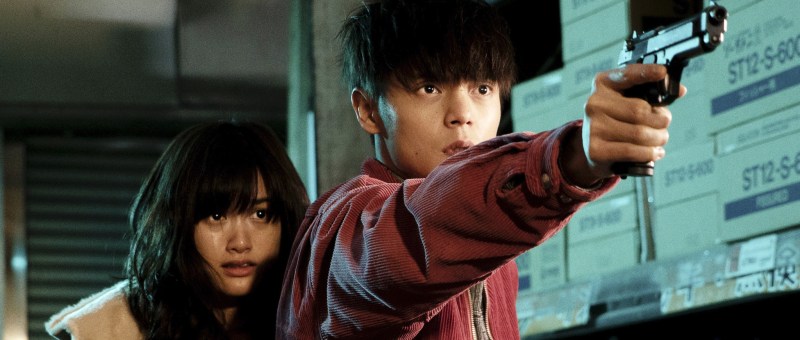
Sullen boxer Leo (Masataka Kubota) is so filled with ennui that nothing really excites him, not even success in the ring. An unexpected KO, however, sends him off to the doctor’s where he is told that he has a possibly inoperable brain tumour and very little time left to live. That is perhaps why he decides to punch a policeman in defence of a young woman running away and desperately pleading for help. Yuri (Sakurako Konishi), known as “Monica” to her captors, was sold to the yakuza by her father and has since become dependent on drugs. Little known to either Leo or Yuri, they are about to become embroiled in a long brewing turf war between the local yakuza and the Chinese Triads engineered by jaded underling Kase (Shota Sometani) who has enlisted rogue policeman Ohtomo (Nao Omori) to help in a plan to steal his gang’s drug supply and have Ohtomo sell it on in the same way he does with “confiscated” narcotics while blaming the whole thing on the Chinese.

Abandoned at birth, Leo is a man who doesn’t know his history and so doesn’t know himself. He tells a reporter that there is no particular reason that he boxes save that he doesn’t know how to do anything else, yet the fighter’s all that remains and “boxer” has become his entire identity. A passing fortune teller advises him that he loses because he only fights for himself and if he truly wants to win he needs to learn to fight for someone else, but Leo is used to being alone and believes he has no need of other people. Knowing he’s going to die means, paradoxically, that he has infinite potential because he has nothing left to lose.

Leo punching out the policeman reawakens in Yuri a memory of her “first love”, a high school classmate who tried to defend her against her abusive father whose ghost still haunts her in drug-fuelled hallucinations. The ultimate proof of the yakuza’s ironic lack of “jingi” or “honour and humanity” when it comes to the treatment of women, Yuri was betrayed first by her father and then by the petty street thug who got her hooked on drugs as a means of control and exploited her body for financial gain.

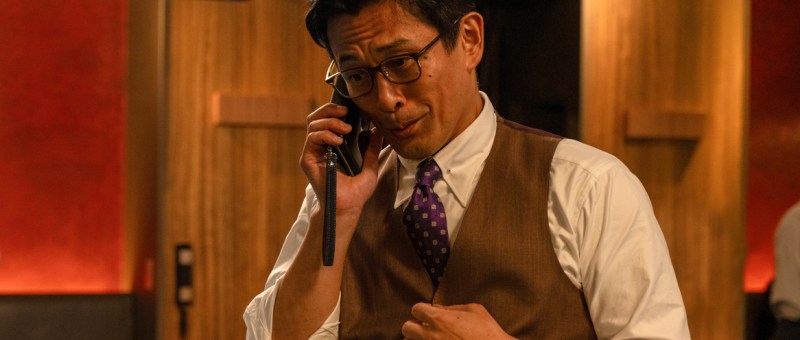
Ironically enough, it’s a Chinese Triad who proves the ultimate heir to “jingi” having come to Japan because of her love for classic Toei gangster hero Ken Takakura only to discover that kind of nobility is something you only see in the movies. While the yakuza lament that they’re at a disadvantage fighting the Chinese because they don’t need to worry about “honour” as dictated by their code, they are quick enough to scream vengeance when Kase convinces them that it was the Triads who offed their street fixer (Takahiro Miura) to get back at recently released gangster Gondo (Seiyo Uchino) who is the reason that the Triad boss is nicknamed One-Armed-Wang. Gondo and Wang are already on a collision course as representatives of their respective ideologies with Gondo perhaps the last true yakuza standing, faithful to his code to the end.

Sensing his strong sense of jingi, the romantic Triad allows Leo to escape with Yuri as if recognising that neither of them belong in this nihilistic world of pointless and internecine violence. Despite proclaiming that he had no need of other people, it’s Leo’s humanity that eventually saves him as he realises that he was always going to die and rediscovers his true strength through fighting to protect someone else. Yuri, meanwhile, finds the will to live again in making peace with the past and laying old ghosts to rest thanks to Leo’s altruistic decision to protect her. Echoing Fukasaku’s classic crime cycle in its severed heads and funky ‘70s jazz score remixing the iconic theme tune, Miike ups the ante with a series of outlandishly idiosyncratic gags as Kase’s nefarious scheme snowballs into a darkly humorous crescendo of ridiculous brutality, but ultimately rejects the futility of a world without jingi in allowing his pure hearted heroes the possibility of escape, saved rather than consumed by their sense of honour and humanity.


First Love was screened as part of the 2019 BFI London Film Festival.

Original trailer (English subtitles)