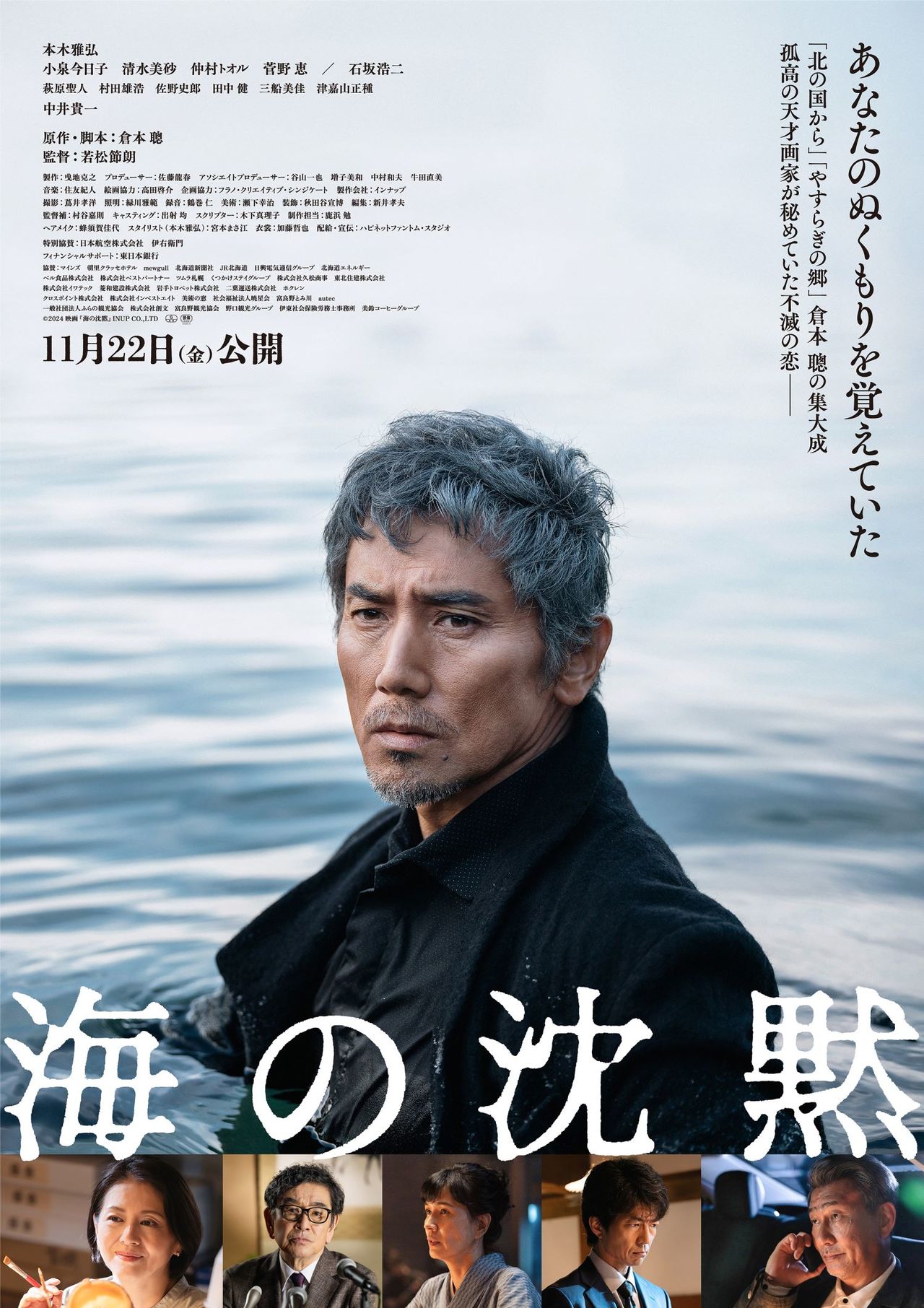
Silence of the Sea (海の沈黙, Setsuro Wakamatsu, 2024)

Can there be any greater humiliation than having your work plagiarised and the other person’s being better? Renowned artist Tamura (Koji Ishizaka) feels he has to say something on seeing an old painting at an exhibition honouring his late mentor and realising it’s not the one he painted. He doesn’t think he ever had the ability to paint something with this kind of power even when he was young, and he didn’t even use the materials which appear to have given this version a emotional depth that the original never had.

In some ways, this is Tamura’s past literally coming to the surface to show him that his life has been a series of mistaken choices and whatever success he may have achieved it’s come at the cost of his artistic soul. The first part of Setsuro Wakamatsu’s Silence of the Sea (海の沈黙,, Chinmoku no Umi) ponders why Tamura might be so keen to confess this work isn’t his when he admits that it’s objectively “better”, but even if that might be true, he has to concede it isn’t him and therefore shouldn’t have his name on it. Though he appears to have become greedy and vain, trading on his connections and more of a celebrity artist than someone with real and urgent ideas to express, he is apparently willing to burn all his bridges on the altar of authenticity while simultaneously refusing to divorce his wife, the daughter of his late mentor, despite living with another woman and their child on the other side of the country.

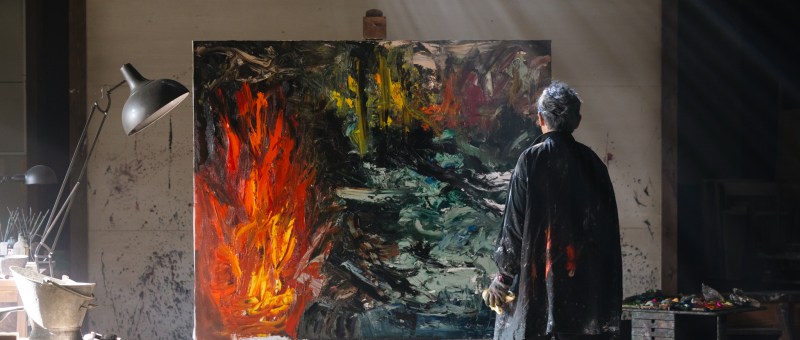
But as someone else says, does it matter whose name is on the painting when it is beautiful in itself? Then again, this beauty is intended both to cover something up and to expose it. In his youth, Tamura apparently threw another artist, Lyuji (Masahiro Motoki), under the bus. 40 years later, Lyuji is a master forger living a life in the shadows tattooing young women with his fevered artistic visions. It’s true enough that he seems to see them only as “canvases” and otherwise rejects personal connection while still carrying a torch for Tamura’s now wife Anna (Kyoko Koizumi). He seems to be stuck in the past, forever meditating on a particular pairing, The Silence of the Sea, which reflected his own moment of trauma when his parents both drowned when he was a child. 

The film seems to pain Tamura and Lyuji as two sides of the same coin. The more Tamura’s star rose, the sicker and more humble Lyuji became as if he were literally bleeding him dry. In the words of his assistant, Lyuji had an imperative to depict beauty, but art seems to deplete him. He literally vomits blood on the canvas while struggling to recreate his lost painting and thereby return to the source of his trauma. The sea for him seems to represent life and death along with life’s beauty and terror, while for Tamura it is perhaps merely picturesque even if for both of them the sun is always setting.

One man has almost painted over the other, stolen a life that might have been meant for him though his talent may lie more in an ability to play the game than in art itself. But at the same time, Lyuji has destroyed himself through his selfishness and single-minded obsession with his art along with the internal traumas it turns out he cannot simply paint over. His life is like the candle that Anna makes in his image, slowly melting away and producing only a single tear from a lonely soul. His eventual conviction is that beautiful things need only exist in our hearts and minds as memory rather than as material things. As he says, measuring art in money is mere foolishness, which paints his career of forgery as an ironic revenge against the art world which values only what’s popular and has become a game for the rich to play to enhance their status little caring for the nature of the art itself. Yet this covering up and later revealing of a truth has led to several deaths, among them a man who lived for art and a woman who yearned for love only to end up a scorned muse of an emotionally distant man. The sea took them all, but for Lyuji at least it may finally have fallen silent in the final perfection of his art.


Silence of the Sea screens as part of this year’s Japan Foundation Touring Film Programme.

Trailer (English subtitles)

Images: © 2024 Eiga Umi no Chinmoku INUP Co.,Ltd

Fukushima 50 (フクシマ50, Setsuro Wakamatsu, 2020)

The “Fukushima 50” (フクシマ50), as the film points out, was a term coined by the international media to refer to the men and women who stayed behind to deal with the unfolding nuclear crisis at the Fukushima Daiichi Nuclear Power Plant. Loosely inspired by Ryusho Kadota’s non-fiction book On the Brink: The Inside Story of Fukushima Daiichi which featured extensive interviews with those connected to the incident, Setsuro Wakamatsu’s high production value film adaptation arrived to mark the ninth anniversary of the devastating earthquake and tsunami which occurred on 11th March, 2011 and closes with a poignant callback to the plant’s role in Japan’s post-war reconstruction as the nation once again prepares to host the (now postponed) Olympics with a torch relay beginning at Fukushima as a beacon of hope as the country continues to rebuild in the wake of the disaster. 

Though inspired by real events Wakamatsu’s dramatisation is heavily fictionalised and while surprisingly frank for a mainstream film in its criticism of the official reaction to the disaster, is also quietly nationalistic while doing its best to pay tribute to the selfless sacrifice of the plant workers who stayed behind to do what they could many of whom had little expectation of surviving. Chief among them would be Izaki (Koichi Sato), an imperfect family man and veteran section chief, and the plant’s superintendent Yoshida (Ken Watanabe) who are both local men and old friends. Local, it seems, is later key with multiple appeals to the furusato spirit as each is at pains to point out that they stay not only to prevent a catastrophic meltdown that would leave most of central Honshu including Tokyo uninhabitable, but because they feel a greater duty to protect their hometown and the people in it. 

Meanwhile, they find themselves burdened rather than assisted by official support as government bodies’ political decision making undermines their attempts to avert disaster while the boardroom of TEPCO who operate the plant reacts with business concerns in mind. A few hours in the prime minister (Shiro Sano) decides to make a visit, in political terms he can’t not national leaders who don’t visit sites of crisis are never forgiven, but his presence actively hinders the recovery efforts. Referred to only as the PM, Wakamatsu’s film presents the man leading the nation as an ignorant bully overly obsessed with his personal image. He has little understanding of nuclear matters or the implications of the disaster, refuses to abide by the regular safety procedures required at the plant, and mostly governs through shouting. Beginning to lose his temper, Yoshida does his best to remain calm but resents the constant interference from those sitting in their offices far away from immediate danger while he does his best to contend with the increasingly adverse conditions on the ground, mindful of his responsibilities firstly to his employees and secondly to those living in the immediate vicinity of the plant who will be most at risk when measures taken to prevent meltdown will lead to an inevitable radiation leak. 

Yoshida’s hero moment comes when he ignores a direct order from the government to stop using seawater to cool the reactors, knowing that he has no other remaining options. Meanwhile, the government refuse offers of help from the Americans, who eventually make a strangely heroic arrival with Operation Tomodachi, discussing plans to move their families to safety while their commander reflects on his post-war childhood on a military base near the site of the nuclear plant. Japan’s SDF also gets an especial nod, granted permission to leave by Yoshida who is beginning to think he’s running out of time but vowing to stay and do their duty in protecting civilians in need. 

In essence, the drama lies in how they coped rather than the various ways in which they didn’t. The conclusion is that the existence of the plant was in itself hubristic, they are paying the price for “underestimating the power of nature” in failing to calculate that such a devastating tsunami was possible. They thought they were safe, but they weren’t. Perhaps uncomfortably, Wakamatsu mimics the imagery of the atomic bomb to imagine a nuclear fallout in Tokyo, harking back to ironic signage which simultaneously declares that the energy of the future is atomic while the plant workers reflect on the sense of wonder they felt as young people blinded by science back in the more hopeful ‘70s as the nation pushed its way towards economic prosperity. Frank for a mainstream film but then again perhaps not frank enough, Fukushima 50 is both an urgent anti-nuclear plea and an earnest thank you letter to those who stayed when all looked hopeless, suggesting that if the sakura still bloom in Fukushima it is because of the sacrifices they made.


Fukushima 50 is available to stream in the US until July 30 as part of this year’s Japan Cuts.

International trailer (English subtitles)