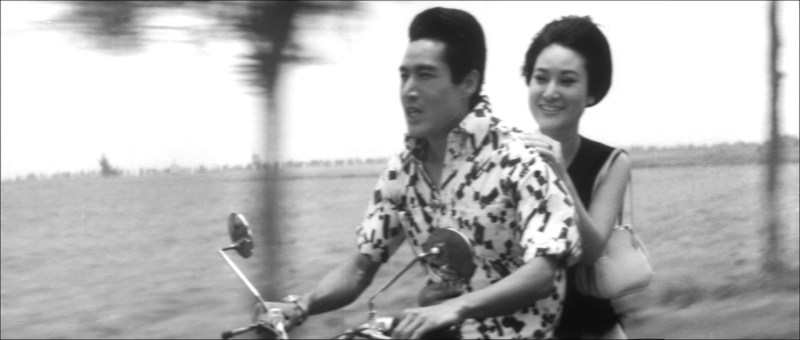
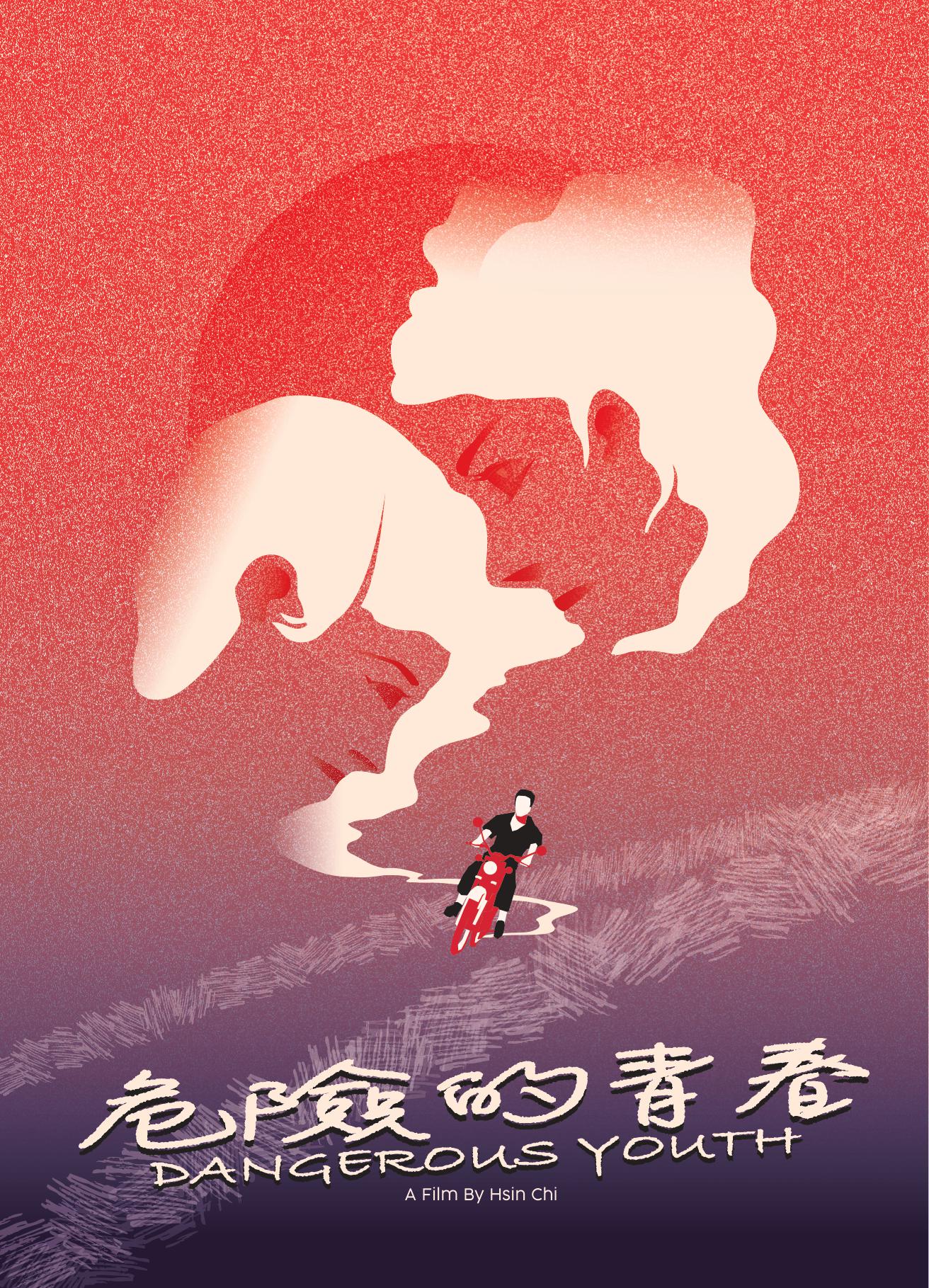
Increasing consumerism has begun to corrupt the minds of the young in Hsin Chi’s ultra contemporary Taiwanese-language drama Dangerous Youth (危險的青春). Unlike similarly themed youth movies from elsewhere such as Kim Ki-duk’s Barefooted Youth (1964, inspired by Ko Nakahira’s Doro Darake no Junjo) or Nagisa Oshima’s Cruel Story of Youth (1960), Hsin’s film is nowhere near as nihilistic as its title might suggest nor are its heroes as delinquent merely morally compromised as they attempt to navigate the changing society around them while feeling as if the things they want have been deliberately placed out of reach.
As the film opens, Khue-guan (Shih Ying) is cheerfully riding on his motorcycle with his current girlfriend on the back behind him, only the trip comes to an abrupt halt when the bike, a symbol of his freedom and independence, gets a flat tire. The pair pull over to a roadside garage to get it fixed and wait in a nearby cafe where they’re served by waitress Tsing-bi (Cheng Hsiao-Fen) who happens to be the owner’s daughter. While they’re waiting, Khue-guan’s girlfriend contemptuously dumps him, complaining that his bike is always breaking down and she’s decided to marry a financially secure engineer while attempting to palm Khue-guan off on Tsing-bi who ironically has a haircut quite like hers and is dressed almost identically. Khue-guan tries to change her mind, but she reminds him that marriage is “a woman’s meal ticket” so why would she or anyone else for that matter marry a poor delivery boy if a better offer came along?
Khue-guan innocently insists that if they stay together and work hard they’ll be rich someday too, but his girlfriend has no desire to wait and no inclination to strive. It’s this ideology of working class aspiration that if you just buckle down and play by the rules you can one day have a comfortable life that is at the centre of the film’s ideological conflict, Khue-guan himself later hearing the same words from Tsing-bi when she refuses to become the mistress of the wealthy widower Mr. Tshi (Chen Tsai-Hsing) but having become so jaded that he no longer believes them only to be apparently converted when a work colleague gives him the same advice that he should give up on the boss’ sexually liberated daughter and find someone who loves him with whom he can work together to build a happy family home.
The happy family home, a conventional middle-class success story, was Khue-guan’s small dream at the beginning of the film before his girlfriend’s slight caused him to lose his way. His crisis is also one of threatened masculinity, feeling himself inferior by virtue of a poverty he does not know how to escape lamenting to an old friend that only college men like him can find good jobs in the changing, increasingly white collar society. In a minor role reversal, it’s clear that women have gained increasing freedom and agency and in fact here hold the power as reflected in the masculinised figure of boss’ daughter Giok-Sian (Kao Hsing-Chih) who runs a hostess bar and refuses to get married instead living a sexually liberated life without romantic attachment. Part of Tsing-bi’s resentment towards her mother (Su Chu) stems from her sexually active love life in which it seems she too has the upper hand. In a repeated motif, we see Tsing-bi’s mother hand money to her lover so he can take time off work, something Tsing-bi later does to Khue-guan who without quite thinking about it has begun to live through her exploitation only objecting when offered money by Giok-Sian who rejects his romantic overtures interested only in bodily satisfaction.
This gender imbalance is later “corrected” towards patriarchal norms as Giok-Sion is finally forced to accept that she is in love with Khue-guan just at the moment he receives his epiphany that the way he’s been living is wrong, love is more important than money, and he needs to get back on the straight and narrow to earn success by working hard rather than exploiting others. Nevertheless, there is plenty of toxic masculinity in the air, the friends of the ageing Mr. Tshi apparently mocking him for his literal impotence, his masculinity questioned in the absence of a female sexual partner. Though as we discover Mr. Tshi is simply lonely having lost his wife and seemingly having no children, asking Tsing-bi only for cuddles and companionship. There is something distinctly uncomfortable in the way that Tsing-bi is thrown at Mr. Tshi like a like live chicken into a pit of crocodiles by Giok-Sian, her father, and his friends each of whom are trying to curry favour for business advantage by exploiting her. With her short hair and tendency to wear pinafore dresses, not to mention often carrying around teddy bears and oversize dolls, the 20-year-old and extremely naive Tsing-bi seems even younger than she is, an innocent little girl misused by an increasingly corrupt society.
Even so Tsing-bi remains the least corrupted of the youngsters, clinging to her love for Khue-guen never realising he too is just using her for easy money even as she ironically throws his own words back at him in suggesting they marry, work hard, and raise a happy family together. Though it was her consumerist desires that originally set her against her mother in her yearning for current fashions and sophisticated city life, she never really wanted the money only Khue-guan while ironically mimicking her mother’s behaviour in accidentally making him a kept man. The reset which occurs at the film’s conclusion at once restores traditional gender roles but also perhaps shifts them in stressing the need of the couple to work “together” even if that sentiment might imply a greater equality than is in reality in play. Nevertheless, perhaps for reasons of censorship (which might also explain why despite the film’s obvious Taiwan setting frequent references are made to Hong Kong landmarks) the conclusion is not as bleak as one might assume from the rather nihilistic, moral panic implications of the title as the young couple are finally placed back onto the “correct” path of honest hard work which is also in its own way a capitulation to their own exploitation at the centre of an expanding, increasingly capitalistic society.
Dangerous Youth streams in the UK until 31st October as part of this year’s Taiwan Film Festival Edinburgh.
Trailer (Traditional Chinese / English subtitles)
 Windows on Worlds