Love Song from Hiroshima (惑星ラブソング, Hideyuki Tokigawa, 2024)

Just because we are far apart, it doesn’t mean we aren’t important to each other, according to an interplanetary messenger hoping to avoid the Earth’s apparently imminent destruction in Hideyuki Tokigawa’s gentle ode for world peace, Love Song From Hiroshima (惑星ラブソング, Wakusei Love Song). Twenty-something Mocchi (Ryosuke Sota) says he’s sick of hearing about the legacy of the atomic bomb, but is himself stuck in the past just as the city is frozen in time.

According to his friend Ayaka (Shiori Akita) who is thinking about studying abroad in the US, Mocchi gives up on things too easily and can’t decide on his path in life. Of course, he doesn’t really want her to go to America because he’s in love with her and too shy to say, but agrees to help her with a social media campaign to get over 100,000 likes and impress her boss so he’ll fund her travel. That’s how they end up meeting “John” (Chase Ziegler), a very weird “American” tourist whom they decide to escort around Hiroshima showing him typically touristic things like getting okonomiyaki which they then post on her social media channels. 

Meanwhile, a shady American agency is on a UFO alert in Japan which links back to a little boy’s fascination with aliens even though his friends keep making fun of him because of it despite spreading their own kinds of urban legends. Yuya is obsessed with the idea of extraterrestrial life while also uncomfortable with the scarred city around him. At his school there are a pair of burnt but surviving trees that have become symbols of resilience and survival, though Yuya hates going to the Peace Park and talking about the bomb because it’s scary. According to his mother, his great-grandmother never liked to talk about the war, though it seems she has told the man looking after her at the care home about her carefree childhood of roller skating in the car-free streets. In a brief moment of lucidity, she turns to Yuya and asks him if his aliens can travel in time, why can’t they go back and stop the bomb from falling. 

The irony is that Mocchi’s sick of everyone talking about the bomb all the time, but it’s still a painful subject for many including the taxi driver who drives Yuya and his mother home. As soon as she starts talking about what she does know about her grandmother in the war, she can feel him looking back at her in the rearview mirror and changes the subject, promising to tell Yuya the rest later when they’re on their own. In his dreams, Yuya ends up chasing after his great-grandmother as a school girl as she tells him that there used to be sweet shops, a barber’s, and a cinema where the Peace Park is now. 

The aliens say that the bomb twisted the fabric of time and space, creating a barrier which they cannot move beyond, while there is another fixed point in the future with seemingly nothing beyond it. We cannot change the past, the aliens admit, but we can change the future. The film’s Japanese title is more like “interplanetary love song”, and it turns out that a universe without the Earth in it is like the world without George Bailey. All the planets that the Earth would have helped will also be lost along with countless other possibilities throughout the universe. 

Mocchi still thinks it’s pointless to “pray” for peace, and that as all anyone in Hiroshima ever seems to talk about is the bomb, he doesn’t see how raising awareness could make much difference. Nevertheless, even he can’t help being moved by the aliens’ opening manoeuvre which cures his cynicism by fulfilling the childhood dream he’d more or less forgotten. Mocchi and Ayaka argue about the realities of nuclear deterrents and geopolitical manoeuvring even if they each agree on the horror of war. Ayaka says she loves her city because it represents peace,  and it is indeed a kind of love song from Hiroshima that they send around the world as a plea for a world without war. Telling Mochi to come up with ways to enact world peace on his own might seem a little unfair, but then it’s true enough it’s something we all have to think about to save the future from the mistakes of the past.


Love Song from Hiroshima screens 24th June as part of this year’s Raindance Film Festival.

Original trailer (English subtitles)
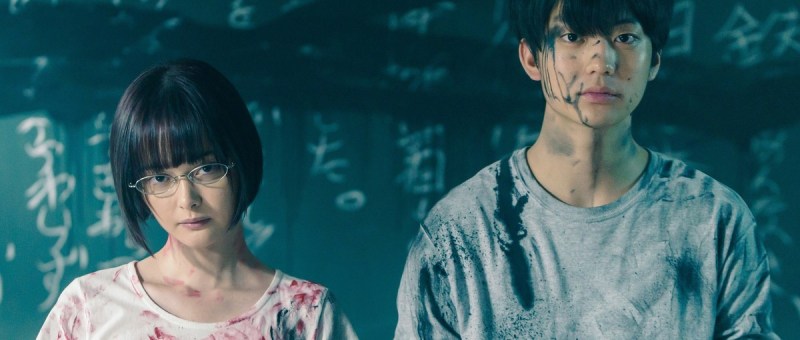
Flowers of Evil (惡の華, Noboru Iguchi, 2019)

Small-town ennui is something familiar to many who’ve found themselves feeling somewhat out of place in the place they’ve always been, but rebellions usually take less obvious forms than the nihilistic rejection of bourgeois respectability enacted by the conflicted hero at the centre of Noboru Iguchi’s Flowers of Evil (惡の華, Aku no Hana). Iguchi is best known as a director of made for export splatter exploitation, so it might come as a surprise to his fans to see him take on the admittedly dark but largely gore-fee adaptation of Shuzo Oshimi’s coming-of-age manga.

Takao (Kentaro Ito), a “regular” high school boy, likes to read “difficult” books such as the poetry collection by Charles Baudelaire from which the film takes its title. He feels himself somewhat above his surroundings, but superficially conforms to the ordinary world around him. Like many of his classmates, he’s developed an adolescent crush on the school’s prettiest girl, Nanako (Shiori Akita), but unlike his friends views her as his “muse”, a pure and untouchable figure of unspeakable desire. Nipping back to the classroom alone to retrieve a forgotten book, he spots Nanako’s gym bag lying on the floor and cannot resist opening it, burying his face in her clothes. Panicked after hearing someone nearby, he takes the bag home with him.

Everyone immediately knows that a “pervert” is responsible for the theft, they just don’t know who it is. Except for the class’ resident strange girl, Sawa (Tina Tamashiro), who apparently witnessed Takao’s descent into perversion in real time. She makes him a deal – write an essay all about what a big pervert he is and she’ll kept his secret in friendly complicity seeing as she is a kind of “pervert” too. Sawa, who is much more obviously “different” than Takao and completely unafraid of embracing it, is convinced that their town is entirely inhabited by “Shit Bugs”, and they are the only elevated beings. Uncomfortable with her own desire, Sawa’s behaviour becomes increasingly intense when Nanako unexpectedly expresses an interest in Takao, apparently impressed that he was so “upfront with his feelings” and willing to stand up for Sawa when she was accused of being a (but not the) thief.

Takao tells Sawa that he just wants to be “normal”, to be the kind of man Nanako could desire. Just another confused teenage boy, he doesn’t yet know who he is or what he feels and is, in a sense, consumed by the sense of emptiness that comes of lacking self-knowledge. He masks his sense of intellectual inferiority by feigning sophistication, spending his free time in second hand bookshops reading the accepted canon with a typically teenage obsession with death and despair. But as he is later forced to admit, he did so largely in order to feel superior. He doesn’t truly understand much of what he read and lacks the maturity to accept his confusion. Nanako challenges him in more ways than one – by calling him on his wilful repression of his desires, and by confronting him about his obsession with Flowers of Evil, a “difficult” book which try as she might she can’t understand. She doesn’t “get” Baudelaire, and she doesn’t “get” Takao because of it, but Takao doesn’t “get” Takao either because he thinks he’s a book filled with blank pages, that if you open the cover there’s really nothing interesting there, just a giant void of emptiness.

Three years after stealing the gym bag, Takao describes his new environment as infinitely grey as if devoid of any sense of life, whereas the climactic summer is coloured by a vibrant greenery he claims to be equally oppressive. Fed up with small-town life, both Takao and Sawa long for a mythical “beyond” on the other side of the mountains which trap them within the claustrophobic environment of their provincial existence. They kick back against small-town conservatism with childish shows of resistance which culminate in a very public act of self-harm dressed as societal attack, but remain unable and unwilling to address the real cause of their frustration in their adolescent inability to accept that desire itself is not “perverse” or somehow sullying some grand romantic notion of pure and innocent love.

Unable to process his desires, Takao remains unable to progress into adulthood and become, as Sawa later chides him, a “regular human”. Normality is, however, what he eventually chooses, reverting to the anxious bookworm he always was only having moved forward in learning to let something go, whereas Sawa perhaps feels that she has no other option that to accept her own “perversion” and be exiled by it. Takao discovers an internal “beyond” and tries to share it with Sawa, but she is looking for something else and cannot join him in the “regular” world to which he is always going to return. Iguchi dedicates the film to all those who are or were tormented by youth, allowing his tortured hero to find his path towards an integrated selfhood, but resists the temptation to belittle his suffering as he strips himself bare to exorcise the emptiness inside.


Flowers of Evil was screened as part of the 2019 Five Flavours Film Festival.

Original trailer (no subtitles)

https://youtu.be/2sXTkrHo2Ls