The Last Blossom (ホウセンカ, Baku Kinoshita, 2025)

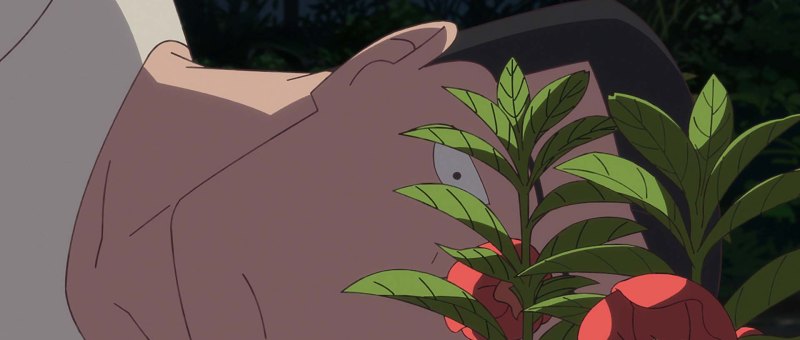
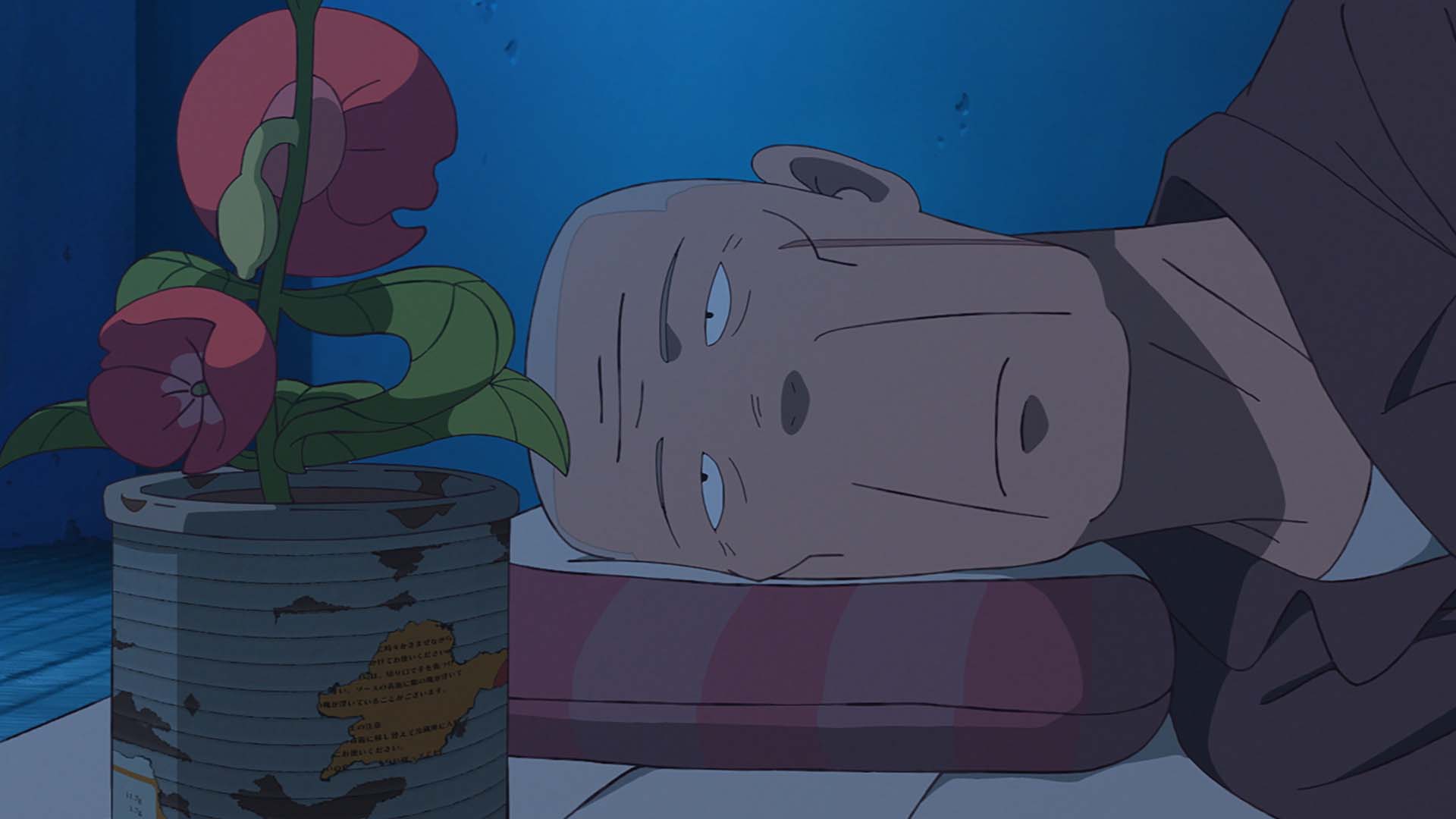
Seen from above, balsam flowers look like an arrangement of leaves, yet when viewed from the side, the pretty flower within becomes visible. It’s an apt metaphor for the “pathetic” life of Minoru (voiced by Junki Tozuka / Kaoru Kobayashi), an elderly gangster apparently drawing close to death all alone in a prison cell except for a talking plant whose voice he is only now able to hear. Created by the team behind the charmingly surreal Odd Taxi, The Last Blossom (ホウセンカ, Honsenka) is an oddly affecting tale in which the hero remains convinced that he can still turn it all around, if only with his final move.

Back in 1986, Minoru had taken in a bar hostess, Nana (Hikari Mitsushima / Yoshiko Miyazaki), who was already pregnant with another man’s child. Emotionally insecure, he could never quite find it within him to tell her that he loved her and their family, and instead began to push her and her son Kensuke away in fear of losing them. Though Nana suggested getting married, he refused saying that he did not wish to bring her into his yakuza life and was worried that it would only cause problems for her if his name was in the papers or he had to go to prison. When he was eventually sentenced to life behind bars, not being married ironically meant that she couldn’t get access to see him, while his applications for parole were always turned down given that he had no one to vouch for him on the outside.

Nevertheless, there are moments of blissful domesticity such as the pair noticing that the ping on the microwave sounds exactly like the bell in the song Stand By Me, which becomes sort of their tune. Yet Minoru’s life is intertwined that of the bubble era, as if his brief years of happiness were a just a bubble that was always destined to burst. During the 1980s, the yakuza was also in a moment of transition and as an underling who feels he owes a debt to his sworn brother Tsutsumi (Hiroki Yasumoto), Minoru is also trapped in another era. Tsutsumi is wary of a young recruit, Wakamatsu (Soma Saito), who is a new yakuza of the corporate age in which the street thugs of the post-war era are slowly becoming legitimate businessmen. Wakamatsu has a good nose for business and has realised that land will be the money spinner of the age, prompting Minoru to engage in a spot of property speculation of his own.

But Tsutsumi is increasingly resentful, knowing that Wakamatsu has supplanted him in the boss’ affections. Old-school yakuza are no longer welcome in a world of boardroom gangsters. It’s clear that Wakamatsu doesn’t like Tsutsumi either, but seems well disposed to Minoru. Ironically all his mannerisms are reminiscent of those of the balsam flower, even down to his slightly sarcastic way of speaking. Nevertheless, Minoru begins to lose himself amid bubble era excess, spending all his time and money on clubs and rarely coming home to Nana and Kensuke. Only when he learns that Kensuke has incurable heart disease and needs a transplant does he begin to step up and assert himself as a father, willing to do whatever it takes to get the money for Kensuke to go to the US for a new heart as the surgery isn’t legally permitted in Japan. 

Minoru has a deep-seated sense of himself as a loser and is always saying that he’s going to turn things around. The irony is that he leaves it so late, but it is indeed with his final move that he gives his life meaning in making clear his feelings for Nana and Kensuke. Maybe it looks like a “pathetic” life when seen from above, but when you look from the side you can the beautiful flower blossoming underneath, a sentiment that could equally stand for Minoru’s quiet nature and buried feelings. Though he allowed himself to be corrupted, starting to drink when he never had before not because he wanted to but because Tsutsumi did, becoming obsessed with work and losing sight of what really mattered to him, he really did manage to turn it around in the end. With a gentle sense of magical realism in the talking plants and occasional moments of surreality, The Last Blossom is a poignant tale of regret and redemption beautifully expressed by the stillness broken by brief explosions of fireworks to be found in Baku Kinoshita’s beautifully simplistic aesthetics. 


The Last Blossom opens in UK cinemas 27th March courtesy of Anime Limited.

Trailer (English subtitles)

Images: ©Kazuya Konomoto /The Last Blossom Production Committee
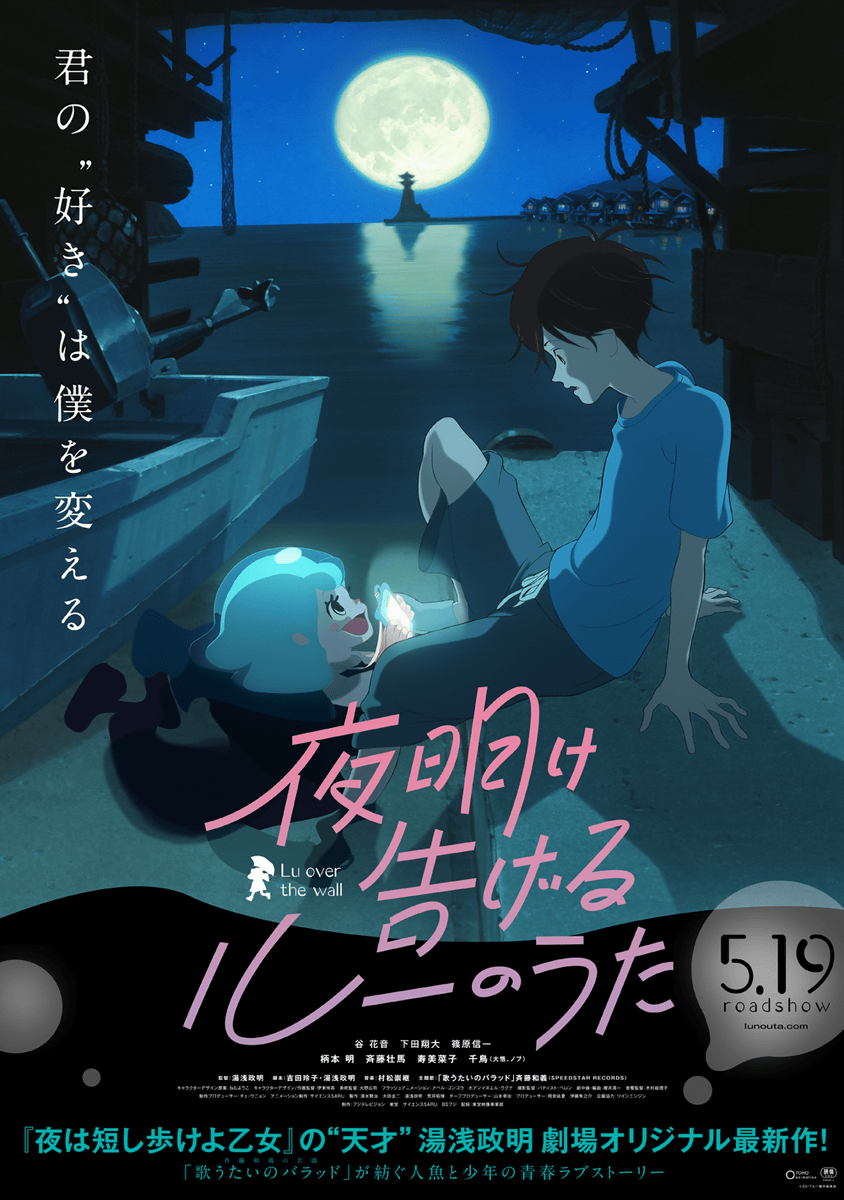
Lu Over the Wall (夜明け告げるルーのうた, Masaaki Yuasa, 2017)

Lu over the wall posterComing of age dramas are the mainstay of anime, but if anyone was going to take one in a pleasingly new direction it would be Masaaki Yuasa. His second release of 2017 following the comparatively more abstract The Night is Short, Walk on Girl, Lu Over the Wall (夜明け告げるルーのうた, Yoake Tsugeru Lu no Uta) is the tale of a boy learning to break of out his emotional repression in order to step into a healthier adulthood but it’s also one of learning to live with loss and grief. From the Irish selkie to the conventional mermaid, people of the sea have more often than not stood in for people from a land of lost things where souls are carried away and lonely sailors lured to their doom, but perhaps we’ve simply misunderstood them and the song they sing isn’t intended to make us sad but only to make us remember the joy of living.

Sullen teenager Kai (Shota Shimoda) is in his last year of middle school with a lot of decisions awaiting him as to the further direction of his life. For the moment, Kai lives in the small fishing village of “Hinashi” somewhere in Southern Japan. “Hinashi” literally means “sunless” and the town is indeed overshadowed by a large cliff which blocks the town from the sun but there’s a more metaphorical kind of gloominess lurking here too. Kai is not the only miserable one, pretty much all of the townspeople once dreamt of escape but have either proved unable to get away from their small town roots, or have tried and failed to make it somewhere else before reluctantly returning, salmon-like, to the place of their births. The only one, it seems, to successfully make it out is Kai’s mum who left the family when Kai was small.

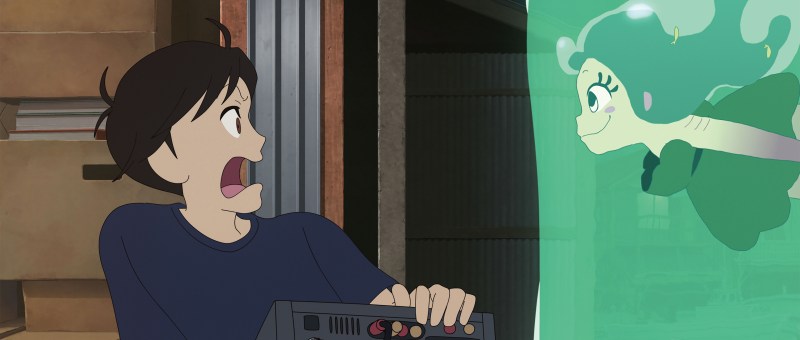
Much to his father’s (Shinichi Shinohara) irritation, Kai’s big dream is music though he’s less than thrilled when bamboozled into joining two other aspiring rockstar teens, Kunio (Soma Saito) and Yuho (Minako Kotobuki), as the third member of “Seirèn” even if it does give him an excuse to explore the generally forbidden territory of Mermaid Island. Whilst there, the trio’s song calls out to a music loving Merfolk girl, Lu (Kanon Tani), who can’t resist joining in and, awkwardly, is a much better lead vocalist than the divaish Yuho.

Lu, a charmingly vibrant toddler-type, is perfectly primed to bring this moribund town back to its sunny old self. Able to conjure her own portable corridors of water to travel over land, Lu tracks down Kai hoping to hear more wonderful music and making childish attempts to communicate through broken Japanese so that she can learn to understand the human world. Lu is not, however, the image most of the townspeople have when they think about Merfolk considering most of the local legends paint them as voraciously carnivorous predators existing only to steal landlubbing souls.

The Merfolk are a perfect metaphor for most of the ills consuming the town – a never seen manifestation of unknown fears. Everyone here has lost someone or something at sea (this is, after all a fishing village) or to the city, or just in themselves in learning to accept reality over the lure of unattainable dreams. Kai’s young and caring if distant father tries to push his son towards the “correct” path of non-stop studying and moral uprightness, but his son is just like teenage him, dreaming musical dreams of escape. It might have all gone wrong for Kai’s dad, but as he’s finally able to admit thanks to the guidance of Lu, he doesn’t regret a minute of it.

Ironically enough, Kai’s name is also the word for shellfish in Japanese, making his grandfather’s (Akira Emoto) frequent lament that the muscles in his dinner won’t open more than a little pointed. Kai is definitively closed off, refusing to even open the letters from his mother and keeping himself aloof at school and at home. Yet he’s not the only one who needs to open up – forced to dance to Lu’s tune (literally) each of the townspeople comes to make peace with those things that are so very hard to say, either letting past traumas float away or deciding to swim away with them.

It is, however, a little uncomfortable when the final resolution takes on a romantic dimension seeing as Lu has been painted as an adorable child with her giant bubbly head, cute high pitched voice, and childishly broken Japanese, not to mention that a secondary plot strand revolves around her father (an anthropomorphised shark/killer whale) who has attempted to shed some prejudices of his own to help his daughter in her desire to make friends with humans. Nevertheless, Yuasa and his scriptwriter Reiko do their best to do justice to all the ills of the town from the corporate greed of the mermaid loving old timer who wants to open a theme park exploiting their image, to the creepy behaviour of Yuho’s governor father, and the ever present themes of loss, guilt, and disappointment. The trio of teens at the centre may have felt themselves trapped in a dead end town, but thanks to Lu they come to realise that they too can jump over the wall and go wherever they want so long as they take the music with them.


Lu Over the Wall is in UK cinemas for one night only on 6th December 2017 courtesy of Anime Ltd.. Find out where it’s screening near you via the official Lu Over the Wall microsite.

Anime Ltd. trailer (Dialogue free)