Space Sweepers (승리호, Jo Sung-hee, 2021)

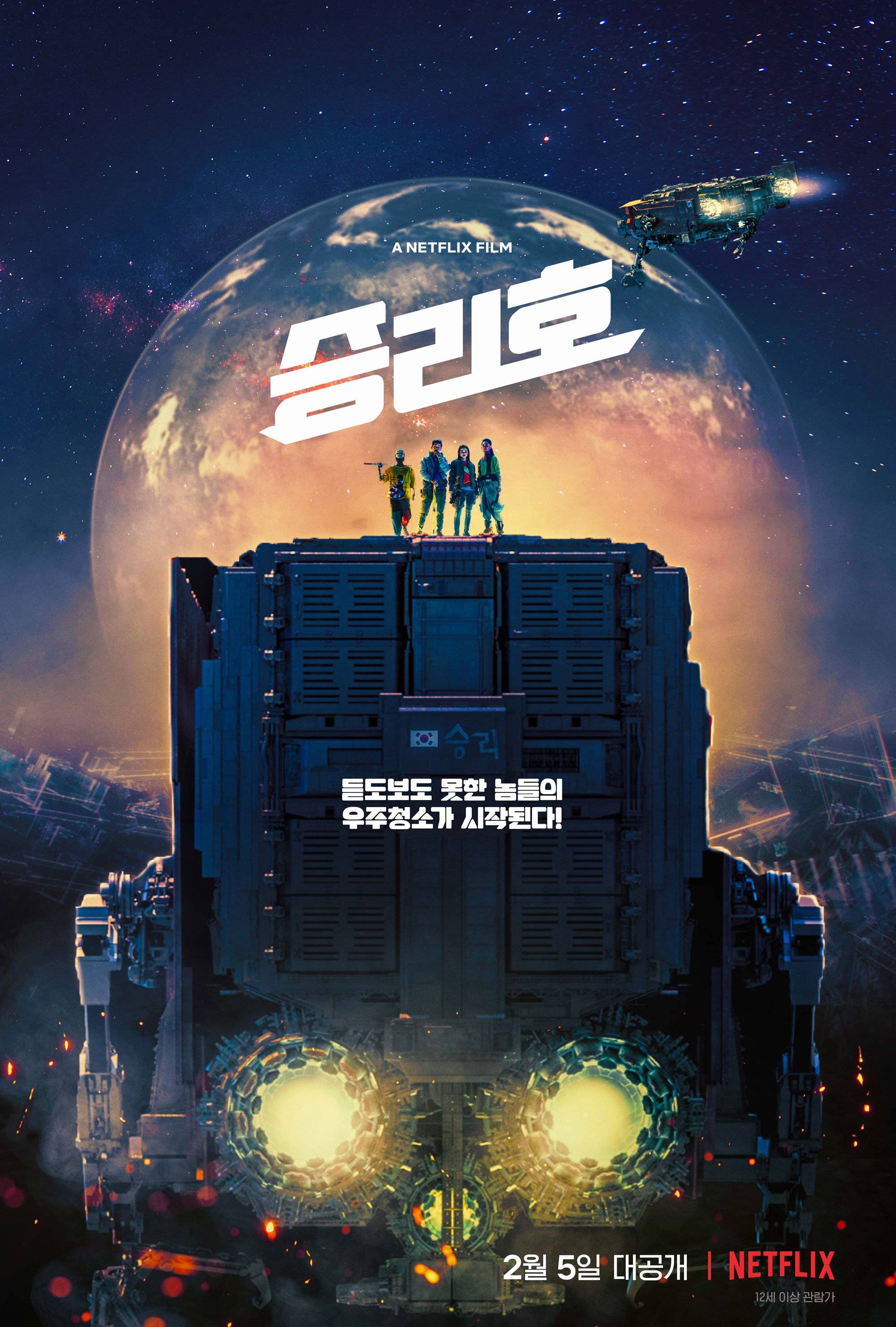
If we’re content to ruin one world, why do we assume our salvation lies on another? Billed as Korea’s first blockbuster science-fiction extravaganza, Space Sweepers (승리호, Seungriho) finds a ragtag gang of junkers quite literally cleaning up humanity’s mess while ironically marginalised into outer space by internecine capitalist consumerism which in insult to injury offers to sell you a cure for the disease it has caused but only to those whom it deems worthy of its dubious promises. 

By 2092, the Earth has become all but uninhabitable. Led by 1952-year-old messianic scientist Sullivan, UTS Corporation has prepared a new artificial orbiting home but only the elite are invited while the remaining 95% linger on the poisoned ground below or else, like the crew of the Victory, wander in space attempting to make a living from clearing the debris left behind after countless sattelltes and space station launches. Yet as jaded space sweeper Tae-ho (Song Joong-ki) remarks, the more you work the more debt you earn. The Victory is a well equipped ship and you’d think that would mean greater earning potential but all it means is that it costs more to maintain while the initial outlay has landed them with unsustainable debt not to mention constant random fines and official interference. All of which is why when they find a little girl hidden in a storage compartment of an abandoned vessel and realise she’s the missing android that’s all over the news, they decide to play off the Black Foxes “terrorist” organisation who kidnapped her and UTC who want her back for all they can get. 

As might be expected for all his claims that “humanity is dirty” in its failure to protect the planet, Sullivan is no pure hearted saviour but an amoral elitist intent on terraforming Mars as some kind of authoritarian “utopia” populated only the “best” of humanity. He claims not to care about money, but cites the false equivalency that those with the deepest pockets must necessarily be those with the greatest capability while privately describing those left below as expendable and not really worth saving. Dressed like a cult leader, even at one point appearing as a giant hologram, Sullivan’s appearance owes a significant visual debt to Neon Genesis Evangelion’s Gendo Ikari, leaving little doubt as to his megalomaniacal intensions as he wilfully sells a solution to a problem he himself helped to cause while continuing to exploit the Earth and the people still on it to hasten its demise and his own enrichment. 

While the central message reinforces the idea that large corporations are not to be trusted while the capitalistic system they uphold is inherently destructive, it also perhaps undercuts that of the impending environmental crisis with which we are faced if we can’t mend our ways fast enough. Even so, it falls to the space sweepers to mount a unified global resistance against the wilful destruction of their homeland in protecting the android, Dorothy / Kot-nim (Park Ye-rin), who of course holds the key to saving the world. Despite having taken in her in with a view to ransoming her, the crew soon bond with the adorable little girl as unofficial daughter while Tae-ho alone remains reluctant in grief over child for whom he continually searches while internalising a sense of resentful failure in the knowledge that he lost her because of his own self-absorbed sense of hopelessness. 

Even so, there may be something a little uncomfortable in the final resolution in which the crew coalesces into a recognisable family unit each of them somehow “improved” as they accept their responsibility for Kot-nim whether in giving up drinking or erasing tattoos. Nevertheless, the film is refreshingly progressive in its depiction of a transgender character who gains the confidence to be their authentic self thanks to the unconditional solidarity among the crew members, though the sudden reversal of UTS from cult-like evil corporate entity to remorseful force for good seems rather optimistic as if the only problem was Sullivan and not the system that gave rise to him.  While the overall aesthetic may be somewhat televisual, Space Sweepers does feature some interesting production design and impressive CGI though its greatest strength lies in the jaded idealism of its space bandit protagonists as they band together to resist their marginalisation with mutual solidarity and compassion.


Original trailer (English subtitles)
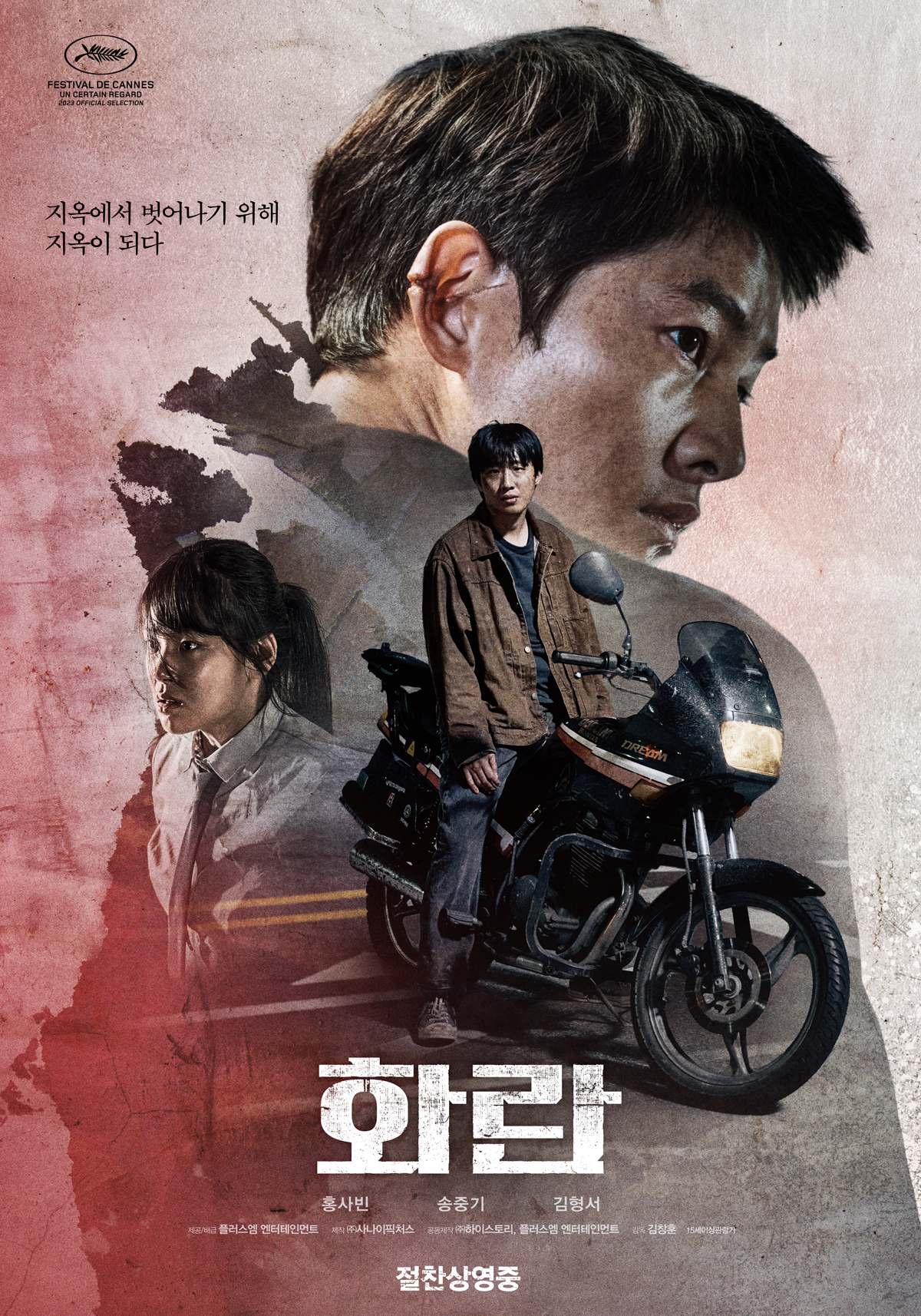
Hopeless (화란, Kim Chang-hoon, 2023)

“Why is everyone out to get him?” the stepsister of the hero asks, wondering why it is that everything in his life seems to go wrong. As its name suggests, Kim Chang-hoon’s Hopeless (화란, Hwaran) take places in a city of despair in which lives are largely defined by violence and money while a young man dreaming of a utopian future in Holland is dragged even further towards an abyss of crime and immorality.

As the film opens, a school boy picks up a rock and hits another on the head. The boy, Yeon-gyu (Hong Xa-bin) goes on to explain that he couldn’t let it go as they live together, hinting at a possible slight against his step-sister Hayan (Bibi) that he avenged more out of a code of masculinity than a genuine desire to protect her. Then again, Yeon-gyun often masks his true feelings and struggles to express himself in any other language than violence. At home, Hayan is his protector against her father, a violent and embittered drunk who makes Yeon-gyun’s life an unending hell. 

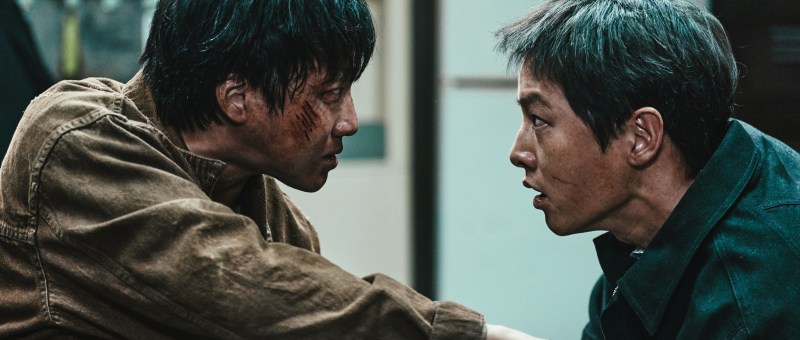
Attacking his classmates gets them to leave Hayan alone, but also to double down attacking him while he’s also liable to pay a large settlement his family can’t afford. Yeon-gyu is gifted the money unexpectedly by sympathetic gangster Chi-geon (Song Joong-ki), but his life is upended once again once again when his step-father leaves him with a nasty scar around his eye. The boss at his part-time job fires him because of it and no one else will hire him leading him straight to the gang to ask for a job. 

Yet Yeon-gyu continues to dream of escape to peaceful Holland, looking at sunny scenes of windmills and flowers while torn over his new criminal career. Though bonding with Chi-geon over a shared sense of parental disappointment and emotional abandonment, Yeon-gyu is uncomfortable with the moral dimensions of his crimes in feeling sorry for the people they rob including a man whose young son is hospitalised and in a coma because of the gang’s violence. Meanwhile, it becomes clear that the gang has political ambitions and has been bankrolling a particular candidate for an upcoming election. When the gang discuss taking out a rival, Yeon-gyu suggests blackmailing him illicit photos instead so no one ends up getting hurt .

Yeon-gyu asks Gi-cheon questions about their violence and he often tells him that these are just things that they have to do as if it were an automatic operation of the gangster code. He describes himself as already dead, a ghost of the child who drowned when his father abandoned him on a lake but takes on a quasi-paternal role over Yeon-gyu seeing him as a younger version of himself equally betrayed by corrupted paternity. Yeon-gyu in turn looks up to him, but continues to mess things up for himself by trying to help the people they’re robbing.

It does indeed seem as if everyone is out to get Yeon-gyu who finds himself engulfed by despair and hopeless, unable to see a way out for himself from his desperate situation. The irony is that a lack of communication eventually results in a kind of tragedy, but one that one ultimately frees both Chi-geon and Yeon-gyu from a word of self-destructive violence allowing Yeong-gyu to renounce it once and all and seek a better future with Hayan in a less a less hopeless place. What Chi-geon had tried to offer was in effect brotherhood, a surrogate family and a home, explaining that Yeon-gyu would be a perfect fit yet Yeon-gyu struggles to play the role assigned to him unable to put aside his humanity to commit the acts of theft and violence the gang expects. 

The irony may be that Yeon-gyu’s mother only married the violent stepfather to protect herself from the unwanted attentions of another man, attempting to fight male violence with a male protector but finding herself once again victimised. Violence arises from insecurity and an inability to communicate and it’s no wonder that Yeon-gyu finds himself caught in its snares while struggling to break free of the futility that surrounds him. Kim captures his sense of despair in his steely camera contrasting the blue skies of Yeon-guy’s Dutch dream for the grimy streets of his rundown neighbourhood but does eventually discover renewed hope for a better future in the choice to walk away from a world of violence towards one of compassion and solidarity. 


Hopeless screened as part of this year’s London East Asia Film Festival.

International trailer (English subtitles)

The Battleship Island (군함도, Ryoo Seung-Wan, 2017)

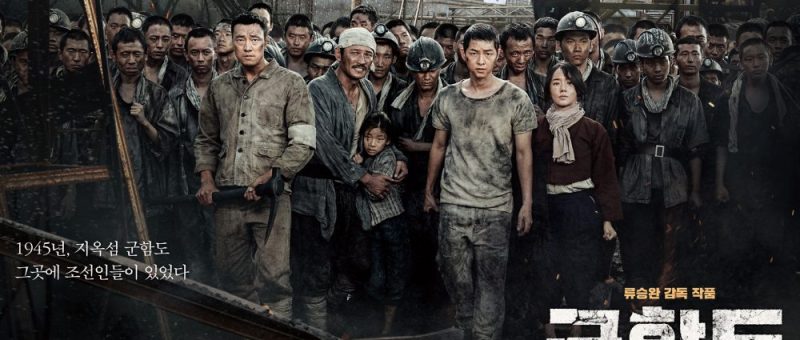
battleship island posterKorean cinema has been in a reflective mood of late. The ongoing series of colonial era dramas have sometimes leaned towards uncomfortable and uncompromising nationalism but among the more recent, there has also been an attempt to ask more serious questions about collaboration and capitulation of ordinary people living under a brutal and often cruel regime. While Age of Shadows dramatised this particular problem through the conflicted figure of a former resistance fighter turned Japanese military police offer, The Battleship Island (군함도, Goonhamdo) goes further in its depiction of those who dedicated themselves entirely to the Japanese Empire and were willing to oppress their fellow Koreans to do so. That is not to ignore the hellish conditions which define the very idea of Hashima as an off shore labour camp where depravity rules, exploitation is hidden, and the camp commander is free to run his ship however he sees fit.

In early 1945 Korea is still under Japanese colonial rule and ordinary Koreans are liable for conscription into the Imperial Japanese army whether they like it or not. Gang-ok (Hwang Jung-min) and his daughter Sohee (Kim Soo-ahn) are members of a popular jazz band but Gang-ok has a habit of getting himself into trouble and so they are tricked into getting on a boat to Japan hoping for a safer, more lucrative life. Where they end up is Hashima – otherwise known as “Battleship Island”. Gang-ok and Sohee are separated with Gang-ok stripped of his musical instruments and Sohee, who is only a child, carted off with the other women destined for the “comfort station”.

Ryoo wastes little time demonstrating the immense evil buried in places like Hashima. A deep seam coal mine in the middle of the sea, the island is a fortress prison from which escape is impossible. Early on, three small boys decide to flee after their friend is killed in a cave-in only for one to be shot and the other two drowned by the lazy soldiers of a Japanese patrol boat who couldn’t be bothered to fish them out of the water. The miners are beaten, starved, tortured and manipulated into submission knowing that capitulation is their best route to survival. Not only are these men the subjects of forced labour, they are also made liable for the “costs” involved in their own enslavement with the bill for their transportation, food, clothes, and tools deducted from their “wages” which are supposed to be paid into their bank accounts for access on release. Those killed whilst working are supposed to receive compensation for their families but as will later be revealed, systematic corruption means their families may not even know their loved ones are dead let alone that they are being denied the money rightfully owed to them.

Things get even worse for little Sohee who is forced into a kimono and smothered with makeup to “entertain” some of the Japanese officers on the island. She manages to buy herself some time when she realises the Korean record the camp commander puts on to “comfort” the “comfort women” is one she is actually singing on. This new discovery earns her and her father a slightly improved status in the camp though she may not be safe for long. Gang-ok has already reverted to his tried and tested methods for getting out of sticky situations, making himself a kind of camp fixer aided by his ability to speak Japanese.

The Korean prisoners are represented by a former resistance leader, Yoon Hak-chul (Lee Kyoung-young), who offers rousing speeches in public but privately is not quite all he seems. Gang-ok gets himself mixed up in a Resistance operation run by an OSS (Song Joong-ki) plant on site to rescue Yoon who eventually uncovers several inconvenient truths which make his mission something of a non-starter. Yoon’s empty rhetoric and self serving grandeur represent the worst of the spiritual crimes discovered on Hashima but there is equal ire for the turncoat Koreans who act as enforcers for the Japanese, issuing beatings and siding with their oppressors in the desperation to escape their oppression. Tragically believing themselves to have switched sides, the turncoats never realise that the Japanese hold them in even lower regard than those they have betrayed.

It is hard to avoid the obvious nationalistic overtones as the Japanese remain a one dimensional evil, smirking away as they run roughshod over human rights, prepare to barter little girls and send boys into dangerous potholes all in the name of industry. At one point Gang-ok cuts an Imperial Japanese flag in half to make the all important ramp which will help the captive Koreans escape the island before being summarily murdered to destroy evidence of Japanese war crimes which is a neat kind of visual symbolism, but also very on the nose. Once again, the message is that Koreans can do impossible things when they work together, as the impressively staged, horrifically bloody finale demonstrates, but as Ryoo also reminds us there no “heroes”, only ordinary people doing the best they can in trying times. 


Currently on limited UK cinema release!

Original trailer (English subtitles)