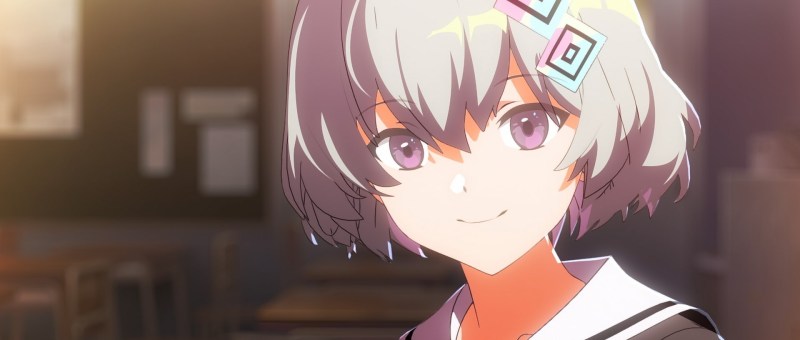
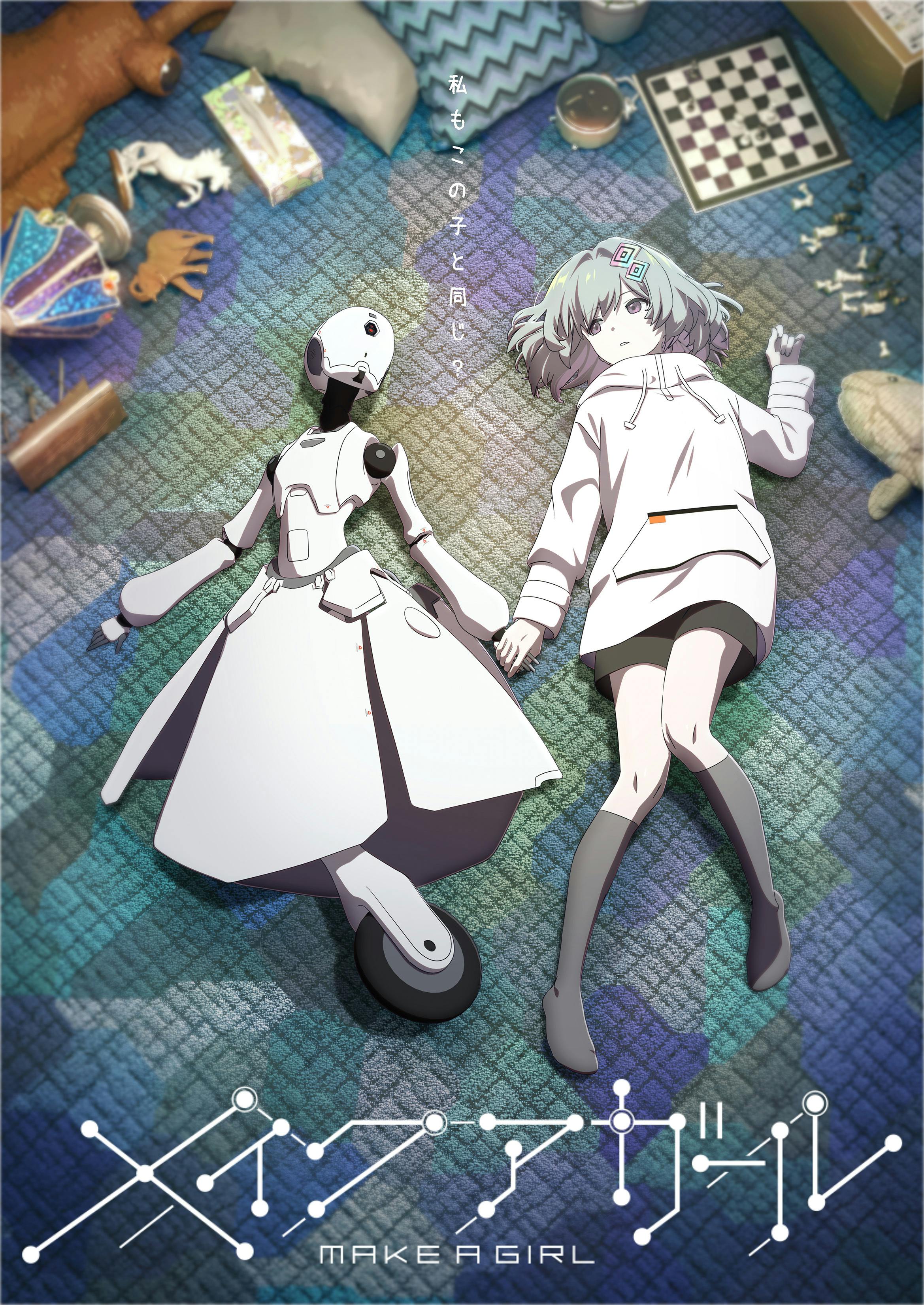
Make a Girl (メイクアガール, Gensho Yasuda, 2024)

A socially awkward teenage scientist takes a friend’s advice too literally and builds himself a girlfriend in Gensho Yasuda’s indie animation, Make a Girl (メイクアガール). The central irony is that Akira (Shun Horie) makes Zero (Atsumi Tanezaki) to improve his productivity, but in fact ends up learning how to interact with people from her. Nevertheless, consciously or otherwise, he’s started off from a questionable position given that his notions of what a girlfriend should be are bound up with his unresolved feelings for his late mother along with outdated sexist attitudes. 

Akira’s mother Inaba was a genius scientist who passed away of an illness sometime previously leaving Akira alone with only their huge lab and a drive containing her memories. Fearing he can’t live up to his mother’s legacy, Akira’s inventions are largely useless time-wasting devices which make ordinary tasks take longer than they would if done in the normal way. That’s why he’s so taken with his friend’s story about how getting a girlfriend has improved his productivity at his part-time job. Not really understanding why his friend’s productivity improved, he decides to create a “girlfriend” for himself, but is only doing so in the hope that she will magically allow him to level up. She is then a sentient being that exists solely to support him by being cute and sweet while he otherwise puts nothing at all into the relationship.

Zero’s desire to fit into the stereotypical “girlfriend” role is signalled by her learning to cook so that she and Akira can eat together, while when she tries to go on a stereotypical date with him, she opts to go clothes shopping and says that she’s realised that she likes it when he makes all her choices for her. Akira is really in the awkward position of being both a paternal figure and a boyfriend, branded a “father” to his creation by his mentor while at the same time associating Zero with his late mother even as he tries to “date” her, albeit in a curiously asexual way. It turns out that his mother’s AI coding contained several safeguards which effectively mean that Akira has total control over Zero and if she attempts to defy him, she automatically tries to strangle herself. When he begins to find her annoying because her desire to spend more time with him gets in the way of his research, he simply gets her an apartment and says he just wants to be friends.

Led into a quagmire of existential questioning both by Akira’s indifference and the probing of his friends, Zero begins to wonder who she really is and if she only “likes” Akira because he designed her that way. Though she desperately tries to get Akira back by being an even more perfect girlfriend, which is after all her life’s purpose, she begins trying to claim her identity by overcoming her programming, which is to say escaping his control to be her own self. Akira, meanwhile, finally realises that what he felt for her wasn’t “annoyance” but “love”, if only if still rooted in all the things she can do for him rather than an acceptance that what his friend meant was that falling in love had given him an eagerness for life through the mutual exchange of emotion, care, and support. 

In any case, Zero’s actions take on a misogynistic quality as if Akira were, in a way, attacked by a “crazy girlfriend” who was only ever going to mess up his life because women always get in the way. The fact that the antagonist is also a woman who is jealous of his genius and a kind of rival to Zero further rams the idea home that women only cause trouble and are a threat to a man’s autonomy, even as Akira is still clearly overly attached to the memory of his late mother. The voice of reason is his wiser than her years friend Akane (Sora Amamiya), though even she at times seems jealous of Zero and shares many of the same outdated notions about what a woman should be. It’s almost as if Akira too is a construct who was only turned on yesterday which is why he has no idea about human feelings or how to interact with other people and is, in effect, learning them vicariously through Zero, who is mainly picking them up from Akane but getting a double dose of patriarchal programming that proves much harder to break than any of Akira’s code.


Make a Girl screened as part of this year’s Camera Japan.

Trailer (no subtitles)

Give It All (がんばっていきまっしょい, Yuhei Sakuragi, 2024)

The last year of high school is a little premature to be defeated by life, but this seems to be what has happened to Etsuko. It’s fitting in a way, because her problem is that she simply gives up too early and is incapable of seeing anything through because she’s already convinced herself that there’s no point in trying. Yuhei Sakuragi’s anime adaptation of the book by Yoshiko Shikimura, Give It All (がんばっていきまっしょい, Ganbatte Ikimasshoi) is indeed all about how there’s no point giving up before the end and no matter the result there’s satisfaction to be gained just knowing that you gave it all you could.

But Etsuko can’t see that to begin with because she peaked too early. Back in primary school, she won all the races because she was tall for her age. But the other children eventually started catching up with her, and she started to fall behind. It didn’t really occur to her train or to try to compete with them because she was used to just winning and the realisation that she wasn’t “special” after all made her feel like a failure at life. To save herself similar pain, she started giving up before she even started believing that there wasn’t any point in trying. Even so, she’s sullen and miserable, not to mention resentful of those who do put in the effort and start to see results. 

That’s one reason she’s reluctant to get involved with the rowing club again despite the encouragement of her best friend Hime. Badgered into it by transfer student Riina, she does the bare minimum and lets the others down, at one point just letting her oars drop while asking herself what it is she’s even doing here. But it’s also being part of a team that gives her a new sense of purpose as she realises that she’s the one who’s the weak link because she doesn’t have the stamina to keep up with the other girls. 

Meanwhile, they all have their problems too. Riina is struggling to make new friends after moving to the town following her mother’s marriage and is also nervous around boys because she’s always attended single-sex schools. Taeko and Mayumi only joined the club to get back at each other because their families are supposedly feuding, though there’s a little bit more to their relationship drama than a buinsseness dispute between their parents. Hime is really just trying to keep the peace and get Etsuko back to being the confident and outgoing person she used be rather a sullen figure of defeat who is aloof to the point of rudeness and refuses to try at anything. 

Ironically, it’s an encounter with the awkward team captain of a rival high school’s team that begins to open her eyes. Based on her earlier experiences, Etsuko assumes that the other team must just be innately talented and will win the upcoming race easily, but the other girl tells her that she’s mistaken. They didn’t win easily and they don’t have room for complacency. Though she seems jealous of the fun Etsuko and the others seem to be having and the genuine friendships that have arisen between them in contrast to the frosty determination and rigorous training that defines her relationship with her teammates, she reminds Etsuko that they work hard and that Etsuko’s team has potential if only they gave it their all.

While the 3D animation sometimes appears uncanny and distracts from the overall aesthetic, the beautifully designed backdrops add to the sense of peace and serenity in the town and echo Etsuko’s own unfolding sense of joy as the world around her brightens thanks to her new friends. What she learns is that it’s foolish to give up too soon without even trying, while not doing anything will leave her stuck in the middle of the water like a boat with no one rowing for the rest of her life. The thing about rowing is that it requires unity and the team to think as one, which means that she has to engage and bond with her teammates while finding fulfilment in her individual contribution through resolving to give it her all no matter what and knowing that’s worth it no matter the result.


Give It All screened as part of this year’s Toronto Japanese Film Festival.

Trailer (no subtitles)

BLAME! (ブラム!, Hiroyuki Seshita, 2017)

blame posterCities. The pinnacle of human achievement and an almost living monument to civilisation. Does the same principle of human collective settlement also relate to the digital realm or will increasing interconnectedness eventually destroy everything we’ve built? Following their landmark CGI adaptation of Tsutomu Nihei’s Knights of Sidonia, Polygon Pictures return to source by adapting the author’s debut work BLAME! into a feature length animated movie. Like Sidonia, BLAME! (ブラム!) takes place many years after a climactic event has led to the fall of human civilisation – an event so long in the past as to have become mere myth to the small number of humans still clinging on to life in a now inhospitable terrain, but BLAME!’s dystopia is very much one created by man, losing control of its technology in its ever advancing hubris.

As the young girl who offers the opening monologue tells us, no one knows how all of this happened. Once, a long time ago, humans lived in a city but a virus came and they lost the ability to communicate with the environment in which they lived. The city began to grow, and the “Safeguard” system decided that humans were “illegal immigrants” in their own land. The exterminators swooped in to wipe them out but a small band of humans has managed to survive a few hundred years in a kind of safe zone protected by a perimeter wall the city’s systems are prevented from monitoring.

The rapid expansion of the city has also meant a reduction in vegetation and the surviving humans are running low on food. An intrepid team of children ventures out into the wasteland in search of sustenance, but they’re spotted and targeted for elimination. A mysterious figure appears on the horizon and saves them. The man calls himself a “human” and is disappointed to realise none of the children are carriers of the “Net Terminal Gene” which he is seeking. Killy (Takahiro Sakurai) claims that the Net Terminal Gene will enable the humans to take back control of the city’s systems, halt the excessive building program and call off the Safeguard attack dogs.

Killy’s appearance brings new hope to the villagers, trapped within their perimeter stronghold but facing the prospect of staying and starving or taking their chances with Safeguard. Concentrating on action rather than philosophising little time is given over to considering how humanity lives though it’s certainly puzzling that there is so little reaction when the band of children returns home much depleted in numbers. Indeed, aside from Pops (Kazuhiro Yamaji), the de facto leader of the community, no other “adults” appear.

Using Killy as a kind of deflective shield, the gang press on until they find an abandoned robot, Cibo (Kana Hanazawa), who tells them about an “Automated Factory” in which she can generate both an abundant food source and a synthetic tablet which will allow them to get back into the city’s systems. What ensues is a deadly firefight as the system fights back. Cibo pleads with The Authority in the digital realm while Killy and the villagers hold back the forces of order with firepower from the outside.

Killy remains a man of few words, his language dulled through inactivity and his expression inscrutable, but the villagers, perhaps lulled into a false sense of security thanks to long years of isolation, never question his motives or reliability. Likewise, Cibo clearly knows more than she lets on but offers the only lead so far on a way back to a less precarious way of life. Killy’s sudden appearance becomes a mythic event, a point of transition in the history of the post-apocalyptic world, but also seems to be without resolution as the closing coda implies.

Like Sidonia, the animation quality is at times variable but often excels in its highly detailed backgrounds, allowing production design to smooth over any narrative gaps. What BLAME! lacks in terms of plot and character complexity it makes up for in world building though it is difficult to ignore the feeling of the loss born of condensing something far larger into an easily digestible whole. Nevertheless, BLAME! does what it sets out to do with quiet brilliance in detailing what might be the first of many adventures of the wanderer known as Killy as he explores a world ruined beyond repair looking for the key to unlock a brighter future.


Netflix trailer (Japanese with English subtitles/captions)