Love’s Whirlpool (愛の渦, Daisuke Miura, 2014)

Love's WhirpoolNo names, no strings. That’s the idea at the centre of Daisuke Miura’s adaptation of his own stage play, Love’s Whirlpool (愛の渦, Koi no Uzu). Love is an odd word here as it’s the one thing that isn’t allowed to exist in this purpose built safe space where like minded people can come together to experience the one thing they all crave – anonymous sex. From midnight to 5am this group of four guys and four girls have total freedom to indulge themselves with total discretion guaranteed.

The four couples are a disparate group which includes a primary school teacher, office lady, shy college student, and a brusque regular who apparently comes to the club five times a week. The male side consists of a slick salaryman, a freeter, a factory worker and an anxious NEET who’s cleaned out his bank account just to be here in this extremely expensive, upscale sex club. After receiving the instructions from the owner (shower first, after sex, after going to the toilet, always use a condom, and respect the women’s right to say no), the group sit awkwardly wearing only their towels waiting for someone else to kick things off.

Everyone is being extremely polite to one another, the women beginning to talk amongst themselves whilst the men do the same. Everyone has come here for the same reason but it’s not as quite as straightforward as they thought it would be. Soon enough, people start to pair up an head downstairs but after the initial ice is broken the edges sharpen, relationships change, and a kind of Bacchanalian harshness begins to take over.

Once inside the split level, trendy club style environment, the guests spend the entirety of the evening naked save for their white bath towels but this is about as far from intimacy as it’s possible to get. They may have all come for one reason, but they each had various different motives for doing so. The office lady and the school teacher are both attractive young women, confident in what they do and don’t want, and would prove a hit in any club or bar (though this is a safer option). The freeter and the salaryman could say the same though the salaryman spends half the evening phoning his wife to explain that he’s been kept out drinking with a boring colleague. College girl and Neet are both too shy to get it on independently, leaving the cynical regular and the overweight factory worker as the odd ones out. It’s not long before they’ve begun to dissect each other, ticking off the check list like remembering to buy washing powder and then discussing the merits of “Ariel” vs “Persil” with your fellow “shoppers” in the checkout line. Utilitarian as it is, as the night goes on the barriers fall away leaving both wild abandon and cruelty lying behind them.

Things are reinvigorated half way through when another couple join, a husband and wife duo who each claim to be 100% OK with how this is going to work but, as it turns out, one of them was more serious than the other. By this point, relationships have begun to solidify themselves and shy Neet has grown attached to the unexpectedly raucous, repressed college girl. Such attachments are unwise in an environment like this, and can become dangerous if everyone does not remain on the same page as to what’s going on. At the end of the evening, the guys are asked to wait so the girls can leave first – to help prevent stalking. This is no strings, remember. No names, no phone numbers, none of this ever happened.

This intense need for secrecy is understandable yet speaks something to the oddly specific conflict between repression and the open expression of erotic desire that is permitted inside the club but only if you follow its rather strict (if very sensible) rules, not to mention the arcane, underground directions needed to find it at all. For some the reason for coming here was loneliness but what they’ll find is only likely to exacerbate the aching lack of connection they already feel. The case of the college student becomes the most interesting as she fights both her own shyness and the intense shame she feels in regards to her own sexual desires. After the fact, she feels as if she’s betrayed herself, as if the “other self” that emerged during the previous night’s proceedings is a shameful doppleganger that must now go back into hiding. She wants to forget this happened, go back to being a lonely college girl but for the NEET, it’s the opposite, he feels unreal now – as if he left his “real” self behind in that unreal space.

A sophisticated take on modern human relationships, Love’s Whirlpool occasionally pulls its punches in opting for a satirical tone and only really skims the surface of why places such as these still need to exist. Stylishly shot and explicit without becoming exploitative or sleazy, Miura’s film proves a refreshingly nuanced, mature take on modern sexual behaviour even if it stops short of probing into some of the darker aspects that flicker around its edges. If Love is a whirlpool, desire is a tornado, but where a whirlpool may drag you under you’ll eventually float to the surface gasping for air. After a tornado burns through, all you’re left with is ashes and emptiness. Modern love, indeed.


English subtitled trailer (NSFW)
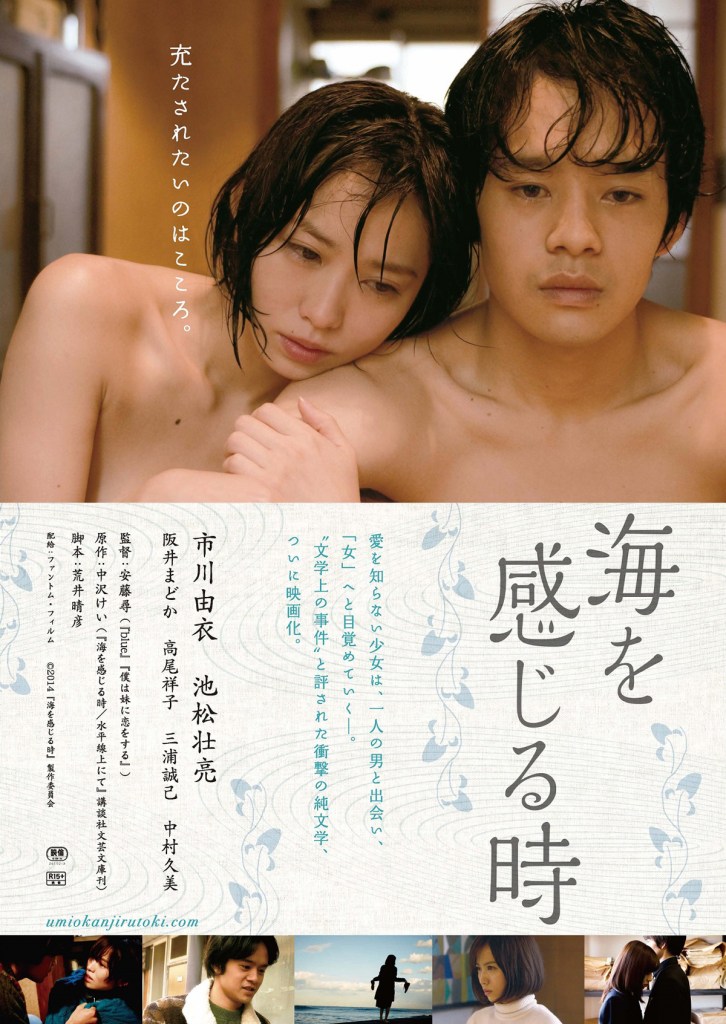
Undulant Fever (海を感じる時, Hiroshi Ando, 2014)

Undulant FeverOne of the most surprising things about the 1978 novel When I Sense the Sea is that its author was only 18 years old when the book was published. Though the protagonist begins as a 16 year old high school girl, author Kei Nakazawa follows her on into adulthood as the damage done to her teenage psyche radiates like a series of tiny, branching chasms stretching far back into a difficult childhood. This 2015 adaptation from Hiroshi Ando, Undulant Fever (海を感じる時, Umi wo Kanjiru Toki), maintains a distant and detached tone which, while not shying away from the erotic nature of the discussion, is quick to underline the unfulfilling and often utilitarian nature of the central couple’s relationship.
Beginning in the “contemporary” 1970s era of the film, Emiko (Yui Ichikawa) and Hiroshi (Sosuke Ikematsu) enjoy a strangely lonely trip to the zoo and later an intimate, if odd, love making session at home. They seem a fairly settled couple but there’s something not quite right between them. On flashing back to their teenage years we learn how they met – as members of the high school newspaper club when Hiroshi was a year above Emiko. The pair quickly embark on a messy sexual relationship but when Emiko declares her love for him, Hiroshi coldly tells her that he was never interested in her as a person but merely as an anonymous body which could easily be replaced by any other female form. Despite his harsh treatment of her and her mother’s eventual discovery of the affair, Emiko continues to pursue Hiroshi until finally he does come to feel something for her which might be described as love. However, at this late stage of the game Emiko’s notions of love, sex, and desire have become so hopelessly confused that she is unable to comprehend the emotional landscape of her life.

It would be easy to read the case of Emiko as one of the “God-why-don’t-you-love-me-oh-you-do-I’ll-see-you-later” blues (to borrow a phrase from Sondheim), but it’s a little more complicated than that. After her father died at a young age Emiko was raised alone by her widowed mother who seems to cut an austere and somewhat distant figure. Her reaction to finding out about Emiko’s relationship with Hiroshi, which only occurs in the first place due to an extreme betrayal of trust, is veering into Carrie territory and only further emphasises how little emotional support Emiko has received from her central parental figure.

After having battled so hard to win some kind of attention from her cold and distant mother, Emiko learns to allow herself to be used and abused by uncaring men in the hope of one day winning their love. Hiroshi is not the focus of the narrative and his problems are less well addressed but no less interesting. His constant pleas with Emiko to simply leave him alone because he because he doesn’t care about her take on a passive aggressive quality in which one starts to wonder if it’s an oddly sado-masochistic way of ensuring she does exactly the opposite. The more he ignores her, the more she is committed to staying by his side. Though Emiko seems to be aware of how cruelly he treats her, she is unable to stop needing him even if she ruins her own life for nothing more than the simple reward of remaining in his general vicinity.

Undulant Fever is a deeply probing exploration of sex and desire and particularly how early relationships can forge the course of a person’s life. An earnest character drama, the film moves at a considered pace which leaves ample room for its protagonists’ complicated emotions. The cold and dispassionate approach is a perfect match for the heroine’s depressed and confused emotional state which leaves her doubting her entire concept of self as she travels from unloved teenage girl to a confused adult woman approaching an unsettled middle age. The surprisingly astute observations of the novel also ring true in the film which captures the book’s late ‘70s feminist leanings whilst at the same time painting a fairly bleak picture of the troubled emotional life of a flawed and damaged modern woman caught in a confusing maelstrom of love and desire.


The R3 Hong Kong DVD of Undulant Fever includes English subtitles.

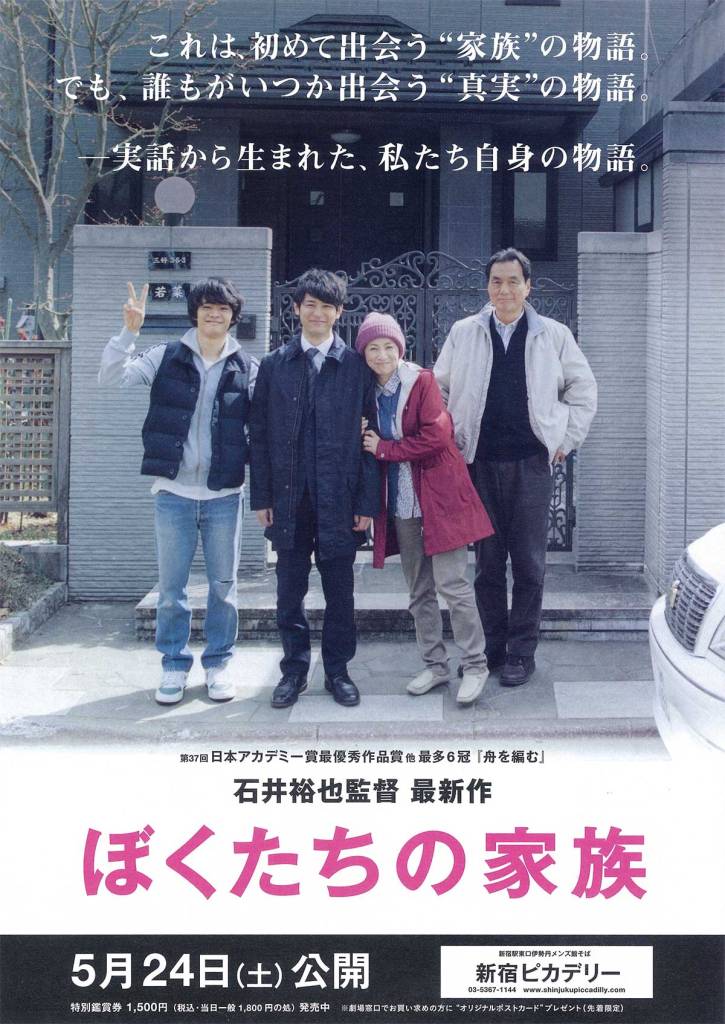
Our Family (ぼくたちの家族, Yuya Ishii, 2014)

Our FamilyYuya Ishii’s early work generally took the form of quirky social comedies, but underlying them all was that classic bastion of Japanese cinema, the family drama. If Ishii was in some senses subverting this iconic genre in his youthful exuberance, recent efforts have seen him come around to a more conventional take on the form which is often thought to symbolise his nation’s cinema. In Our Family Ishii is making specific reference to the familial relations of a father and two sons who orbit around the mother but also hints at wider concerns in a state of the nation address as regards the contemporary Japanese family.

Reiko (Mieko Harada) is an ordinary Japanese housewife in late middle age with a husband still working and two grown up children. She’s been worrying lately that she seems to forget things and she also has periodic trances almost like someone pressed the paused button. This all comes to a head when she and her husband Katsuaki attend a family dinner with their in-laws to celebrate the news that their eldest son, Kousuke (Satoshi Tsumabuki), and his wife are expecting their first child. Having behaved quite strangely all night long, Reiko finally ends by repeatedly addressing her daughter in law by the wrong name and muddling up details about the baby. Reiko’s still young but the natural assumption is perhaps that she’s slipping into senility, dementia or possibly even Alzheimer’s but a visit to the doctor turns up something that no one was expecting as they’re eventually made to understand that Reiko may only have a week left to live.

This devastating news of course sends shock waves through each member of the family and not least Kousuke who’s just learned he’s about to become a father. One of the things Reiko was most distressed about was that she’d wake up one day and her family would have fallen apart. It seems she grew up in an unhappy home and was determined not to replicate the experience for her children. Perhaps she did have cause to worry as there were definite cracks in the foundation of this household even before Reiko’s illness in that youngest son Shunpei (Sosuke Ikematsu) seems to have had a strained relationship with both his father and his older brother. In contrast to the other two men, Shunpei, still a student, is much more laid back and easy going though his father perhaps thinks him feckless and irresponsible. He meets his mother sometimes and she lends him money behind the father’s back but they talk more like friends than a mother and son.

Perhaps this division between the men in her life has been playing on Reiko’s mind but there are other problems too. Part of the bubble generation, Reiko and Katsuaki have been living well beyond their means for years and have amassed considerable personal debt. In fact, Katsuaki remortgaged the house a while back and made Kousuke a guarantor on their loan. Their best option would be to file for bankruptcy but doing that would leave Kosuke liable for the return of the mortgage so Katsuaki is reluctant to pursue that option. Now that Reiko’s in hospital money is at the forefront of everyone’s mind as they contemplate paying not only astronomical medical fees but potentially also paying for a funeral too.

This financial strain spills over into Kousuke’s new family as, when talking to his wife about needing to help out his parents, Kousuke discovers that Miyuki is just about as unsupportive as one could be. She brands Kousuke’s parents as irresponsible dreamers still living in the bubble era and suggests their predicament is both their own fault and their responsibility as, at their age, they should have been saving money for just these kinds of situations. Scornfully she insists that she doesn’t want to be “that kind of parent” and retires to bed in outrage. Having also refused to even accompany Kosuke to visit his mother in hospital (seeming to miss the point that he might be looking for her support rather than asking for appearance’s sake), poor Kousuke is left all alone trying to deal with the impending birth of his child and death of his mother all in a few short weeks.

The crisis does, at least, bring the three men a little closer together as it requires a kind of unilateral action that pushes previous resentments and ill feeling into the background. Reiko’s condition also means that she says some things that she would never have revealed directly to her family which both hint at some of her suffering over the last thirty years but also the deep love she has for her them. Katsuaki is revealed as a fairly ineffectual man who cares deeply but is blindsided by his wife’s condition and unable to face the facts leaving the bulk of responsibility to his oldest son. This kind of family abnegation is anathema in Japan – one would never want to be a burden to one’s children but Katsuaki is now both financially and morally dependent on Kousuke. Kousuke himself is not quite mature enough for this level of responsibility despite his impending fatherhood and his younger brother Shunpei may appear indifferent to everything but is merely putting a brave face on things though he may be the most dependable (and emotionally intelligent) of the three.

By the end, there is a glimmer of hope. The family can be repaired if you’re willing to work at it which means being willing to face the problems together and without any secrecy. Everyone, including the older generation, has in some senses “grown up”, facing the future together having accepted themselves and each other for who they are. Like applying a touch of kintsugi, their glittering wounds have only made them stronger and made each refocus on what’s really important. Neatly moving into a more dramatic arena, Ishii proves he’s still among Japan’s most promising young directors able to marry an idiosyncratic indie spirit with a more mainstream mentality.


The Hong Kong DVD/blu-ray release of Our Family includes English Subtitles!

Unsubtitled trailer:

http://www.youtube.com/watch?v=4D2dweKMgqQ

Pale Moon (紙の月, Daihachi Yoshida, 2014)

Pale-Moon_MainDaihachi Yoshida’s last venture into human dynamics, The Kirishima Thing, took the high school environment as a microcosm for society as a whole. In some senses painting on a large canvas by illuminating the inner lives of these teenagers acting as both individuals and as members of a group, The Kirishima Thing was equal parts ensemble character drama and probing social commentary. Pale Moon (紙の月, Kami no Tsuki) is no different in this regard although it focuses more tightly on one individual and shifts age groups from turbulent adolescence to middle aged desperation. Set in 1994 just after the bubble burst, this gleefully cheeky (im)morality tale takes another sideways glance at the social norms of contemporary Japan.

Rika (Rie Miyazawa) is a demure woman in her early forties. A childless former housewife, she’s recently moved from a part time position at a bank to a full time job where she works as a kind of personal banking assistant visiting wealthy clients at home to discuss their financial needs and physically depositing their money in the bank for them. Efficient, reserved, reliable – Rika is the perfect employee, that is until one day she spends some of a client’s money because there isn’t quite enough in her purse. She takes the money straight out of an ATM and replaces it right away, of course, but a line has been crossed. It’s a quick step from a gentle misappropriation of funds to a series of interestingly decorated hotel rooms with a boy half your age, embezzlement on a grand scale, blackmail, bank fraud – the list goes on. How did it ever come to this? Yet, it’s the strangest thing – Rika has never felt more alive.

Money – it’s the life blood of capitalism. It makes the world go round and drives people crazy as they try to amass even more little bits of paper with numbers written on them. It’s fake, an illusion that we’ve all bought into – no more real than a paper moon (to go by the film’s original Japanese title), though we continue to set all of our hopes afloat on its surface. When Rika finally convinces her financially challenged young lover to accept her (stolen) money, she tries to convince him that nothing will change but, of course, it does. The dynamics fluctuate and money gets in the way, the toxicity of debt starts to eat away at any genuine connection that may have existed. The irony is, Rika is one of those people who steals in order to give away. It sounds selfless, even altruistic, but is in fact the most intensely selfish action that can be taken. “It’s better to give than to receive” goes the mantra of the nuns of the Catholic school where young Rika was educated, but they also council that charity should never have anything to do with your own gratification. This is the lesson that Rika finds so hard to learn, it feels so good to give – how can it be wrong to take?

It’s easy to say that the world has changed a lot in the intervening twenty years between now and the time the bulk of the action takes place, but maybe it hasn’t. The first thing that strikes you is how extraordinarily sexist Rika’s world is. It’s not long before she’s being asked questions about her marital status whilst being made to feel uncomfortable, alone in the home of her elderly male client. Then at the office her boss praises her efforts whilst sadly lamenting that women have more “tools” at their disposal than men do, which is both insultingly crude and a put down of her skills and hard work. Rika only gets her permanent position because another woman, an employee of nineteen years standing, has been forced out through a campaign of constructive dismissal because the big wigs don’t like paying higher salaries to older female workers but they won’t promote them past a certain level either. Her younger colleagues make fun of their “spinster” supervisor, Sumi (Satomi Kobayashi), who, only a generation older, had to make a clear cut choice between work and family and having chosen a career now sees the rug being pulled out from under her with the standard “transfer to head office” game plan in place to force her into retirement.

Rika’s home life offers a similar level of hope for the future. Her husband is probably well meaning, but totally insensitive and the marriage is at best unfulfilling. He pooh-poohs his wife’s thriftiness and her new “hobby” at the bank, totally failing to understand her motivation. At one point he announces he’s being transferred abroad so she’ll have to give her notice – it never occurs to him she may not wish to go, let alone that she’d refuse over something so trivial as her own job. It’s little surprise then that she’d so quickly fall for a handsome and attentive stranger. An “amour fou”, an old story but no less potent than it ever was.

Rika knows none of it’s real – that her temporary crime fuelled reprieve can’t go on forever, but that only makes her feel more free. In one telling episode, Rika is talking to a granny she’s in the process of swindling and remarks on her beautiful new necklace. What a shame it’s fake, Rika says, but the old lady replies that she knows it’s only imitation but she doesn’t care – it’s pretty, she likes it and she’s happy. That perhaps is the answer. Rika saw her chance and she took it. That takes some courage and whatever the moral outrage one might feel, there’s something undeniably admirable, even exciting, about Rika’s dramatic escape from the constraints of conventional social behaviour.


Pale Moon is receiving its UK Premier at the Glasgow Film Festival on 19th February so if you’re in the Glasgow area be sure to check it out!