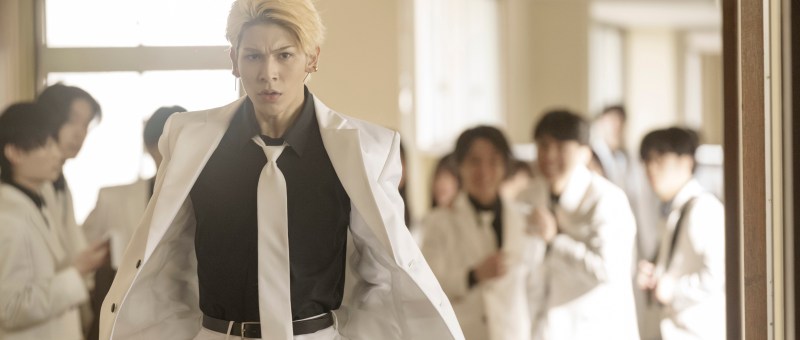
Honeko Akabane’s Bodyguards (赤羽骨子のボディガード, Junichi Ishikawa, 2024) [Fantasia 2025]

Unbeknownst to her, a high school girl’s entire class is actually made up of bodyguards hired by her distant father, whom she doesn’t know either, to keep her safe because his work makes her an easy target for international criminals. Adapted from the manga by Masamitsu Nigatsu, Junichi Ishikawa’s Honeko Akabane’s Bodyguards (赤羽骨子のボディガード, Akabane Honeko no Bodyguard) is in some ways fairly typical of the genre in its parade of unrealistic hairstyles and over-the-top humour, but also anchors itself in a genuine sense of friendship and youth solidarity as the class come together under a charismatic leader not only to protect Akabane but each other too.

That charismatic leader would be Ibuki, a cocksure delinquent and childhood friend of Akabane’s who’s also been carrying a torch for her all these years. Nevertheless, it comes as quite a surprise when he’s officially hired by Jingu (Kenichi Endo), a man who claims to be the head of Japan’s Security Services. After his wife died, he decided to place Akabane for adoption to keep her safe from the duplicitous world in which he lived. But now there’s a 10 million yen bounty on her head and every criminal enterprise he’s ever been after is desperate to get their hands on her. What Ibuki doesn’t know is that he’s hired the rest of the class too who all have various skills from rhythmic gymnastics to torture. It’s imperative that Akabane never find out that she’s a target, nor that Jingu is her biological father, and continues to live a “normal” carefree life.

She certainly appears to have no skills of her own other than her ability to quote legal infractions in her desire to become a lawyer like her adopted parents. While this may on some level remove her agency in making her dependent on her classmates for protection, it’s also Akabane that takes the initiative in romance by making overtures to the otherwise diffident Ibuki. Other the other hand, she’s painted as the mirror image of her sister, Masachika (Tao Tsuchiya), who has been raised as a boy and taught to be an assassin but craves the kind of love and affection Jingu pours on Akabane. 

This is one reason that she is eventually able to find unexpected common ground as she and Akabane are obviously both firmly on team Ibuki with Akabane thankful that someone else can see Ibuki’s good side even if most people mistake him for being a scary and dangerous person. Like his father, the late policeman, he believes that to protect someone you must protect everything they love which is why he’s desperate to protect the whole of the class too so that Akabane’s world remains consistent. Most of the other students aren’t too invested in their jobs and are only doing this for the paycheque, but eventually end up coming together thanks to Ibuki’s insistence that he won’t leave them behind. Not only does he need their help to protect Akabane, but genuinely respects their friendship and wants to save them too.

Then again, we’re presented with a series of images of paternal and hierarchal failure. Ibuki’s own father was killed in the line of duty and while alive had little time for his son, if like Jingu trying to keep his child out of the dangerous world in which he lives. Jingu gave up one daughter to keep her safe, but has a strained relationship with the second who feels like a failure and is desperate for a chance. Even the head of the class is compromised as he first proves himself willing to sacrifice the lives of his men in achieving their goal of protecting Akabane and then seems to commit several blunders including being unable to unmask a mole. Ibuki becomes a de facto leader, but at the same time what emerges under him is a relationship of equals and solidarity between those in a similar situation. They are no longer working for Jingu or following their leader’s orders but thinking for themselves and actively protecting each other. 

Ishikawa puts together some excellent action sequences that demonstrate what a well-oiled machine the students can be in standing up against criminality while maintaining the zany humour and making Ibuki an oddly pure figure of warmth and integrity as he resolves to protect all of those around him if most especially Akabane to whom he is unable to voice his real feelings. She meanwhile, admittedly a damsel in distress, is at least taking the lead when it comes to their romance even if she continues to needle him about his rough and uncouth behaviour. Honeko Akabane is it seems very well protected from any threats that come her way save perhaps that of her hidden past.                                                                                                                                    


Honeko Akabane’s Bodyguards screened as part of this year’s Fantasia International Film Festival.

Original trailer (no subtitles)
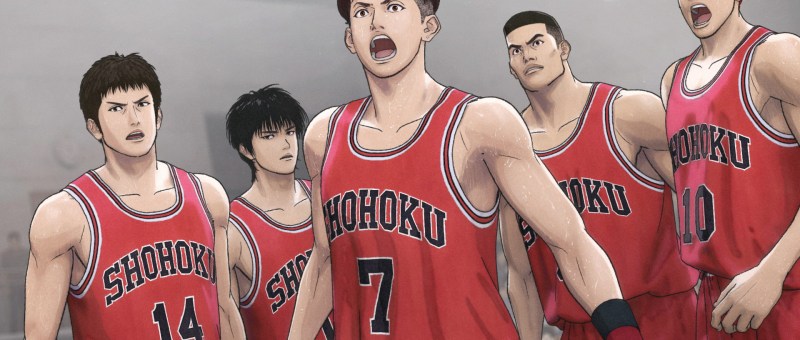
THE FIRST SLAM DUNK (Takehiko Inoue, 2022)

Takehiko Inoue’s basketball-themed manga Slam Dunk is a ‘90s landmark that also spawned a hugely popular TV anime adaptation. A few attempts had been made over the years to produce a feature-length film, but Inoue had turned them all down until, that is, the production team were able to come up a unique look that matched the author’s vision and truly made it seem as if the characters were “alive”. Finally impressed, Inoue then agreed to script and direct the anime himself even going so far as to retouch scenes in both 3DCG and 2D to ensure they fulfilled his high expectations. 

Titled The First Slam Dunk, the film takes place entirely over a single game but switches its focus from the protagonist of the manga, red-haired former delinquent Sakuragi (Subaru Kimura), to “Speedster” Ryota Miyagi who makes up for his short stature with nimble manoeuvres. Inoue cuts between the championship match with rivals Sanno and the players’ private lives as they battle their demons and insecurities on the court and off. 

Originally from Okinawa, Ryota lost his father and brother in quick succession. Sota had been something of a mentor figure, getting him into basketball and encouraging him to keep playing even if others said there was no point because he was simply too small. When Sota chose to cut their practice short to go fishing with some friends, Ryota was of course upset and angry saying a few things he came to regret when Sota was lost at sea and never came back. “Cocky” as someone later describes him, Ryota uses bravado to mask his insecurity and struggles to redefine his relationships with his grief-stricken mother and younger sister while also competing with the shadow of his absent brother whose number he continues to wear even after moving to the mainland and joining a new high school team, Shohoku. 

As he later says, basketball was a means of dealing with his grief though it was difficult for his mother to support him because its associations with Sota. Showcasing the stories not otherwise told in the manga, Inoue taps into an adolescent sense of existential crisis and individual anxiety as filtered through the basketball game in which, as their quietly supportive middle-aged coach tells them, it’s only over when you decide to give up. Meanwhile, the guys from Sanno are experiencing something similar and most particularly Ryota’s opposing number, Kawata, even if the team is also given an edge of uncanny invincibility in the sometimes suspicious aura of their coach. 

Only by facing their individual anxieties can the guys begin to play a full role on the team, each of them as the coach says bringing their own unique talents and learning to play to each other’s strengths. In the end it comes down to willpower and self belief, continuing to play even when victory seems impossible and pressing for the final slam dunk even as the seconds tick down to zero. Inoue captures a real sense of tension in the game scenes, the dynamism of the 3DCG and the use of motion capture paying off along with some innovative creative decisions that really allow the game to come “alive” in the way Inoue seems to have envisioned with victory hardly assured as the guys go all out utilising not only their physicality but strategy and psychology in trying to claw their way back from 20 points behind with time fast running out. 

Very different stylistically from the average anime sports movie and particularly one following a previous TV adaptation, Inoue displays a truly remarkable sense of cinematic composition while he largely steers away from the kind of high school cliches common to the genre concentrating instead on strong characterisation and an otherwise poignant story of learning to live with grief as Ryota begins to become his own man while honouring his brother’s legacy. Often dazzling in its dexterity, Inoue’s directorial debut excels both on the court and off finding the small moments of doubt and confusion among each of its heroes and witnessing them achieve a psychological slam dunk that allows them to keep moving forward despite their fears and anxieties in refusing to give up even when it might seem hopeless. 


THE FIRST SLAM DUNK screens July 26 as the opening night gala of this year’s JAPAN CUTS and opens in cinemas in the US & Canada July 28 courtesy of GKIDS.

Gold Kingdom and Water Kingdom (金の国 水の国, Kotono Watanabe, 2022)

After centuries of conflict, two feuding countries finally begin to put the past behind them to work for a common future in Kotono Watanabe’s animated fantasy romance, Gold Kingdom and Water Kingdom (金の国 水の国, Kin no Kuni Mizu no Kuni). Adapted from the manga by Nao Iwamoto, this is very much a story of coming together to create a better future for all in which it’s always better to follow the most difficult path if it leads to longterm peace rather than opting for a quick fix like a dynastic marriage that won’t take place for another fifty years. 

In this case, the dynastic marriage actually works out but only because romantic heroes Sara (Minami Hamabe) and Naranbayar (Kento Kaku) end up meeting by chance and falling in love organically despite the class disparity and cultural differences between them. The kingdoms of Alhamit and Balkari had been feuding in part for the petty reasons of a dog and cat respectively doing their business on the wrong side of the border wall erected after previous war. Neither nation being very much interested in the dynastic marriage proposed by the previous generation in which Alhamit would give its most beautiful woman as a wife to Balkari’s cleverest man, Alhamit sent a cat instead while Balkari sent a dog. Poor Balkari engineer Naranbayar simply laughed off his new “bride” while Princess Sara of Alhamit decided to go along with the ruse knowing that to kick up a fuss would likely send both nations back to war. 

They happen to meet when Sara transgressively ventures beyond the wall in search of her dog, Lukman, who has fallen in a hole in the forest. With her pretty sisters needling her, Sara asks Naranbayar to pretend to be her new husband, little realising that he is the man she is intended to marry. The youngest of four sisters, Sara has always felt inferior and fears that she cannot live up to the title of Alhamit’s most beautiful woman but begins to fall for Naranbayar who is in fact very clever but also kind in the way most of her family aren’t. Naranbayar genuinely cares about the people of Alhamit and quickly works out that in this incredibly wealthy, “golden” desert city they will run out of water within 50 years while water is something the poor nation of Balkari has in abundance. 

An alliance will save the lives of people in Alhamit, but also also benefit those of Balkari in boosting its economy but not everyone is motivated towards a diplomatic solution with many in the court clearly agitating for war in which they would simply conquer Balkari to capture its resources. The King is under pressure in thinking of his historical legacy, not wanting to be seen as a weak monarch as his namesake earlier was in having restored with relations with Balkari rather than seeking to dominate it militarily. Under the sway of potentially corrupt shaman Piripappa (Chafurin) he rules with an authoritarian fist, while his haughty daughter Leopoldine (Keiko Toda) has appointed a handsome actor as an advisor to signal her opposition. 

Only through the genuine love which emerges between Sara and Naranbayar can the country be saved in turning away from pointless acrimony towards a more open future marked by mutual cooperation and friendship between two equal nations. Through falling in love with Naranbayar, Sara grows in confidence and learns to see herself as beautiful no longer inferior to her sisters but playing a full part in the life of the court as they work together to solve the water issue and return life to their arid land. Beautifully designed with its Middle-Eastern aesthetics and strong contrast between the desert kingdom of Alhamit and the beautiful forests of Balkari, the film also features charming paper art bookends and a watercolour credits sequence depicting a happier future for both nations as they forge a new society together. Heartfelt in its central romance, Watanabe’s charming love story positions cross cultural connection as the best means of overcoming centuries of pointless conflict along with allowing each of its heroes to become more of themselves as they work together to create a new world of love and peace in which all can prosper and live in happy harmony. 


Gold Kingdom and Water Kingdom screened as part of this year’s Nippon Connection.

International trailer (English subtitles)