Flowing (流れる, Mikio Naruse, 1956)

The denizens of a moribund geisha house contemplate visions of independence in post-war Japan Mikio Naruse’s thriving ensemble drama, Flowing (流れる, Nagareru). There is indeed a flowing through the geisha house, a tumble of comings and goings though mostly connected to money which is itself constantly flowing though the for geisha mainly in the wrong direction. Released in the year of Prostitution Prevention Law, the film casts a shadow over the lives of these women who are unwittingly living in their industry’s twilight but asks if it’s really possible for a woman to survive without a man while each of them is in one way or another badly let down by an inconstant lover. 

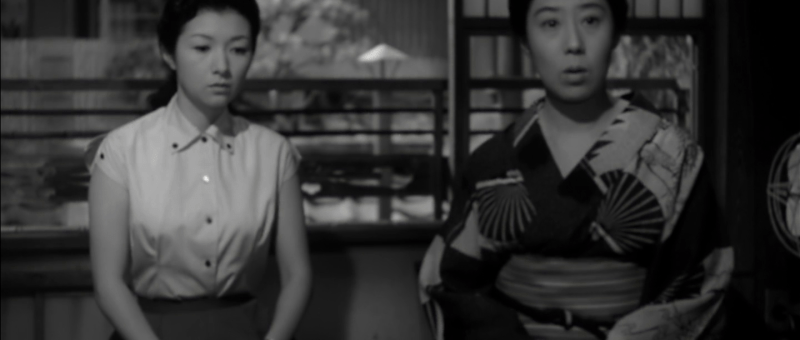
We’re constantly told that Tsutanoya is the most respectable geisha house in town yet despite its well appointed interiors, it’s clear that business is not good. As the film opens, a young geisha, Namie, is accusing the owner’s daughter Katsuyo (Hideko Takamine) of diddling her on her pay. Katsuyo acts indignant and tries to shift the blame back onto Namie but later admits that the house has indeed been skimming a little more off their wages than was agreed claiming all the geisha houses do it which is probably true but doesn’t make it right. In any case Namie will eventually quit and end up working at “some third rate place” while her uncle (Seiji Miyaguchi) causes problems for proprietress Tsuta (Isuzu Yamada) complaining that Namie was exploited and wanting both the backpay he feels she’s owed and compensation though it seems unlikely any of that money is finding its way back to Namie. Meanwhile the house is a geisha down with only former office worker Nanako (Mariko Okada) and 50-year-old veteran Someka (Haruko Sugimura) on the books.

Despite their financial situation, Tsuta hires a new maid, Rika (Kinuyo Tanaka) who is immediately renamed “Oharu” on her arrival. Oharu is a salt of the Earth type, infinitely capable, maternal, kind and loyal bringing a much needed sense of stability to the ever flowing geisha house while also fascinated by this exotic and arcane world. But then as Tsuta cautions her geisha houses may look glamorous from the outside but the life inside them isn’t always fun. Oharu runs into trouble on her first trip to the grocers when they inform her Tsuta hasn’t paid her tab and they can’t let her add to it until she does. A 45-year-old widow whose only child died a year previously, Oharu is also trying to live an independent life, a conflicted Tsuta struck with wonder at her ability to survive without a man, but may also have struggled, grateful to have been offered the job which others might have declined because of the stigma towards the sex trade as finding employment as a middle-aged woman is near impossible. 

At the film’s conclusion even she may imply it isn’t really possible to live as a woman without some kind of support or losing one’s humanity suggesting that she may return to her husband’s hometown and the family she claims not have gotten along with after learning of Tsuta’s betrayal at the hands of an old friend and former geisha, Ohama (Sumiko Kurishima), who at any rate seems to be living quite well as the proprietress of a restaurant. Traditionally, the profession of geisha was seen as a kind of independence in itself but it’s also one that by its nature is reliant on men. Tsuta is often described as someone who is not able to do anything else yet is highly skilled at music and dance having spent a lifetime in training. Without a patron she is stuck and as we learn she threw hers over to pursue a man she loved but he left her in the lurch having mortgaged the geisha house to invest in his business by taking a loan from her older sister who seems to have a nice sideline as a polite loan shark also having loaned money to Someka. 

The most outwardly cheerful, Someka is in other ways a dark vision of a geisha’s future surviving on nothing but nihilistic hedonism while apparently living with a much younger man who eventually leaves her to marry into another woman’s family. Katsuyo has rejected the geisha life explaining that she is unable to, as Nanaka puts it, say silly things to men in order to earn her keep and is essentially incapable of ingratiating herself with men she doesn’t like. She claims she has no desire to marry, unconvinced that any man would be interested in a geisha’s daughter while certain that for a man marrying into a woman’s family is humiliating while suggesting the same would be true for her. Putting her faith in industry, she buys a sewing machine and sets about figuring out how to use it less because she envisages being able to support herself and her mother through taking in needlework than she just wants to feel as if she’s doing something. 

Meanwhile, Tsuta’s niece Fujiko observes all the comings and goings of the geisha house learning the traditional arts in preparation for a future which will soon be obsolete. In a typically Narusean touch, Tsuta comes to a resolution about her future and envisages a new beginning for herself but is unaware the rug is soon to be pulled from under her by the underhanded capitalist Ohama who plans to turf her out to turn the geisha house into another restaurant. “My days of seeking favours from men are over,” Tsuta admits, not of her own volition but simply understanding that she no longer has access to that kind of independence though in essence surrendering her autonomy in leaving herself to the mercy of Ohama in order to escape her older sister’s control. Someka had laughed raucously at Katsuyo’s insistence that she need not be dependent on a man (and after everything she’s seen why would she want to be?) but the younger woman is undeterred even as we see her struggling, doubting that her efforts will in the end be enough to win her her freedom. Ever the optimist, Tsuta is perhaps doing something similar but even Oharu is considering giving up and going home, too good to survive in the dog eat dog world of the contemporary capital where the flow of currency is the lifeblood of the city implying that perhaps the answer to her question is no, a woman can’t survive alone, nor can she rely on female solidarity, but she’ll have to try anyway because there is no other choice. 


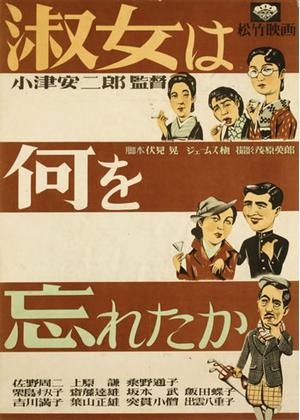
What Did the Lady Forget? (淑女は何を忘れたか, Yasujiro Ozu, 1937)

Japan was in a precarious position in 1937. Ozu’s What Did the Lady Forget? (淑女は何を忘れたか, Shukujo wa Nani wo Wasureta ka) was released in March of that year but by July the Second Sino-Japanese War would be in full swing and on the home front increasing censorship would render this kind of inconsequential comedy a much less easy sell. True enough, the film includes no “patriotic” content though it does eventually reinforce a set of patriarchal values in the remasculinisation of a henpecked husband while quietly sniggering at a new bourgeois social class.

The drama unfolds in the home of a medical professor, Komiya (Tatsuo Saito), and his austere wife Tokiko (Sumiko Kurishima). The couple have no children and mostly lead separate lives. Tokiko spends her days with two close friends, widowed single-mother Mitsuko (Mitsuko Yoshikawa), and wealthy older woman Chiyoko (Choko Iida) who is married to her husband’s friend, Sugiyama (Takeshi Sakamoto). The three women gossip about the usual things from fancy department store kimonos to new ways to laugh so you don’t get wrinkles along with the bizarrely difficult maths problems Mitsuko’s son has been studying in preparation for middle-school that none of them can answer. To help with the embarrassingly taxing homework, Tokiko offers to find a tutor, press-ganging her husband’s best student, Okada (Shuji Sano), into spending time with Mitsuko’s son Fujio (Masao Hayama) though it turns out that he too, a college graduate, is unable to solve these middle-school level problems. 

The real drama occurs when the couple’s neice, Setsuko (Michiko Kuwano), whom Tokiko had described as “proper” and “wholesome” rocks up from Osaka having become the epitome of a modern girl. Setsuko’s arrival further strains the Komiyas’ already fraying relationship as her surprising habits which include driving, smoking, drinking, and hanging out with geisha, continue to exasperate her aunt whose main objection to all of those things is that they aren’t appropriate because Setsuko is not yet married. To get away from his nagging wife who forces him to go golfing as usual when he doesn’t really want to, Komiya stashes his clubs with Okada and goes to a bar in Ginza where he meets Sugiyama who has also been forced outside by his wife. Sugiyama really does go golfing, promising to mail a previously written postcard to Tokiko on Komiya’s behalf, while he is eventually joined by Setsuko who has tracked him down to the bar despite being told to stay home and mind the house (the Komiyas have two live-in maids so the instruction seems unnecessary at best).  

As a “modern gal” Setsuko has some strangely old fashioned ideas even as she behaves like a 1930s ladette, striding around like man while drinking, smoking, and generally being almost as intimidating as Tokiko just in a more likeable fashion. Setsuko finds Komiya’s deferral to his wife embarrassing, encouraging him to be more masculine and stand up for himself even advising that he use violence to reassert his position as the man of the house. He seems uncomfortable with the idea but eventually does just that after a climactic argument once his lying about the golf and Setsuko’s nighttime adventures have been exposed. Caught in a moment of frustration, he slaps Tokiko across the face, leaving her to retreat in shock apparently “beaten”. The thing is, however, Tokiko likes it. She sees his slapping her as a sign of his love, as if she’s been needling him all this time in hope of a reaction while frustrated that perhaps he doesn’t care for her. Once he hits her, the marriage is rebalanced and repaired with traditional gender dynamics restored. She becomes more cheerful and deferent to his male authority, he acknowledges that he enabled her “arrogance” with his weakness as a man.  

Setsuko however, continues to shout at her uncle, disappointed that he apologised for his reaction and accusing him of giving away the victory he’d just won. He tells her that he’s simply using reverse psychology because wives like to believe they’re in charge and in the main it’s best to let them. Setsuko seems satisfied, but jokes with her new love interest Okada that he better not use reverse psychology on her. Or, he can, but she’ll just use reverse reverse psychology to get the upper hand, which perhaps undercuts the central message in praise of traditional gender roles. Nevertheless, What Did the Lady Forget? is full of Lubitschy late-30s charms from an unexpected sighting of real life star Ken Uehara at the Kabuki to Setsuko’s movie magazines featuring Marlene Dietrich and repeated references to Frederich March and William Powell proving that Ginza is open even in 1937, while the Komiya household descends into an oddly peaceful harmony of delayed marital bliss. 


Currently streaming in the UK via BFI Player as part of Japan 2020. Also available to stream in the US via Criterion Channel.

Every-Night Dreams (夜ごとの夢, Mikio Naruse, 1933)

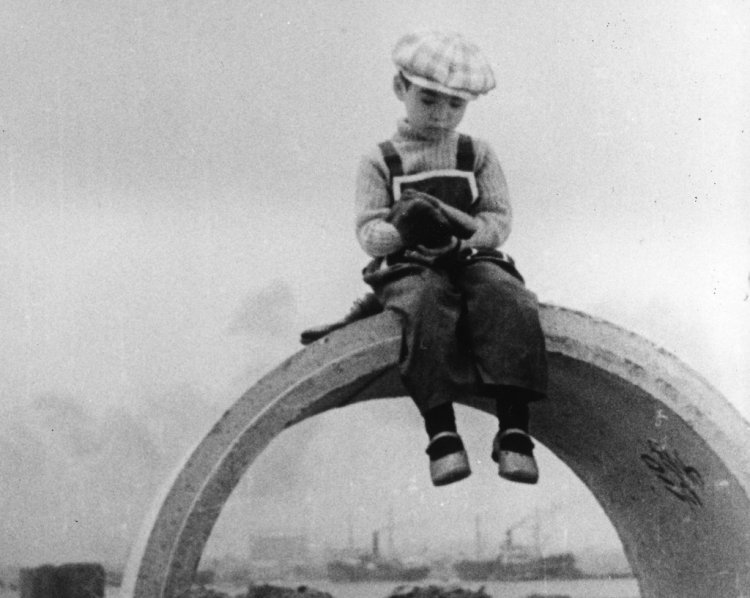
Every Night DreamsFollowing on from Apart From You, Naruse returns to his exploration of working class women struggling to get by in a male dominated world in Every-Night Dreams (夜ごとの夢, Yogoto no Yume) also released in 1933. This time we meet weary bar hostess Omitsu who has a young son she’s raising alone after her deadbeat husband ran out on them a few years previously.

Omitsu doesn’t particularly like working in the bar, but as her mama-san grudgingly admits, she is quite good at it. She’s a modern woman who can drink and smoke and flirt to keep the guys buying drinks and wanting more though she’s finding it increasingly difficult to deflect some of the more intense interest such as that from a sleazy boat captain that her boss is eager to keep happy. Whilst at work, her son is looked after by a kindly older couple in her building who urge her to find a nicer line of business or get married again to a more reliable man.

The gentle rhythms of her life are disrupted when her long absent husband finally reappears. After first rejecting him outright, Omitsu eventually relents and lets him back into her life. However, despite his seemingly sincere pledges to change, get a proper job, start being a proper husband and father, Mizuhara fails to achieve any of his aims and also becomes increasingly jealous about Omitsu’s job at the bar. When their son, Fumio, is injured in an accident and requires expensive medical treatment, events reach a tragic climax.

Naruse would return to women alone facing a difficult economic future in many of his films but Omitsu’s situation is only made worse by the ongoing depression. Realistically speaking, there are few lines of work available to a woman in Omitu’s position and the more well regarded of them probably wouldn’t pay enough to allow her to keep both herself and her son, even as it stands she tries to borrow money from the bar to “reward” the older couple who watch Fumio while she’s working (though of course they wouldn’t take it). Omitsu herself feels there’s something degrading about her work and when her friend advises her to remarry, she exclaims any man worth a damn would run from a woman like her. Unfortunately, she may, in some senses, be right.

The man she ended up with, Mizuhara, is most definitely not worth a damn. It’s not entirely his fault he can’t find work – he does look for it and appears to want to find a job but in this difficult economic environment there’s not much going. Applying at factory, he’s turned down almost on sight because he’s a weedy sort of guy and doesn’t look like he’s cut out for physical labour. His inability to get ahead and provide for his wife and child sends him into a kind of depression and self esteem crisis which has him thinking about leaving again, especially as his increasing jealousy threatens his wife’s bar job which is their only form of income (whether he likes it or not). Fumio’s accident forces his hand into a series of bad decisions taken for a good reason but which again only cause more trouble for his family.

Naruse is a little flashier here than in Apart From You using canted angles, faster editing and even more zooms to hint at the panic felt by Omitsu in the increasingly distressing situations she finds herself in. Like the train accident in Flunky, Work Hard, the news that Fumio has been hit by a car is delivered in an expressionistic style beginning with his father putting down the boy’s toy car as a troupe of kids arrive and the screen is stabbed with a series of rapidly edited, alternating angle shots of intertitles mingled with the shocked reaction of the parents and the other children. If Naruse felt compelled to provide an ending with some sort of hint of far off promise in previous films, here he abandons that altogether as Omitsu laments her sad fate and instructs her son to grow up strong, not like his father, but like the mother who is doing everything she can to ensure his life won’t always be like this.


Every-Night Dreams is the fourth of five films included in Criterion’s Eclipse Series 26: Silent Naruse box set.