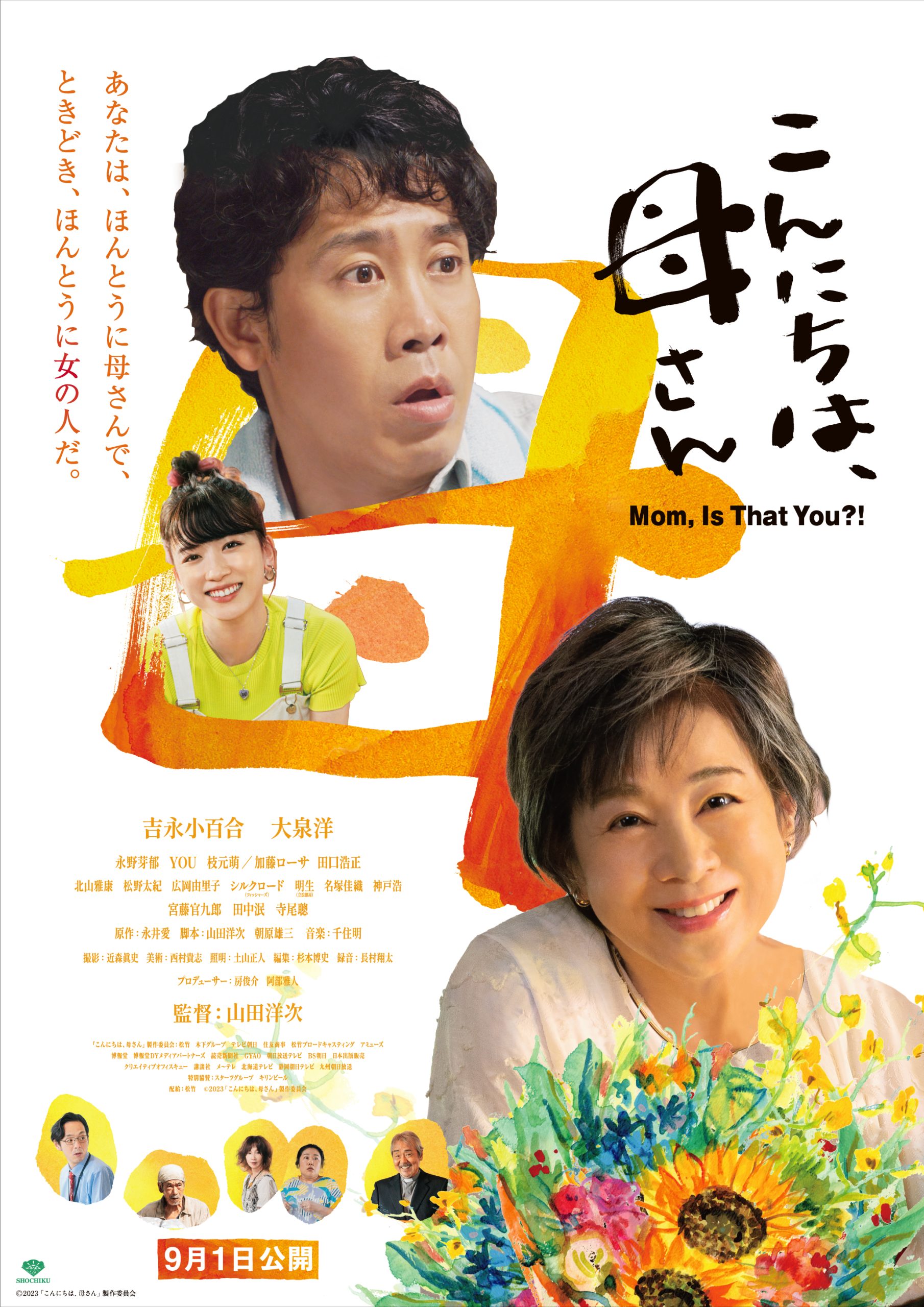
Mom, Is That You?! (こんにちは、母さん, Yoji Yamada, 2023)

“People of my generation can’t throw anything away,” an older woman admits on her hearing her daughter-in-law has just been featured in a TV series about decluttering. Inspired by Ai Nagai’s 2001 play, the latest from veteran director Yoji Yamada Mom, Is that You? (こんにちは、母さん, Konichiwa, Okasan) seems to hint at a series of circular generational divides while suggesting that the children of the Bubble-era in particular are too quick to get rid of things they don’t think they don’t need anymore.

That’s the irony of soon-to-be 50-year-old Akio’s (Yo Oizumi) salaryman job in HR. It’s his job to cut dead wood from the company and this current round of polite requests to employees of a certain level to take early retirement includes his uni friend Kibe (Kankuro Kudo) who doesn’t take kindly to what he sees as a personal betrayal. Unlike Akio who is beginning to tire of the salaryman dream, Kibe fiercely fights for his position and identity as an executive at a big company even when faced with banishment room treatment and disciplinary dismissal after an altercation with the boss.

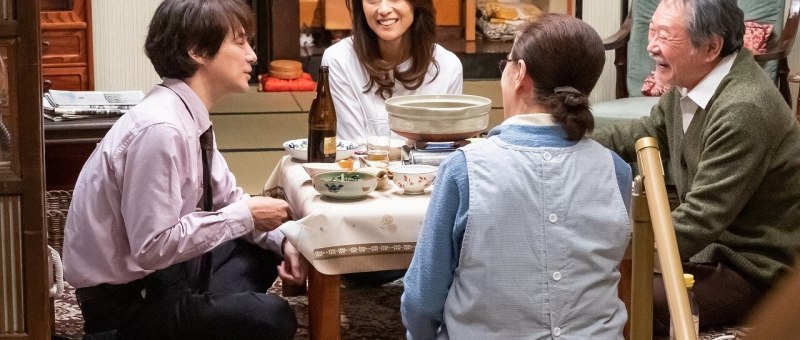
But what Kibe doesn’t know is that Akio is already facing a series of crises. His marriage has collapsed and his university student daughter Mai (Mei Nagano) is having a crisis of her own. Fresh from her tidying success, her mother has told her that all she can do is get good grades followed by a boring salaryman job like her dad’s which doesn’t seem to be what she wants which is why she’s run off to stay with her grandmother Fukue (Sayuri Yoshinaga) who runs a traditional shop selling tabi socks near the Sumida River. Fukue has a kindly, laid-back attitude remiscent of the shitamachi spirit found in other Yamada films in contrast to the stressed out uptightness of Akio who hasn’t told her about his impending divorce nor work troubles but finds himself paying a visit home in an attempt to sort himself out only to find Fukue keeping herself busy with a local charity group and nascent relationship with a church pastor. 

Fukue’s charity work is emblematic of a waste not want not philosophy that has otherwise disappeared from the modern society as they pick up the things other people don’t want and donate them to the needy even if it sometimes seems a little simplistic or patronising. Biting into some reject crackers from the local rice cracker shop, Akio reflects that they’re something that’s made to console people and it’s work that has meaning unlike his soulless corporate job that gives him nothing other than stress and money. At the time the play was written, the fallacy of the salaryman dream was clear for all to see in the post-Bubble society but to a man like Akio getting a company job was a big deal and his success is still the talk of his mother’s friends even he starts to wonder if he still has time to start again and discover a more meaningful way of living.

Some of these ideas, and the timescales involved, make much more sense for the play’s millennial setting rather than the film’s apparent present day given the references to the firebombing of Tokyo which would require the older protagonists to be their late 80s to even remember. Akio dismisses his mother’s charity work and insists that the homeless are only those who opted out of the competitive society he too has come to doubt or else were excluded from it, while he’s resentful of her attachment to the pastor in contrast to Mai who is excited by the prospect of her grandmother’s love affair and enduring possibilities of age while Fukue is beginning to fear not death but dependency if her health should suddenly decline. 

It’s in the midst of her heartbreak that the film affords Fukue a new beginning if in coming full circle, Akio choosing to make a clean break with the unhappiness in his life and Mai embracing her youth while falling for the old world charms of her grandmother’s tabi sock shop almost exclusively catering to sumo wrestlers, who as someone points out never waste anything, and people trying ceremony for the first time at 60. Like most of Yamada’s work, the film has a gentle humanity and melancholy poignancy but also a sense of hope and continuity that run contrary to an overly corporatised society in which young and old are already losing faith.


Mom, Is That You?! screened as part of this year’s Toronto Japanese Film Festival.

Original trailer (No subitles)
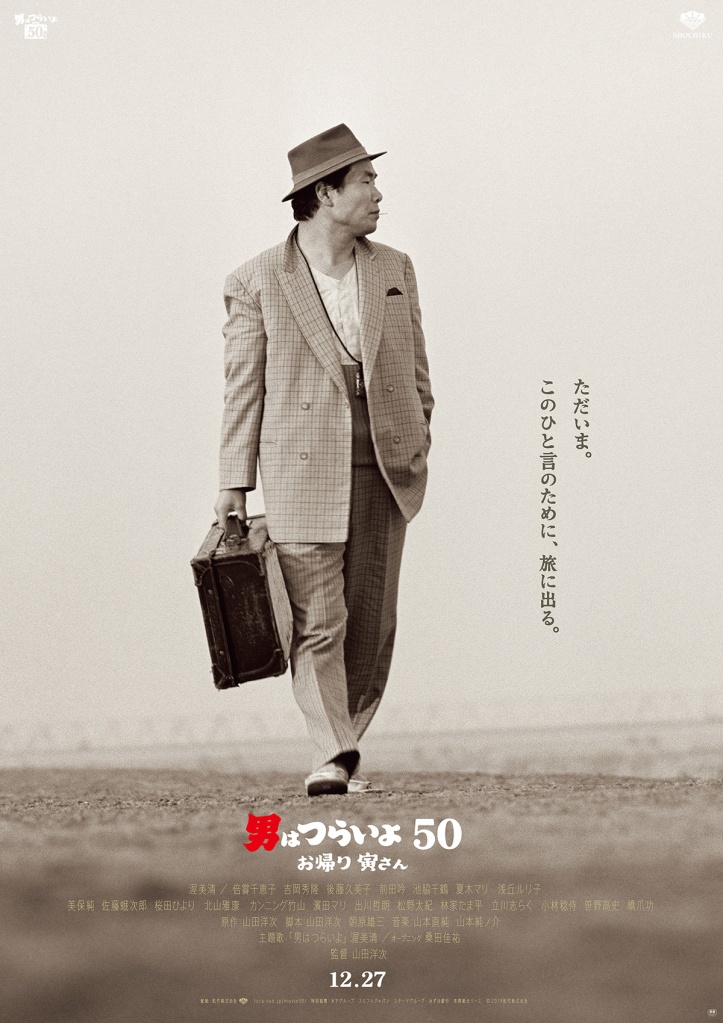
Tora-san, Wish You Were Here (男はつらいよ50 – お帰り 寅さん, Yoji Yamada, 2019)

From 1969 to 1996, travelling salesman Tora-san appeared in 48 films, a 49th movie special appearing after star Kiyoshi Atsumi’s death brought an unavoidable end to the series. Tora-san, Wish You Were Here (男はつらいよ50 – お帰り 寅さん, Otoko wa Ysurai yo 50: Okaeri Tora-san) arrives to mark the 50th anniversary of the first film’s release, and as the series had done in its later stages, revolves around Tora’s neurotic nephew, Mitsuo (Hidetaka Yoshioka), who is now a middle-aged widower and father to a teenage daughter. Feeling somewhat wistful, Mitsuo’s thoughts turn to his now absent uncle, wishing he were still around to offer some of his trademark advice along with the gentle warmth and empathy which proved in such stark contrast with his otherwise anarchic and unpredictable personality.  

Yamada, who directed all but two of the series in its entirety, opens with another dream sequence this time of Mitsuo as he finds himself overcome with memories of his first love, Izumi (Kumiko Goto), who is now married with children and living abroad working for the UNCHR. Mitsuo’s wife passed away from an illness six years previously and he’s so far resisted prompts from his relatives to consider remarriage though it seems fairly obvious that his editor, Setsuko (Chizuru Ikewaki), has a bit of a crush on him. Having taken a gamble giving up the secure life of a salaryman to become a novelist, Mitsuo’s first book is about to be published and it’s at a signing that he serendipitously re-encounters Izumi who just happened to be in the store that day on a rare trip to Japan and spotted the poster. 

Like many Tora-san films, Wish You Were Here is about the bittersweet qualities of life, the roads not taken, the misdirections and misconnections, and the romanticisation of a past which can no longer be present. At a crossroads, Mitsuo ponders what might have been recalling the shattered dreams of his first love which seems to have ended without resolution because of the unfairness of life. He wishes that his crazy uncle was still around to make everything better, offering more of his often poetic advice but most of all a shoulder to cry on as he’d been for so many women throughout the series. But Mitsuo himself has always been more like Tora than he’d care to admit, if tempered by his father Hiroshi’s shyness. He too is a kind man whose bighearted gestures could sometimes cause unexpected trouble. What he’s learning is in a sense to find his inner Tora, embracing his free spirit through his art if not the road, but also coming to a poetic understanding that sometimes the moment passes and there’s nothing you can do to take it back, only treasure the memory as you continue moving forward. 

That’s a sentiment echoed by Lily (Ruriko Asaoka), one of Tora’s old flames, who now runs a stylish bar in Tokyo. The beauty of the Tora-san series was that it aged in real time. The actor playing Mitsuo played him as a child and we saw him grow up on screen just as we saw Shibamata change from post-war scrappiness to bubble-era prosperity and beyond. The family’s dango-shop has had an upscale refit and there is now a modern apartment complex behind it where the print shop once stood. Seamlessly splicing in clips from previous instalments as Mitsuo remembers another anecdote about his uncle, Yamada shows us how past and present co-exist in the way memory hangs over a landscape. Once or twice, the ghost of Tora even reappears hovering gently behind Mitsuo only to fade when he turns around to look while there’s an unavoidable sadness as we notice the Suwas’ living room is now much less full than it once was. 

Aside from his uncle, it’s the warm family atmosphere that Mitsuo recalls from his childhood, something which, like Tora, he might not have always fully appreciated. Driving Izumi to a potentially difficult reunion with her terminally ill estranged father (Isao Hashizume), he refers to his own parents as “annoying” in the “pushy” quality of their kindness, something which irritates Izumi who points out that she’d have loved to have such a warm and supportive family and if she had she might never have gone to Europe, implying perhaps that their fated romance would been fulfilled. The Shibamata house was Tora’s port, he could wander freely because he had somewhere to go back to where they’d always let him in no matter what kind of trouble he caused.

A fitting tribute to the Tora-san legacy, Wish You Were Here is also a joyful celebration of the Shitamachi spirit. Tora might be gone, but the anarchic kindness and empathy he embodied lives on, not least in the mild-mannered Mitsuo and his cheerful daughter who seems to be continuing the family tradition of meddling in her loved ones’ love lives as her lovelorn father prepares to move on in memory of Tora, the free spirited fool.


Tora-san, Wish You Were Here streamed as part of this year’s Japan Cuts.

International trailer (English subtitles)