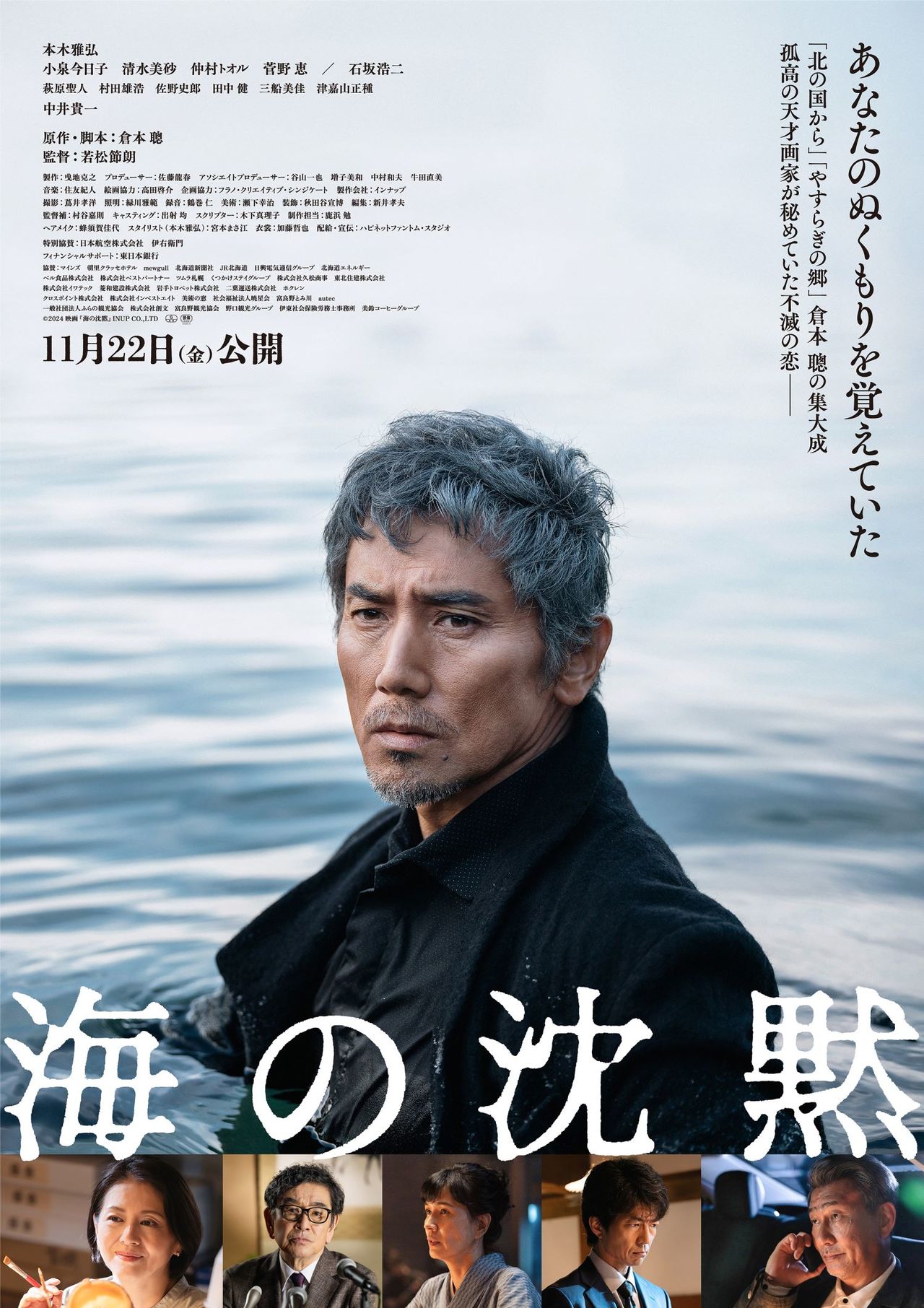
Silence of the Sea (海の沈黙, Setsuro Wakamatsu, 2024)

Can there be any greater humiliation than having your work plagiarised and the other person’s being better? Renowned artist Tamura (Koji Ishizaka) feels he has to say something on seeing an old painting at an exhibition honouring his late mentor and realising it’s not the one he painted. He doesn’t think he ever had the ability to paint something with this kind of power even when he was young, and he didn’t even use the materials which appear to have given this version a emotional depth that the original never had.

In some ways, this is Tamura’s past literally coming to the surface to show him that his life has been a series of mistaken choices and whatever success he may have achieved it’s come at the cost of his artistic soul. The first part of Setsuro Wakamatsu’s Silence of the Sea (海の沈黙,, Chinmoku no Umi) ponders why Tamura might be so keen to confess this work isn’t his when he admits that it’s objectively “better”, but even if that might be true, he has to concede it isn’t him and therefore shouldn’t have his name on it. Though he appears to have become greedy and vain, trading on his connections and more of a celebrity artist than someone with real and urgent ideas to express, he is apparently willing to burn all his bridges on the altar of authenticity while simultaneously refusing to divorce his wife, the daughter of his late mentor, despite living with another woman and their child on the other side of the country.

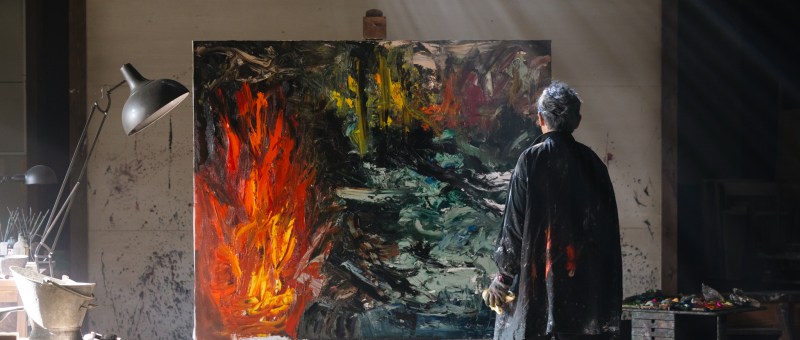
But as someone else says, does it matter whose name is on the painting when it is beautiful in itself? Then again, this beauty is intended both to cover something up and to expose it. In his youth, Tamura apparently threw another artist, Lyuji (Masahiro Motoki), under the bus. 40 years later, Lyuji is a master forger living a life in the shadows tattooing young women with his fevered artistic visions. It’s true enough that he seems to see them only as “canvases” and otherwise rejects personal connection while still carrying a torch for Tamura’s now wife Anna (Kyoko Koizumi). He seems to be stuck in the past, forever meditating on a particular pairing, The Silence of the Sea, which reflected his own moment of trauma when his parents both drowned when he was a child. 

The film seems to pain Tamura and Lyuji as two sides of the same coin. The more Tamura’s star rose, the sicker and more humble Lyuji became as if he were literally bleeding him dry. In the words of his assistant, Lyuji had an imperative to depict beauty, but art seems to deplete him. He literally vomits blood on the canvas while struggling to recreate his lost painting and thereby return to the source of his trauma. The sea for him seems to represent life and death along with life’s beauty and terror, while for Tamura it is perhaps merely picturesque even if for both of them the sun is always setting.

One man has almost painted over the other, stolen a life that might have been meant for him though his talent may lie more in an ability to play the game than in art itself. But at the same time, Lyuji has destroyed himself through his selfishness and single-minded obsession with his art along with the internal traumas it turns out he cannot simply paint over. His life is like the candle that Anna makes in his image, slowly melting away and producing only a single tear from a lonely soul. His eventual conviction is that beautiful things need only exist in our hearts and minds as memory rather than as material things. As he says, measuring art in money is mere foolishness, which paints his career of forgery as an ironic revenge against the art world which values only what’s popular and has become a game for the rich to play to enhance their status little caring for the nature of the art itself. Yet this covering up and later revealing of a truth has led to several deaths, among them a man who lived for art and a woman who yearned for love only to end up a scorned muse of an emotionally distant man. The sea took them all, but for Lyuji at least it may finally have fallen silent in the final perfection of his art.


Silence of the Sea screens as part of this year’s Japan Foundation Touring Film Programme.

Trailer (English subtitles)

Images: © 2024 Eiga Umi no Chinmoku INUP Co.,Ltd
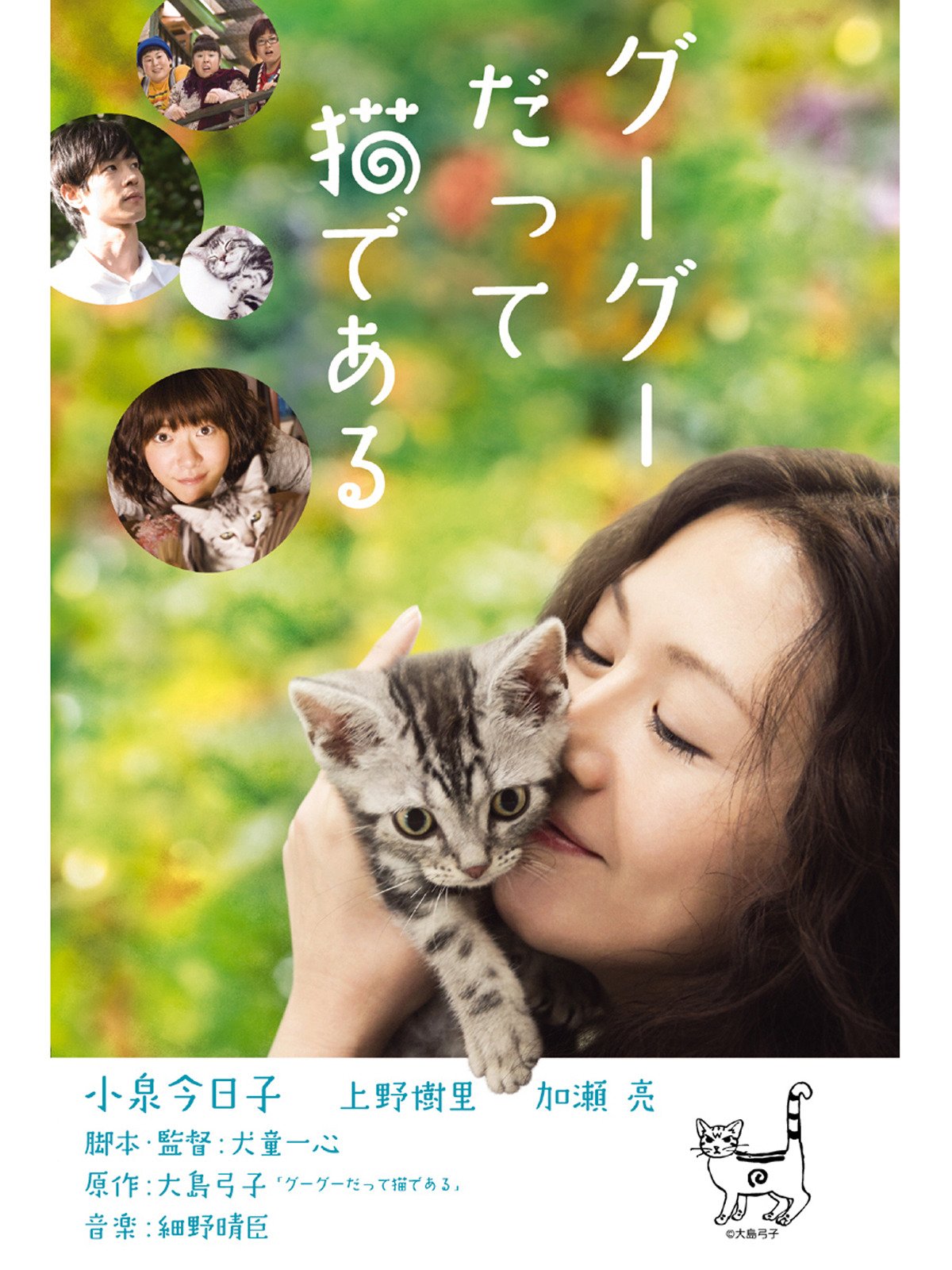
Gu Gu the Cat (グーグーだって猫である, Isshin Inudo, 2008)

Gu Gu the cat posterJapanese cinema has long been in love with the local flavour movie. It may be true that many otherwise fantastic examples of the small subgenre have a “sponsored by the tourist board” aesthetic, but then the pure “furusato” love is usually genuine enough and often proves infectious. Gu Gu the Cat (グーグーだって猫である, Gu Gu Datte Neko de Aru) is a case in point in its fierce determination to sell the benefits of trendy Tokyo suburb Kichijoji – an upscale bohemian neighbourhood well known for being home to artists and dreamers who take care to foster the kind of hometown spirit you wouldn’t normally associate with city living. The film is also, however, the story of a struggling middle-aged mangaka who is forced to deal with a long delayed existential crisis after her elderly cat passes away.

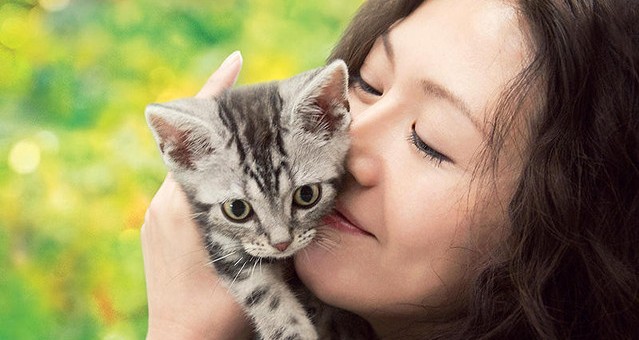
Ça Va had been living with Asako (Kyoko Koizumi) for the last 15 years but passed away while she and her team were working flat out on a special Christmas issue. Asako is of course devastated and not least because she feels guilty that perhaps she was too busy to notice that Ça Va was ill until it was too late. According to her assistant Naomi (Juri Ueno), Asako’s career had been faltering even before Ça Va passed away – the Christmas issue had been the only thing she’d produced all year leaving her team of assistants out of pocket and worried for the future. Grief-stricken as she is, Asako eventually decides to get a new cat, Gu Gu, enabling a rebirth in her professional as well as personal lives.

Based on an autobiographical story by mangaka Yumiko Oshima, Gu Gu the Cat wastes no time in reminding us that being a mangaka is a precarious business. Asako is well acclaimed as an artist and has inspired countless young women with her shojo manga (Naomi not least among them) but is still pressed into working insane hours to meet publication deadlines and is constantly badgered by her publishing company to provide new material. Her mother (Chieko Matsubara), meanwhile, just wants her to settle down and get married before it’s “too late”.

Asako’s mother’s nagging may seem like the usual kind of conservatism that is a little embarrassed by an unmarried middle-aged woman, as well as with the idea of a woman having a career and especially in manga which is a “popular” art and therefore less respectable than literature or painting. It is also, however, born of knowing her daughter and seeing that there is a part of her that hasn’t quite matured thanks to working on manga all her adult life which has left her feeling isolated and lonely in a way a cat might not be able to satisfy. This is perhaps why potential love interest Seiji (Ryo Kase) describes all her manga as “sad”, and why Asako is somewhat uncomfortable with being treated as a “famous author” rather than as a person.

Gu Gu the cat takes a back seat to most of the action (as cats are want to do) but does help engineer a meeting with Seiji who, despite being much younger than Asako, begins to reawaken in her a sense of desire if not exactly for romance then perhaps for life. Following a familiar pattern, however, Asako re-channels that desire into her manga – coming up with an idea in which a teenager suddenly grows old, neatly mirroring her sudden sense of having become “a woman of a certain age” overnight without really noticing. Having lost Ça Va, Asako attempts to come to terms with lost time in accepting that many choices have already been made and opportunities lost. In that sense there is something sad in Asako’s decision to remain alone in knowing that in the end she lost love because she was too timid to claim it, but then, the answer isn’t new romance but an acceptance of being happy in the present in the knowledge that things change and people leave but it will all be OK in the end.

Based on Oshima’s real experiences, Inudo’s film takes a turn for the melodramatic towards its conclusion which feeds back into his “live every day” message but is perhaps a little heavy for the cheerful slice of life drama surrounding it. Likewise, his strange decision to sell the joys of Kichijoji (which appear to be many) through an American Eikaiwa teacher narrating a journey through the area in the manner of a TV programme aimed at tourists is a particularly strange one which in no way benefits from its surreal plot revelation. Nevertheless, Gu Gu the Cat is a warm and affectionate tribute to this seemingly warm and quirky area which acts as a kind of coming of age story for its middle-aged heroine who, in a sense, births herself in coming to an acceptance that life goes on and the best you can do go along with it for as long as you can.


Original trailer (English/Chinese subtitles)

Miracle: Devil Claus’ Love and Magic (MIRACLE デビクロくんの恋と魔法, Isshin Inudo, 2014)

Miarcle devil claus posterChristmas is a time for romance, at least in Japan, but thanks to the magic of the season it can also be confusing. For one nerdy aspiring mangaka at the centre of Isshin Inudo’s Miracle: Devil Claus’ Love and Magic (MIRACLE デビクロくんの恋と魔法, Miracle Devil Claus-kun no Koi to Maho) it’s about to become very confusing indeed as he becomes convinced a prophecy he himself made up when he was a child is actually coming true. Cross-cultural love, lifelong longing, frustrated dreams, and misconstrued realities threaten to derail fated romance but never fear – it is Christmas after all, and even evil Santa has his heart in the right in place as long as anyone is prepared to really listen to him.

Hikaru (Masaki Aiba) and Anna (Nana Eikura) have lived across the street from one another all their lives and been friends as long as either of them can remember. These days, Hikaru is chasing dreams of manga success while working in a bookstore, and Anna is an aspiring artist specialising in large scale metal work. 20 years ago, Hikaru made up the figure of Devil Claus who is the embodiment of Santa’s emotional pain on being forgotten and abandoned for 364 days of the year. Seeing as no darkness can be permitted in the heart of Santa, Devil Claus evolved into his own pixie-like creature and now mostly stars in the cute, inspirational posters Hikaru illegally pastes all over town.

Devil Claus is also a big part of a prophecy Hikaru revealed to himself in which he believed Devil Claus would eventually lead him to the “Goddess of Destiny” who will appear dressed in red with the moon at her back, carrying knowledge of the future and accompanied by a leopard! It is quite a list and so when Hikaru bumps into an extraordinarily beautiful woman wearing a red coat, carrying a wooden leopard in one hand, and a collection of books about “the future” in the other, he comes to the obvious conclusion. In a coincidence worthy of the movies, it just so happens that the woman is Seo-yon (Han Hyo-Joo), a Korean artist in charge of organising a large scale Christmas display which is also the project Anna has been working on.

Predictably enough, Anna has long been in love with the completely clueless yet pure hearted Hikaru. Ironically, Hikaru thinks of Anna as a big sister who has always protected him when he is so obviously unable to stand up for himself, but though she berates him for his lack of backbone she is the one too embarrassed to confess her real feelings and has been patiently waiting for him to finally notice her all her life.

Nevertheless, this particular plot strand takes a strange turn when Anna figures out that Hikaru’s “Goddess of Destiny” is almost certainly Seo-yon. Despite her own feelings she does her best to fulfil Hikaru’s dreams but Inudo frames her behaviour strangely – Anna acts coldly towards Hikaru, while gazing somewhat longingly at Seo-yon who seems to literally sparkle as the sun shines ever behind her. It would be easy to come to the seemingly obvious conclusion that Anna has a different reason for being irritated with Hikaru and his current romantic pre-occupation (why exactly does she already have the book Seo-yon has been wanting before she decides to give it Hikaru to give her?), but the dilemma is later reframed as an inner conflict about her lack of traditional femininity. Yes, Anna’s “manly” dungarees and love of welding might easily play into a stereotype supporting the first conclusion but are actually offered as reasons for feeling underconfident in romance. Just as Hikaru thinks he isn’t good enough for someone so glamorous and accomplished, Anna thinks she isn’t good enough for Hikaru because she can’t measure up to a woman like Seo-yon.

All of that aside, the refreshing message behind Devil Claus is less one of conforming to a social ideal than of learning to regain your self confidence in order to open yourself up to the vulnerability of exposing your true feelings. Hikaru’s romantic and professional rival (not that Hikaru would ever really think of anyone else as an enemy), Kitayama (Toma Ikuta), was one a top rated city trader and now apparently successful mangaka but in a depressive slump over a conflict of artistic integrity. Only by remembering the importance of sincerity and emotional connection can he unlock his creative block by remembering what it is that’s really important. Frothy fun and proud of it, Devil Claus mixes infinitely cute if slightly subversive animation with innocent and pure hearted romance in which the main messages are embracing your authentic self and accepting other people’s. In other words, a perfect Christmas story.


Original trailer (no subtitles)