Wicked Priest 4: The Killer Priest Comes Back (極悪坊主 念仏三段斬り, Takashi Harada, 1970)

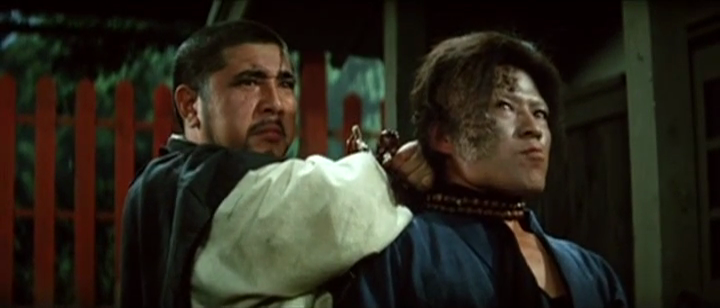
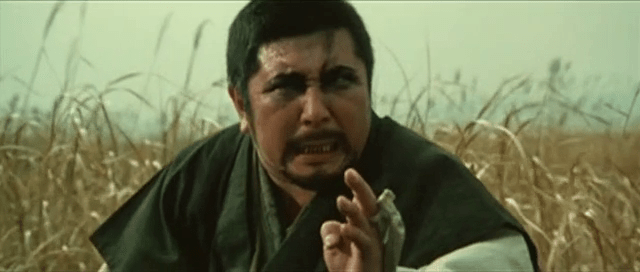
At the heart of the Wicked Priest series is an idea of rootlessness, the wandering monk Shinkai (Tomisaburo Wakayama), an orphan, often finding himself dragged into familial disputes between fathers and sons for one reason or another often estranged from each other. The aptly named Wicked Priest 4: The Killer Priest Comes Back (極悪坊主 念仏三段斬り, Gokuaku Bozu: Nenbutsu Sandangiri) finds Shinkai returning to his hometown after reencountering a childhood friend who’s found himself on the wrong side of a historical divide.

When Shinkai and Takegoro (Ichiro Nakatani) left their childhood village, they swore to become the best priest and mountain owner in Japan respectively but that obviously hasn’t worked too well for either of them. Takegoro evidently joined the wrong side during Bakumatsu chaos, a fact rammed home when his attempt to use currency issued by a feudal lord is rebuffed in a gambling den whose owner reminds him that it is now worthless. Only official currency issued by the central government is considered legal tender. On top of all that, it seems Takegoro might also have been cheating which signals just how far he has fallen. Running into him by chance, Shinkai ends up saving the day while accidentally humiliating a chastened Takegoro who is given a further dressing down by the old school lady yakuza boss Kuroda (Chieko Naniwa), also known as “the Thunder Woman”, who appears to be in charge, shooting off his little finger as an attempt to save face. 

In any case, the encounter has Shinkai feeling nostalgic and he decides to return to his hometown to hold a proper memorial service for his late mother. Only once there he ends up being drawn into another cycle of local corruption on discovering that the river workers are being exploited by rival yakuza groups who are working them to exhaustion and paying almost nothing. The leader of the Gondawara is quite obviously up to no good as he wears a western suit and has a handlebar moustache, quite clearly an amoral capitalist while his rival Ryuo (Eizo Kitamura) is a violent thug in ominous sunshades. In actuality, however, they are both branches of the yakuza syndicate led by Kuroda who is of the old school and doesn’t approve of their exploitative mindset. Just as she had Takegoro, she gives both men a good telling off reminding them that the river workers are essential for providing a steady supply of coal without which the new industrial economy will flounder. 

It’s also true that this same industry is fuelling militarisation and an eventual eye towards expanding imperialism, but Kuroda does seem to be mainly mindful of the workers welfare immediately insisting they should be paid a fair wage which is five times more than they’re currently getting. Ryuo and Godawara superficially agree but intend on simply exploiting their workers differently by demanding five times as much work for five times as much pay in a fifth of the time. Shinkai does his best to defend the rights of the local people, but is faced with a dilemma on realising that Takegoro is member of Godawara and hellbent on killing him having become cynical and desperate, willing to sell out a childhood friend for a few pennies. 

Part of Shinkai’s mission is winning Takegoro back over the side of right while reuniting him with his mother whom he’d been too ashamed to visit. On the other hand, this is perhaps the first time Shinkai shows a darker side to himself on threatening to rape a lascivious nun who tricked him into a martial arts contest while rebuffing his amorous intentions. He’s also still being pursued by Ryotatsu (Bunta Sugawara) and ironically ends up temporarily losing his sight himself but just as always Ryotatsu decides to come to his rescue mostly because it would be very annoying if someone else killed him first before he’s got his revenge. He also agrees to wait for Shinkai to finish his mother’s memorial service before scheduling their death match, the most patient revenger in jidaigeki history. In any case, it all ends with another massive showdown as a wounded Shinkai purifies the town of corrupt yakuza and liberates the river workers while finally getting to honour his late mother’s memory leaving Ryotatsu to make his exit deciding that vengeance can wait until the mourning’s over.
Wicked Priest 3: A Killer’s Pilgrimage (極悪坊主 念仏人斬り旅, Takashi Harada, 1969)

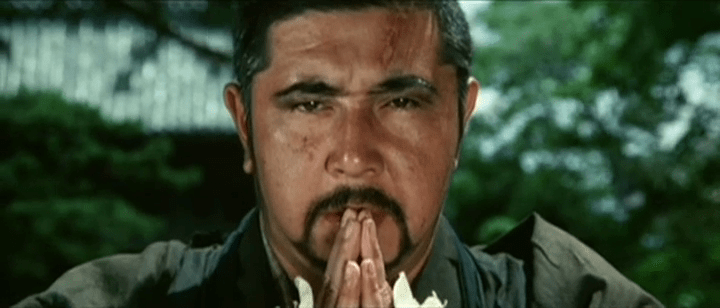
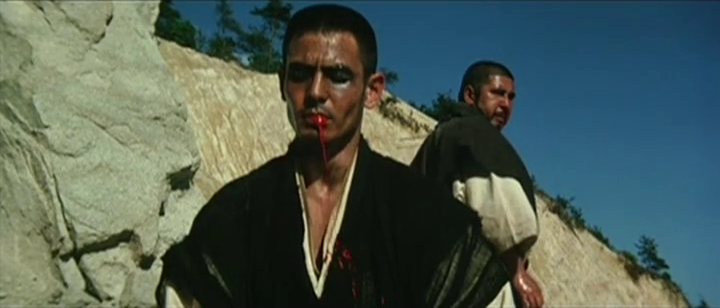
Three years on from his arrest at the end of the previous film, Shinkai (Tomisaburo Wakayama) returns for more lecherous adventures across Japan in Wicked Priest 3: Killer’s Pilgrimage (極悪坊主 念仏人斬り旅, Gokuaku Bozu: Nenbutsu Hitokiri Tabi). This time he finds himself mixed up with revolutionary pirates planning to overthrow the government with weapons smuggled in from Singapore, but it isn’t so much politics that bothers Shinkai as injustice as he tries to help the townspeople defend themselves against politicised bandits and a weird new religion while dealing with the fallout from the last time he found himself enacting justice. 

As usual however the film opens with an odd prologue in which a randy Shinkai is invited to the home of a man who tells him there’s a strange local custom in which women soon to be married think it good luck to be deflowered by a passing stranger and even better if he’s a monk. Of course, Shinkai nearly gets a little more than he bargained for before heading off towards the central fishing village which is at this time of the year home to only women and old men with all the husbands and sons off chasing tuna for the foreseeable future. Taking a liking to a widow named Omine (Hiroko Sakuramachi), Shinkai’s plans are scuppered when she realises that he’s the man who killed her admittedly no good, violent drunk of a gambling husband. Being the charmer that he is, Shinkai manages to talk her round only her brother-in-law Ryuji (Tatsuo Terashima), who’s supposed to marry her sister Otae (Eiko Ito), is hellbent on revenge. Meanwhile, the town is invaded by cruel pirates who commandeer the local well and keep the villagers prisoner. 

“Helping people is my duty,” Shinkai had told the man who weirdly wanted him to sleep with his daughter and true enough he’s never been one to turn away from those in need even if he’s not all that keen on taking responsibility for them. He feels bad for Omine that he ended up killing her husband even if he thinks her husband brought it on himself because of his behaviour, and even after encountering Ryuji tries to talk him down from his revenge rather than simply fighting him even though Ryuji still refuses to forgive him even after Shinkai is nearly fed to sharks in his place by the cruel leader of the pirates. He is later saved by Yamanami (Minoru Oki), a fugitive on the run for killing a politician in Tokyo presumably as part of his revolutionary activities but has become disillusioned with the gang whom he thinks have lost sight of their cause and are now no better than bandits. Shinkai had claimed he could see Yamanami was a good man because of his all-seeing monk eyes, and later praises him as someone who held fast to his beliefs while bravely standing up to his sociopathic gang boss. It isn’t so much that Shinkai has much opinion on their political stance and desire to overthrow the government, only about the way they conduct themselves, callously throwing dynamite around and hassling the local women. Yamanami asks his boss what the point of winning is if everyone resents you, but his boss simply tells him to think about winning first and ideological purity later. 

In a bizarre subplot, meanwhile, Shinkai also finds himself squaring off against a weird sex cult/fake religion on an island connected with the pirates who are also planning to sell off the village women as payment for their Singaporean weapons. Once again, the randy monk becomes a staunch defender of women, saving Otae from becoming the weird priest’s sex slave and shutting down the trafficking plot by indulging his strange love of eye gouging. Meanwhile he’s still being pursued by Ryotatsu (Bunta Sugawara), the blind monk from the previous two films. Blow for blow, there may not be as much action for the warrior monk despite his heroic attempt to reach the well while under fire and eventual descent on the bandit hideout in a single-handed bid for justice, but there is something in Shinkai’s demands for a just world despite his lasciviousness that overcomes his fixation on women even if this time it seems as if the sun may have set on his travels. 


Wicked Priest 2: Ballad of Murder (極悪坊主 人斬り数え唄, Takashi Harada, 1968)

The Wicked Priest returns for a second instalment but once again finds himself confronted with imperfect paternity in The Wicked Priest 2: Ballad of Murder (極悪坊主 人斬り数え唄, Gokuaku Bozu: Hitokiri Kazoe Uta). This time directed by Takashi Harada, the series begins to embrace its anarchic nature in the sometimes cartoonish exploits of its hero who largely just wants to have a good time but is inconveniently called to missions of justice while silently stalked by ghosts of the past in the form of spooky monk Ryutatsu (Bunta Sugawara) whom he blinded in a fight at the end of the previous film. 

Now a lonely wanderer, Shinkai (Tomisaburo Wakayama) comes across a fleeing yakuza with a small boy in tow and steps in to help. As he discovers, the man, Rentaro (Asao Koike), is a former gangster whose wife has passed away leaving him the sole parent to Seiichi, a little boy of around six. Rentaro wants to turn himself in to the police so he can fully sever his ties to the underworld and start again along a more honest path to raise his son right, but needs to deliver him to his father, a jujitsu instructor, before he can. Somewhat surprisingly, Rentaro suddenly asks Shinkai, a man he’s never met before, to take Seiichi to his grandfather before rushing off supposedly to give himself over to justice. When Shinkai arrives, however, Iwai (Hideto Kagawa), the grandfather, refuses to let them in having disowned his son over a local scandal some years previously. 


As in the first film the major theme is paternal disconnection, Rentaro caught between wanting to be a good father to his son and seeking his own father’s approval. Fatherless himself, Shinkai cannot understand nor condone Iwai’s stubbornness in refusing even to look at his small grandson but resolves to care for him himself until his grandfather changes his mind or for as long as he is needed. Meanwhile it turns out that Rentaro was once involved with the evil gang, Godo, who have been causing trouble in the town by trying to muscle on the local cockfighting scene. 

Godo have also been force recruiting some of the local men to increase their dominance while schmoozing with a corrupt politician, Kadowaki (Hosei Komatsu), hoping to make cockfighting a local speciality, even going so far as to kidnap a young woman known to Shinkai and gift her to him. Shinkai manages to rescue her after dressing up as a head priest and subtly suggesting to Kadowaki that his election prospects might suffer if any rumours were to get out about untoward goings on in his household. Iwai explains that jujitsu is not meant to be a violent art used to tackle evil gangsters but is anyway posited as a kind of local resistance leader standing up to Godo but with little effect other than making himself a target for their ire while left vulnerable in their ability to use Rentaro against him. 

While getting mixed up in a local dispute trying to stand on the side of the little guy while looking after Seiichi, Shinkai’s exploits are often comedic in nature as he continues to play the part of the ironic monk though with real sincerity. Sneaking into a temple and belatedly discovering it to be a convent he becomes captivated by a Buddhist nun who appears to experience some kind of sexual awakening but then becomes fixated on him, insisting on becoming his wife and causing him to hide in a chicken coop to avoid her. On the other hand, his stalking by Ryutatsu takes on an almost spiritual quality as the near silent monk, now even more gaunt than before, shuffles his way towards him. Yet this Ryutatsu is a little more spiritual than before, agreeing to postpone his quest for vengeance unwilling to fight Shinkai with little Seiichi looking on and even at one point stepping in to protect him himself because all children are Buddha. Nevertheless, the film ends with another bloody battle surprising in its intensity with severed limbs and sudden violence as Shinkai ensures that those in the wrong get what’s coming to them, speeding up the wheel of karma by a turn or two to make sure they face justice, of one sort of another, in this world if not the next.