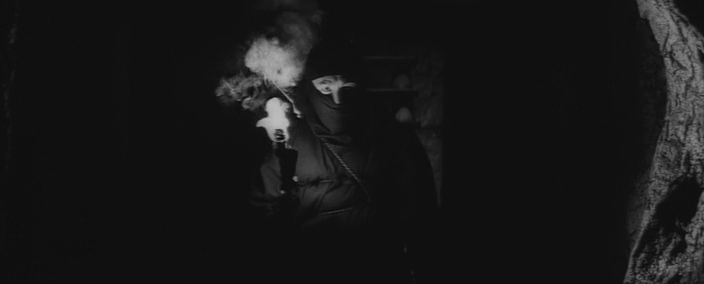
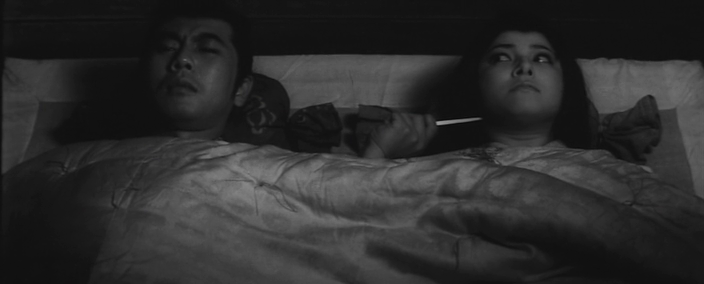
Shinobi no mono 8: The Three Enemies (新書・忍びの者, Kazuo Ikehiro, 1966)

The abiding constant of the Shinobi Mono series had been its continual forward motion, at least up until instalment seven which had backtracked to the death of Ieyasu. This eighth and final film (save for a further sequel released in 1970 starring Hiroki Matsukata replacing Raizo Ichikawa who had sadly passed away a couple of years earlier at the young age of 37) however reaches even further back into the mists of time setting itself a few years before the original trilogy had begun.

This time around, we follow young Kojiro (Raizo Ichikawa) on what is a more stereotypical tale of personal revenge albeit that one that eventually becomes embroiled in politics as he joins a ninja band that’s working for Takeda Shingen (Kenjiro Ishiyama). In slightly surprising turn of events, Ieyasu (Taketoshi Naito) turns out to be what passes for a good guy at least in contrast to Shingen’s duplicity though Ieyasu himself is still young and at the very beginning of his military career which is why unlike his older self he’s a little more proactive and willing to start a fight as well as finish one. In any case, Shingen thinks he’s an easy target largely because he simply hasn’t been in post long enough to have begun making connections with local lords, bribing them with gifts to secure their loyalty. 

In any case, Kojiro’s journey begins as something more like a martial arts film as he surpasses his current teacher and is told to find a man called Sadayu (Yunosuke Ito) in the mountains if wants to be up to gaining his revenge against the three men who killed his father while trying to steal his gunpowder. Perhaps there’s something a little ironic in the fact that Kojiro’s father was killed in a fight over what amounts to the substance of the future engineering a wholesale change in samurai warfare and edging towards the oppressive peace of the Tokugawa shogunate. But to get she revenge, Kojiro commits himself to learning true ninjutsu as the film demonstrates in a lengthy training montage. Unlike previous instalments, however, there is left emphasis place on the prohibition of emotion with the reason Kojiro cannot romance Sandayu’s adopted daughter down to her father’s whim forbidding her from marrying a ninja.

Apparently not the Sandayu of the earlier films despite the similarity of the name, this one has decided to side with Shingen because he’s mistakenly concluded that he is a “fair person who understands us ninja” when in reality he just using them and is no better than Nobunaga or Ieyasu. Shingen hires them to tunnel into a castle through the well, but is entirely indifferent to their complaints about safety leaving a Sandayu voiwing vengeance. The ninja, he says, generally serve themselves and are bound to no master but he seems to have thought Shingen was different only to be proved wrong once again.

Of course, Kojiro continues looking for the men who killed his father though they obviously guide him back towards conflict anyway. When he tracks some of them down, one remarks that all he did was finish him off which was an act of kindness to end his suffering not that he necessary approved of what his fallow gang members had done. Kojiro finds a surrogate father in Sadayu much as Goemon had though this time a slightly better one even if Sandayu is also a man with a lot on his conscience. Even more so than the other films, this one takes place in a largely lawless land too consumed with perpetual warfare to notice the starving and the desperate let alone the inherent corruption of the feudal era. The bad of ninjas has a rather scrappy quality, not quite as sleek as the Iga of previous films while also a little naive. Shooting more like a standard jidaigeki, Ikehiro uses relatively few ninja tricks generally sticking to smoke and blow tarts with a few shrunken battles. Nevertheless, the violence itself is surprisingly visceral beginning with unexpected severing of an arm and leading to a man getting stabbed in both eyes. Then again, the film ends in the characteristically upbeat way which has become somewhat familiar only this time Kojiro runs back towards romantic destiny now freed of his mission of vengeance and the oppressive ninja code. 
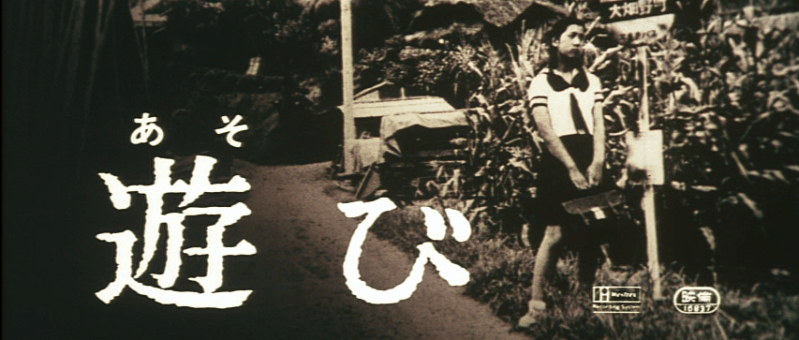

Play (遊び, Yasuzo Masumura, 1971)

5a4a5621a8387Yasuzo Masumura is most often associated with the eroticism and grotesquery which marked the middle part of his career, but his beginnings as a regular studio director at Daiei are a more cheerful affair even if darker in tone and with additional bite. His debut, 1957’s Kisses, was an unusual youth drama for the time – an innocent romance between a naive boy and girl who meet when each of their parents is languishing in jail. Far from the tragic conclusion of Ko Nakahira’s Crazed Fruit, Masumura offers his youngsters a degree of hope and the possibility, at least, of a happy ending. Daiei would go bust in 1971, and so it’s a minor irony that Masumura would revisit a similar theme towards the end of his tenure at the studio. Play (遊び, Asobi, AKA Play With Fire / Games), inspired by Akiyuki Nosaka’s novel, is another tale of youthful romance threatened by a harsh society, but this time around Masumura is not quite so hopeful.

A 16 year old (unnamed) girl has become the main breadwinner for her mother and bedridden older sister following the death of her father, formerly a violent drunk. Having had to leave school, she has a full-time job at an electronics factory where she lives in the company dorm along with a number of other female employees, most of whom are a few years older than she is. The girl is an earnest sort, she resents her mother’s constant pestering of her for money, but she sends her pay checks home keeping only enough to keep herself fed and clothed.

When an older woman, Yoshiko, who works as a “hostess” in one of the local cabaret bars comes to visit, she does so dressed to the nines with a handsome man sporting fancy sunglasses and porting a selection of upscale cakes. Yoshiko sells the virtues of life in the clubs, talking about the money to be made by having fun while the naive gaggle of young women remain in awe of her confidence, poise, and fancy haircut. In desperate need of money, the girl considers Yoshiko’s suggestion which is what brings her into contact with the (unnamed) boy (Masaaki Daimon).

The boy is 18 and pretends to be more worldly wise than he really is. He offers to show the girl around the cabaret scene, though he discourages her from working there. Taking her out and around town, the boy charms the girl though he has a dark and ulterior motive. The boy is a petty yakuza for a gang whose main stock in trade is pulling girls off the street and raping them for reasons of both blackmail and forced prostitution.

Owing to her young age and bad experience with her father who was often drunk and violent, the girl has steered clear of men. The other girls make fun of her for not having a boyfriend, not wearing make up, and for being “good” in sending all her money home. The girl isn’t really interested in the same kind of fun loving life as the more jaded of the factory girls – especially when she sees them roll in drunk boasting about the bruises on their skin from a night of debauchery, or even staggering back crying with a dress torn to shreds after being violently assaulted (perhaps by the same kind of yakuza thugs that will shortly target her). Despite the harshness of her life, she remains naive and innocent, concerned for her mother and invalid sister who have only her to depend on.

The boy is in a similar situation, though far less keen to confess it. Also let down by a drunken, promiscuous mother, he’s found himself in a gang desperate for the approval of his new “big brother”. Though he reacts with horror to the gang’s main stock in trade, he does not try to stop it even if he stops short of rape himself, but continues to assist in trapping the girls whilst fully aware of what will happen to them.

Coming from a harsh world, the boy has never met anyone as earnest or as naive as the girl and her goodness starts to reawaken something in him. Likewise, the girl, unaware of the boy’s true purpose, has never met anyone that was so immediately nice to her – her fear of men and alcohol dissipates as she (mistakenly, or perhaps not) believes she has met someone truly good and kind who only wants to help her. The girl does not belong in the boy’s world of sleazy clubs and youth haunts but bears them well enough for him. The boy recognises the incongruity and takes her somewhere else, still conflicted in his true purpose of delivering her to the dingy love hotel where his boss conducts his illicit trade.

The boy and the girl are innocents corrupted by their environments. Let down by irresponsible parenting (perhaps also a symptom of the difficulties of the society they live in), the pair remain trapped, dreaming of freedom and happiness but seeing no way of finding them. Deciding to make a break for it, leave their respective disappointing families far behind, the boy and the girl sail away. Their boat is full of holes, but they refuse to be beaten, committing to forge ahead together they swim towards the sea and an uncertain but hopeful future.


Title sequence (no subtitles)