The Boy and the Heron (君たちはどう生きるか, Hayao Miyazaki, 2023)

Sales of Genzaburo Yoshino’s 1937 novel How Do You Live? (君たちはどう生きるか, Kimitachi wa Do Ikiru ka? went through the roof when it was announced that the no longer retired Hayao Miyazaki would be directing a new film with the same title. Predictably, Miyazaki’s film turned out not to be an adaptation at all, or at least not a literal sense, but was intensely interested in the question not so much how do you live but how will you? Will you allow the past to make you bitter and live in a world of pain and resentment, or will you choose to live in a world of peace and beauty free of human malice?

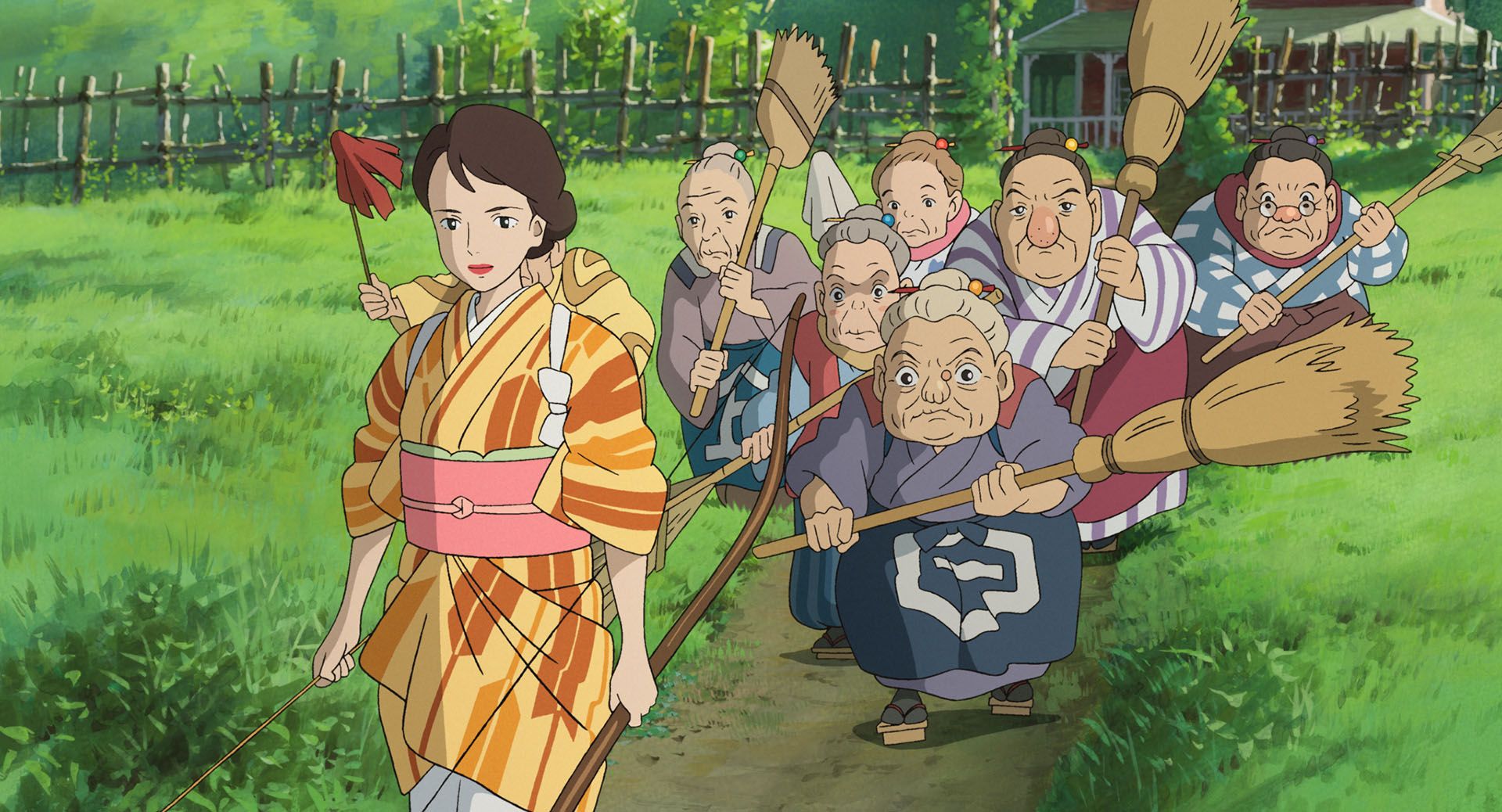
These are of course the questions faced by a post-war generation, the children of Miyazaki’s own era who came of age in a time of fear and suffering. Mahito (Soma Santoki), the hero, loses his mother in the firebombing of Tokyo. He runs through a world of shadows to save her from the flames but of course, he cannot. A year later everything has changed. His father has remarried, taking his mother’s younger sister Natsuko (Yoshino Kimura) as his new wife. Natsuko is now pregnant which suggests the relationship began some time ago though Mahito knew nothing of it and had no recollection of ever having met Natsuko before being sent to live in her giant mansion in the country more or less untouched by the war. 

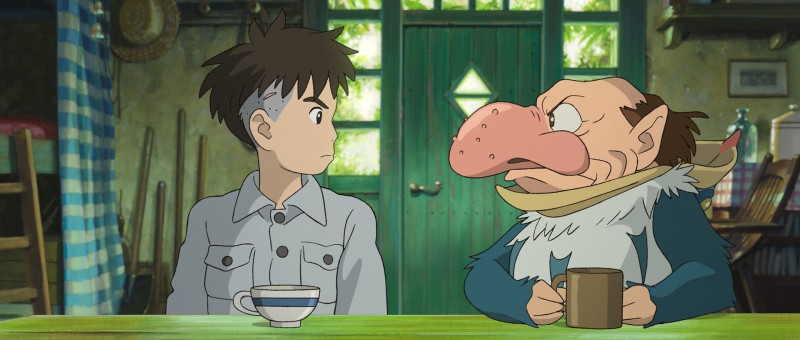
It’s here that Mahito’s own malice rises. He is polite, if sullen, but cannot warm to his new stepmother and resents his father’s relationship with her. Perpetually bothered by a grey heron (Masaki Suda) his first thought is to kill it, crafting a bow and arrow from bamboo and one of the heron’s own feathers. Shunned as the new boy at school he hits himself on the head with a rock while his father, Shoichi (Takuya Kimura), comically vows revenge and lets him stay home. As he points out, there’s not much “education” going on anyway with most of the students pulled away from their studies for “voluntary” labour in service of the war effort in this case agricultural. 

Shoichi has moved to the country to open a factory which it seems produces canopies for fighter planes which is all to say that he is profiting from the business of war, though transgressively referencing the failure in Saipan over breakfast with the mild implication that it might work out alright for him. There is after all a grim reason they’ll be in need of large numbers of aircraft parts in the near future. Mahito’s dark impulses are directly linked to those of militarism and the folly of war. When he finally enters the tower of madness apparently constructed by a great-uncle who went insane through reading too many books, he discovers that his enemies are an ever expanding clan of fascistic, man-eating parakeets led by a Mussolini-like despotic leader attempting to manipulate the Master of the tower. 

Inside the tower is a land out of time, a place for those already dead or in essence an eternal past. It’s here that Mahito is presented with a choice, how will he live? Will he choose malice and destruction, or will he choose to leave and build a new world of beauty and peace above? In many ways, the important point is that the choice is his as it is ours, that we are free to decide and that our choices create the world in which we live. Through his adventures in the tower, Mahito begins to come to terms with his situation and resolves to accept Natsuko as a mother and make friends of those he once considered enemies. When the tower itself crumbles, it takes with it the last vestiges of authoritarianism and tyranny.

Prompting his epiphany, Mahito discovers a copy of How Do You Live? in his room, a present from his late mother inscribed to the grown-up Mahito. He is surrounded by the world’s ugliness, forced into a surprisingly graphic fish gutting session that leaves him wiping away blood, recalling his profusely bleeding head injury and the scar it will forever mark him with. Pelicans imprisoned in the other world meanwhile tell him that they have no choice but to behave as they do for the Master of the Tower neglected to put enough fish in the rivers intending them to destroy rather nurture new life while their young too learn all the wrong lessons. Yet there is beauty and strangeness here too, along with kindness and humanity. Boundlessly inventive, Miyazaki couples surrealist visions of murderous birds and the hellish scenes of a city on fire with Mahito the only figure visible in his pale blue school uniform darting through the soot and the shadows. A vivid symphony of life, the film may in its way be about grief and the pain of moving on but finally discovers a kind of serenity in an accommodation with the present and the eternally unfinished question of how you yourself will live. 


The Boy and the Heron screened as part of this year’s BFI London Film Festival.

The Legend & Butterfly (レジェンド&バタフライ, Keishi Otomo, 2023)

“What was everything for?” an ageing Nobunaga (Takuya Kimura) asks his attendant Ranmaru (Somegoro Ichikawa) towards the conclusion of Keishi Otomo’s historical epic, The Legend & Butterfly (レジェンド&バタフライ, Legend & Butterfly) produced in celebration of Toei’s 70th anniversary. Oda Nobunaga is such a prominent historical figure that his story has been told countless times to the extent that his legend eclipses the reality, but rarely has been he depicted so sympathetically as in Otomo’s history retold as romantic melodrama in which he and his wife, Lady No (Haruka Ayase), are mere puppets of the times in which they live dreaming only of a place beyond the waves where they might be free of name or family. 

Tellingly, Otomo opens in the spring of 1549 in which the dynastic marriage was arranged to broker peace between unstable neighbouring nations Owari and Mino. Nobunaga’s father’s health is failing and he fears in the chaos of his death Mino may attack, while No’s father fears that her brother will soon revolt against him plunging the fiefdom into disarray and therefore vulnerable to an attack by Owari. At this point, Nobunaga is known as “the biggest idiot in Owari,” a foppish dandy who cares only about appearances. As he prepares to meet No, his courtiers apply his makeup and do his hair while dressing him in a rather outlandish outfit No immediately insults as “foolish”. He treats her with chauvinistic disdain, barely speaking save to order her to pour the drinks and give him a massage only for her to point out that she’s been travelling all day and a “thoughtful” considerate husband would be giving her a massage instead. “I detest women who do not know their place,” he snaps. “I detest men who are ignorant,” she counters. The wedding night ends in humiliating failure as No demonstrates her martial arts skills and Nobunaga is forced to call his guards to rescue him. 

Little is known of Lady No in historical record, but here she is bold and defiant, as her father had said too free with her opinions for a woman of the feudal era. She claims to have been married twice before and assassinated both husbands on her father’s orders, implying that she is essentially sleeper agent more than hostage and will kill Nobunaga without a moment’s thought as soon as the word is given. Yet she also begins to guide her husband towards his destiny, mocking him as a fool but giving him useful strategic advice that wins him glory on the battlefield along with the political advancement that led him to become the first great unifier of Japan. For all that they “hate” each other, they are well matched and have a similar sensibility that allows them first to become allies and then friends before frustrated lovers.

But their love is enabled only when they escape the feudal world, shaking off their retainers to go on a “normal” date in Kyoto where they dance to Western musicians and taste foreign candy only to end up accidentally massacring some peasants when No’s martial arts training kicks in trying to stop a man beating his son. Even so, they are forever linked by their time in Kyoto in the romantic talisman’s of a carved wooden frog and a European lute even if the blood-spattered jizo and buddhist statue watching their eventual connection imply there will be a reckoning for all the blood that is spent. Jumping on a few years, the film does not elaborate on what caused Nobunaga to become a man without a heart and lose the love of his most trusted ally but positions his transformation into the “Demon King” as the kernel of his undoing just as his dream of unifying Japan and bringing about an age of peace (if one ruled by fear) is about to become a reality. 

In any case, the one thing that everybody knows about Nobunaga is how he died though then again his remains were never recovered giving rise to a happier ending in which he and Lady No were finally able to escape the feudal world to chase a freer future beyond the sea which is perhaps what they do in the film’s poetic final sequence in which they might in a sense share a dream connected by frog and lute. It might not be very historically accurate, but that is perhaps the point in hinting at the lives they might have led if the world had been different. Otomo films with a painterly eye that lends an air of poignant gravitas to a tale of romantic tragedy in which love is both salvation and destruction amid the flames of a collapsing temple. 


The Legend & Butterfly screened as part of this year’s JAPAN CUTS.

Original trailer (English subtitles)

Killing for the Prosecution (検察側の罪人, Masato Harada, 2018)

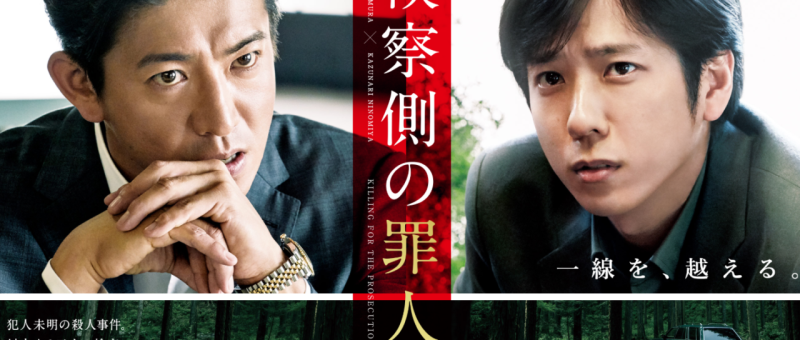
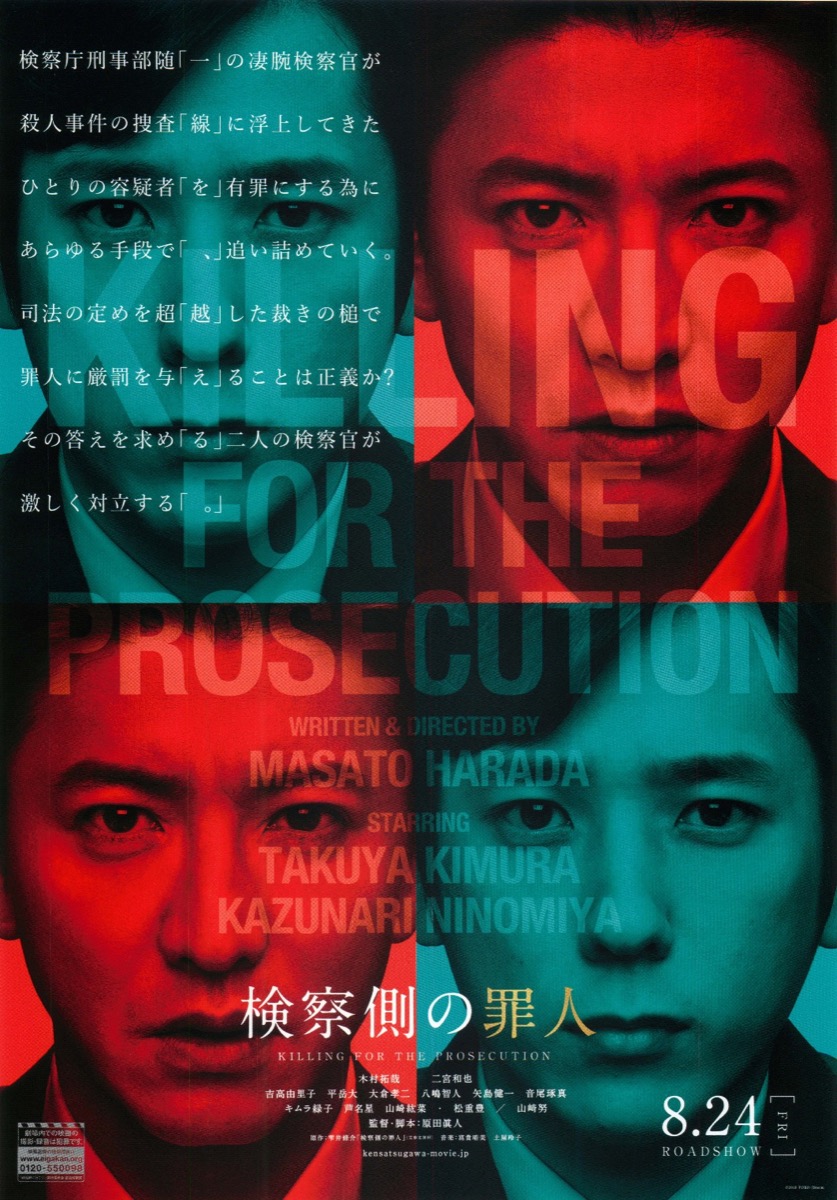
Killing for the Prosecution posterThe vagaries of the Japanese legal system have become a persistent preoccupation for anxious filmmakers keen to interrogate the continuing rightward shift of the contemporary society. Stretching right back into the post-war world, filmmakers from Yoji Yamada and Yoshitaro Nomura to the more contemporary Masayuki Suo and Gen Takahashi all had their questions to ask about the courts system before Hirokazu Koreeda pushed the dialogue in a slightly different direction with the probing The Third Murder. Killing for the Prosecution (検察側の罪人, Kensatsugawa no Zainin) picks up Koreeda’s baton and brings with it all the baggage of the aforementioned films in asking similar questions about the nature of justice and most particularly within the context of Japan under the conservative government of Shinzo Abe.

In the contemporary era, rookie prosector Okino (Kazunari Ninomiya) gets a prime Tokyo job working for his mentor Mogami (Takuya Kimura) which begins with investigating a bloody double murder of an elderly couple who were apparently running an illicit side business in usurious loans. The suspect list includes a series of shady characters, but one catches Mogami’s eye – Matsukura (Yoshi Sako), a man arrested and subsequently released in relation to a brutal murder of a school girl Mogami had known and liked while he was a student. Unable to let the case rest, Mogami finds himself fixated on the idea of nailing Matsukura for the pensioner murder in order to get justice for the previous killing which has now passed the statute of limitations.

Meanwhile, Mogami himself is also embroiled in a conspiracy surrounding an old friend, Tanno (Takehiro Hira), now a senator accused of corruption. Harada opens with a brief prologue set during Okino’s final pre-graduation briefing in which Mogami offers a somewhat cynical lecture on the role of the prosecution and the nature of justice. Like the lawyers at the centre of The Third Murder, he is keen to emphasise that the truth is rarely relevant in the face of the law and that justice is a game won by constructing impenetrable narrative. He insists that “there is no such thing as rain which washes away guilt”. Yet his love of justice is so fierce that he collects and displays gavels – a complicated symbol seeing as Japan doesn’t use them but like many other countries has internalised an association with them thanks to American movies.

America, in itself, becomes a complicated facet of Mogami’s judicial confusion as he finds himself pulled between left and right. In his meetings with Tanno, we originally find him complicit with the regime, presumably acting to protect his friend and thereby enabling his corruption but we later come to realise that the opposite is true – that the pair of them are complicit in the system in order to undermine it. Tanno, apparently disillusioned with right wing politics and committed to pacifist ideals, attempted to blow the whistle on systemic political corruption and has been hung out to dry. Lamenting that there is no press freedom in Japan, he has been unsuccessful in his attempts to frustrate a persistent shift towards remilitarisation (apparently hastened by his own wife who has embarrassingly enough been photographed at a neo-nazi rally) but coldly cuts off Mogami’s offer of further assistance by reminding him that he too is “part of the system”.

Mogami goes rogue, but he does so more for reasons of personal vengeance than pursuit of justice. Desperate to nail Matsukura he begins to bend his narrative while his earnest rookie underling, Okino, remains conflicted about his boss’ increasingly suspicious behaviour. Yet the possibility remains, if Matsukura didn’t do it someone else did. If Mogami has Matsukura pay for this crime rather than another one, perhaps a kind of justice is served but a dangerous man would still be out there. In the end, Mogami transgresses in pursuit of his own kind of justice becoming the kind of “criminal” prosecutor he cautioned Okino against becoming in his already cynical opening speech.

That aside, Mogami ties his crimes to a long history of injustice and oppression in allusion to his grandfather’s accidental survival of the battle of Imphal thanks to a kind of purgatorial space known as “Hotel Tanang” to which he returns in an oddly surreal dream sequence which places himself and Tanno as descendants of men who refused to die for oppressive imperialistic concerns. The “Skeleton Road” buys him an uneasy alliance with a genial yakuza (Yutaka Matsushige) who provides another source of temptation to turn to the dark side, but the question he seems to be left with is whether it’s acceptable to pursue one’s own kind of justice in the knowledge that the justice system is inherently corrupt.

Okino, who might ordinarily be our hero, seems to say no but lacks the courage to resist – unlike his steadfast assistant, Saho (Yuriko Yoshitaka), who is combating injustice in her own though perhaps no more ethical (and still less than altruistic) ways. “People die, things break, all the same”, Matsukura rambles as if to lay bare the film’s nihilistic leanings as it points out a litany of seemingly irreparable social ills. Mogami breaks cover for an instant when meeting with a police officer after overhearing a woman trying to press a rape charge and being rebuffed, stopping briefly on his way out to encourage her to keep pressing her case in solidarity with her solitary quest against a seemingly impenetrable wall of indifference, while the mild foreshadowing of a contemporary preoccupation about what to do with the problem of elderly drivers in an ageing society becomes an odd kind of punchline in a bleak existential joke. Dark and cynical, Killing for the Prosecution sees little cause for hope in the increasing murkiness of its constantly declining moral universe, finding release only in its final, frustrated scream.


Original trailer (no subtitles)

Blade of the Immortal (無限の住人, Takashi Miike, 2017)

blade of the immortal posterGenerally speaking, revenge tends not to go very well in Japanese cinema. It has the tendency to backfire. When you’re immortal, however, perhaps revenge is risk worth taking – then again, it’s not your life your weighing. Takashi Miike is no stranger to the jidaigeki world, though in adapting Hiroaki Samura’s manga Blade of the Immortal (無限の住人, Mugen no Junin) he harks back to the angry, arty samurai films of the late 1960s from Gosha’s Sword of the Beast with which the manga features some minor narrative similarities, to Kobayashi’s melancholy consideration of corrupted honour, and the frantic intensity of Okamoto’s Sword of Doom.

The film opens in black and white as a disgraced samurai, Manji (Takuya Kimura), tries to protect his younger sister, Machi (Hana Sugisaki), who has gone mad through grief only to see her murdered by a bounty hunter. Manji enters a state of furious, mindless killing which leaves the bounty hunter’s vast crowd of henchmen lying dead and Manji mortally wounded. Consumed by guilt and having lost the sister who was his sole reason for living, Manji longs for death but a mysterious old woman who calls herself Yaobikuni (Yoko Yamamoto) has other ideas and curses Manji to a life of eternal suffering by means of sacred bloodworms which give him the power of infinite, near instant healing.

Fifty years later, the land is at peace under the Tokugawa Shogunate but peaceful times are dull for warriors. The Itto-ryu school of swordsmanship has a mission – to take over all of the nation’s martial arts facilities and restore power to the sword. They have no honour or ideology save that of kill or be killed and are content to use any and all weapons which come to hand. A young girl, Rin (Yoko Yamamoto), is a daughter of one of these schools and has her eyes set on becoming a top swordswoman herself but when the Itto-ryu show up at her door, Rin’s father’s training proves worthless as he’s cut down with one blow while the gang kidnap Rin’s mother. The Itto-ryu’s sole concession to morality is in letting Rin alone, seeing as it’s “vulgar” to toy with children.

Rin vows revenge on the Itto-ryu’s leader, Anotsu (Sota Fukushi), at which point she runs into Yaobikuni who recommends she track down Manji and hire him as a bodyguard. Fifty years of immortality have turned Manji into an isolated, embittered wastrel with rusty swordskills but Rin’s uncanny resemblance to Machi eventually begins to move his heart. Despite generating a master/pupil, big brother/little sister relationship, Manji fails to teach Rin very much of consequence that might assist her in her plan to avenge her family, leaving her a vulnerable young woman beset by enemies and random thugs, and eventually caught up in a government conspiracy. The irony of Manji’s life is that he’s just not very good at the art of protection and all of his attempts to do something good usually provoke an even bigger crisis, in this case leaving his new little sister open to exactly the same fate as the one he failed to save for much the same reasons. Apparently, Manji has learned little during his extended lifetime except how to brood and glare resentfully at the world.

It turns out being immortal is kind of a drag. Manji wants to die because he can’t cope with the burden of his guilt, but another similarly cursed man he meets has lived much longer and lost far more, becoming tired of the business of of living. Manji’s existence has lost all meaning, but as he puts it to another world weary warrior who shares his brotherly grief, he’s not the only hero of a sad story. Rin’s need for vengeance gives him a purpose again – not just in the literal revenge, but in being the protector (though one could argue this is less positive than it sounds and might explain why he fails to teach Rin anything very useful, even if it doesn’t explain why she also forgets all her father’s teachings).

Rin remains conflicted over her mission of revenge, confessing to a similarly conflicted assassin that she agrees killing is wrong but that right and wrong no longer matter when it comes to people you love. A dangerous and dubious assertion, but it does bear out the more positive message that love, or at least learning to live for others, can be a transformative force for good as Manji allows himself to resume his role as the big brother despite his past failings. Violent and visceral, if also humorous, Blade of the Immortal is, oddly enough, a story of love but also of cyclical paths of violence and revenge, and of the general muddiness of assigning the moral high ground to those engaged in a quest for retribution.


Blade of the Immortal was screened as part of the BFI London Film Festival 2017 and will be released in UK cinemas courtesy of Arrow Entertainment on 8th December.

International trailer (English subtitles/captions)